In Don DeLillo’s novel White Noise, the narrator, Jack Gladney, and his university colleague Murray drive outside their anonymous college town, one not unlike my own, to see what is reputedly “the most photographed barn in America.” Standing among a throng of shutterbugs, Murray finally says to Jack, “No one sees the barn.” All anyone can see after so many photographs is the image of the barn, not the thing itself. As someone who has lived in Lexington, Kentucky, for over half my life, I often feel that way about horses. Now, with the World Equestrian Games descending upon the city, horse imagery is so pervasive that I have a hard time seeing the genuine article.

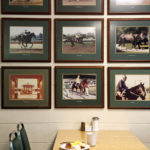
Nor am I alone in this. While Lexington is the self-proclaimed Horse Capital of the World, few people actually ride horses around here. After all, you can’t saddle up a Thoroughbred unless you weigh in the neighborhood of 120 pounds. And the horse farms themselves spread across swaths of rolling bluegrass well outside the city’s more mundane machinations. So except during the spring and fall meets at Keeneland racetrack, Equus remains more a symbol of the city than part of its daily conversation.
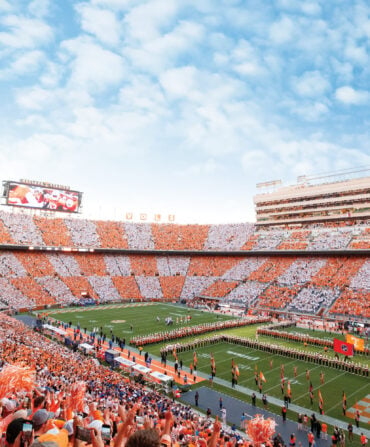
The same cannot be said for basketball. University of Kentucky basketball is the conversation around here, 365 days a year, and to ignore or try to rise above this fact is to find oneself on the lonely outskirts of a blue-and-white-clad crowd. I know because I once was that outlier. My grandfather was the UK swim coach for many years, and our family had very good season tickets for basketball and football games. Growing up in the 1970s, I wanted to be Kyle Macy, the unflappable point guard of the 1978 championship team.
But when I actually arrived at UK as a student in 1985, I was singing a different tune. Sports, I had decided, much to my father’s consternation, was beneath my high-minded aspirations as an English major. I didn’t attend a single game during my time on campus.

Photo: Caroline Allison
Horse Play Morning exercise.
Then I moved away from Kentucky to a place where no one talked about basketball…and I missed it. Badly. On the rare occasion that I caught a televised game of Tony Delk and Walter McCarty sinking threes and running beautifully spaced fast breaks, I realized that was as pure a form of poetry as the Yeats and Auden I had studied as an undergraduate.
Now I teach writing at UK and I quite happily embrace the culture of basketball. I have even come to see that a certain strand of anti-intellectualism can be quite helpful when interacting with my deconstructionist colleagues from Yale. Still I wonder what they make of a couple hundred men and women who, each September, set up camp for two weeks outside the Joe Craft Center, waiting to purchase tickets, not to any game, but to the basketball team’s first practice. These devout fans while away the time playing cornhole, a variant on horseshoes whereby a player tries to toss a small beanbag into the other player’s, um, cornhole.

Photo: Caroline Allison
True Blue Banners hang in Memorial Coliseum.
Of course such low-brow behavior can reflect poorly on the city and the school. When UK played Cornell in March in the Sweet Sixteen, the national media cast the game as the Brainiacs vs. the Knuckleheads. To that invidious comparison, UK center DeMarcus Cousins had the only sensible response: “It’s a basketball game—it’s not a spelling bee.” A part of me (the non–English teacher part) wants to put that on a bumper sticker.
Still, there’s one thing about UK basketball that I haven’t been able to reconcile. I just mentioned Joe Craft, a Kentucky coal baron who got his name attached to UK’s practice facility. Now a group led by him has offered the university $7 million to build a new dorm for the basketball players who, it must be said, already enjoy far tonier accommodations than the rest of the student body. But there’s one catch: To get the money, UK has to call the new dorm—wait for it—the Wildcat Coal Lodge.
Here is what I find most maddening about this ridiculous moniker: According to a 2008 study by the Brookings Institution, the city of Lexington already has the largest carbon footprint, per capita, of any U.S. city—largely due to our profligate use of eastern Kentucky coal. And cars. Like many Southern cities, Lexington tore up its streetcar lines in the late 1930s when it was still a small town. Poor postwar planning and development resulted in three concentric rings—the hinterland farms, the car-clogged suburbs, and the downtown—that, in effect, divide Lexington into three cities.
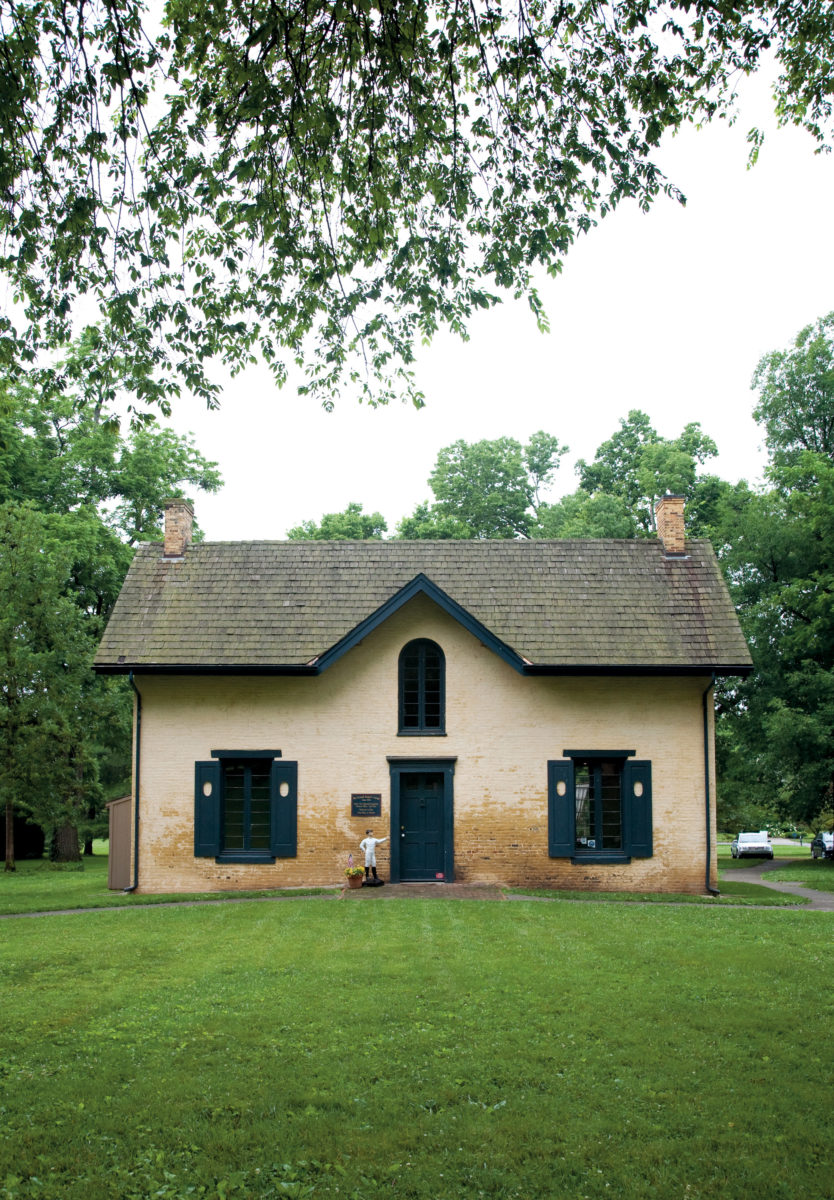
But in the wake of the Brookings study, Lexington has begun to green, at least on its outermost and innermost reaches. The Urban County Council formed a Purchase of Development Rights program whose goal is to preserve fifty thousand acres of farmland by purchasing agricultural easements from struggling farmers. This has resulted in more high-density, low-impact residential development downtown, very close, as it turns out, to where the city was founded in 1775. That’s when William McConnell, along with Mary Todd Lincoln’s grandfather Levi, discovered a series of cold springs here and decided to name the spot in homage to the recent Revolutionary War victory at Lexington, Massachusetts. Today, McConnell Springs is a twenty-six-acre pastoral sanctuary in the heart of the city’s industrial district. A lordly old bur oak, which would have been a sapling in McConnell’s day, still leans over a trail that leads to a new wetlands project where a series of ponds filter and clean the city’s storm water.

Photo: Caroline Allison
Bartender Ricky Arnett is a familiar sight at Dudley’s on Short.
Just up the street, a visionary restaurateur named Les Miller and his wife, Aumaine Mott, have opened Stella’s Kentucky Deli, which serves completely local and seasonal fare. Several surrounding churches have started community gardens. Local activist Jim Embry recently organized the Bluegrass Food Security Summit, with the goal of planting a garden in every school, church, and empty lot around Lexington. In Cheapside Park, once the site of slave auctions, the city just completed a glass and steel pavilion that now houses a wildly popular farmers’ market. On Saturday mornings you may find a young man named Shane Tedder (newly hired as UK’s sustainability coordinator) mixing up smoothies with a bicycle-powered blender. Six blocks away, Les Miller and his brother Josh have brought back to life a derelict watering hole called Al’s Bar that now serves up ridiculously cheap local bison, in the form of burgers.
After dinner, Al’s Bar becomes a nice example of how Lexington has parlayed its newfound spirit of sustainability into something of a cultural awakening. It was here, two years ago, that local poet and provocateur Eric Sutherland started what he dubbed the Holler Poets Series—its name a nod to the mountain hollows that shaped so much of Kentucky’s oral tradition, as well as a suggestion on how to be heard when reciting a poem in Al’s Bar. Once a month, two featured poets perform/holler, but the real success of Holler is an unusually strong hour of open mike, around which a dedicated community of local poets has formed.
Last March’s Holler was dubbed “Poets for Peace in the Mountains.” Sutherland planned it to raise awareness about the mountaintop removal strip mining that provides cheap coal to Lexington but is devastating the central Appalachian Mountains. The bar was packed with like-minded Lexingtonians—poetry fans and basketball fans who wanted no part of Joe Craft’s Wildcat Coal Lodge.
Still, one has to admit, change comes slowly around here. Downtown planners have spent the last five years trying to decide whether to change one-way thoroughfares to two-way streets. No word yet on that.
For two weeks this fall, Lexington really will be the Horse Capital of the World. Many of us will rent out our houses to the horse-crazy visitors, or like local author Ed McClanahan, just get the hell out of town until the World Equestrian Games are over. After that we’ll clean up and get back to the work of reinventing Lexington as a more sustainable, more interesting kind of Southern city. More than one of us will make a call to The John Calipari Show and advise our new basketball coach on how to better attack the 1-3-1 defense—because this year, baby, we’re going all the way.