

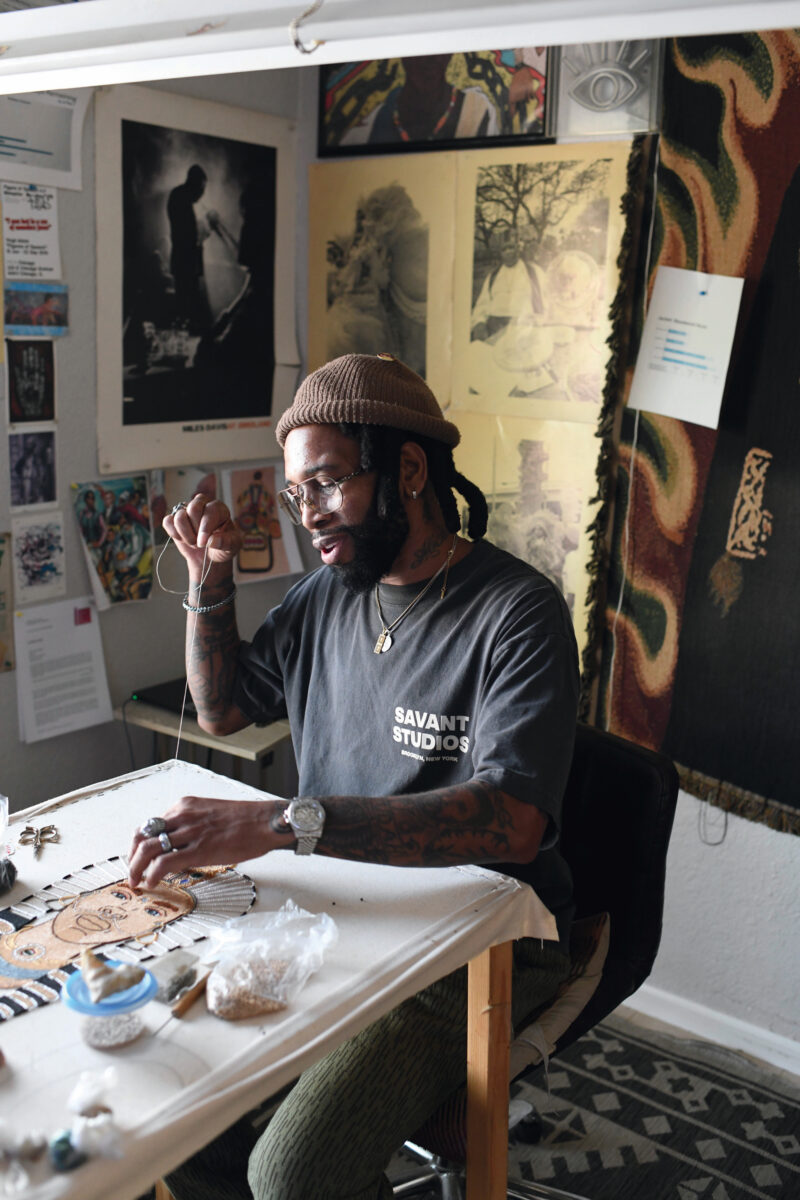
Every year during Mardi Gras, little Demond Melancon would stay out all day, first with his grandfather at the Zulu parade and then with his mother, who would take him to see the Black Masking Indians. For more than a century, those Black “tribes” across New Orleans’ wards have donned intricately beaded suits with regal feathers to honor the local Indigenous people, who, as one belief has it, hid African Americans from slave catchers before the Civil War. A typical tribal formation might consist of a Spy Boy in front; a Little Chief, Flag Boy, and Big Queen in the middle; and the Big Chief in the back. Now an artist and a Big Chief himself, Melancon makes his own astounding suits and leads the Young Seminole Hunters from the Lower Ninth Ward to commune with up to forty other tribes as they “confront” one another in the streets in ceremonial battle. The joyous tradition reminds Black people, often residing in the poorest parts of the city, that beauty lives in and around them. “Where I grew up, they called it C.T.C.—Cut Throat City,” Melancon recalls of his neighborhood. “But I don’t feel like that.”
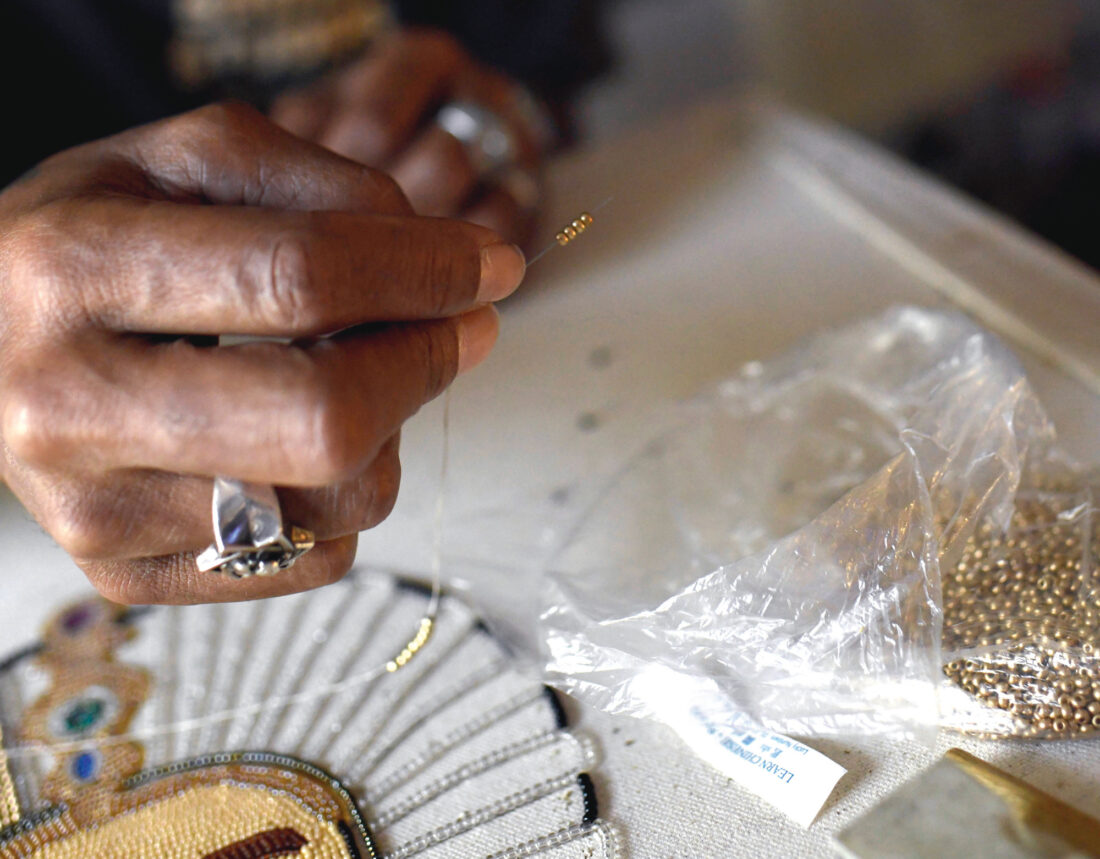
Melancon channels that passion into his suits, jaw-dropping works of art that each take him more than a year to make, as he carefully attaches some fifteen pounds of feathers and nearly a million custom beads and rhinestones he imports from around the globe. The other Big Chiefs in his community taught him how to sew and to bead as a teenager; he rattles off mentors like Ferdinand Bigard and Keitoe Jones and Tootie Montana. Melancon passes down knowledge, too: He uses his suits, he says, to teach kids what they might not learn in school—and to lead by example. His 2020 suit, Jah Defender, for instance, included portraits of the last emperor of Ethiopia, Haile Selassie, and his wife, Menen Asfaw. “I took my 2018 Black Masking Indian apron, titled Ethiopia, and I put it in an auction at Sotheby’s,” he recounts. “It sold, and that’s how I got my house. That’s what I want to portray. We ain’t got to be suffering outchea. You can be a homeowner, and you can be somebody through your beadwork.”
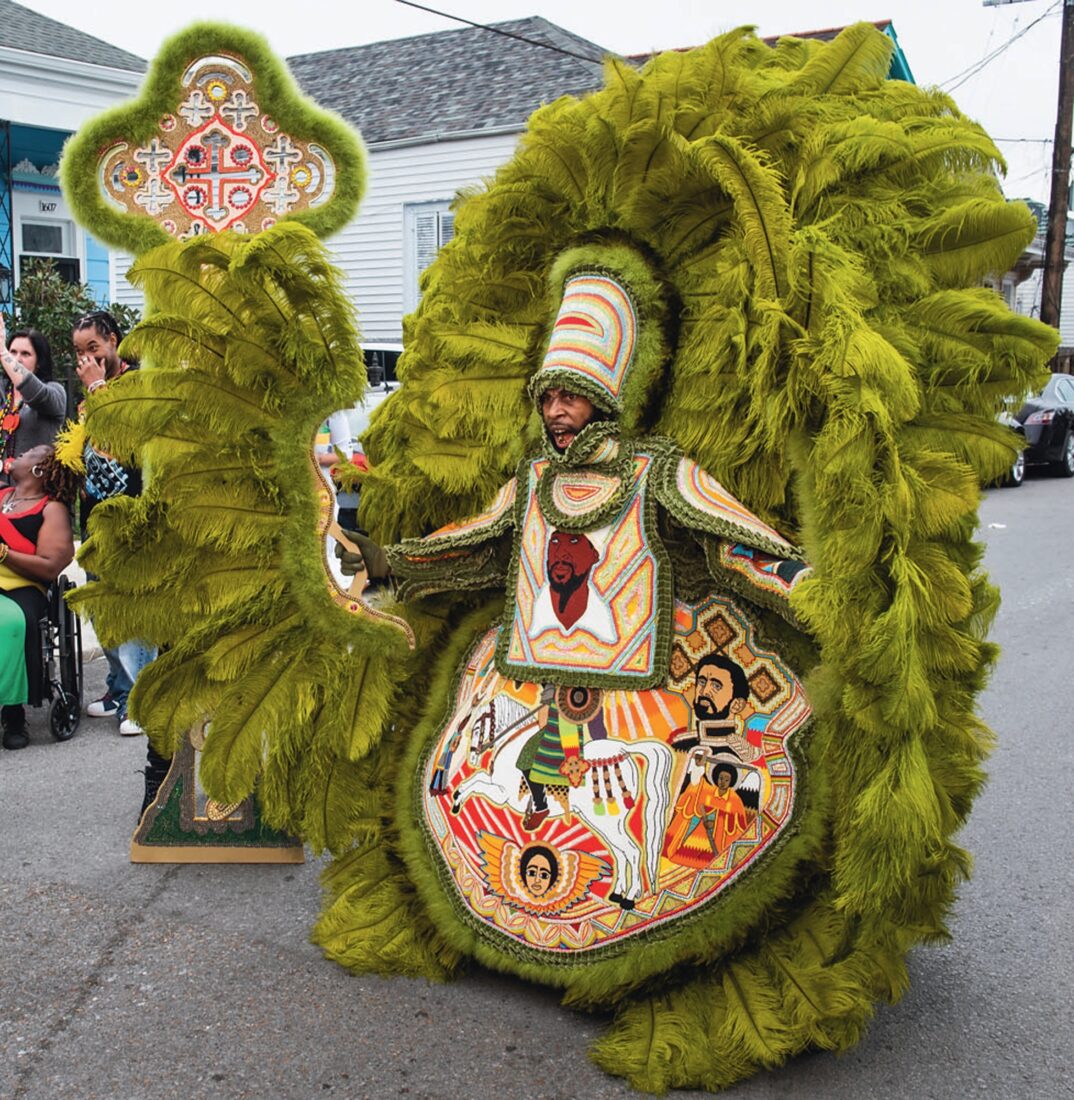
Melancon works on the suits with his wife, Alicia. They start by stretching a large swatch of canvas out onto a wooden table to sketch out the designs. Then they sew almost twelve hours a day, taking the occasional break to walk their French bulldogs and watch football. Adorning his suits with beaded portraits of Black and Indigenous heroes, Melancon says, is his differentiating factor—in past years, he’s depicted the New Orleans legend Bras-Coupé and scenes from Rastafarian culture. It was while beading a suit called Africa, featuring a Tanzanian scene, that he discovered a unique bead that made all the difference in his Indigenous beadwork.
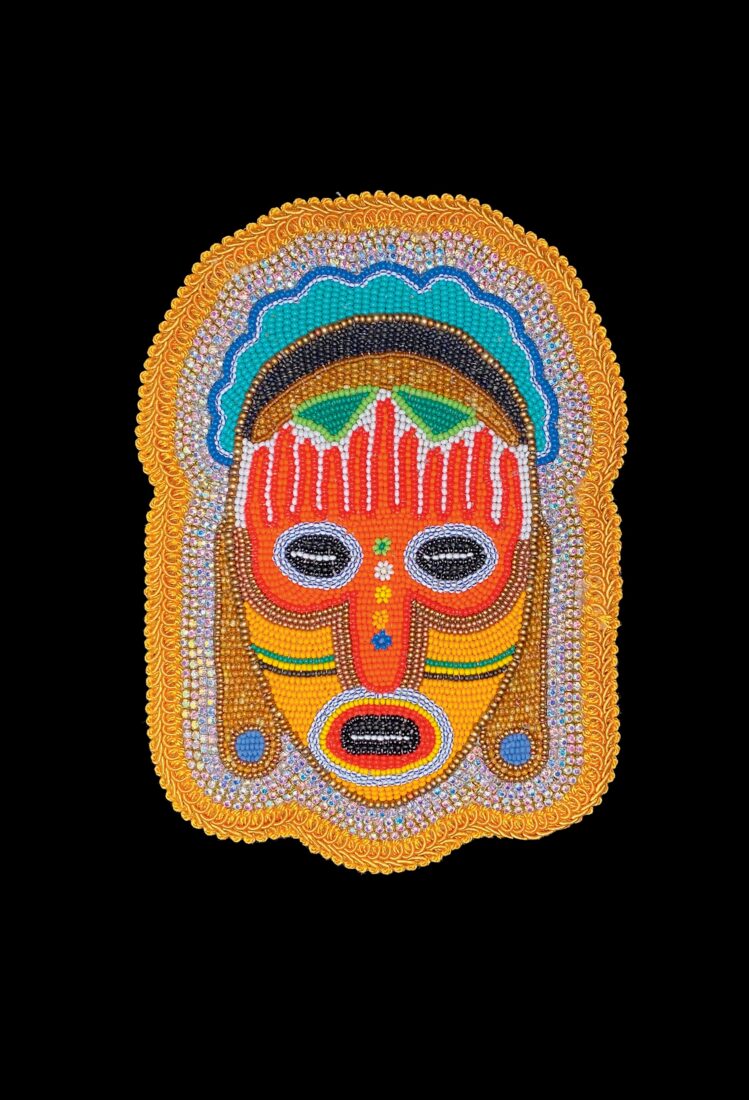
“I used to bead red people,” Melancon explains, “but then I found out that came from [Europeans calling Indigenous people savages], so I found a bead called desert sand and I started beading brown and caramel-colored people. I changed the narrative around Indians in the Mardi Gras suits; I know I taught that to the culture in this city.”
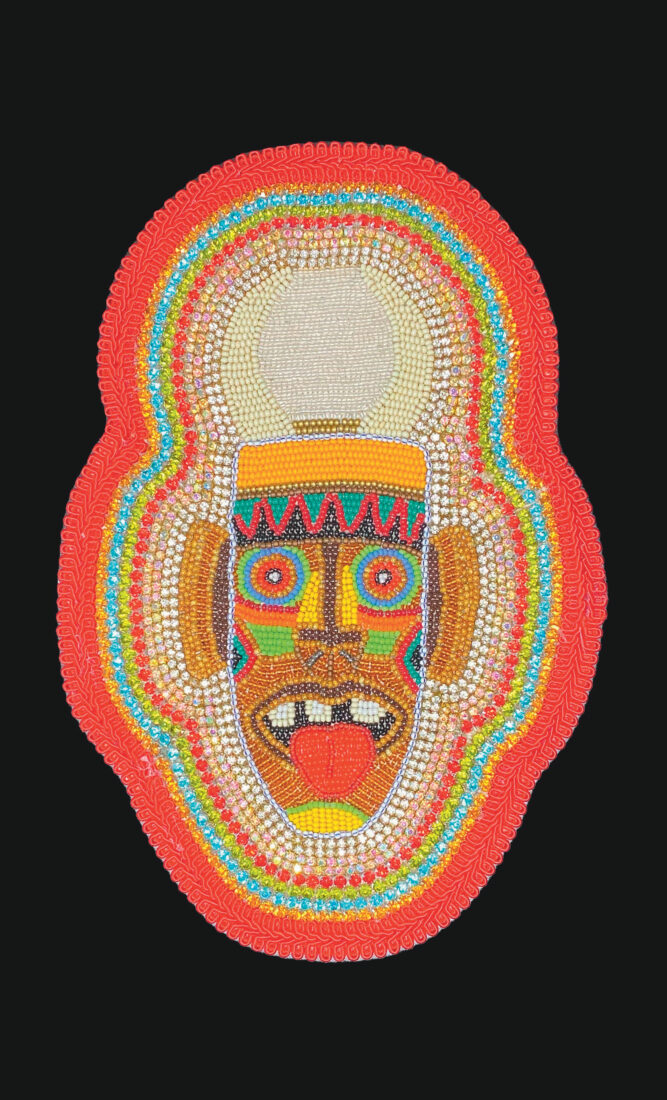
Paying homage to these histories also catapulted Melancon into the world of fine art. In 2017, he began beading portraits as stand-alone works, first of famous New Orleans musicians, then eventually masks inspired by Yoruba gods and Ashanti warriors, his way of connecting to the West African cultures that many African Americans lost in the Middle Passage. The pieces, each no larger than a doily, capture the likenesses in hundreds of tiny flesh-toned beads, as well as bronze, gold, blue, and red metallic ones surrounded by iridescent rhinestones and decorative trim.
His portraiture quickly earned a place in group and solo shows at the African Diaspora Art Museum of Atlanta, the International African American Museum, the African American Museum in Philadelphia, and the Halsey Institute of Contemporary Art, to name a few places. Last year, he collaborated with Levi’s and Denim Tears, capturing the spirit of Black Masking on a jean jacket. But he’s also keeping his heart and feet close to the community—and the dream—that raised him.
“I do this three hundred and sixty-five days a year,” Melancon says. “Before this, I poured concrete and cooked lobsters at Drago’s. Now I’m an artist and I get to wake up, drink my coffee, and sew. I’m doing what I wanted to do as a kid.”
Kelundra Smith is a freelance arts journalist, playwright, and critic from Atlanta. She is also the director of publications at Theatre Communications Group. As a member of the American Theatre Critics Association, she cocreated the Edward Medina Prize for Excellence in Cultural Criticism, which recognizes writers from historically underrepresented groups. Follow @pieceofkay on X and @anotherpieceofkay on Instagram.