
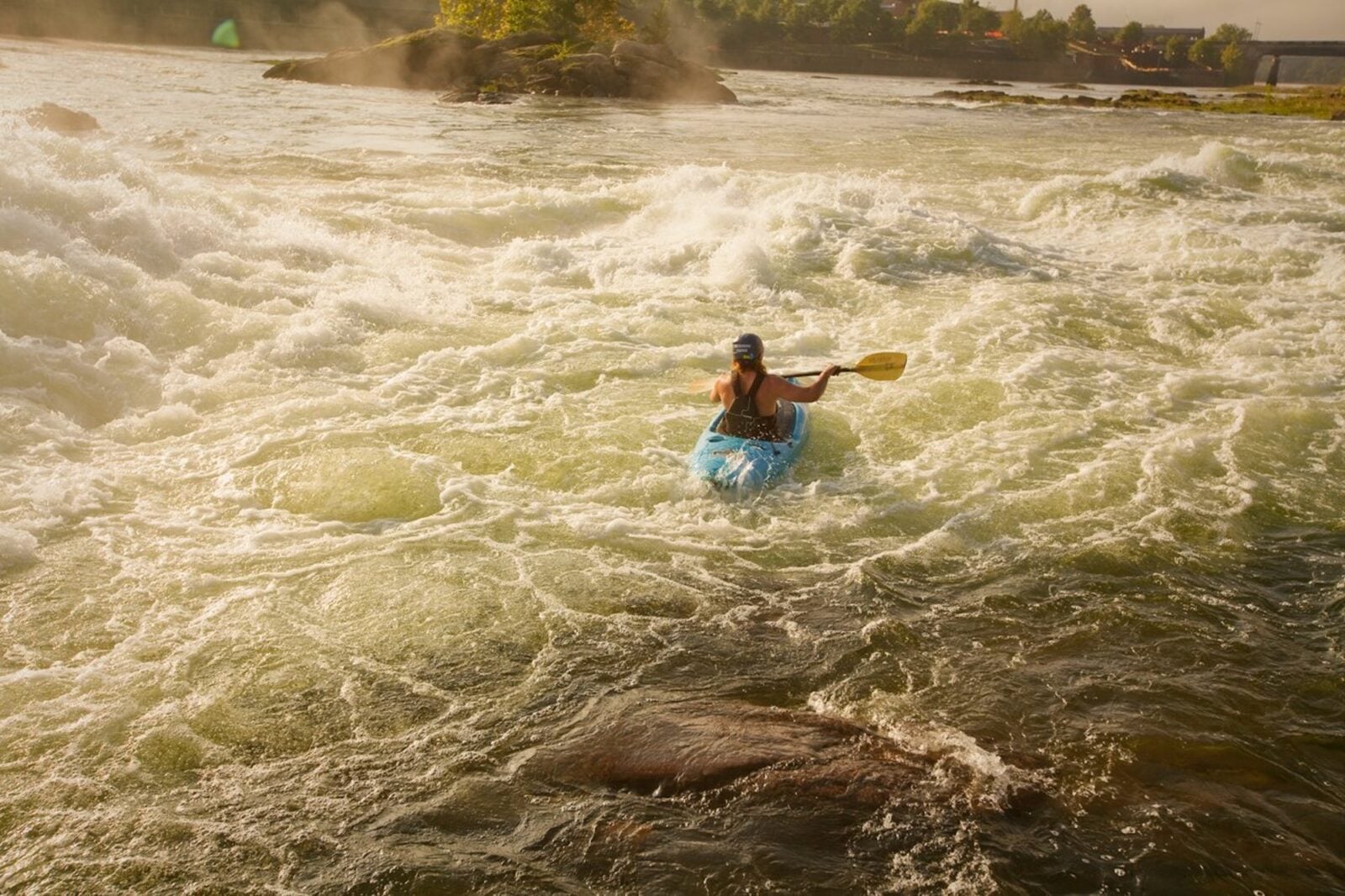
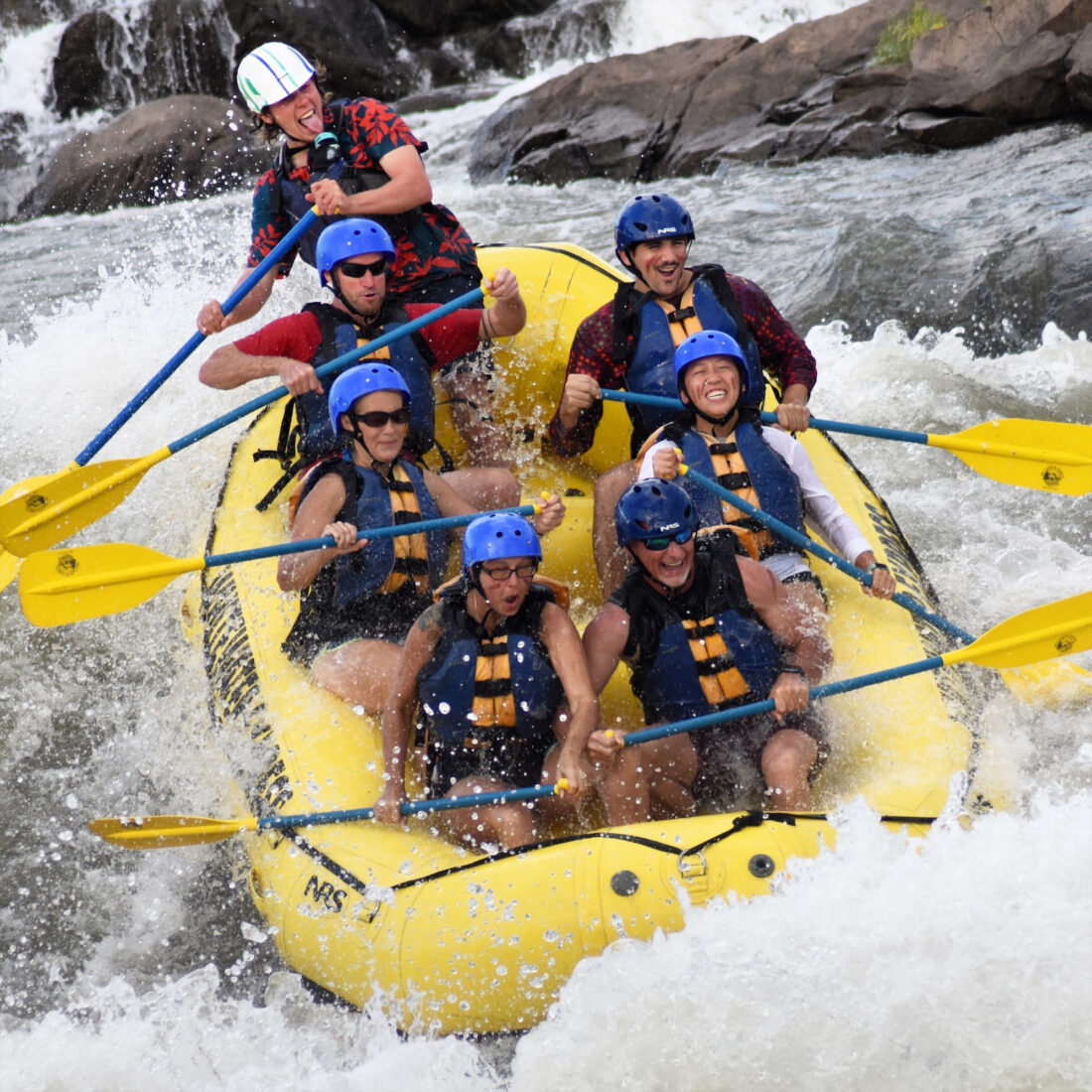
The excitement turns electric as craggy, island-sized slabs of striated rock strangle the Chattahoochee River into a maze of roaring chutes, and the raft surges forward as if someone buried the throttle. The nose drops into a rollercoaster of churning waves; whoops erupt as spray flies over the bow. My two teenage kids and I paddle hard as our guide expertly rudders through a bouldery, slightly banked channel that brings a machine gun of multi-foot dips and leaps that threaten to teeterboard us all into the water.
The bifurcation rejoins the river moments later, and the flow downshifts to a chorus of cheers and laughter. The lull lets me appreciate the densely wooded banks and upper story of a historic brick mill building. We steer toward a massive stone bottleneck and stairwell-esque suite of white water, and it’s hard to believe I’m passing through the heart of a 206,000-person city.
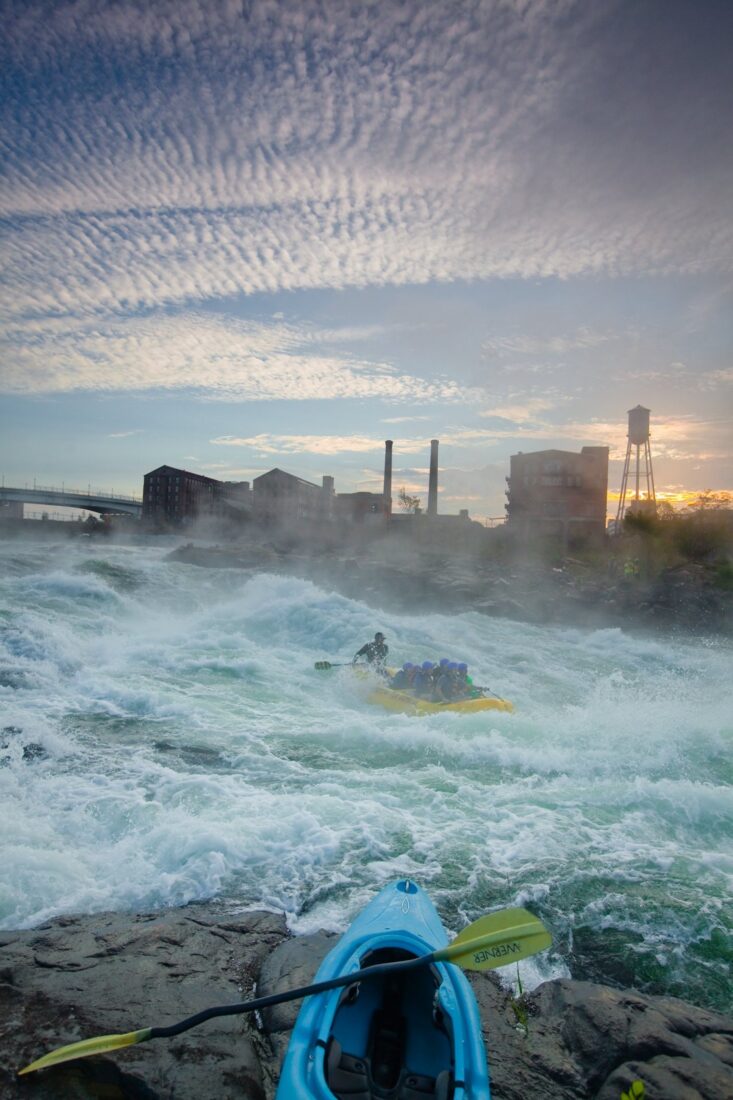
This is the opening section of Columbus, Georgia’s RushSouth Whitewater Park. The 2.5-mile, fall-line-fueled urban paddling course is the largest of its kind on the planet and crashes through a hit parade of about sixteen natural and human-augmented rapids—including the world’s biggest wave feature, which creates an oceanlike swell that lets you surf against the current. It concludes at a beautiful riverfront park in the historic downtown with a viewing platform, upscale food court, dedicated outfitter, and learning center. The dam-controlled span flows at lower, family-friendly volumes in the morning, while afternoons bring a prograde ruckus of 13,000 cubic feet per second.
RushSouth attracts about 50,000 adventure travelers a year, and elite-level kayakers call it a freestyle Shangri-La. “Columbus is a guiding light for what’s possible,” says Terry Best, freestyle committee chairman of the International Canoe Federation. The organization crowned the municipality its first ICF Freestyle Center of Excellence in August 2025 and tapped it to host both the 2028 Freestyle World Cup and 2029 World Championships. The designation is part of a new program that aims to develop an official international competitive circuit and introduce more people to the sport.
“This announcement was at least ten years in the making,” Best says. While 2024 Summer Olympics host city Paris, France, was a formidable frontrunner, Columbus boasted an unparalleled culture of support. Most notable was a track record of unstinted philanthropic backing. The city is the arguable birthplace of Coca-Cola, and various shareholder-descendants of former company principles still call it home. Aflac insurance company is also headquartered there.
Both corporations “have never hesitated to lend financial support to projects that elevate the city’s brand and boost quality of life for residents,” says Dan Gilbert, who owns RushSouth partner outfitter Whitewater Express. He’s pushed for development around the historic waterfront downtown district since the company’s founding in 1980, and was instrumental in securing the ICF designation.
“The Chattahoochee offered great kayaking and rafting below the dam at Lake Oliver to begin with,” Gilbert says. Proximity to an international airport in Atlanta and comparatively warm water temperatures made the stretch a favorite of Mid-Atlantic and Northeast white water hounds. The installation of a twenty-two-mile linear riverfront park and boardwalk in 1992 helped spark a downtown renaissance that filled historic warehouses, mills, and office buildings with restaurants, lofts, shops, art galleries, bars, and stay spots. That and more than $42 million in public-private investment in RushSouth has transformed Columbus into an international bucket list destination and breeding ground for world-class pros like current Team USA standout and part-time Whitewater Express instructor Mason Hargrove.
“We were already getting A-list professionals and enthusiasts coming from all over Canada, Europe, and the U.S.,” Gilbert says. The ICF announcement has brought a major uptick, and “we anticipate those numbers will continue to grow as we approach championship events in 2028 and 2029.”
But white-knucklers aren’t the only ones benefitting from the accolades. Gilbert has partnered with the ICF and local school systems on an ambitious educational initiative that will offer for-credit kayaking classes to high schoolers starting next fall. Whitewater Express will ferry participants to and from RushSouth twice a week, where certified instructors like Hargrove will teach them the ins and outs of paddling. Courses will also feature an event component in which learners plan and help with area festivals and competitions. Gilbert anticipates the program will expand to serve 200 local students a year within a half decade and more regional school systems within ten.
“The idea is to create a blueprint that other cities can adapt to their own unique set of strengths and assets,” Best says. He hopes Columbus’s success will trigger a domino effect that ultimately makes freestyle kayaking an official interscholastic sport and peppers the globe with dozens of equally meritorious sister Centers of Excellence.