

Home & Garden
How One North Carolina Couple Turned Their Love of English Gardens into a Paradise of Moss, Leaf, and Stone
In a lush rhododendron forest in Highlands, a green Eden grows at Thistlewaite
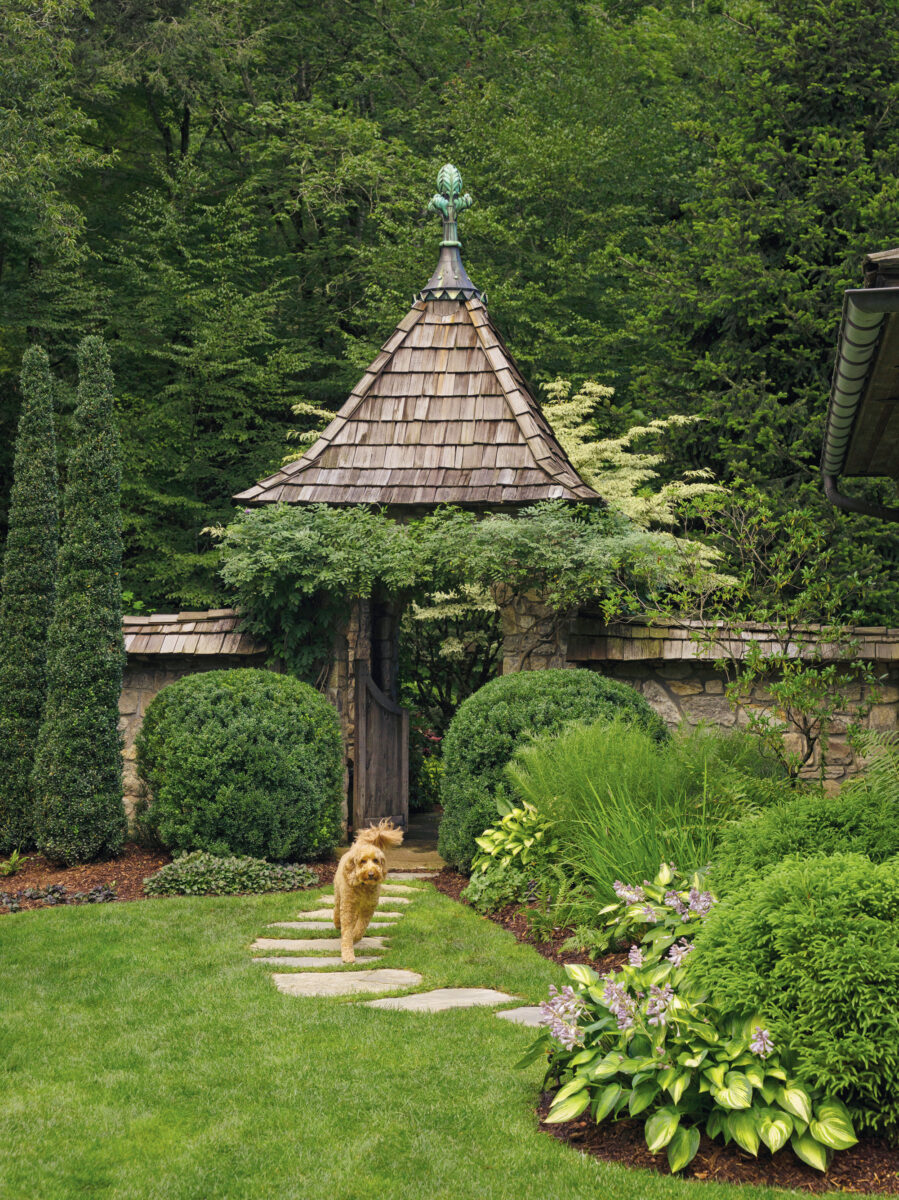
Photo: WILL CROOKS
In Frances Hodgson Burnett’s classic novel The Secret Garden, ten-year-old Mary Lennox turns a key in an ivy-covered door and finds a hidden bower of tangled, leafless vines. Only when her friend, the stout Dickon, slices through the stems to reveal their “greenish an’ juicy” insides does she realize the garden is alive.
I thought of the book on a visit to the home of Bill and Stephanie Reeves in Highlands, North Carolina—and not just because its nickname, by happy accident, sounds a lot like Misselthwaite, the Secret Garden manor. When the Reeveses designed Thistlewaite in 2009, they modeled it after an English country house, stone-enclosed garden and all. On a gray winter morning, bare vines rambled up its finial-topped lych-gate. Where Misselthwaite has “crocuses an’ snowdrops an’ daffydowndillys” and above all, roses, Thistlewaite has foxgloves, asters, and seemingly every variety of hydrangea. “It’s thrilling how these things survive the winter and just burst forth in spring,” Bill says.
Attired in the lushness of that renewal, Thistlewaite has appeared in coffee-table books and earned landscape designer Alex Smith a prestigious Shutze Award from the Institute of Classical Architecture & Art. It’s a star of local garden tours. “We’re so happy if you come here as a guest and maybe learn one new plant or something new,” says Stephanie, a former schoolteacher who in the 1990s channeled her love of antiques into a second career when she opened the lighting store Edgar-Reeves in Atlanta. She appreciates the seeds a garden tour can plant: Once, at a Highlands estate called Sagee Manor, she became taken with an espaliered purple smoke tree interwoven with Princess Diana clematis—the handiwork of Smith, who is based in Atlanta and trained under the late English gardening legend Rosemary Verey.
As a birthday present, Stephanie arranged a meeting with Smith for Bill, a retired executive search consultant—the most expensive gift ever, he jokes, but one that keeps giving. After sixteen years of tending their 1.3 acres themselves, right down to trimming the formal parterre with scissors, the couple presides over a “forever garden,” as Bill calls it. Spring brings an explosion of catmint and joe-pye weed along the entry path before blossoms of native wisteria adorn the lych-gate. Smith, meanwhile, has opened a satellite office near Highlands and become “like a son” to Bill.
But time taketh, too, and the Reeveses are downsizing to a condo in town. “We’ve aged out,” explains Bill, who is eighty-four. “Last year was the first year the garden was more a burden than a joy.” By the time the buds break in April, Thistlewaite’s new owners, who are younger and have the good grace to be plant lovers, will have settled in. But there’s still time to give one last tour.
How do you create the garden of your dreams? Start by copying what you love. For this couple, that’s a classic English aesthetic, “whether higgledy-piggledy or exactly manicured,” Stephanie says. While in the Cotswolds, they fell for the architecture of Sir Edwin Lutyens, who is known for blurring the lines between outdoors and in, and they happened to be friends with the perfect person to pay homage: Norman Davenport Askins, a celebrated Atlanta architect with whom Bill had attended Georgia Tech.
Every room at Thistlewaite, whose name nods to Highlands’ Scottish heritage, looks out to the garden or the mountains. Its rough-hewn siding came from blighted hemlock felled on the property. Besides the lych-gate with its moon-shaped doorway, Askins’s exterior flourishes include a stone driveway bridge, a gabled outdoor fireplace, and twin porches flanking the courtyard. To this canvas of hardscape, Smith added vines for patina and softening. Now, Smith says, “the garden looks like it’s been there for a hundred years, which is kind of the trick.”
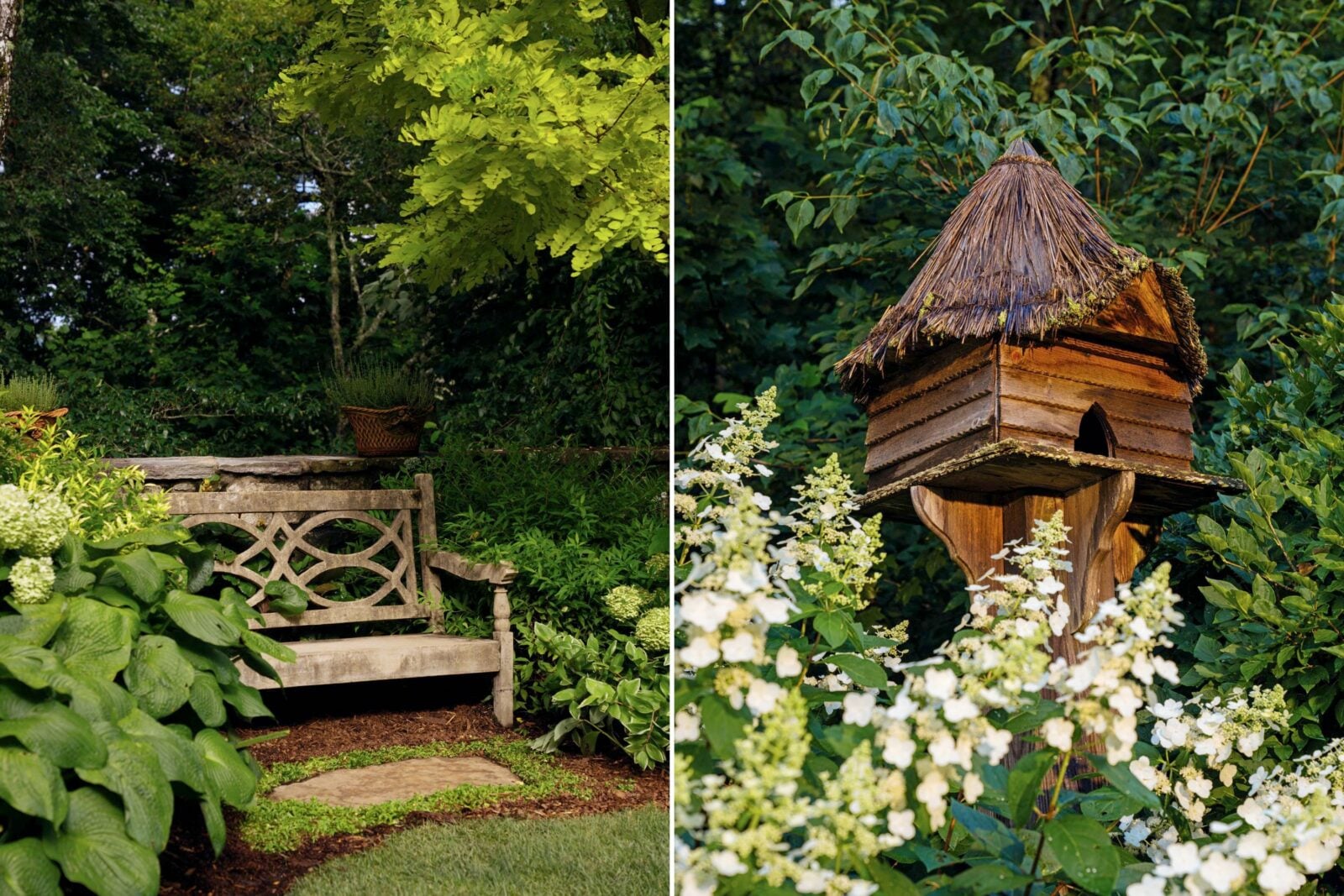
Photo: WILL CROOKS
Hostas and the golden leaves of a honey locust frame a bench; a thatched birdhouse.
Another trick involved conceiving of the landscape as rooms, starting with the cottage-like entry garden, where butterflies alight on summer’s crocosmias, gooseneck loosestrife, and the wildflowers Bill sprinkles from seed packets and Stephanie arranges in antique silver vessels. Peonies, another favorite cut flower, rest on reed stakes each May. From there a path passes between a pair of cast-stone borzois—Russian wolfhounds—and through the moon gate into the courtyard, whose layered border includes Siberian iris, Japanese anemone, and a replica of the espaliered smoke tree that started it all. Ivy and Akebia scale the retaining wall and cover the stone chimney—Bill’s “Jack and the Beanstalk” moment. But the pièce de résistance is the parterre, a scrolling design of creeping Jenny and ajuga with Prosperity, a nineteenth-century French statue, at its center in a ring of miniature boxwoods.
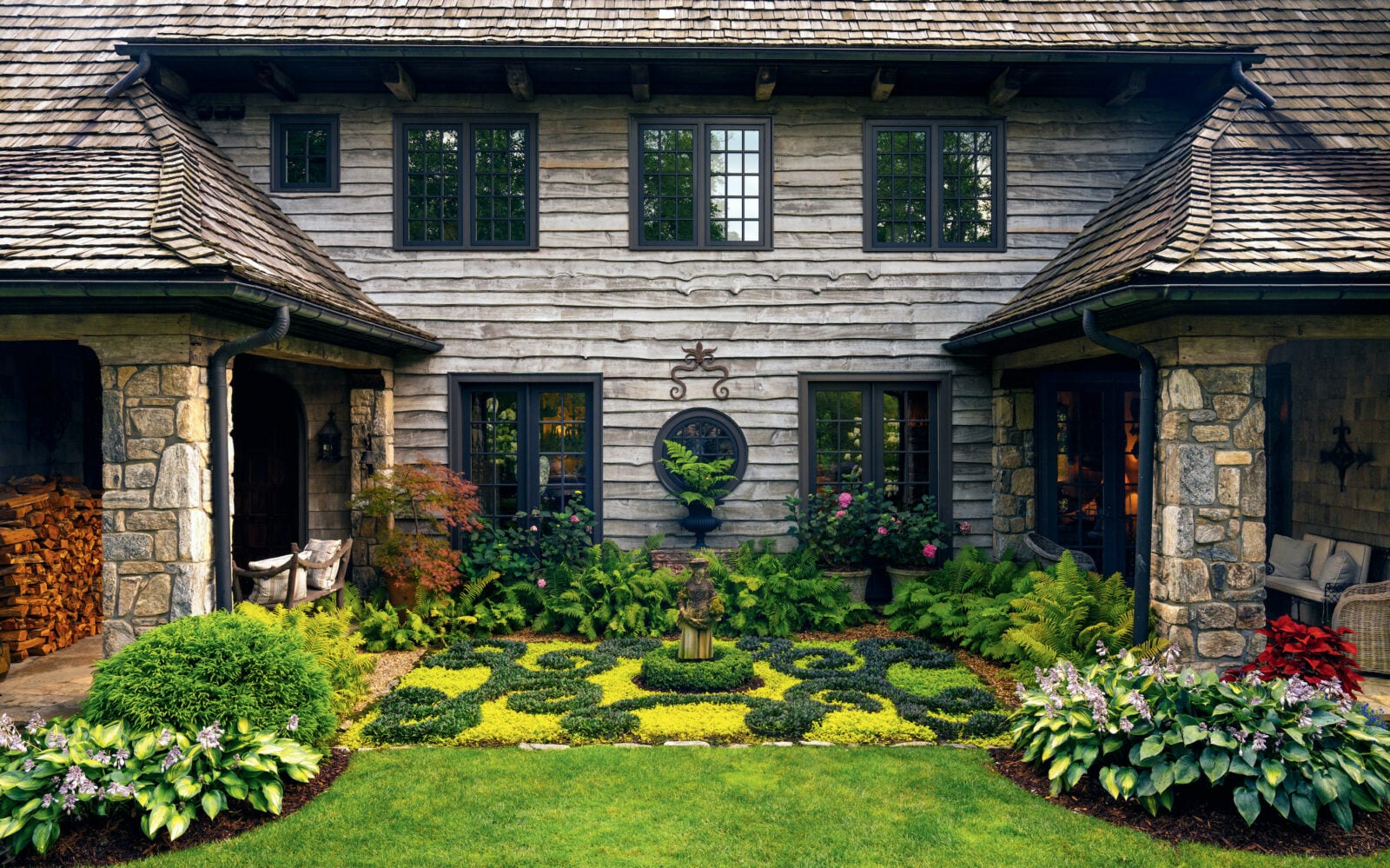
Photo: WILL CROOKS
Porches flank the formal parterre, a scrolling blend of burgundy ajuga and chartreuse creeping Jenny.
Wilder but no less showstopping is the “seep garden” along the back of the house. After the construction crew blasted part of the property, Smith deployed the exposed rock as a rustic wall, which weeps natural spring water. Coral bells, barrenwort, and ferns arise from the crevices and salute a nearby Stewartia tree, whose peeling bark and camellia-like flowers show the possibilities of planting native. Mother Nature returned the favor with galax and delicate bluet for ground cover, plus moss in every shade of green, which Bill coaxed along by dispersing the spores. One tuft is so lacy and long tendriled you might as well be peering at it through a microscope.
Moss and other “crud,” as the Reeveses call it, are key ingredients of a dream garden. Years ago, the couple was horrified when a pressure-washing crew took it upon themselves to treat Prosperity, but she was porous and “got her shine right back,” Stephanie says. Likewise, Bill looks stricken when I admit to having thrown away a leaky old birdbath in my yard in Atlanta. The confession poured out after he showed me his own cracked and crud-covered birdbath, which he’d filled with dirt and spotted dead nettle—a planter with built-in drainage, painfully charming.
Perched on a plateau in a temperate rainforest, Highlands comes closer to the conditions of an English garden than just about anywhere else in the South. But you won’t find wild bears in England. The couple installed nest boxes for birds but can’t put out seed lest it draw the unruly visitors, which trample the hydrangeas.
Rhododendrons also run amok; Thistlewaite’s driveway winds through a thicket so towering you understand what it means for a plant to be truly happy in a climate. It’s not the only species living its best life. As Bill leads me down a Tolkienesque tunnel through the shrubbery, the goldendoodle Abby and standard poodle Cassie blaze their own rollicking trails.
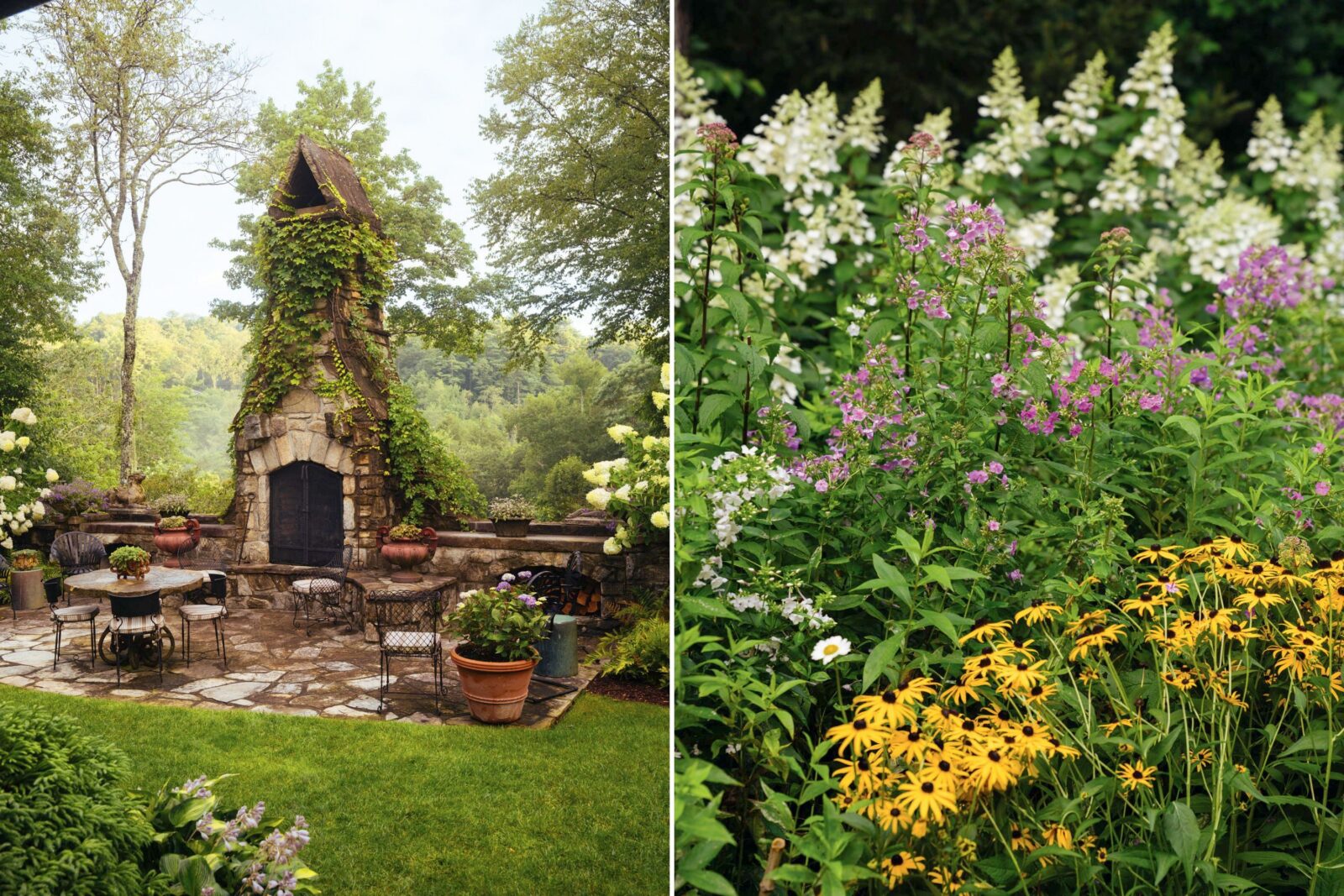
Photo: WILL CROOKS
The outdoor entertaining area overlooks part of the historic Kelsey Trail; black-eyed Susan, phlox, and Tardiva hydrangea in the lush entry garden.
Our destination is a stream at the property line, where a springhouse offers a glimpse of life before electricity. The inhabitants of the still-intact log cabin next door—a 1930s relic by noted Highlands builder Joe Webb—would have stored their eggs and milk in this little hut, the chilly water providing refrigeration. Today the springhouse is another fetching garden ornament, moss blanketing its stone roof like snow. “This is a serene place to come and meditate,” Bill says, gesturing to where the stream trips into the valley. If there’s a secret garden at Thistlewaite, this ferny cove would be it, though Mary Lennox could never think it lifeless.
Only a true gardener—one who has felt the seasons come and go—would understand how it’s possible to walk away from such a paradise. “Highlands is a beautiful place. You don’t have to own what you see to enjoy it,” Bill says with the tone of a man at peace with the next chapter. They’ll still have the mountains, the ultimate forever garden. Spring will still come and paint the rhododendrons fuchsia; there’s no shortage of them to shelter romping dogs. Standing in this leafy nook, it’s hard not to think, too, of the small gifts humans bestow on the earth. A tumbledown icebox. A greenery-filled birdbath. A stone wall covered with vines, hinting at more loveliness on the other side.
Elizabeth Florio is Garden & Gun's senior digital editor. She joined the staff in 2022 after nine years at Atlanta magazine, and she still calls the Peach State home. When she’s not working with words, she’s watching her kids play sports or dreaming up what to plant next in the garden.