It’s a Saturday afternoon, and Heather Elson is walking down the sidewalk to the Grant Park Farmers Market in Atlanta. A shimmering trace of silver catches her eye, a crumpled piece of mylar trapped in the tangles of a chain-link fence.
Her boyfriend, Dan, turns to her with a familiar plea. “Don’t.”
He’s been here before. He knows that look.
On Monday, Elson will return to work as a licensed professional counselor for children and families. Even in her office, plastic waste finds its way to her. Clients arrive with heaps of empty contact lens cases—symmetrical screw-caps otherwise bound for an unglamorous fate.
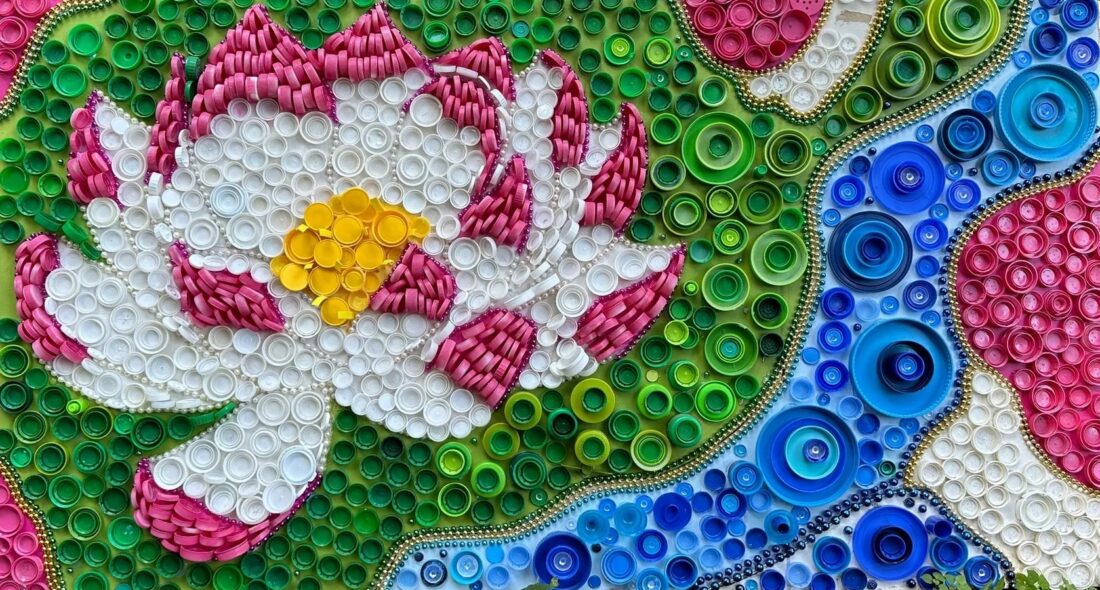
In the hands of Elson and her volunteers, those scraps of silver and discarded containers become part of something truly remarkable. Elson is the CEO and founder of No More Liddering, an organization that transforms single-use plastic waste into large-scale, community-made art installations. The projects show students, volunteers, and onlookers the impact of their everyday consumption.
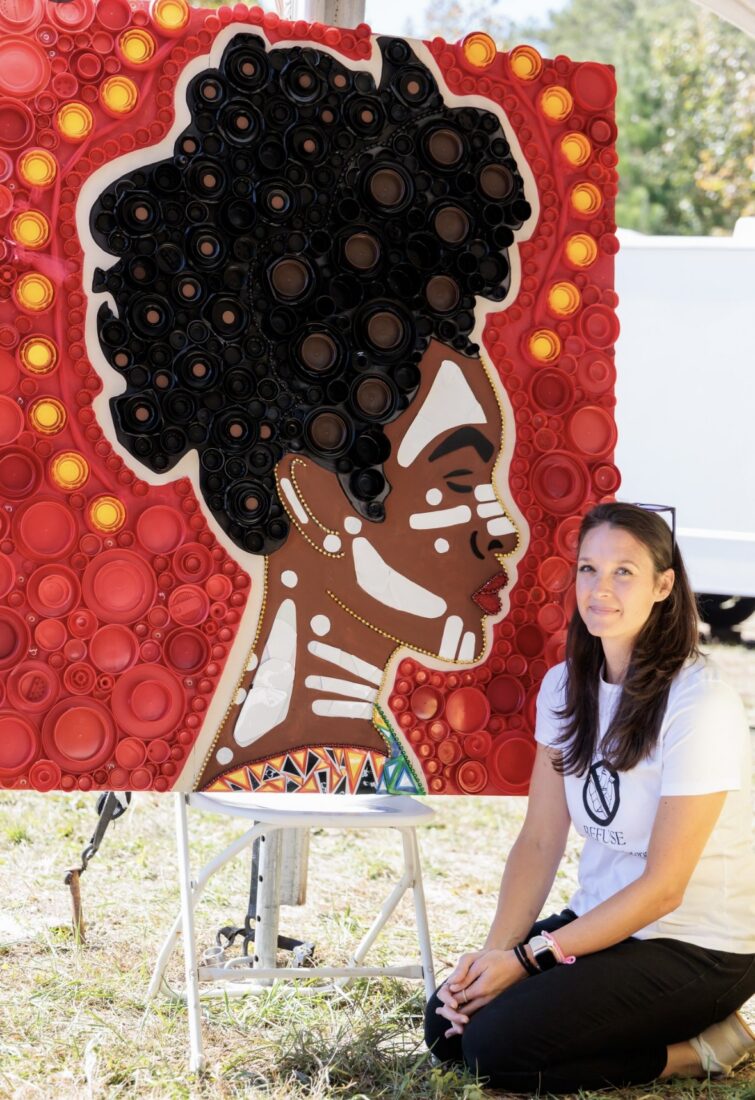
The work began in 2021 with a collection of lids from her grandmother and her card-playing friends. “And then my grandmama refused to stop collecting lids,” Elson says with a laugh.
In 2023, No More Liddering’s installations began appearing in local schools, first at Davis Elementary in Marietta, Georgia, and then graduating to the locker-lined halls of nearby Mabry Middle School and Wheeler High School.
By 2025 Elson’s “garbage art and plastic fever dream” had come true; No More Liddering had repurposed 75,000 plastic lids across forty-four art installations with over twenty-five school and community partners, including the home of the Atlanta Falcons and the Atlanta United. “Did I think I would be in Mercedes-Benz Stadium within a year of being a nonprofit?” she says, laughing. “No.”
Utilizing over 14,000 plastic pieces and seventeen hours of volunteer work, Elson and her team created the organization’s largest piece to date—Dawn Rising: A New Era of Sustainability—in homage to the world’s first TRUE Platinum–certified zero-waste stadium.
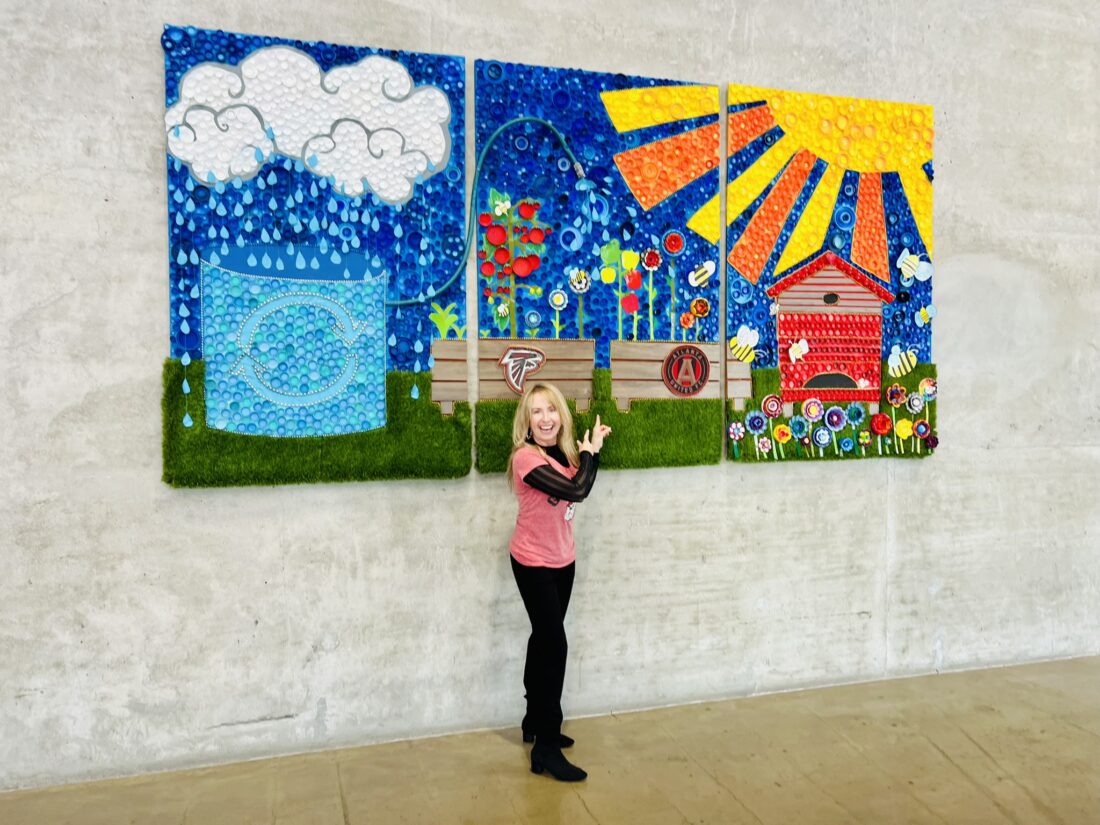
Golden rays of a bottle-capped sun reach from the artwork’s highest corner, representing the stadium’s 4,000-plus solar panels. A blue model cistern depicts the underground water reclamation facilities tucked beneath the stadium. Red bottle-cap tomatoes wearing emerald hats of plastic packaging sprout on vines, a reflection of the on-site urban garden. Sewn strands of raindrops, salvaged from a vinyl pool float, sprinkle from a white cloud.
“What Heather is doing is groundbreaking,” says Alfredo Faubel, founder of Miura Board, whose company partners with Elson and supplies the 100 percent recycled alternative to marine plywood. “She takes what people consider waste, and she creates something of beauty.”
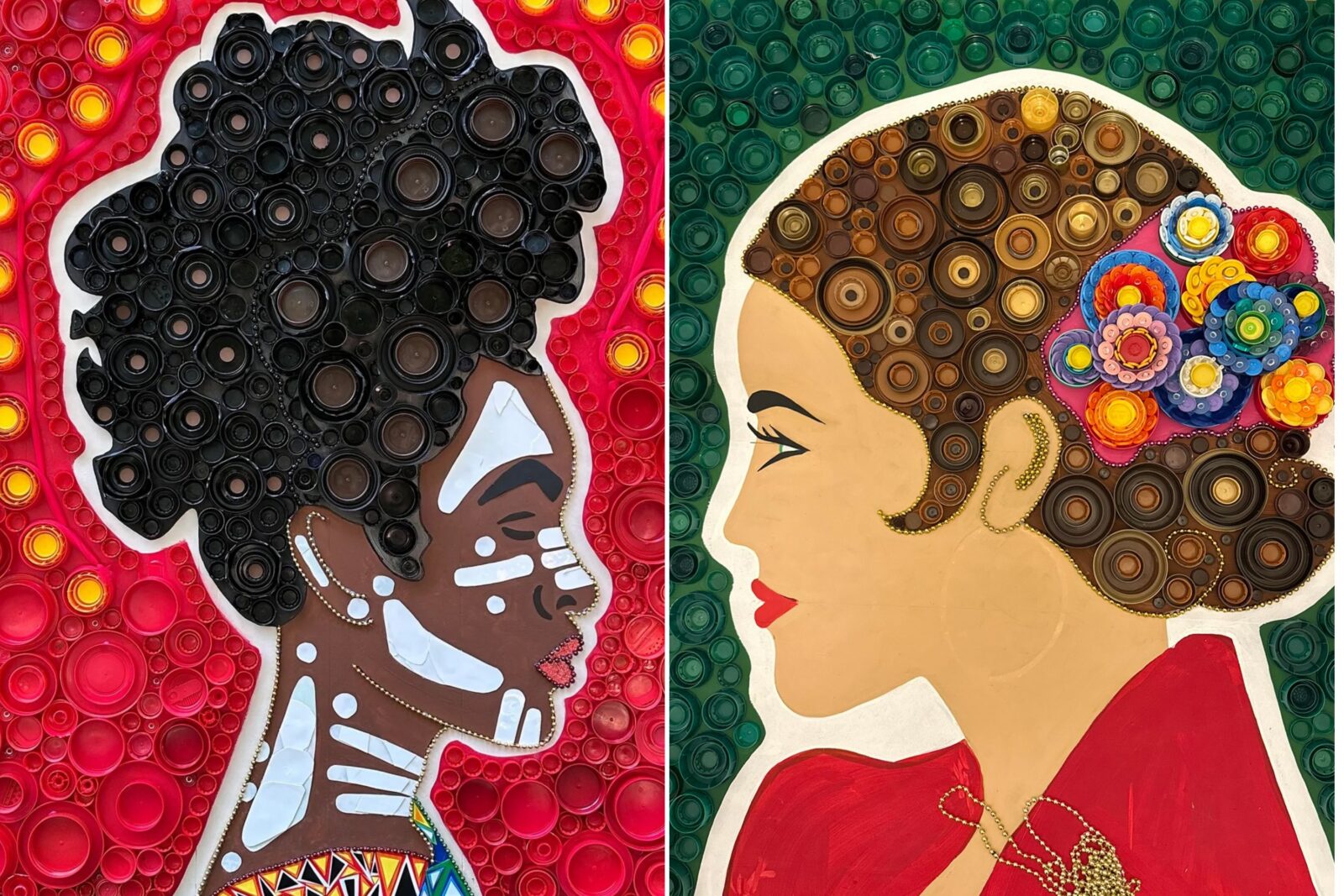
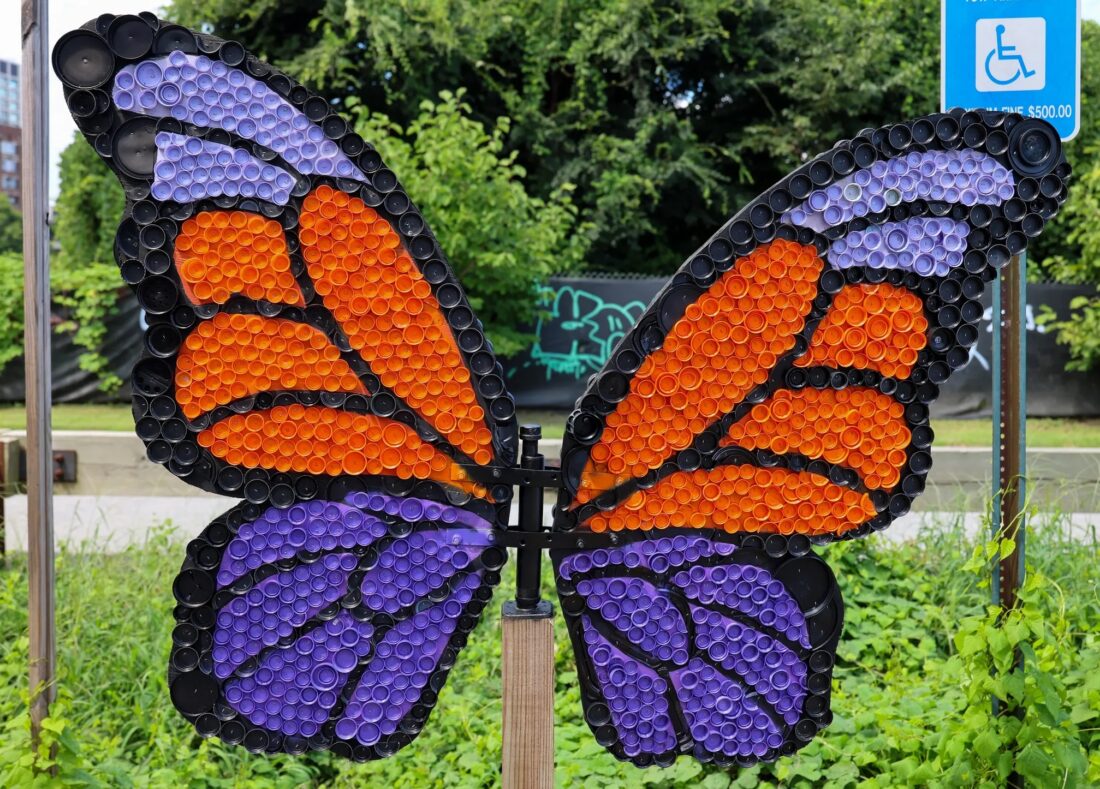
Most of the installations take shape in Elson’s basement, where incomplete works line the walls. A pair of butterfly wings sparkles in purple, teal, and yellow. Bottle-cap designs in SEC team colors await their place in the homes of unsuspecting family members. A woman’s plastic portrait receives a touch of unexpected elegance, as pastel hospital vial caps swirl to form the spiraled flowers pinned to her hair.
Nearby, countless clear tubs reveal their color-coded contents—a repurposed rainbow that stretches from the signature reds of peanut butter jars to the deep blues of neglected water bottle caps and sour cream lids.
Plastic in every hue and shape, a treasure trove of salvaged twist-tops and propellor-shaped caps from children’s squeeze pouches, all of which Elson rinses out in a baby pool beneath the Georgia sun.
So much plastic, and yet: “This is a minuscule fraction of what is in the world,” Elson says. “This is in my basement—and this is just the tops of these containers.”
She exhales. “We have got to care more about where our trash goes.”
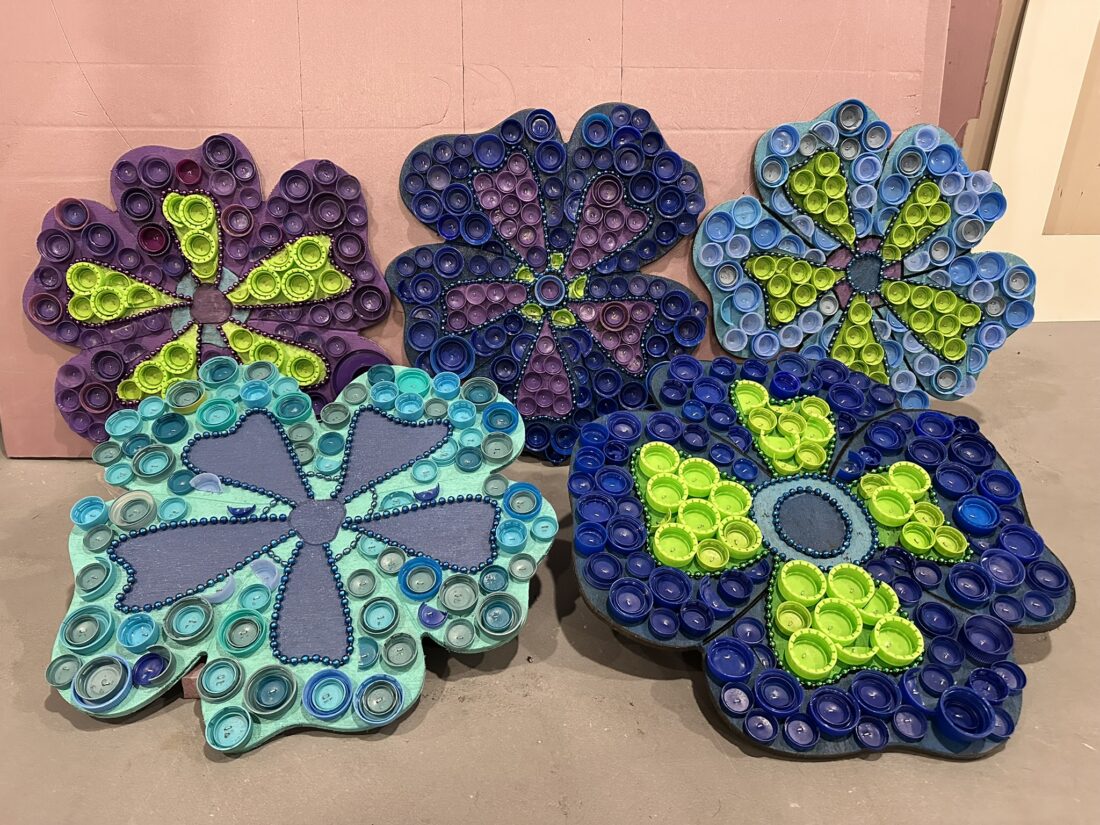
In each hand, she holds out an oversized flower carved from Fabuel’s upcycled material. They will soon join twenty-two others in No More Liddering’s Earth Day installation at the Atlanta Botanical Garden. Students across Georgia have already decorated sixteen similar flowers with colorful caps and shiny Mardi Gras beads in springtime hues. The final eight will receive their makeover in the Children’s Garden on April 22, where all are invited to fasten final lids and details before the flowers complete the hanging bouquet.
“I’ve been at the garden for more than twenty years, and this is the first time I’ve had an opportunity to do an art installation with kids that they are making and then it gets to stay,” says Kathryn Masuda, the garden’s director of youth programs.
Like light shining through stained-glass panels, Elson’s passion for education peeks through each repurposed plastic piece.
“We all know it’s the kids. We’ve got to get their attention,” she says. “I did this because I wanted them to see collaboration, cooperation, compromise—all these things you can utilize to make something so cool and big and make these abstract feelings of empathy concrete.”
As for the rest of us, Elson suggests adopting a simple resolution.
“Refuse plastic beverage bottles, all of them,” she says. “Refuse plastic bags every single time.”
It’s a mantra modified for single-use plastics, worth carrying well beyond Earth Day: “Reduce. Reuse. Recycle. Refuse.”
Lilly Stone, a 2026 intern at Garden & Gun, grew up in Atlanta and graduated from the University of Georgia, where she studied journalism and sustainability.