I have learned, over the course of my forty-eight years on Earth, that I have too many possessions. My drawers overflow with T-shirts I can’t bear to part with. My basement is cluttered with golf clubs I’ll probably never put back into my bag. I have too many shoes, too many books, too little space, and too much attachment to various trinkets and souvenirs to ever truly dig out of my mess.
My sixteen-year-old daughter, Molly, suffers from a similar affliction. She saves concert tickets and friendship bracelets and Post-it notes she believes she will one day mold into perfect paper flowers. I have tried to convince her that she is not fated to repeat her parents’ mistakes, but sometimes when I see the state of her room, I question whether that’s true.
But when she asked me a sweet, innocent question last year— “Dad, what do you want me to get you for Father’s Day?”—I had a minor epiphany. I didn’t want stuff. I wanted a shared experience.
I wanted her to read my favorite book, The Prince of Tides, by Pat Conroy.
My wound, growing up, was not geography. Although the book’s famous opening line grabbed me when I initially read it twenty-five years ago, I am not a Southerner, or anything resembling one. I was raised in the mountains of Montana, and when I picked up Conroy’s family epic for the first time, at the urging of my younger sister, I had no concept of the South Carolina Lowcountry. I had never eaten shrimp and grits, never tasted pimento cheese, never sipped a drop of sweet tea. I had never even met a bona fide Southerner. The places Conroy described in the novel might as well have been outer space.
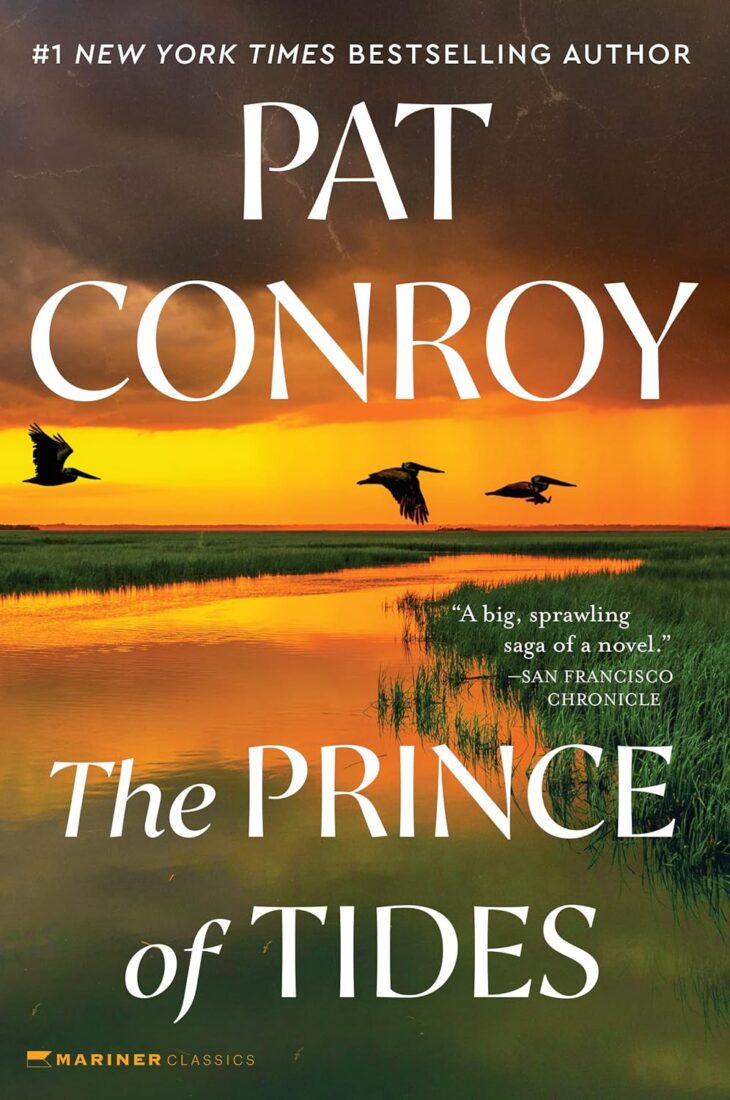
And yet…I was enraptured. I came to the book with cartoonish views about the South, the idea that it was a strange and backward place. But bit by bit, page by page, I fell deeply in love with the beauty of the world he had constructed.
Conroy’s prose could be verbose, flowery, even overwrought, and the dialogue overcooked by half. A third of the way through the book, I started writing down every word I didn’t recognize or understand on a piece of yellow notepaper, and after reading a hundred pages, I had filled every inch of it. But no book had ever made me feel seen quite like The Prince of Tides. Tom Wingo, the novel’s protagonist, was a ruminative, stubborn, sensitive football player (and eventually coach) who loved literature, his family, and the land that birthed him. I was a sensitive, contemplative, stubborn college football player who loved my big Irish family and whom teammates often teased for bringing novels to read on road trips. There is a scene late in the book where Tom returns a punt for a surprising touchdown—something I had done once in high school—and as he is running to the end zone, he imagines that he is the only boy on that field who has ever read Lord Byron’s poetry, or even knows his name. It was such a preposterous detail, but as I read it, my eyes filled with joyful tears.
How had Conroy tapped into my soul and spilled pieces of it all over the pages of this book? I did not feel damaged the way Tom did, but for the first time, I understood how a boy’s family history might serve as a road map that could explain why, as a man, he chose to walk a certain path. It was not a story about what it meant to be a Southern family, even if it was marketed and framed as such. It was a story about the power of telling stories, about trauma, but also about love and memory.
I had missed the height of Conroy’s fame. By the time I found the book, in 1998, it had been in circulation for a dozen years. At that point most people identified the story with the film adaptation starring Barbra Streisand and Nick Nolte. But in my mind, the film stripped away all the most important parts of The Prince of Tides— the relationship between the three Wingo children, and their connection to the land and communion with it. The way they felt about the marshes of South Carolina was no different than how I felt about the rivers of Western Montana. Water was akin to the soul, the essence that ran through everything, and it gave the words used to tell family stories movement and life.
When I started dating a girl that spring, I loaned her my copy, told her it was the best way to understand me. She was not a reader, she informed me, but she vowed to try. Two months later, when we reunited for the fall semester, she sheepishly presented me with a beautiful hardbound first edition. A replacement, she said. She had read my paperback copy with such love and intensity, it had fallen apart in her hands. She wanted me to own a version that would last forever. I kept it pristine, barely a single page creased. Our relationship ultimately ended, but her gesture continued to endure, even decades later.
It was that same copy that I put in my daughter’s hands last year, fully aware that the book’s closing message had taken on a deeper resonance for me over time. On the final page, Tom wishes there could be two lives apportioned to every man, and he reminisces about the romance he and psychiatrist Susan Lowenstein shared but ultimately walked away from. Love was complicated, sometimes contradictory, and it felt like Molly was old enough to begin to process that message. Her mother and I had decided to divorce when Molly was seven, and it wasn’t long before there were two households and two sets of stepparents and stepsiblings. I wanted her to understand that her family, just like the Wingos’, may have been ripped apart by forces beyond her control, but she and her siblings were the gravity that would always hold everyone together.
Forty years past the book’s publication, and ten since his death, Conroy has faded a bit from public consciousness. It is easy to forget, in an era of oversharing, how difficult it was in the 1980s to discuss the kind of mental health issues he wove through the book. But in an episode of the Apple TV series Ted Lasso—another piece of art my daughter and I had bonded over—the team’s psychiatrist, Sharon, reveals that her favorite book is The Prince of Tides. That Easter egg, in a plotline about a psychiatrist trying to get a sensitive-but-stubborn English Premier League coach to deal with his past traumas, made my heart swell. Conroy might be gone, but his magic, his empathy, and his compassion live on.
I will forever think of myself as a Montanan, but my daughter is a Marylander, having lived in Baltimore, near the Chesapeake, her entire life. Maryland occupies a unique place in our country’s DNA, being both of the South and not. I wondered if she might connect with the book in ways that had eluded me. As she read it over the course of several months, I longed to know what parts were speaking to her but left her alone to process them at her own pace.
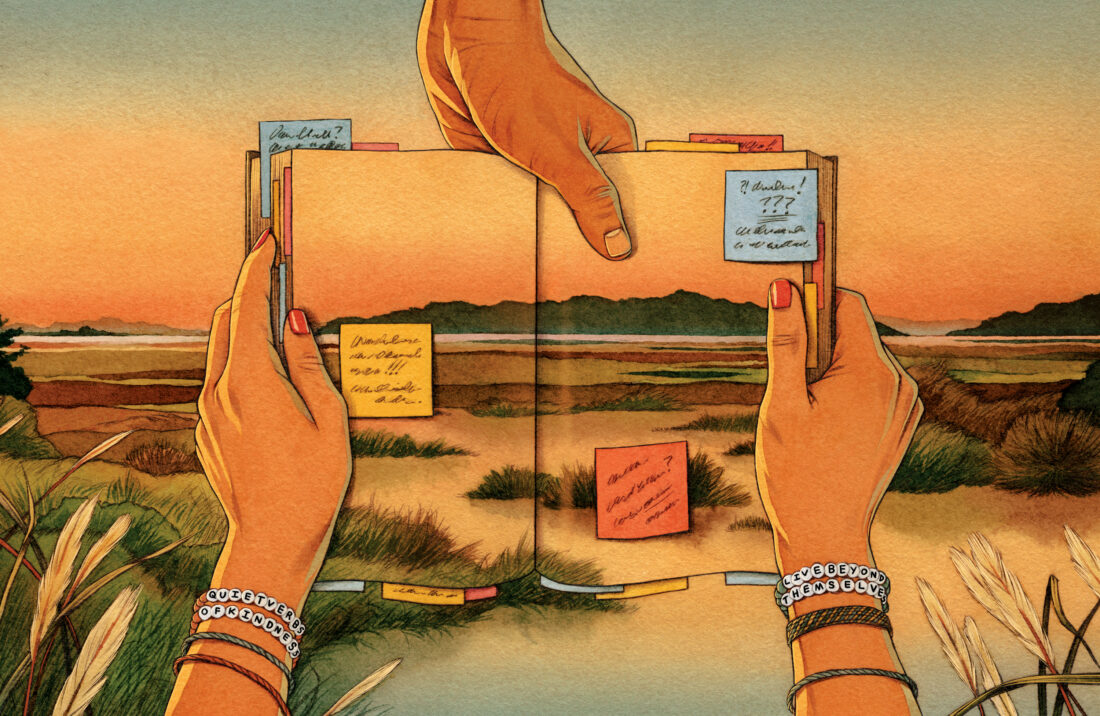
After she finished, she placed the book on my desk one night before bed. When I discovered it the next morning, I saw she had returned it with a beautiful addition. On half the pages, she had attached a colorful Post-it, and in her tender handwriting, she had written nearly a hundred notes—about the characters, about the story, about the sections she had cried her way through.
This whole paragraph was beautiful.
Already crying lots, these paragraphs made me cry harder, the feeling of reconnecting and forgiving and pure joy made me feel exactly what they were feeling with the art of this description.
This goodbye killed me. I could envision my dad in this scenario, saying all the things on this page.
I told myself that Father’s Day I did not need more belongings, just deeper connections. Somehow, my daughter had taken one of my most prized possessions and turned it back into a gift.
Garden & Gun has an affiliate partnership with Bookshop.org and may receive a portion of sales when a reader clicks to buy a book. All books are independently selected by the G&G editorial team.