“The fish were jumping in the boat!” Maybe for the first time in the history of angling writing, that sentence is not literary hyperbole. But I’ll get to that in a bit.
I began fly fishing for tarpon with my dad in the 1950s glory days of the Florida Keys—before poling platforms and graphite rods, before the hippie hordes of the sixties and seventies, before grouchy guides and Sea-Doos. Back then, the only tarpon I cared about catching were the big ones, and over the next fifty years, I caught my share of those all over.

Then, a decade ago, I fished a coastal river in Cuba called the Hatiguanico with my friend Richard French. Drifting through jungle toward the sea, we hooked lots of juvenile tarpon between ten and forty pounds using eight-weight rods, and after that experience, I quit caring if I ever caught another big one.
What I love about the juvies is their eagerness to eat a fly, their nonstop aerial acrobatics, and the fact that I can boat and release them without putting undue stress on either them or my replaced shoulders. With my newfound love of small tarpon, French, whose business is sending clients to fish all over the world, suggested I give Campeche, Mexico, a go, so I put together a group of friends and my daughter last spring and went.
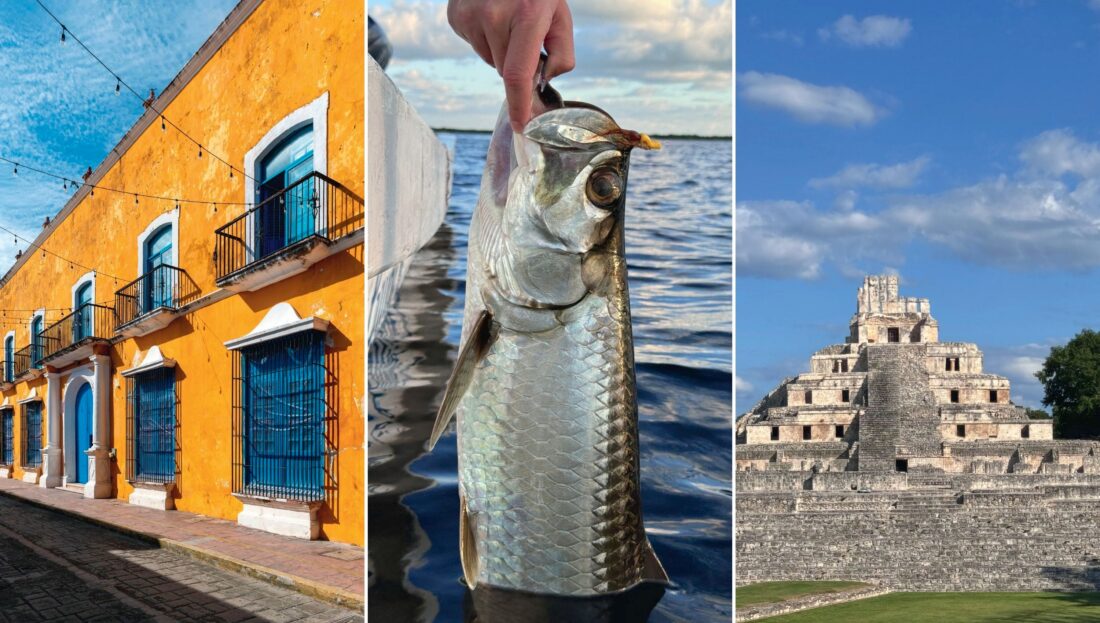
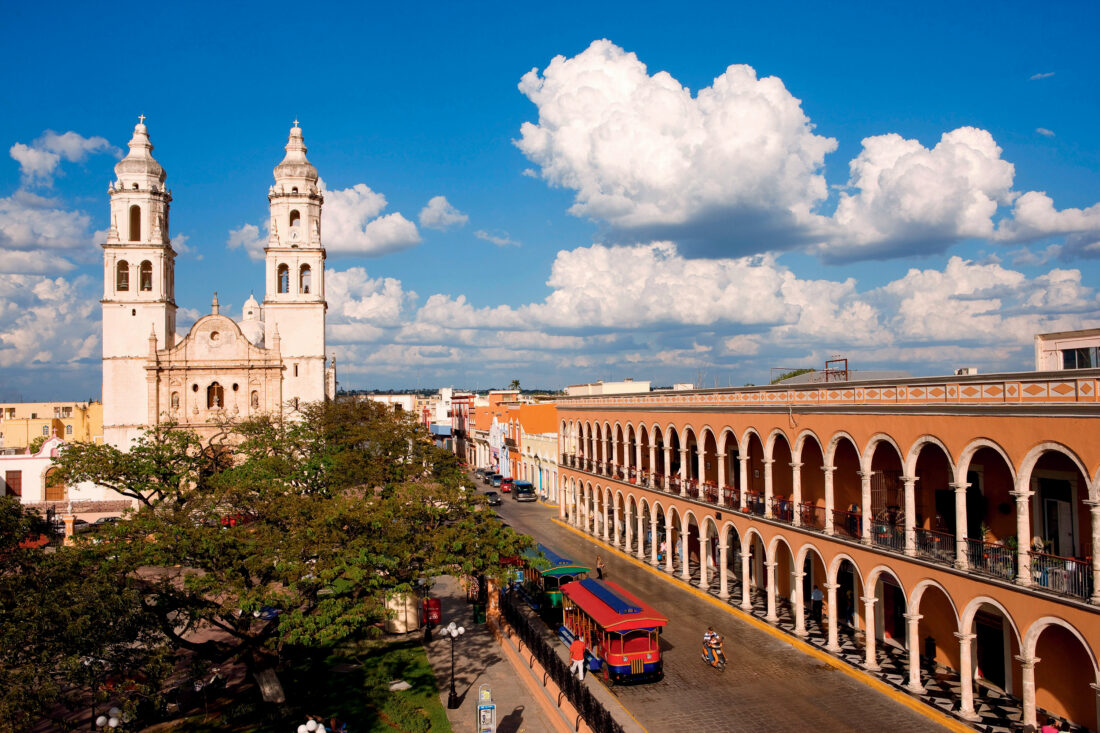
Few places I have visited are as interesting as the city of San Francisco de Campeche, on the west coast of the Yucatán Peninsula. Spanish conquistadors founded it in 1540, and its prime location on the Bay of Campeche soon made it one of Spain’s most important new-world ports. Today Campeche, a UNESCO World Heritage Site, offers an inner core of superb colonial architecture, a bevy of fine restaurants, friendly locals, and a light, merry air about it that’s reminiscent of Barcelona without the crowds. It also offers what is arguably the best small tarpon fishing in the world.
With an encyclopedic knowledge of the city and the bay and its fishery, as well as an almost otherworldly ability to get anything done in un momento, Raul Castaneda has operated his outfit under the name Tarpon Town Anglers since 2003, at first putting his clients up in hotels but more recently at the house in which he grew up. With three large, air-conditioned bedrooms, the house sits in the central part of the city, within walking distance of shops, restaurants, and the town square with its fine seventeenth-century cathedral.
After unpacking and a quick dip in the house’s pool, we met with Raul in the living room, overseen by photos on the walls of such angling notables as Lefty Kreh, Gary Loomis, and Brian O’Keefe grinning and gripping Tarpon Town fish. To beat the Yucatán heat, Raul told us, we would breakfast at five a.m., be on the water by six, fishing by six thirty, and back at the lodge by one or two; then take a siesta or walk, followed by dinner on the town.
The next morning was clear and windless when we met our guide, Juan Chay, at the dock at six. I was fishing that day with my Canadian salmon-fishing mate, Gerry “Deepwater” Doucet, who had never caught a tarpon and was nothing less than lit up with wanting to. The boat, a comfortable twenty-three-foot panga powered by a ninety-horsepower, four-stroke Suzuki, had us across the bay and fishing inside of twenty minutes.
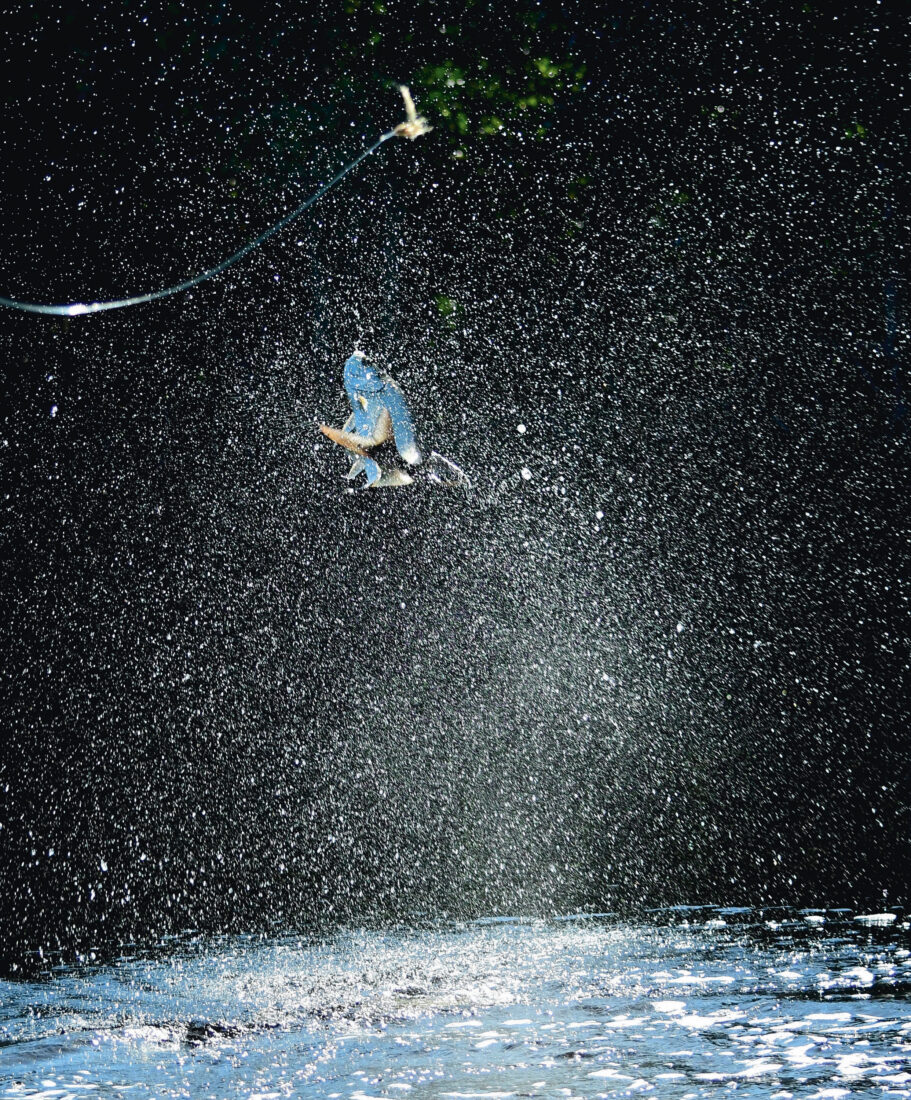
Game fish, of course, are where you find them, and where you find the most of any given species is in the habitat that best supports them. Campeche Bay’s 815-square-mile Los Petenes Biosphere Reserve provides extensive habitat for juvenile tarpon—the mangrove forest along the coast is one of the world’s largest. According to Aaron Adams, the director of science and conservation for the Bonefish & Tarpon Trust, the tarpon here most likely spawn offshore of Veracruz, and ocean currents bring the larvae into the mangrove swamps of the Reserve. There they thrive, growing in about a year to a foot or so long before moving at different stages into first the creeks, then the mangrove shorelines, and finally into the grass flats of the open bay. At about six years old, the Campeche tarpon leave the bay to follow one of two offshore migratory patterns, which explains why the ones caught here range uniformly in weight between five and a maximum of sixty pounds.
And there is God’s own amount of those. When Juan killed the outboard and took up his pole off the shoreline of unbroken mangroves, tarpon tails, dorsal fins, and bubbles showed all around us in the calm water. That water was less than a foot deep over the turtle grass that makes up one vast flat along the entire Campeche Bank and provides a smorgasbord of crustaceans and baitfish. To match that hatch, Gerry and I were fishing Enrico Puglisi baitfish patterns on nine-foot, twenty-pound leaders knotted to forty-pound bite tippets.

The fish were moving around, and it was impossible to see that movement in the early light. After a frustrating hour or so, a breeze came up out of the north and the tarpon quit showing in the bay, so Juan began poling along the shoreline with Gerry blind casting into pockets in the mangroves. These are not the shrubby mangroves you find in Florida and the Bahamas but grave, twisting trees up to eighty feet tall, their interstitched branches and roots forming an impenetrable habitat perfect for tarpon, monkeys, jaguars, and more than three hundred species of resident and migratory birds. The mangroves are veined with tidal creeks, varying from a hundred yards to less than ten feet across. In the first of the creeks into which Juan poled us, tarpon were showing their tails and dorsals as far as we could see. Gerry hooked up right away, and the fish tossed the fly dismissively back at him on its third or fourth jump.
“My God,” he said. “What a show that was! You’re up, pal.”
“Not until you catch one,” I said. Which he did about five minutes later and then, when I insisted, another—a clone of the first at about eight pounds.
“Is this fun or what?” Gerry said, giving me the bow. With the little tarpon whizzing and leaping all over the creek like ballerinas, it was indeed about as much fun as you can have with an eight-weight and your clothes on.
By the time I had lost and caught one, it was ten thirty and a long enough stretch since breakfast that we pulled into the shade of a mangrove for lunch and a cerveza. When Juan poled us back into the bay, it was whitecapped by a strong and rising northeast wind, in our face for the ride home and bringing rain clouds, so Juan pulled the plug, and we pounded our way back to the dock.
Everyone in our group had good fishing that day, which made it particularly disappointing to hear from Raul that according to the forecast, there would be no more of it for the next two days. But he had planned for us some alternative activities that proved so much to my liking that I would happily go back to Campeche solely to repeat them.
I had visited the ruins of Mayan cities before, but none as evocative as Edzná, to which we traveled by an hour-long van drive the next day. Our guide, Juan Manuel Jimenez, was thoroughly fluent in the historical details of the place, and over the three hours we spent there, he made those ancient jungle remnants of a bizarre, astonishingly sophisticated culture come absolutely alive.
Edzná may have been founded as early as 600 B.C. and was inhabited until 1450. At its height the city had a population of 25,000 living in thousands of structures spread over nearly ten square miles. After the Mayans abandoned the city for some unknown reason, it was digested by the jungle and only discovered by anthropologists in 1907. As we wandered around it, the place took on for me a sort of pleasantly disassociated enchantment, as if I were a guided tourist on another planet, one with beautifully designed stone temples, underground water reservoirs, and a stone ball court on which an incomprehensible game called pelota was played, to the death, it is believed, of the losers.
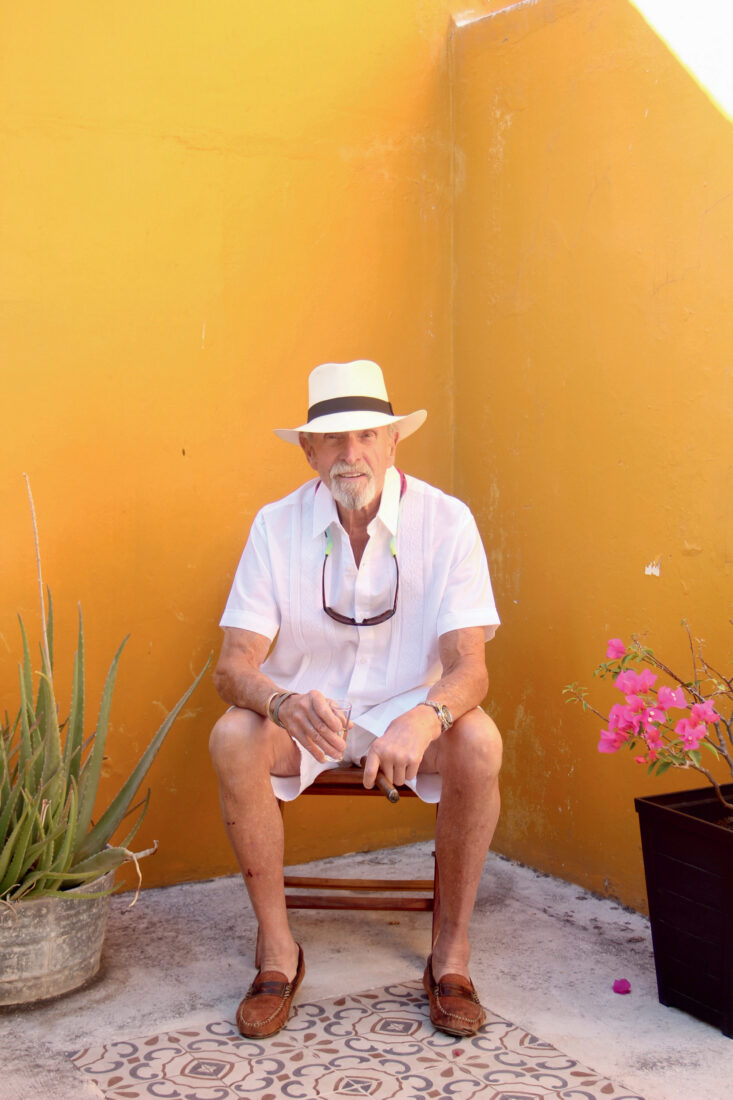
As predicted, the following day was still too windy to fish, and Raul sent us off with Jimenez after breakfast for a tour of two nearby Mayan villages. The first, Bécal, is renowned for making what many connoisseurs of the art believe to be the world’s finest woven hats, constructed of palm fronds that are split into thin strips, dried, then pieced together in underground rooms where the humidity remains constant. The panama hats are such works of wearable art that I defy any reader who happens to go to Bécal to resist buying one.

The second village, Pomuch, is as famous for its bread as Bécal is for hats, and deservedly so, we discovered, while lunching on splendid soft baguette sandwiches of ham, cheese, and jalapeños at one of the town’s many bakeries. In addition to its bread, Pomuch has one other notable tourist attraction, one you don’t find everywhere: The local cemetery generously displays to the public the skeletons of its permanent residents in open coffins.
Indulge me, if you will, a word or two about my daughter, Greta. She is a singer-songwriter, a businesswoman, and a former world-champion snowboarder, and she hosted her own travel program on the Oxygen network. She is also a laser-focused, take-no-prisoners angler and my favorite person to share a boat with, which is what I did on our fourth day in Campeche.
Our guide for the day, Roberto Pastrana, poled the creeks with Greta in the bow, her game face on. The water was off-color, and that, plus a full moon, may have accounted for why the tarpon that morning were loath to eat. Back in one of the larger bays, we could watch the fish either ignore or turn off the same red-and-black Enrico Puglisi tarpon streamer on which she had caught fish the first day. Finally, at around ten o’clock, we found ourselves in a small creek where the tarpon were bubbling and willing. As Roberto poled us farther, it narrowed from forty or so feet across to twenty, to ten, and finally to little more than the width of the boat.
I was in heaven. I had watched Greta catch one tarpon of about fifteen pounds and have two more jump off; the vault of mangroves overhead was broken in places with patches of blue sky in which frigate birds wheeled; the air was cool out of the sun and pungent with the marsh smell; Greta was whooping and roll casting to tarpon showing in the tiny ribbon of water; and I was on my second Modelo Negra. I had taken out my notebook to detail all this blessedness, and Greta had turned to me to request I get my foot off her line when I felt something slap my shoulder. Assuming it was Roberto’s pole, I went on blissfully with my note-taking.
“Dad!” Greta said. “Didn’t you feel that? A tarpon just hit you in the back! It almost jumped in the boat.”
“Is that what it was?” I asked her, capping my pen. And at that, the same? Another? Tarpon did jump into the boat and commenced to drum the deck as passionately as Ringo Starr.
“I’m not freaking believing this!” Greta said as she tried to help Roberto get the writhing fish in hand. “It’s got to be a sign, right? What do you think it means?”
I gave it some thought. “Obviously, Greta, it means the tarpon want us to come back to Campeche.”
For an angling stay in Campeche, Mexico (or other dream tarpon destinations), Richard French arranges tailored trips through his company, Slipstream Angling World Wide; you can find more information at slipstreamangling.com.