
The day Ruby died, I lifted her failing body from the family Volvo and felt how heavy—despite her recent lack of appetite—she’d become. The stub of her tail wagged, as if she’d forgotten she’d been somberly lying at death’s door for the past month. Inside Virginia Tech’s vet school, the technician promised that Ruby wouldn’t feel a thing. Then she shoved needle into paw and thirty seconds later, she was gone.
At home, we threw out Ruby’s bed, that cushion that still held an imprint of her body. In the days that followed, I’d visit Elijah’s room and forget that Ruby wouldn’t be there to look up at me with those sad, expressive eyes all boxers own. In her place, my son had left a shoebox: his baby blanket, her collar, and her leash. A makeshift memorial to his childhood, which ended, I suppose, the moment his beloved dog stopped breathing.
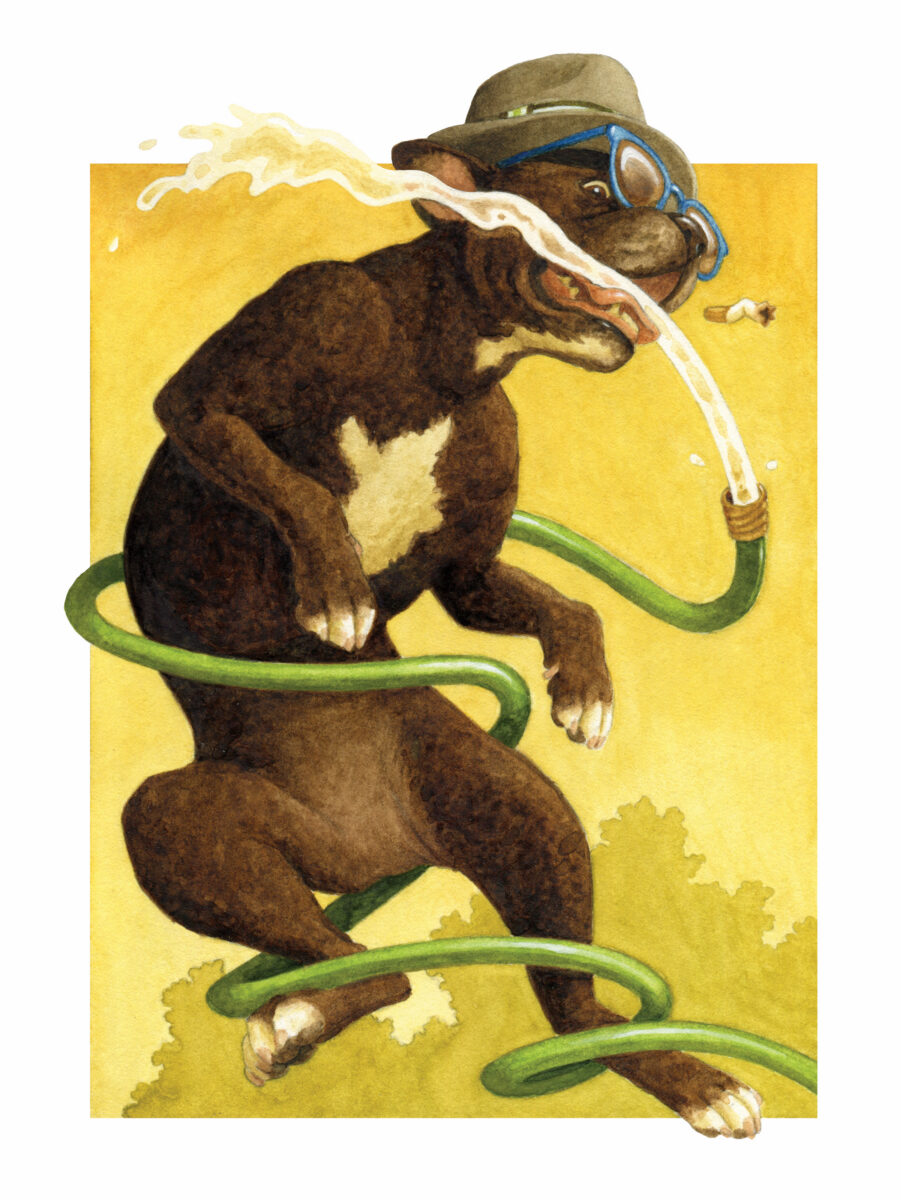
Somehow we expected she’d just keep going. For so long, she was energetic, obedient, tolerant. My son often dressed her in his clothes. Hats. Sunglasses. A pair of his underwear, fitted over her head. She chased, with great ferocity, the spray of water from our garden hose. In addition to broccoli florets we tossed her during dinner, she was also fond of cat turds and cigarette butts, which she gobbled up with gusto before we could stop her—something I reminded Elijah of every time he lay down on the floor and let Ruby stand above him, licking his face while he laughed.
Here’s what we usually don’t tell people when they ask about our family: All our other babies died. I don’t mean dog babies. I mean human ones. Five heartbeats. Four miscarriages. Elijah had been the first—and the last—to make it to full term.
At some point, my wife, Kelly, said to me, “Let’s get him a dog. Every boy needs a dog!” I disagreed, mainly on the grounds that I didn’t want to take care of one. So I put my foot down. I was not an “animal person.” Case closed.
Then one day my son appeared in my home office, clutching a single paper. It was late November. Did I mention he was six? And that he was all angelic baby fat and cowlicks? My wife stood behind him, trying not to smile as Elijah handed me the note. “Dear Santa,” it said. “I would like a puppy for Christmas.” The letter existed just this side of legible, like a prop from a movie, with crusty and backward crayon letters. I knew this, as soon as I read it: My son was getting a dog.
We picked up Ruby a few days after Christmas. She’d been the runt of the litter. Last one picked. Didn’t matter to Elijah, who sat in the back seat with the puppy in his lap. “Mommy?” he said. “I’m going to marry Ruby.”
It was, as they say, love at first sight.
I’ve lost my patience with people I love: my parents, my sister, my wife, my son. Same with Ruby. I got mad when she licked me. When she repeatedly smacked her lips. When she whined. When she looked at me, full of expectation. When she wouldn’t pee or poop—and when she did. When she got scared of stumps, shadows, trash in the road, and unexpectedly lunged from whatever she feared.
Despite his cherubic features, my son was no angel—at least not when he was awake. He had a sulky streak. He often got mad at his mother. At me. On rare occasions: his friends. But he never—not once—got mad at Ruby. Even when she was a pup, when she gnawed heads off his action figures and I held the victims to her face and said, “No, no!” very sternly, my son would intervene, hugging her around the neck and mashing his face into hers, whispering, “It’s okay, Ruby. It’s okay.”
One day, I came home and noticed Ruby’s food was untouched. She wasn’t on her bed. Or in any room upstairs. I finally found her downstairs in her crate. I said her name. She blinked. Didn’t move. Weird, I thought. She hates that crate. I called the vet, who said, “Bring her in.”
That night, we ate grilled chicken outside on our deck. It was warm and sunny. Winged insects pollinated yellow blooms. A second gin and tonic would normally have contributed to a magnanimous sensation. But not that day. We’d visited the crate at the vet where Ruby sat forlornly, a cone around her neck to prevent her from tugging the IV out of her paw. Now Elijah sat before his dinner, not eating. He said, “Life’s not fun without Ruby.” I tried to swallow the bite I’d just chewed. I thought, I should’ve said no to the dog years ago. But it was too late. We had agreed to love something that would break our hearts, trading guaranteed future grief for whatever joy a dog’s brief life could offer.
But Ruby did not die—not then. Like President John F. Kennedy, she was diagnosed with Addison’s disease. Her adrenal glands had not been producing adequate steroid hormones; she would need medication for the rest of her days. Ruby lived another eight years. Her nose got flaky and scaly, a side effect of the pills she gobbled up with peanut butter and a half slice of bread every morning. The disease decayed her teeth, too, and even though she had to have eleven removed, her breath stayed alarmingly bad. We moved to a new house and got a kitten—put it in a box and gave it to Elijah for Christmas—who quickly showed Ruby who was boss.
The year Ruby died, I made a photo book for Kelly’s birthday—my annual chronicle of family life. On the interior flap, I posted a picture of Ruby looking sullen in a brown cap with white trim. Beneath it, I transcribed an imagined message from beyond:
“deer peeples, i’s here in heaven. it pree cool… the cafeteria serves fresh broccoli and cigarette butts. and there are no stumps, shadows, vacuums, manholes, or surprises. I gets to lick other dogs’ faces and humans are made out of peanut butter and nobody ever makes me wear underwear on my head. also? my teefs grew back! so things is lookin up. only thing is, I don’t see any of y’all fools anywheres. don’t forget about me down there and remember to love and take care of each other like I cared for you. xo, the Ruber.”
I thought I was being clever, deploying dog grammar and imagining a heaven built for Ruby. But reading it now, I realize I was writing the truest thing I knew about love and memory and the stories we tell ourselves about where our beloveds go when they leave us.
“Ruby!” my wife and son still say when they happen upon her picture, whispering her name like a benediction. Because Ruby was a dog who sneezed when she got excited, who never met a manhole cover she didn’t try to avoid, who got rewarded with broccoli when we commanded her to speak and she did. A dog who put herself in her crate when she had accidents, because she was sorely ashamed. A dog who, in her youth, would rocket in wide circles around the neighborhood field the moment I unleashed her. Her running was always pure joy made visible, dog smile and everything, reminding all of us what it looked like to be completely, utterly, beautifully alive.