

Let’s say, for illustrative purposes, that you, like me, have been alive for a half century or so. You remember rotary phones and VCRs and wine coolers. What you might also remember is more birdsong. Since 1970, North America has lost nearly a third of the birds that serenaded your childhood—about three billion. These are not exotic birds from the margins but rather the ordinary birds of fields, forests, and backyard feeders: sparrows, warblers, blackbirds, and finches. If a walk through the woods strikes you as quieter than you recall from years past, there’s a reason: It is.

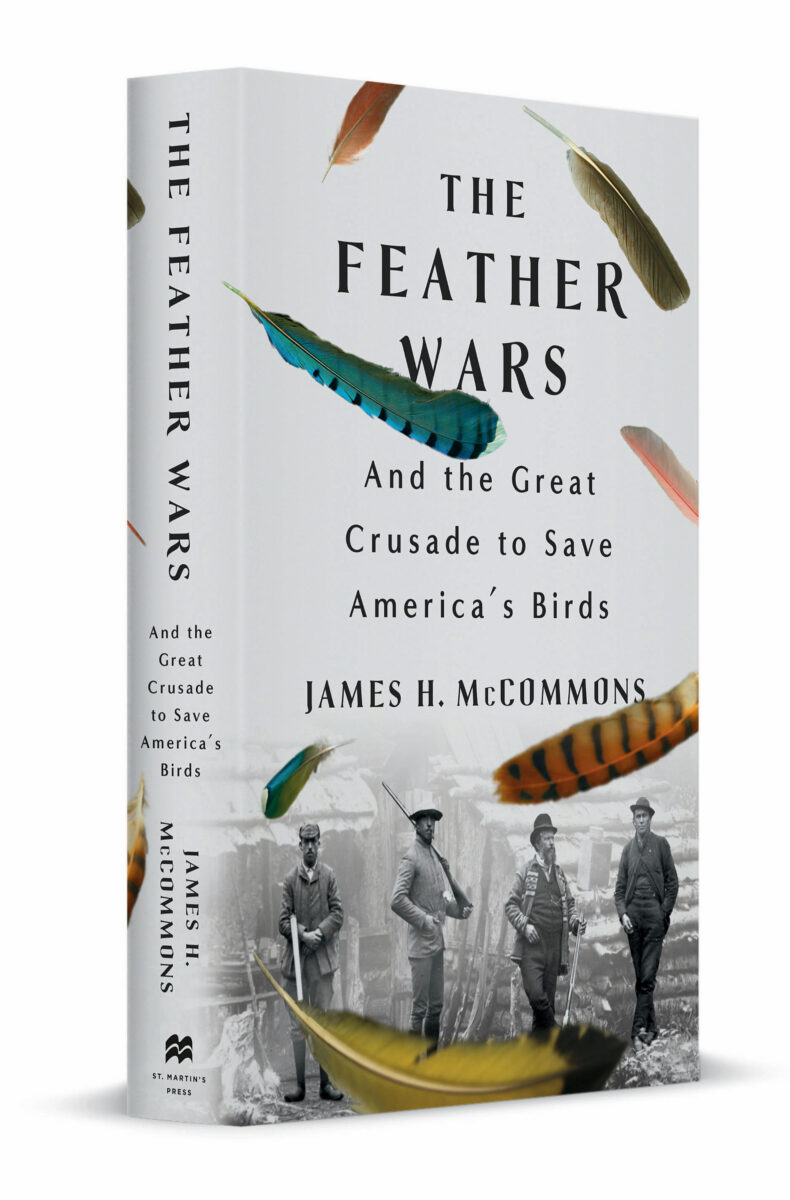
Yet we’ve been on an excruciatingly similar precipice before. How we stepped back from that brink is the subject of James H. McCommons’s The Feather Wars, a bracing history of the mass slaughter of birds in the late nineteenth and early twentieth century and the efforts of a ragtag coalition of crusaders—hook-and-bullet magazine editors, forward-thinking politicians, society belles, Pinkerton detectives, and a Louisiana hot sauce magnate, to name a few—to save America’s birds.
How mass was the slaughter? Market hunters used homemade cannons to blast flocks of sleeping ducks. “Southern farmers,” McCommons writes, “netted tens of millions of American robins to feed hogs.” So-called “eggers” raided seabird colonies for eggs to eat or sell. “On summer evenings,” McCommons continues, “boys and men took target practice on purple martins and nighthawks.” Florida excursion boats gave tourists shotguns to plug passing birds. Even naturalists and scientists shot birds in order to study them.
The feather trade only worsened things. Featheradorned hats for women came into style in the 1870s and grew ever more extravagant. Fashionable women went about with swan and raven and dove feathers atop their heads. At one point, McCommons writes, “women showed up at dinner parties wearing earrings of hummingbird heads, gowns edged with wings, and small, close-fitting hats—toques—consisting entirely of songbird feathers.” By 1900, an estimated five to eight million North American birds were being killed for feathers annually, a number that doesn’t account for the wounded, abandoned, and orphaned birds.
Cue the crusaders. McCommons’s cast of heroes is wide and variegated, a reminder that the motives for movements are often cobbled and sundry. The editors of the erstwhile magazine Forest and Stream wanted to preserve game birds for a new breed of ethical hunters. The Boston society matron Harriet Hemenway, who organized the first feather hat boycott, was repulsed by the carnage she read about. Others connected the demise of the buffalo and passenger pigeon with the gunfire they heard year-round. E. A. McIlhenny, who operated Tabasco on Louisiana’s Avery Island, was a colorful nest of contradictions: almost single-handedly saving the snowy egret from extinction, via the nascent science of breeding and propagation, and preserving vast swaths of wetlands for bird protection, yet marketing wild bird eggs for profit and trying to open a hunt club between two refuges. He shot scores of Louisiana black bears. He also kept one named Tubby as a pet.
If the crusaders weren’t always a cohesive band, they shared a cohesive mission: to stanch the wanton killing of America’s birds, to put constraints on a Gilded Age culture that believed it had none. They lobbied Congress and state legislatures. They wrote books, pamphlets, articles, laws. Others, as McCommons recounts, took direct action in the field, with some murdered for it. But ultimately they prevailed, mostly by quashing, finally, the “false belief,” in McCommons’s words, “that nature could be exploited without consequence.”
Today’s threats are different—pollution, habitat loss, glassy architecture, and outdoor cat predation included—but the crisis looks the same. What’s missing, as of now, is the crusade. In 1913, Connecticut Senator George McLean gave an emotional speech on the Senate floor, decrying the avian death toll. “I want the birds saved before we as a great people learn by experience,” he said, “that the birds are more vital to our comfort and happiness than we are to theirs.” More than a century later, we could stand to hear that refrain once more, before silence finishes what fashion and gunfire began.
More New Books: Feasts for Foodies
Delicious new culinary reads

A helpful timeline in Southern Roots: Recipes and Stories from Mama Dip’s Daughter (Countryman) by Anita “Spring” Council connects the family dots behind Chapel Hill, North Carolina’s beloved Mama Dip’s restaurant before digging into recipes like the stewed corn that made Vogue’s André Leon Talley ask for extra helpings. Down South + East: A Chinese American Cookbook (Abrams) honors the Atlanta chef Ron Hsu’s Asian roots and Southern upbringing with goodies like pad thai with roasted Georgia peanuts. And the Raleigh writer Brigid Washington’s poignant memoir, Salt, Sweat & Steam: The Fiery Education of an Accidental Chef (St. Martin’s Press), simmers with culinary school drama. The love story at its heart tempts you to peek ahead to see if she forgives a college sweetheart who had the habit of asking her on dates and then inviting friends along, too. —CJ Lotz Diego
Jonathan Miles, a Garden & Gun contributing editor, has been the magazine’s books columnist since 2012. He is the author of three novels, including Anatomy of a Miracle, which was a finalist for the Mississippi Institute of Arts and Letters Award in Fiction. A former resident of Oxford, Mississippi, he is currently Writer-in-Residence at the Solebury School in New Hope, Pennsylvania.
Garden & Gun has an affiliate partnership with Bookshop.org and may receive a portion of sales when a reader clicks to buy a book. All books are independently selected by the G&G editorial team.