

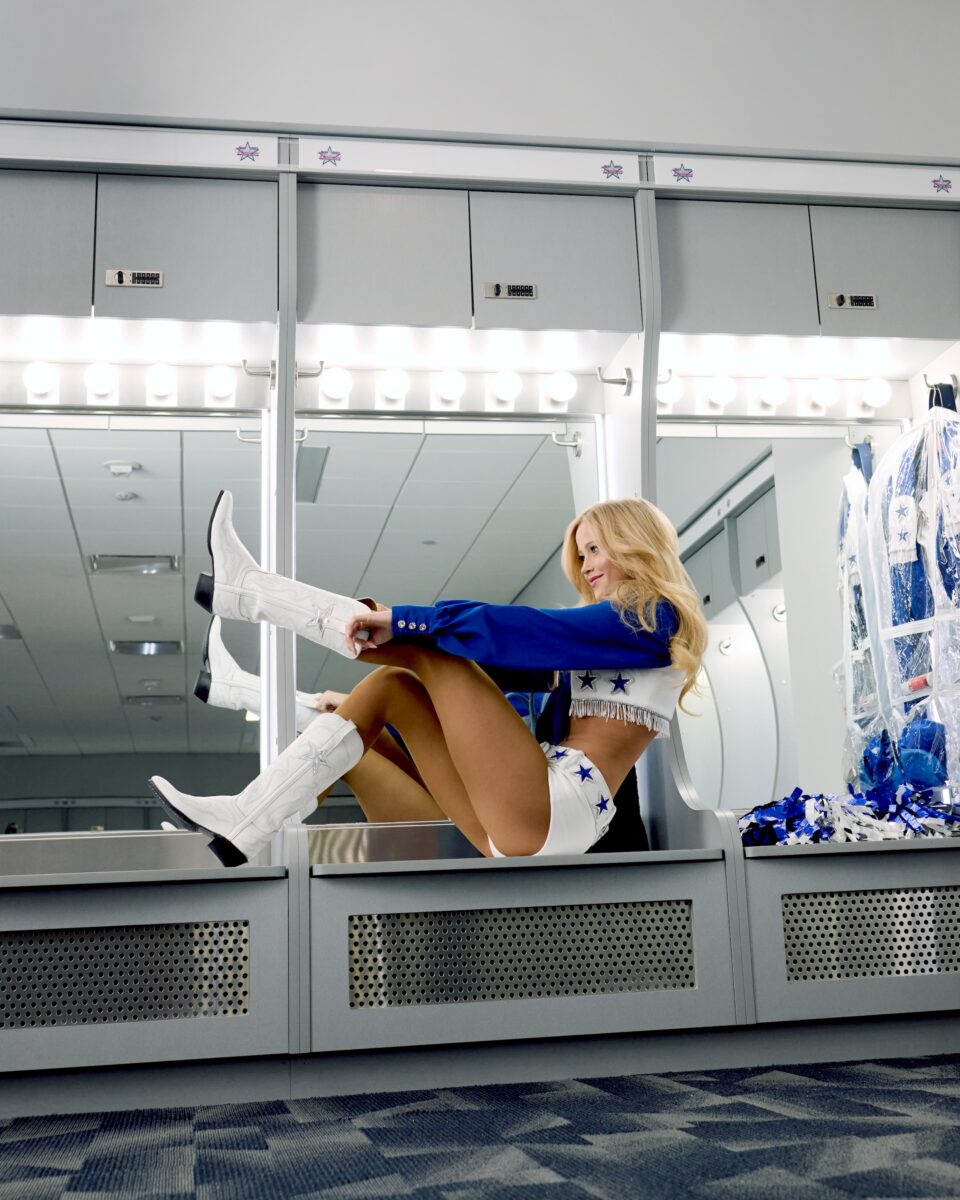
For a Dallas Cowboys Cheerleader, nothing less than a forehead-high kick makes the team. As America’s Sweethearts, the Netflix reality show that follows the National Football League’s most famous cheer squad, has revealed in its three seasons, the job also requires pirouetting, snapping into razor-sharp formations, and launching into the iconic jump split—all while smiling like your dreams depend on it. As if that weren’t enough, each of these gravity-defying moves has to be pulled off in gleaming white cowboy boots.

Perhaps no piece of the Dallas Cowboys Cheerleaders’ (DCC) uniform is more iconic than those fourteen-inch-tall stunners. They’re so recognizable that in 2018 the Smithsonian Museum added them to their American history collection. Introduced in 1972 to complete the now-legendary ensemble of blue-and-white crop tops and tiny white hot pants, they’re as synonymous with the DCC as the jump split itself. But the original version was essentially a glorified go-go boot. It wasn’t until 1989 that the organization made the full Western shift—and it will surprise no one who has spent any time in a saddle that the traditional cowboy boot does not an ideal dance shoe make.

“I actually performed in cowboy boots throughout college,” says entering third-year Dallas Cowboys Cheerleader Trinity Miles. “Real, hard-soled boots with a metal shank and no design adjustments for flexibility.” Let’s just say, it was tricky.
So the DCC turned to Lucchese in 2011. The El Paso–based bootmaker had spent more than a century perfecting traditional cowboy boots; surely they could create one capable of surviving up to ten hours of precision choreography. First, however, they’d need to reengineer the Western aesthetic into a high-performance athletic design.
“The cowboy boot and the dance shoe are at opposite ends of the spectrum when it comes to mobility and function,” says Trey Gilmore, Lucchese’s senior director of product and development for footwear. He decided to deconstruct the star-spangled shoe and rebuild from the bottom up.
“We started with the outsole,” Gilmore says. “A classic cowboy boot is built with a thick leather sole that’s stiff right out of the box. When people say they’re ‘breaking in’ a pair of boots, they’re really breaking in that heavy leather.” Gilmore exchanged the heavy outsole for a supple, soft calfskin leather. Then a special proprietary sole is used to provide flexibility without sacrificing the traditional look.
The shank had to go too. “We replaced that with a unique leather supportive system,” Gilmore says. When all was said and done, the new shoe was half the weight of a traditional cowboy boot.
For the thirty-six women on the team, those tweaks make all the difference.
“The way the boots are designed allows us to point our toes so much more naturally, which is vital for high kicks,” Miles says. “I also notice it throughout our iconic ‘Thunderstruck’ entrance, where we bolt across the field right at the beginning of the dance. The boots move with us but are still structural, which helps us to be powerful and grounded while we dance.”
But even once the boot is finally broken in, a process that can take up to two weeks, the real test begins. Thanks to the fitness tracker she wears during games, Miles knows she typically logs between 20,000 and 25,000 steps on game day alone—roughly eight to twelve miles. Multiply that by ten home games, then add Christmas performances, community appearances, and nightly rehearsals, and a single pair of boots would easily rack up about five hundred miles in one season.
“We actually cycle through seven or eight different pairs of boots each season,” Miles says. Every cheerleader has a practice pair that can withstand scuffs and countless rehearsals, two pristine game-day pairs reserved for performances, and another pair dedicated to media appearances.
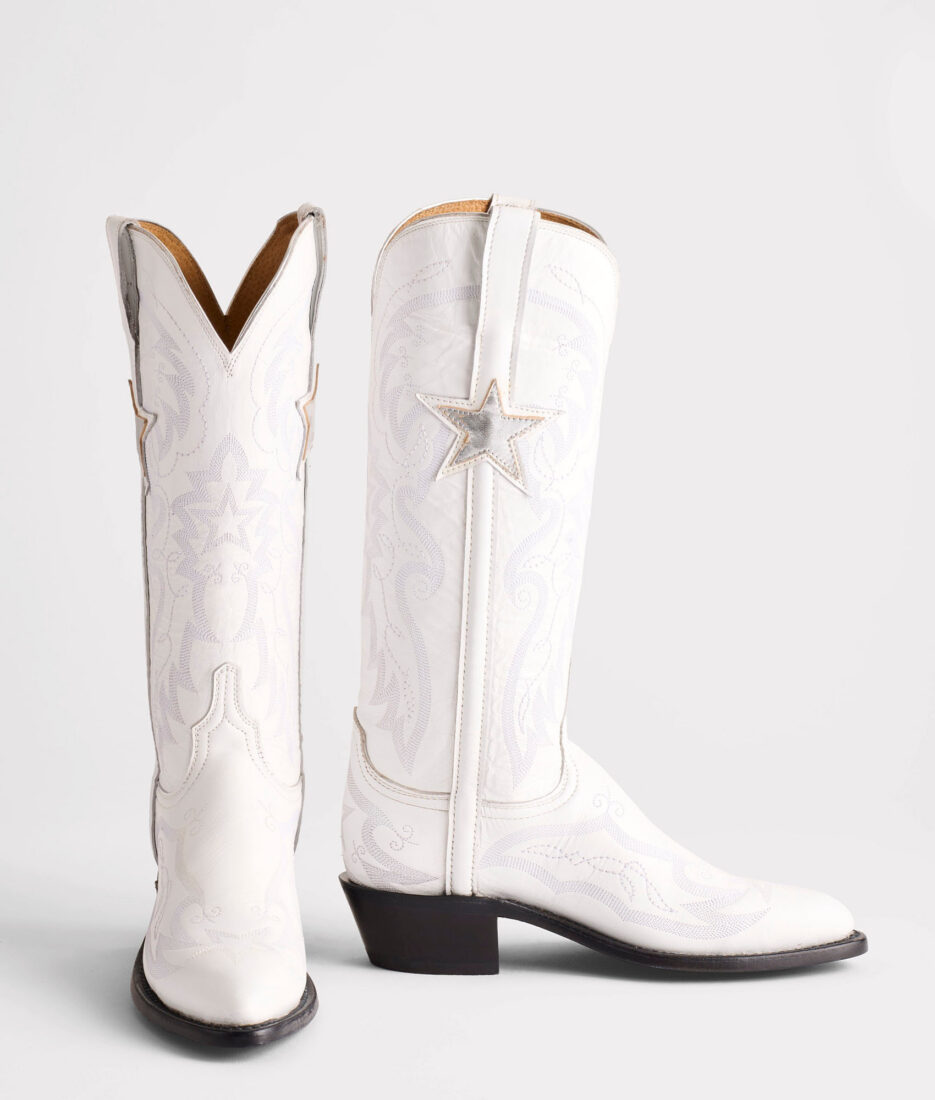
Each year, Lucchese also creates two especially meaningful custom designs. For the Salute to Service game, the cheerleaders wear boots accented with a red, white, and blue leather stripe honoring U.S. service members and veterans. Then comes My Cause, My Boots, when Lucchese hand-dyes the signature star on each pair to represent a cause that’s deeply personal to the individual cheerleader.
Perhaps second only to the thrill of slipping on her first pair of Luccheses during the rookie cameo photoshoot, Miles says the annual My Cause, My Boots game carries the greatest emotional weight.
“I chose to bring awareness to breast cancer in honor of my cousin, who is a breast cancer survivor,” Miles says. “Having the opportunity to wear boots that represented her journey made that game incredibly meaningful for me.”
Given the near-mythic status of the DCC’s signature boots, it’s no surprise some fans want a pair of their own. Lucchese sells the Gina in its traditional cowboy format, giving DCC devotees the chance to step into the same iconic silhouette worn on the sidelines. And for the future cheerleaders practicing kick lines in the living room? There’s the Mini Gina: pint-size white boots perfect for impromptu halftime shows. Anyone can order a pair. But fair warning: The forehead-high kicks don’t ship in the box.
Kinsey Gidick is a freelance writer based in Central Virginia. She previously served as editor in chief of Charleston City Paper in Charleston, South Carolina, and has been published in the New York Times, the Washington Post, Travel + Leisure, BBC, Atlas Obscura, and Anthony Bourdain’s Explore Parts Unknown, among others. When not writing, she spends her time traveling with her son and husband. Read her work at kinseygidick.com.