
Music
The Inside Story of the Athens Music Scene
For the past half century, bands and musicians from Athens, Georgia, have shaped what the world hears. The B-52s and R.E.M. have sold millions of records and landed top-ten pop hits. Widespread Panic and Drive-By Truckers have toured relentlessly. The Elephant 6 collective has created some of the most acclaimed indie rock of all time. Hundreds of other Athens artists fill the spaces in between—some lost and beloved, some tragically cut short, others making fresh music today.
The musician Brian Eno coined the term scenius—the collective genius that comes from a group of creative people contributing ideas and supporting one another. And there’s no better example of scenius in action than Athens.
What follows is an oral history of the music scene there, told by people who have lived it. Even they’re not sure how a midsize Georgia city known for football and frat parties became one of the most important music towns on the planet.
But they have some theories. And they definitely have some stories.
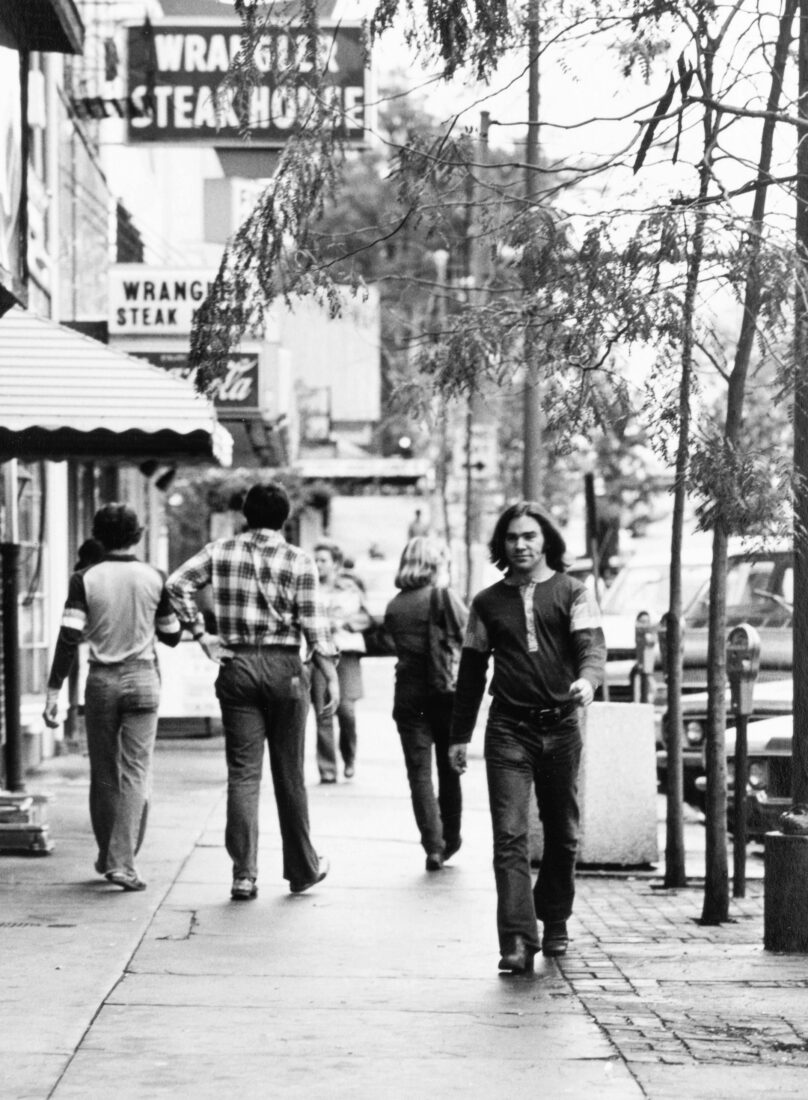
Photo: TERRY ALLEN
College Avenue in downtown Athens in 1977.
The big bang of Athens music happened on Valentine’s Day 1977, when five friends—Fred Schneider, Kate Pierson, Keith Strickland, and siblings Ricky and Cindy Wilson—played a house party, their first show as the B-52s.
Dana Downs (bassist for the Tone Tones1 and more): The show was insane. The girls had on white wigs. The floor was shaking. Everybody was dancing. And we were so excited, because we did love Patti Smith, Talking Heads, people like that. But we were like, We have our own band. We have our own band.
Arthur Johnson (Bar-B-Q Killers2 drummer): The B-52s, their origin story’s amazing—they were at a Chinese restaurant and decided they were gonna be a band. I don’t know that they had a lot of experience, but they got good really fast, and wrote incredible songs really fast.
Jim Tremayne (entertainment editor of The Red & Black3): They weren’t necessarily doing it to become big stars. I mean, who in the world would ever think a band like the B-52s would become as big as they did? I go back and listen to the B-52s, and they sound miraculous to this day to me.
Dave Schools (Widespread Panic bassist): I heard about the B-52s in middle school, because I listened to this radio station in Richmond. They’re playing an interview with Debbie Harry [of Blondie], and she proselytized about the B-52s. Then I saw them on Saturday Night Live. I took my allowance money, and I went and bought that record immediately.
Velena Vego (booker for the 40 Watt Club4): When I moved here [in 1983], I went to house parties, and there’s Cindy Wilson and Fred Schneider. You just can’t even believe that your idols are there. They’re just people, right? And as sweet as they can be, you know?
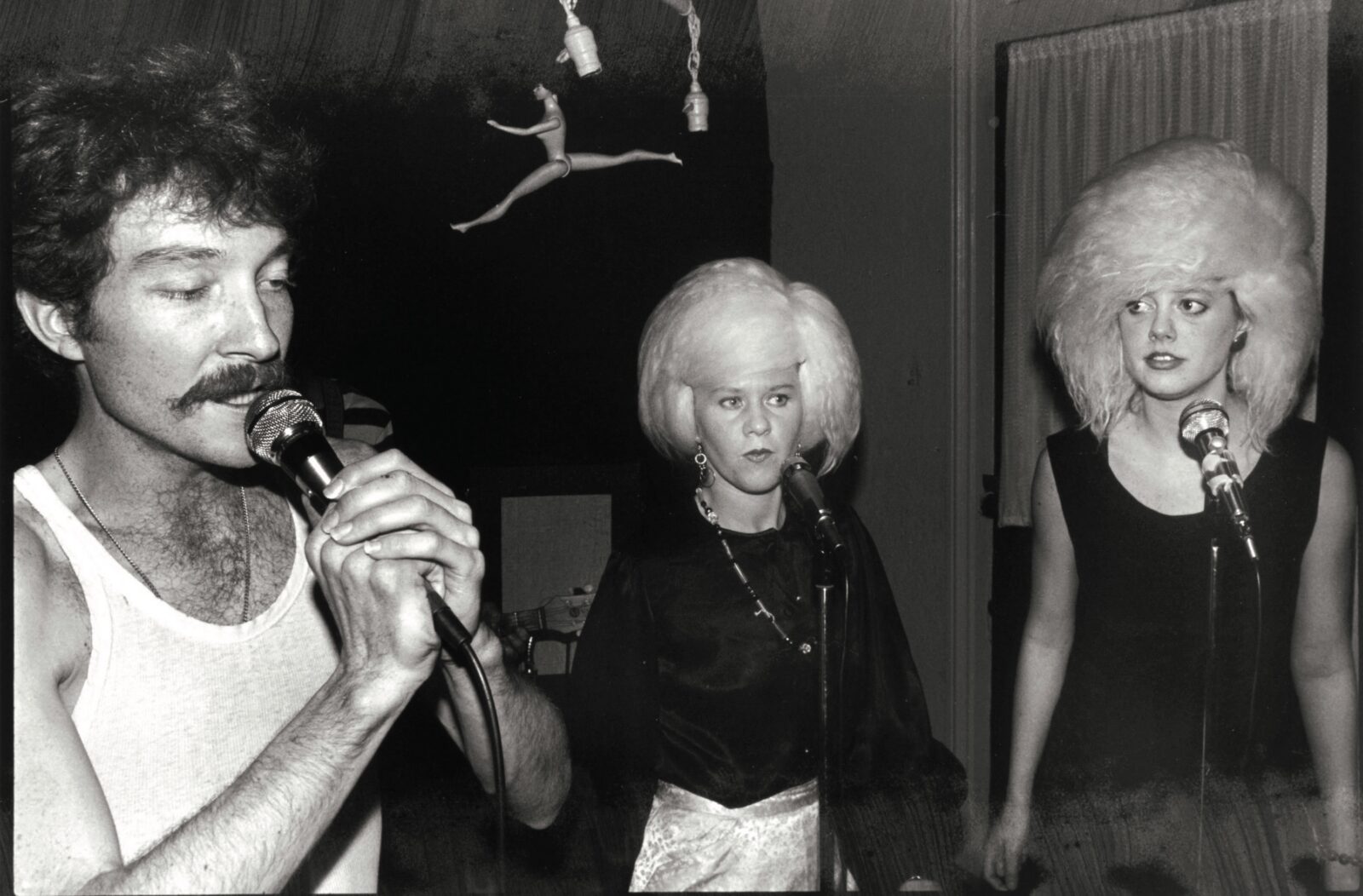
Photo: Kelly Bugden
Fred Schneider, Kate Pierson, and Cindy Wilson of the B-52s at the band’s first performance, at a 1977 house party.
The B-52s moved away in the late seventies but returned often to play shows or visit friends. Those who saw them perform at the beginning began to form new bands with new sounds, such as the lean art-rock of Pylon5
and the textured instrumentals of Love Tractor.6 Athens had the right recipe for young musicians: a thriving University of Georgia art school, a hollowed-out downtown, lots of part-time jobs, and cheap rent.
Vanessa Briscoe Hay7 (Pylon lead singer): The whole idea when I came to UGA in 1973 was to study art education. But once I was here, I realized the people I had the most in common with in the art department were over in drawing and painting, and so I switched majors, but there’s not really a whole lot of careers you can do [with those].…Then I found a weekend job at DuPont [Textiles], where a lot of other musicians worked, including some of the future members of Pylon and Method Actors.8 [Athens] was so cheap at the time that I could support myself.
Mark Cline (Love Tractor guitarist): I got to Athens for school in the fall of ’77, and I was in the art school, where I met Vanessa. I met all the guys from Pylon. The music scene originated at the art school, really as an art project for everybody. We were all bored shitless because there was nothing to do. So we would make our own fun.
Mike Mills (R.E.M. bassist): There was a relatively small group of people in Athens in the late seventies, early eighties that were into the same sort of music. So naturally you all drew together. The other thing was that when they built the mall in Athens, all the big stores left downtown, so downtown was open and available for people to do whatever they wanted.
Patterson Hood (Drive-By Truckers singer/guitarist): That’s not to say there weren’t other cool towns and cool shit happening. But Athens was unique. Chapel Hill is Southern, but Athens is more Southern; it’s so steeped in kudzu and just weirdo shit.
Cline: I would finish my studio class in the art school, and then I’d wait for Michael [Stipe] to finish his studio class. Then we would go to his house and listen to records, the latest singles that had come over from London.
I can’t stress how much gay culture influenced what happened, and also feminist culture, because the women were tough and killer; they were awesome. So it was like this family of people, very accepting. We didn’t really participate in the rest of campus whatsoever. We weren’t welcome.
Hay: The first couple of times we played, people just stood there and stared at us, and I was kind of nervous. I was like, we must be really horrible. But it turned out they just didn’t know what to make of us.…The third or fourth time we played, at a place called the Brick House—which was out in Oglethorpe County, in the middle of a field—the B-52s came; they just immediately started dancing like crazy. It was like a switch got flipped. People went, Oh hell yeah, you can dance to this. And it just got crazy in there. It was like the air was moving in and out, like a speaker box.
Vego: My band was Pylon. I love Vanessa Hay. I loved the band’s music.
Bill Berry (R.E.M. drummer): They’re the best live band I’ve ever seen. They were playing really minimalistic stuff, but if you didn’t tap your foot, you should’ve called your doctor.
Hay: Our whole goal in the beginning was just to go to New York, get written up in New York Rocker, and then disband. It’s like an art project. You go out and put up your show, the show goes on, and then it’s over.
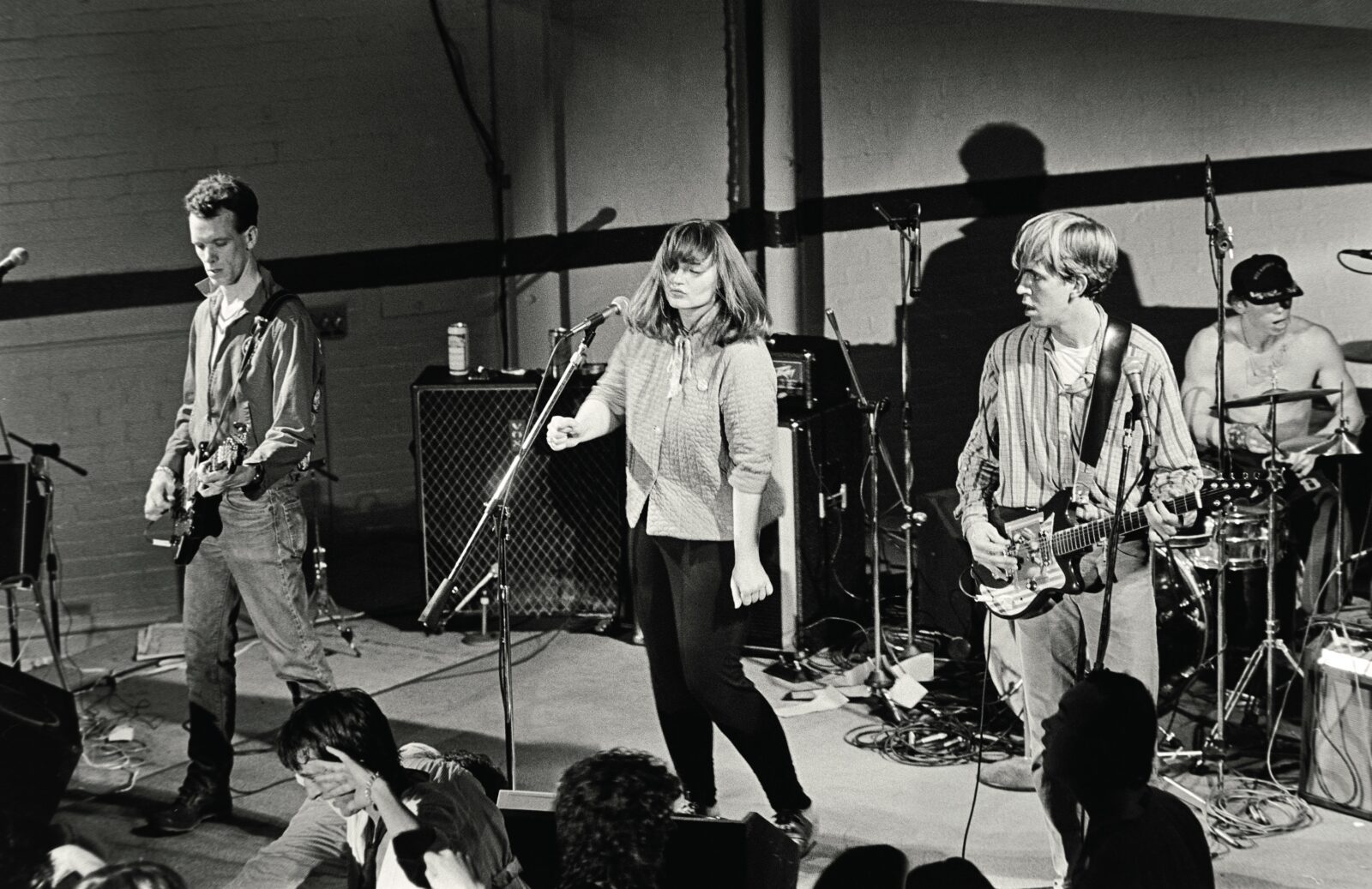
Photo: TERRY ALLEN
Pylon plays the University of Georgia’s Memorial Hall in 1980.
In 1980, Bill Berry, Peter Buck, Mike Mills, and Michael Stipe lived at various times in an apartment built inside the old St. Mary’s Episcopal Church on Oconee Street. One closet had a hole in the wall that opened into the sanctuary. The four played their first show there that April. Later that month they picked a name, which Stipe had come across in a dictionary: R.E.M.
Bertis Downs (R.E.M. adviser and attorney): I knew Bill because he and I both were on the concert committee at UGA. We booked Pablo Cruise and the Village People. And he wasn’t at a meeting, and somebody said, Bill Berry has resigned from the concert committee because he started a band.
Berry: Oh, man, the church, the famous church that was a box built inside of a church, inside of a nave of the church, but it took up almost all the church. You could go to the hole in the wall and go back to where the altar was. That box contained one big room, which was a living room and kitchen, and three really small bedrooms, and rent was $125 for three people. What is that—$42 apiece?
Tremayne: The first time I saw R.E.M. was in ’81 or ’82, at the Mad Hatter.9 It’s hard to explain when you see something new and great and you’re trying to get your head around all of it. It was incredibly exciting. You knew they had something. It was not like anything else. You could dance to them. They could rock out. They were very kinetic onstage. They were just kind of stunning.
Bertis Downs: Three words: really good songs. They wrote really good songs.
David Barbe (member of Mercyland10 and Sugar11): I was in J-school and was going to be a sports journalist. But then I got [R.E.M.’s debut EP] Chronic Town and saw them play in a club, and it’s like, f **k writing for the newspaper, man, my destiny is rock and roll. And you know what? In spite of how worried my mom was, I was totally right.
Craig Williams (program director of UGA student radio station WUOG in the early eighties): We were thrilled when R.E.M. showed up on [Late Night with] David Letterman [in October 1983]. We had a little watch party at Reed Hall. And we just were tickled by Michael hiding behind Peter Buck,12 or whatever it was he did.
Barbe: There’s that kind of famous thing where Bill Berry was trying to decide whether to stay with R.E.M. or Love Tractor as the drummer.
Berry: I was in both bands for about three months. In fact, I twice played with both bands. R.E.M. would play and Love Tractor would open. I’d wear a cowboy hat with the Love Tractor set and keep my head down. And then it would be off, and I’d change clothes and play the R.E.M. set. I loved Love Tractor. I still do. You know what made me decide? R.E.M. had a singer. I figured we had a better chance with a singer.
Bertis Downs: He decided to go with the band that had Michael Stipe in it, which was probably a really good idea.
Cline: All the bands, we ended up living on Barber Street in these old Victorians. Mike Mills and Bill Berry lived next door to me. I lived with Michael [Lachowski] and Curtis [Crowe] from Pylon and Kit [Swartz] from the Side Effects,13 who also was in Love Tractor. It was at the house they called Pylon Park. Peter [Buck] lived four houses down. Michael Stipe lived next door to that house. On the eastern side of Barber Street, when they repaved the sidewalks, Linda Hopper, Maureen McLaughlin, and Leslie Michel—these women helped support the scene—went out and wrote all the bands’ names in the [cement], and they’re still there. I’ve told the city they need to lift that up and preserve it.
Mills: The greatest thing was Michael of Pylon had a phone number, and it was called the Party Line. And you would call Lachowski and tell him where the party was that night. And he would put it on the Party Line. He’d say, You have reached the Party Line; tonight’s party is at so-and-so’s house and such and such an address, and that’s how everybody knew.
Berry: There was a Wendy’s14 within walking distance that had within walking distance that had a salad bar. It was only like $1.29 for all you could eat. We got small, small portions so we could make many visits. And every time we would pass the very end of the buffet line, there was that big bowl of Captain’s Wafers crackers. Every time we went through, we grabbed about four or five of those and slipped them into our little loose-fitting jackets with a deep pocket. So we’d leave, and we’d walk home with our dinner.
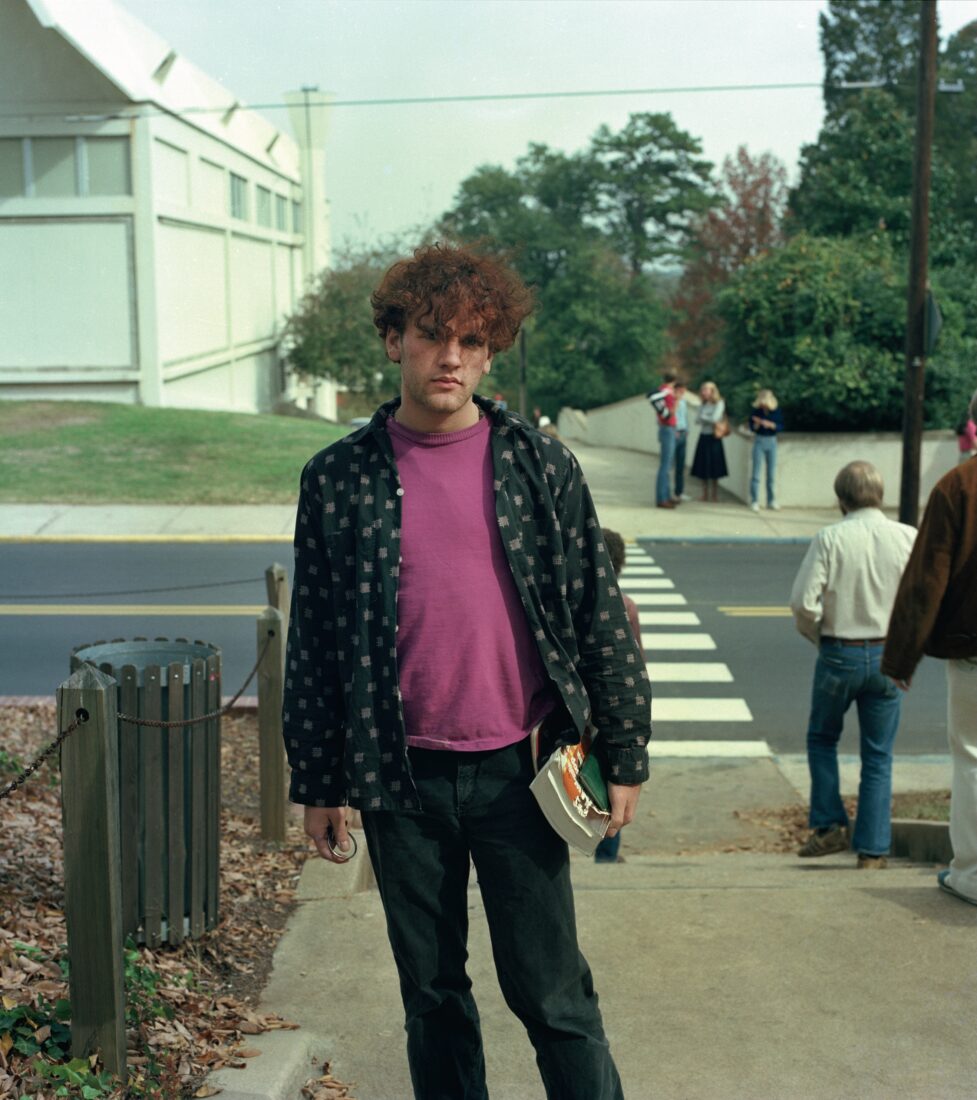
Photo: TERRY ALLEN
Michael Stipe in front of UGA’s art building in 1980.
R.E.M.’s success on the road led other Athens bands to follow.
Cline: In the very early days, on a Friday, maybe, we would finish or skip class, pack up our cars with our instruments, and drive to New York and play a show, because there was, at that time, nothing in between, right? You couldn’t play Richmond or something. We were this instrumental dance band, and only in New York would people get it. R.E.M. had a much more rock-and-roll stance. They could go play Chapel Hill, they could go play Nashville. They would come back to say, Listen, we just played such and such place. You guys need to call them. Which we would do. And all of a sudden, R.E.M. broke open all these clubs for everybody.
Barbe: They really were accomplishing the thing of becoming popular and being a critically acclaimed, high-quality band, right? That made it seem real.
Back in Athens, bands were getting louder and faster.
Manfred Jones (the Woggles15 lead singer): There were bands like Dreams So Real,16 which still mirrored this jangly sort of sound. But there was also a much harder sort of thing as exemplified by Bar-B-Q Killers and Mercyland.
Johnson: We were friends with bands, and so it didn’t seem that hard or challenging to try to write some songs or put a show together, and then get up and play music, because the Uptown Lounge17 was very informal at that point. We had a lack of embarrassment about getting up and being terrible, which we were for a while.
Barbe: Bar-B-Q Killers is kind of the beginning of the punk rock side of things. Out of that come Mercyland, and Porn Orchard, and Eat America, and the Jackonuts,18 and all these heavier-edged bands are coming up in that.
Johnson: When we moved to Boston, we remember being shocked that one of the first times we were at a club, a woman who ran the club said, “Okay, if anybody takes their clothes off, you’re out. You’re banned from the club.” People would get naked in Athens onstage all the time. I mean, I played naked once.
Around the same time in the early eighties, David Barbe met a couple of students who would eventually take Athens music in a different direction with their band Widespread Panic.
Schools: Literally minutes after, like, shooing my mom away and back to Richmond, I walked out into the Reed Quad. This shirtless guy, a rail of a short, little guy, with kind of spherical uncut hair and a plastic Chiclets necklace, comes walking up, and he goes, “You’re new here, aren’t you?” It turned out to be David Barbe. Instantly we were talking about being bass players.
Barbe: The other side of the tree, starting school at the same time, being in the first-ever music business class taught at the University of Georgia along with me, is John Bell.
John Bell (Widespread Panic singer/guitarist): Everywhere I went, like, for the first week, there’s that guy.
Schools: I went to see [Bell] at a club, and he was upstairs sitting on a barstool, playing his acoustic guitar. It was like one long stream of consciousness song, cover songs, made-up stuff. I was like, What a voice and what balls. I turned to my friend and said, “Boy, this guy’s cool. He sure could use a band.”
Bell: I shared a house on Boulevard with a number of other guys that came in and out. It was fifty-five bucks a month.
Schools: I just wanted to play music with cool people, and I had a particularly private-school academic way of doing that, which is proper performance. And these guys, it was about the hang, and about fun, and about trying to do something different. And I didn’t know that’s what I should have been looking for, but it found me and accepted me.
Bell: I remember a little backlash saying, We thought we were going to hear some new music, and you guys are just old rock-and-roll hippies. Sorry. We never presented ourselves as anything different. We just happen to be from Athens.
Schools: There was almost a concerted effort at that time, with all the like weirdo thrift-store punk-rock kind of bands, art-school bands, and don’t-give-a-f **k kind of bands, that if we compartmentalized ourselves publicly and dissed each other, it would benefit all of us. But in reality, we’re all at the same party, drinking out of the same keg.
Barbe: You can work over here, you can use all my awesome gear, you can ask me any question, I’ll tell you everything I know, and you can steal all my ideas and tell the world you invented it. I don’t care, and you’re not gonna hurt me. Just do cool stuff, and you know, buy me a beer every now and again. That’s just kind of the Athens thing.
Patterson Hood tried to build a similar scene in his hometown of Muscle Shoals, Alabama. After falling short, and falling out with his musical partner Mike Cooley, Hood came to Athens a week after his thirtieth birthday, in 1994, to start over.
Hood: I had a friend in Atlanta. We were going to get a place together, and he was helping me scope out a job there. And right at that time, he got offered a job in Athens, and they needed two people. I had been to Athens one time with that friend and my then-girlfriend, and we saw the Cracker/Counting Crows show at the 40 Watt, and spent the day walking around, going to different bars and drinking beer and eating burritos. And I thought it was the coolest town I’d ever seen. So I was like, yeah, that’s close to Atlanta. I can always move. Once I got to Athens, it was love at first sight. That was how I formed Drive-By Truckers: I combined Cooley with people I met in Athens. And hell, we turn thirty in June. The band’s about to be the same age that I was.
Carter King (Futurebirds19 singer/guitarist): My older siblings were big Spreadheads [Widespread Panic fans], so I got into that, then Drive-By Truckers—the last few years of high school, my older brother came back from school and was like, you gotta listen to this band, and I became obsessed.
Barbe: Bands like Panic and Drive-By Truckers built their business model on R.E.M.
Hood: I went and saw Sugar at the 40 Watt, with David Barbe playing bass. And I couldn’t quit watching him. He was magnetic onstage, and he looked like the meanest motherf**ker alive. Then we became friends with him and his partner when he built the studio Chase Park, in ’97. I worked construction, helping build the studio, in exchange for enough studio time to make Gangstabilly, the first Drive-By Truckers record. A lot of jobs I wasn’t particularly competent at, but, you know, I can hammer a nail and I can turn a screwdriver. But my specialty was, I’m a big guy. I could hold up the sheet of Sheetrock while they nailed it in place.
Later, around 2007, Futurebirds would take a similar path.
King: I was in the music business program. David Barbe wasn’t the director yet. But you get an internship as part of that program, and so I was like, I wanna work at the studio where Drive-By Truckers record, and that’s how I ended up at Chase Park, under David Barbe’s leadership. A couple of my bandmates, Thomas Johnson and Brannen Miles, were also interns at Chase Park, so that’s how we met.
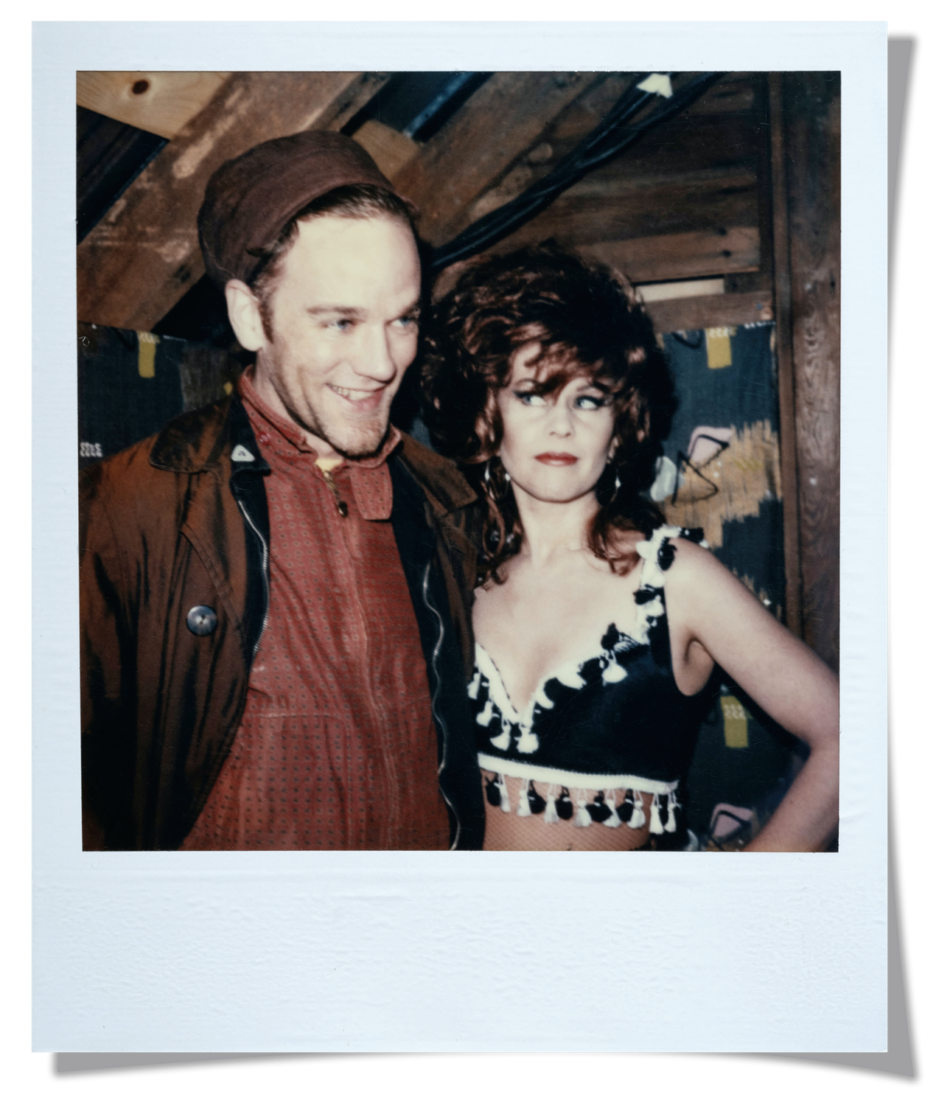
Photo: TERRY ALLEN
Stipe hangs out with Pierson in 1989 on the set of the B-52s’ “Deadbeat Club” video.
As those other bands emerged, R.E.M. became international stars. Their 1991 album Out of Time sold more than eighteen million copies, and the single “Losing My Religion” reached the top ten. These were no longer the Wendy’s salad bar days.
Berry: Our royalty statements and checks would go directly to our homes. So, it was about three or four months after Out of Time was released. Our attorney’s wife, Katherine Downs, was walking her dog. Just happened to be walking by the same time I was going out to check the mail. She came up my steps and said hey. I had mail, and saw it was a royalty statement. It was more than ten times the last one. She said, “Bill, are you okay?” She thought something was wrong, because I was just like, What? I mean, I could have bought several homes. I didn’t say a word. I just looked at her, eyes wide, and turned the check around and showed it to her. I will never forget that.
R.E.M. paid it forward, giving gear and support to many of Athens’s newer bands.
King: The gear manager for R.E.M. would hire us to go load trucks for them when they were going to make records, and come reorganize their warehouses with all their gear.
Andrew Rieger (Elf Power20 singer/guitarist): The R.E.M. guys were always very supportive of us; they came out to our shows early on, and they let us open for them. Around Christmastime, they had their fan club mailing, and a bunch of the Elephant 6 people would put those packages together.
Elephant 6 was a collective of bands that included Elf Power, Of Montreal, Olivia Tremor Control, the Apples in Stereo, and Neutral Milk Hotel.21 Jeff Mangum’s band, Neutral Milk Hotel, came to be considered one of the essential bands of the nineties—especially after the release of their 1998 album, In the Aeroplane over the Sea. The collective’s sound, lo-fi rock with a tinge of psychedelia, reshaped the Athens sound once again.
Rieger: At first, I felt like what we were doing wasn’t aligning with some of those heavier bands. I met the guys from Olivia Tremor Control at a party, and thought they were an amazing band. We realized we were kindred spirits, that we were both into four-tracking and home recording, so that was when we realized there were other people in town who had a similar aesthetic to what we were doing.
King: Of Montreal put on some awesome shows. Big, elaborate, theatrical performances with all their friends onstage doing choreographed dances, and, you know, a casket full of whipped cream, and just all kinds of eccentric stuff that, as a young kid, you’re like, You can do that?
Vego: That was a great wave. There were people that were like, Jeff Mangum lives in Athens, Georgia! Kind of like the mystique of Michael Stipe.
Hood: Elephant 6 began right about the time I moved there. And there was all this cool shit happening in all these different directions. I was obsessed with it. At one point, there were like 350 local bands in a city with barely 100,000 people.
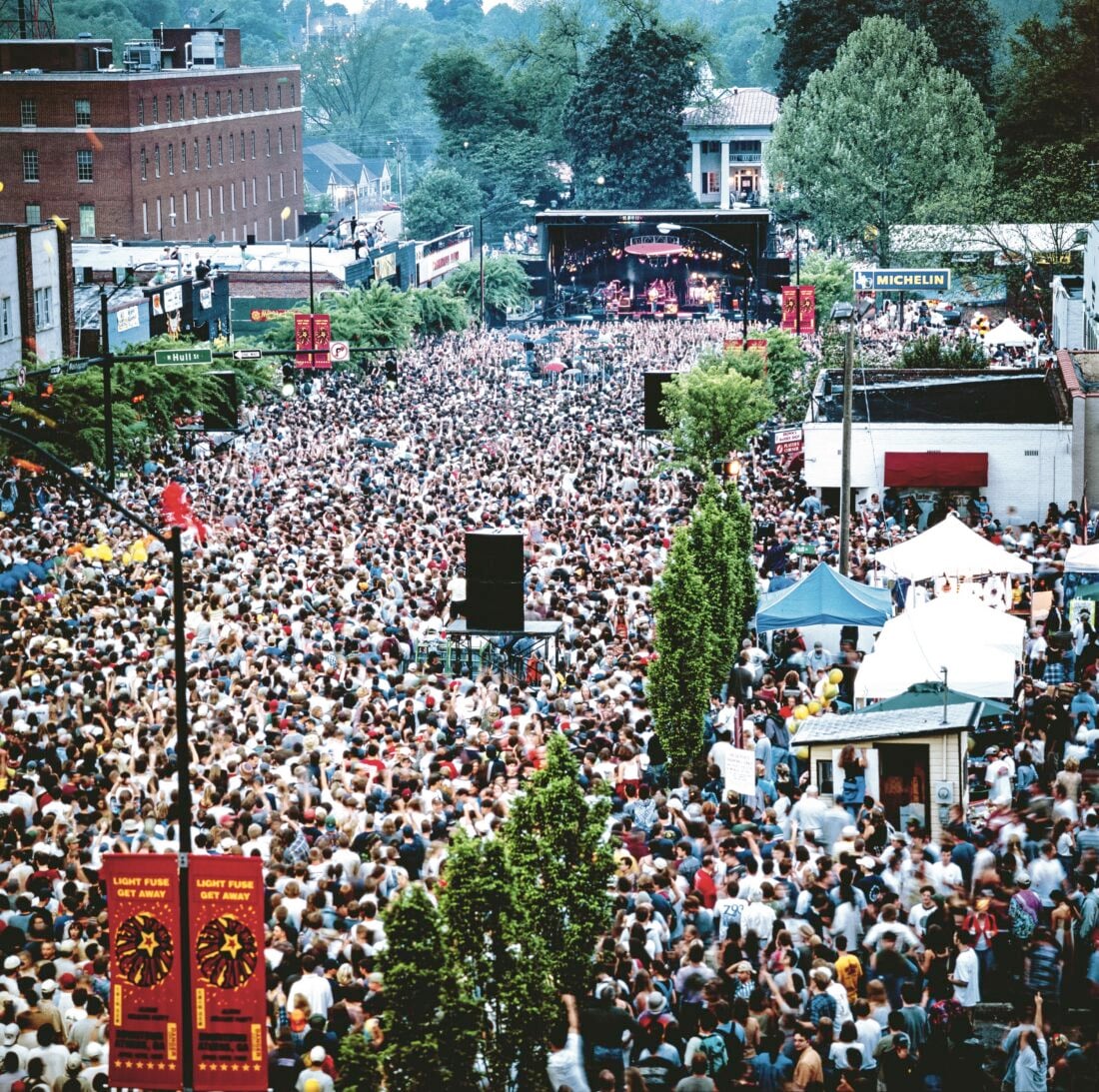
Photo: TERRY ALLEN
Widespread Panic at the free 1998 Panic in the Streets concert in downtown Athens.
Many of those bands—all the way back to the beginning—played on one another’s records and at one another’s shows. Kate Pierson of the B-52s sang backup on R.E.M.’s hit “Shiny Happy People.” Widespread Panic wrote a song called “Love Tractor,” and Love Tractor wrote a song called “Antarctica (Widespread Panic).” And Elf Power released an album with singer-songwriter Vic Chesnutt called Dark Developments.
Chesnutt had been partially paralyzed in a drinking-and-driving accident when he was eighteen. He struggled with alcohol and drugs before he died of an overdose at age forty-five. The Athens music scene has endured long enough that many members have passed on—Ricky Wilson of the B-52s, Laura Carter of Bar-B-Q Killers, Todd McBride of the Dashboard Saviors,22 and Daniel Hutchens of Bloodkin,23 among others. Chesnutt’s death was the one musicians tended to bring up the most.
Hood: As I would meet people, they would always say, “Have you seen Vic Chesnutt? You need to see Vic Chesnutt. He’s the best songwriter in town.” So I was a little skeptical when I walked into the 40 Watt while he was playing a benefit for Gwen O’Looney, who was running for reelection as mayor. I didn’t know until they rolled him out onstage that he was in a wheelchair. I remember standing there, front row, watching him perform with tears running down my face. I was so blown away and so moved. I felt like he wrote a type of song I spent my life pursuing, but he was more fearless with it than I had ever been.
Chesnutt and Elf Power covered R.E.M.’s “Everybody Hurts” for an R.E.M. tribute concert. There’s a powerful version on SoundCloud recorded at a sound check in Asheville.
Rieger: That was Vic’s idea, to do that song. Some of the rest of us wanted to do something more upbeat. We were really glad that Vic convinced us to do that ballad, because his take on it was very poignant. The way that he sang it was just a really special, really cool version that he managed to conjure out of himself.
The actor Michael Shannon and his musical partner, Jason Narducy, started their R.E.M. tribute concerts in 2023, with Shannon on lead vocals. Each year their shows cover an R.E.M. album in its entirety (and in order). Last year all four members of R.E.M. joined the group for “Pretty Persuasion” at a sold-out 40 Watt. The duo sold out two more shows at the 40 Watt in February.
Michael Shannon: I don’t really know what more you could hope for. That’s about the pinnacle of it, to have the whole band there. That’s the top of the ladder.
On Shannon’s first trip to Athens, Michael Stipe had showed him around town.
Shannon: He met me for lunch, and the place we had lunch at wasn’t too far away from some places that were pretty significant in the history of the band, different little houses where they had written songs, or places he had lived along the way. He took me around and he showed me the water tower that “Time After Time” is based on, on the Reckoning album. And then he walked me over to the 40 Watt for the sound check. He’s a very kind person. They all are.
Peter Buck bought a place in Athens a few months ago, which means all four members of R.E.M. once again own houses there. Hay, Barbe, and many others still make Athens home. Others have moved away, for now or for good. They all still miss it.
Schools: There wouldn’t be a night I didn’t wake up out of bed, especially during COVID, [when I wouldn’t get] on Zillow to look at houses in Athens.
Hood: All these years later, we still do our annual homecoming shows at the 40 Watt. I was a monitor guy there. They were always super supportive of me and my bands.
King: I haven’t lived in Athens in years, and a lot of the guys are the same, but we’re still, on paper, from Athens, Georgia. It’s our cosmic heart, our cosmic hometown.
Cline: We’re on group chats, because we all went through this together. We built what became this international scene in Athens. I remember being at a party with Mike Mills years ago. He’d been on tour with R.E.M. I’d been on tour with Love Tractor, and we came back. We looked at each other and we’re like, Did we do this? Is this our fault?
Berry: About three months ago, when all four of us happened to be in town, we went out to dinner. When all of us are in town, we never fail to get together.
Mills: We were friends above everything else, and that’s why we made it. As life goes on, you get older, you have to make a point of hanging out. It doesn’t happen randomly.
Vego: There is an innocence about Athens that I appreciate.
Bell: When I was at school, I was pretty shy and intimidated by everybody, felt like everybody had their shit together except me. And when I go back there, I still kind of have that feeling of like everybody here is so cool. It boggles my mind I’m part of its history, that the band is part of its history.
Barbe: Everybody loves coming to Athens, because it really does seem like…maybe it’s not a fountain of youth, but like the fountain of creativity. It’s magic.
Cline: We do get nostalgic. We talk about how rarefied it is that we were so lucky to be in that town, in that place, and to have created what we created. It might happen in another city, another town, but it happened in Athens, and I feel so happy that I was there for that.
Who’s Who
Voices of Athens, in alphabetical order
David Barbe Member of Mercyland and Sugar, among other bands; Drive-By Truckers producer; owner of Chase Park Transduction studio; director of the University of Georgia’s music business program
John Bell Singer/guitarist for Widespread Panic
Bill Berry R.E.M. drummer, 1980-97; former Love Tractor drummer
Mark Cline Guitarist/singer for Love Tractor
Bertis Downs R.E.M. attorney
Dana Downs Singer/bassist for the Tone Tones, Go Van Go, and more (no relation to Bertis)
Vanessa Briscoe Hay Pylon lead singer; current member of Pylon Reenactment Society
Patterson Hood Drive-By Truckers singer/guitarist
Arthur Johnson Drummer for the Bar-B-Q Killers
Manfred Jones The Woggles lead singer and a disc jockey on SiriusXM’s Underground Garage channel, as the Mighty Manfred
Carter King Singer/guitarist for Futurebirds
Mike Mills R.E.M. bassist/vocalist; current member of Howl Owl Howl
Andrew Rieger Elf Power singer/guitarist; co-owner of Orange Twin record label; UGA music business program lecturer
Dave Schools Bassist for Widespread Panic
Michael Shannon Actor; lead singer of R.E.M. tribute band with musical partner Jason Narducy
Jim Tremayne Entertainment editor of UGA student newspaper The Red & Black in the early eighties; current editor in chief of DJ Life
Velena Vego 40 Watt Club talent booker; Cracker and Camper Van Beethoven manager; former Mystery Date lead singer
Craig Williams Program director of UGA student radio station WUOG in the early 1980s
1. The first alternative band to form in Athens after the B-52s. Broke up in 1979.
2. Hilarious eighties punk band fronted by androgynous singer Laura Carter. Featured in seminal 1986 documentary Athens, GA: Inside/Out.
3. Student reporters such as Tremayne and Charles Aaron haunted the clubs and wrote some of the first profiles of 1980s Athens bands.
4. Longest-running and most important Athens music club. Opened in 1979 with a party hosted by Pylon drummer Curtis Crowe; the joke was the only lighting was a 40-watt bulb in the ceiling. Relocated several times before landing on West Washington Street, its home since 1991.
5. Choice of many fans as the greatest of the Athens bands; R.E.M. covered its song “Crazy” on the album Dead Letter Office. Active 1979–83, 1988–92, and 2004–09.
6. Started as all-instrumental band; known for MTV single “Spin Your Partner” and cover of the Gap Band’s “Party Train.”
7. Worked for twenty-one years as a nurse after Pylon; now sings the band’s songs with a new group, Pylon Reenactment Society.
8. A “two-piece psycho-funk band” (as Peter Buck described it) formed in 1979 by guitarist Vic Varney and drummer David Gamble; various forms go to ’83.
9. Cavernous early-eighties Athens club located in an old warehouse, as was the popular i&i club. The Mad Hatter building on East Hancock Avenue was demolished and is now the site of the Classic Center convention/concert hall. The former i&i space on Oconee Street now houses UGA offices.
10. Postpunk trio (Barbe, Andrew Donaldson, and Joel Suttles), 1985–91.
11. Trio formed by Bob Mould of legendary Minnesota punk band Hüsker Dü. Barbe plays bass. Had first concert at the 40 Watt in 1992, broke up in 1995, and reunited in 2025.
12. The band played two songs that night—“Radio Free Europe” and the then-unreleased “So. Central Rain (I’m Sorry).” Stipe sat on the drum riser behind Buck while Letterman interviewed Buck and Mills.
13. Best known for headlining the famous 1980 show where R.E.M. debuted at the old church on Oconee Street.
14. Other cheap spots where you were likely to run into Athens musicians in that era: the Taco Stand on North Milledge Avenue, the old Gyro Wrap on Broad Street, and the Grill burger joint on College Avenue. All three still exist. Weaver D’s, whose slogan AUTOMATIC FOR THE PEOPLE became the title of R.E.M.’s 1992 album, closed in February after forty years.
15. Garage-rock band formed in 1987 by WUOG radio employees (Jones also worked at Wuxtry Records, the essential Athens record store). They went on to make records for Wicked Cool, the label owned by Bruce Springsteen sidekick Little Steven Van Zandt.
16. Trio led by singer/guitarist Barry Marler that put out two albums with Arista Records in 1988 and 1990. Best known for the MTV single “Rough Night in Jericho.”
17. Live-music venue from 1984 to 1989, booking local and national acts. Widespread Panic made its name in Athens by playing the Uptown on Monday nights for a dollar-a-head cover charge.
18. The last three bands are local groups from the mid-eighties that shared a fondness for harder rock than the R.E.M. jangle. One version of Jackonuts featured Laura Carter of Bar-B-Q Killers.
19. Quintet described by USA Today as “mixing Neil Young & Crazy Horse with My Morning Jacket.”
20. Originated in 1994 and still active; original member Laura Carter is unrelated to Bar-B-Q Killers’ Laura Carter.
21. These bands moved in and out of Athens over the years as part of the collective, occasionally sharing band members and often sharing potlucks. The 2022 documentary The Elephant 6 Recording Co. covers their origins.
22. Roots-rock band that released three albums in the nineties; Peter Buck, Mike Mills, and Vic Chesnutt played on their debut, Kitty.
23. Bluesy rock band started by two friends from West Virginia—Hutchens and Eric Carter—who moved to Athens in the eighties and released their first album in 1994. “Of all the musicians I know that died,” David Barbe says, “when Danny died, I really felt like something got ripped away from me.”
Interviews have been edited for length and clarity.
Widespread Panic photograph in lead illustration by Paul Natkin/WireImage
Tommy Tomlinson is the author of the books Dogland and The Elephant in the Room. He writes a newsletter called The Writing Shed and hosts the podcast Southbound through WFAE, the NPR station in Charlotte. He grew up in Brunswick, Georgia, and lives in Charlotte with his wife, Alix Felsing; her mother, Joann; and a cat named Jack Reacher.