

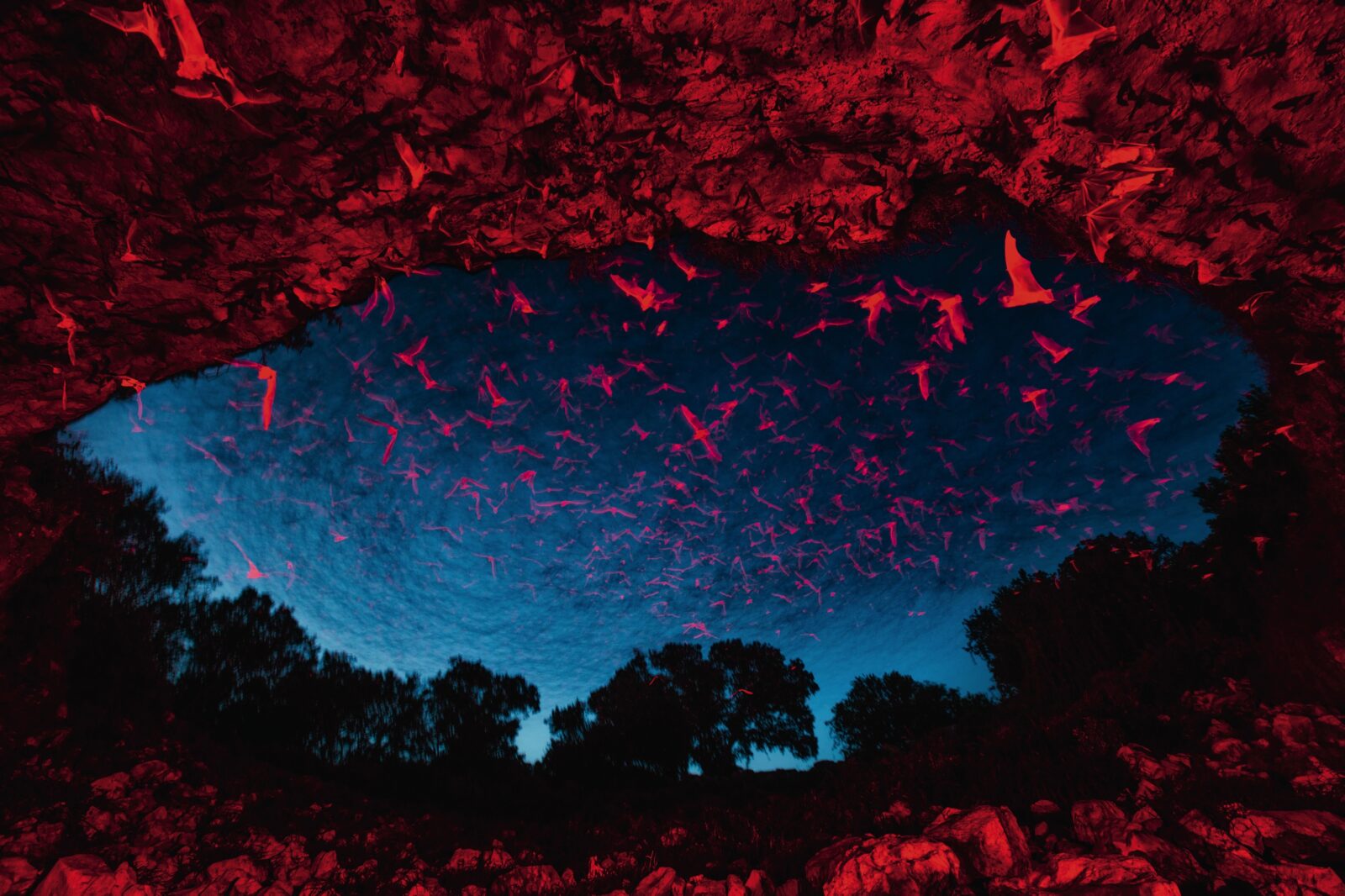
We were just beginning to shake off the pandemic the first time I went to see the bats. I live in Austin, Texas, a city already known for those animals—Bat City, we call it. But to break out of the isolation and recall my place as part of the wider world, I needed more than the measly million or so bats that live scattered around town, under bridges and in abandoned buildings. I needed an excess of bats.

So at the height of summer, two friends and I packed up some sandwiches. We wound out of Austin through a tangle of highways and spooled out into the hot, dry countryside. Before reaching the outskirts of San Antonio, we turned down a dusty road and entered Bracken Cave Preserve, the summer home of twenty million Mexican free-tailed bats. Volunteers from Bat Conservation International were waiting for us with clipboards and instructions to be quiet. We left our car and stepped into the trees.
Tucked into the Texas Hill Country, Bracken Cave Preserve is home to the world’s largest bat colony, and one of the densest concentrations of mammals on earth. Each year, the bats leave Mexico and migrate north, flying over some thousand miles of desert. The males disperse, settling in small bachelor colonies. The females come to Bracken Cave. The kicker is this: These bat girls are pregnant. Bracken Cave is also the world’s largest maternity ward.
That first visit, we walked a wooded path to the cave. It was still daylight, but the sun threw long shadows. We mingled quietly with the other visitors (people come from all over to see these creatures). We settled onto benches to wait at the cave’s mouth, as if sitting before a stage. From the first flickers of movement, like wisps of dust, just as the sun began to set, the whispering stopped, and we all fell silent. The bats began to swirl out, rise into the air in a great spiral, and fly into the sky.
Since that first visit, I’ve returned every year. I’ve gone in the heat of summer, when the bats are pregnant. I’ve gone after the babies have been born and the mothers are fetching a meal of moths, then racing back to nurse their young. I’ve gone later in the season, when the baby bats follow their mothers out of the cave and into the night, learning to hunt insects in the fields. I’ve gone as summer turns to fall, when the bats have already begun migrating south, and I’m seeing the stragglers. No matter when I go, the cave appears the same: a dark sinkhole depressed into the ground that looks as though the earth is yawning. The smell is the same. (If you’ve never smelled the guano of twenty million bats, this is your chance.) The bats look the same: First I see those familiar flashes inside the cave, like fluttering insects. Then comes the overwhelming moment when, seemingly as one, they achieve acceleration and surge out of the cave and up the slope into a great spiral over our heads. A tornado of bats, the volunteers call it.
It is a sight I wait for all year. I sit as close as I am allowed, so close that at times the bats whip by just inches from my face. They seem not to notice me. It is as if they are in another world, but their sonar is so precise, they never touch me. Sometimes the spiral widens and an arm of it spins right over my head. I look up (keep your mouth closed!) into a thousand soaring bats and feel an immense joy and relief that’s hard to explain. The sound is miraculous, too: percussive, thrumming, millions of tiny delicate wings beating the air, moving together in rhythm. What must it feel like to be that in sync with your tribe? Often there are other little animals—skunks, snakes, raccoons—around the rocks at the cave’s entrance, trying to nab a bat for dinner. We gasp when a hungry hawk swipes one out of the air and swoops away.
One year, I went to Bracken in the depths of a July spent under a heat dome. We arrived at six in the evening, so hot it was hard to breathe. The volunteers began late, cutting short their usual educational talks. I have seen the programming several times, but I still love it—a volunteer holding up a giant photo of a bat and telling me (once again) how incredible it is that this girl finds her own baby in the dark cave, night after night, among millions. But on this sweltering evening, there was none of that. We all trudged in silence to the cave, fewer of us than usual, sweating and feeling a little sick, but determined. It was a long hot summer. We had to see the bats. Needed to. Come what may.
It takes hours for the bats to emerge, a line of them in the sky, waves of them in the distance. But every year, after only an hour or so of watching them fly, not long after dusk, the volunteers come around and tell us gently that it’s time to go. Why? It’s getting late. And how can you blame the volunteers? Rules are rules. Besides, who wants to sit in the dark with fifteen million bats flying around? Well, I do. I’d stay all night if I could, watch the light slip away and the whole scene fade, see night take over, until I’d be left with only the ancient sound of tiny wings drumming in the dark.
Texas and my life here have changed—and in many ways, have stayed the same—since the pandemic began. The Mexican free-tailed bats have been coming here for thousands of years. I have come for five. I see a few seconds of their lives, and they see a few seconds of mine, all of us witnesses to one another’s journey.