

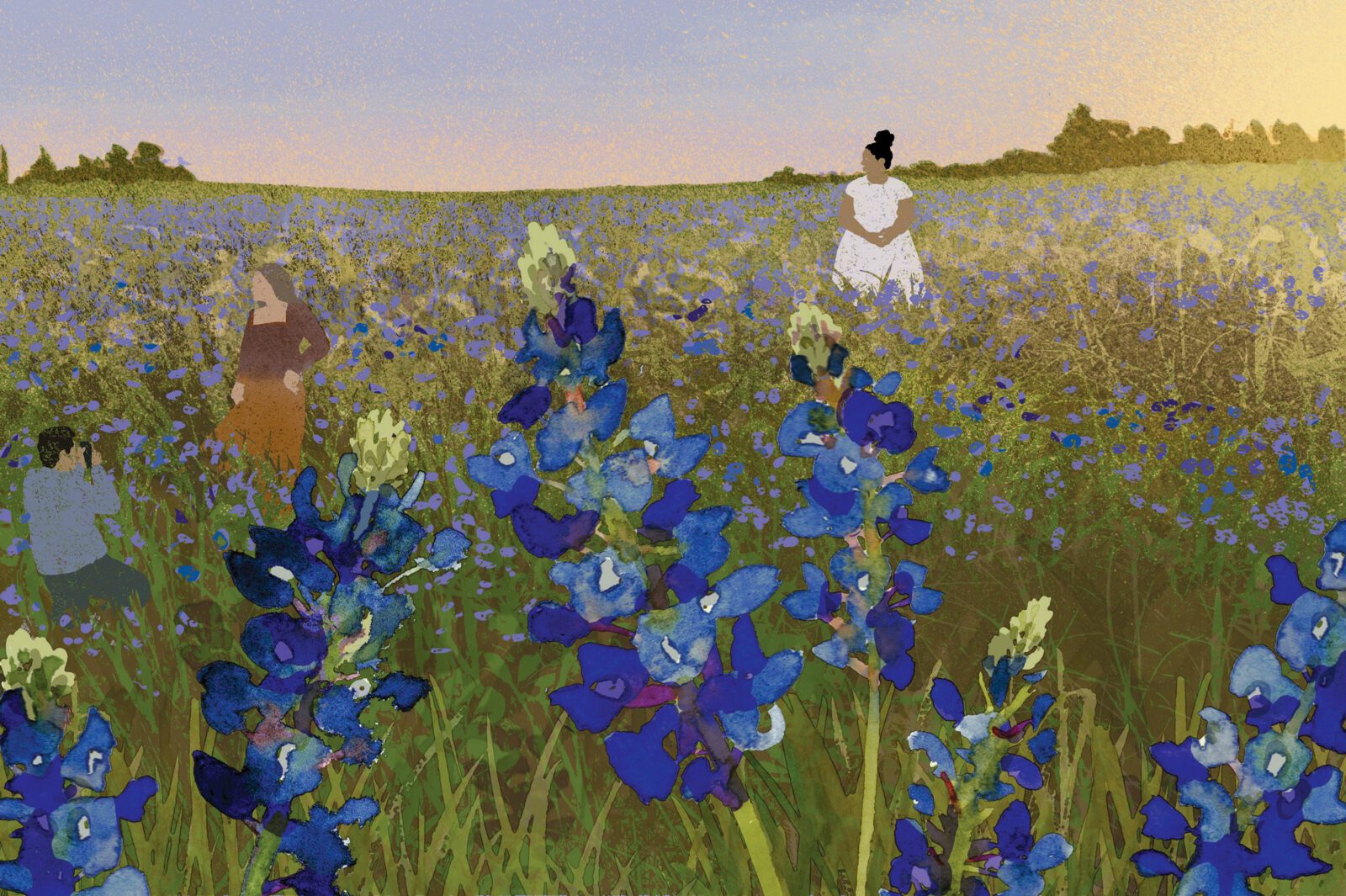
A hundred miles out from Ennis, Texas, I spotted my first sign of the state’s harbinger of spring. Along a country roadside, those initial bluebonnets burst in stark contrast to the barrenness of the past week-plus I had spent exploring national parks in West Texas and New Mexico: Carlsbad Caverns, where I’d gotten stuck 750 feet belowground when the elevators stopped working; Guadalupe Mountains, where a snowstorm required me to turn around; White Sands, where I played in the pearly gypsum dunes, the crystals cold against my bare feet; Big Bend, its harsh beauty softened at night by unparalleled stargazing.

On this Western adventure last April, everything I encountered felt like it had thorns on it. Cacti, yuccas, ocotillos, purple prickly pears, spiky desert spoons—I admired their ability to survive in such tough terrain, all so different from the glossy evergreens and fragrant flowers heralding spring at home in the Carolinas.
Ennis would be a lark, a last-minute detour inspired by a fellow travel writer and a native Texan, Alex Temblador. She and I had appeared on a panel together at the Dallas Literary Festival, and as we prepared to part, she reminded me it was almost bluebonnet time. During April, she explained, Ennis, a small town about forty miles southeast of Dallas, becomes something like Bluebonnet Central, and the town’s festival to celebrate the bloom’s arrival verges on Texas-level legendary.
Bluebonnet wildflower watches had long been on my radar, but I had never before found myself in Texas in the springtime. During previous trips, typically at the tail end of summer, residents would assure me how pretty the place could be before it got dry, before the sun scorched everything that didn’t move. As a tumbleweed inevitably rolled past, I would just nod, struck silent by the fact that the Western trope I had seen on TV was in fact very real.
Now it was the right time, and with Temblador’s recommendation, I was headed to the right place. What, I wondered, was so alluring about those big carpets of wildflowers I had seen on my social media feed? What compels us to gather and stare at the ephemeral when we have almost any visual delight available to us via phone, computer, or television screen? What kind of hold did these wildflowers have over people?
Of course, in Texas, bluebonnets aren’t just any kind of wildflower. The name covers a handful of lupine species with densely clustered, mostly bright blue flowers tipped in white. From late March to early May, they open and spread across the state, largely in the Hill Country. From a distance, a field of them can look like a cascade of blue flames. Some call the appearance and enjoyment of what became the state flower in 1901 the best free show in Texas. But more deeply, for many Texans they also represent resilience.
Texas can be a hard place, with drought, wildfires, tornadoes, and, a few months after my trip, deadly flooding. But the hardy blooms always come back, capable of lifting the spirit after a difficult season. Just where they decide to show up, though, can be a mystery. Bluebonnet blossoms last but a month or so, and afterward, they drop their seeds for the next year so the cycle can begin again. The amount and timing of fall and winter rains that follow determine the success of germination and the next blooming season. Since the 1930s, the Texas Department of Transportation has helped things along by spreading bluebonnet seeds along roadways annually to promote beautification and control erosion.
This kind of mass obsession with a single wildflower intrigued me. Even the local Buc-ee’s bows to the bloom, filling a section of the supersized gas station with T-shirts and travel mugs featuring the store’s beaver mascot superimposed on a Texas-shaped image of bluebonnets. Back home, very few of our wildflowers are blue, and very few open expanses exist to support blooming natives that stretch on for miles. In the right years, when fringed phacelias gather in the Great Smokies in great enough numbers, they look like fresh snow on the forest floor. But even that springtime affair is becoming rarer, as the effects of development and climate change mount.
The plants I was seeking out on this weekday, just before the start of the annual festival, had endured a drier-than-usual autumn, and so far, bloom watchers had reported only sporadic sightings. In fact, when I arrived in Ennis, ahead of some hundred thousand people expected by the weekend, I learned at the welcome center downtown that flowers had not yet appeared at the nearby Bluebonnet Park, and I was steered elsewhere.
For a while I drove the Bluebonnet Trails’ forty-plus miles’ worth of loops dotted with hot spots; members of the Ennis Garden Club monitor the trails so they can update the welcome center, too. As I began to lose light, I decided to speed to one final stop: the Meadow View Nature Area, tucked into the eastern arm of Bardwell Lake. When I drove up, the line of parked cars stretched from the clearing to a small stand of trees several acres away. I emerged from my rental car and almost leaped into the sky when I spotted a sign warning of snakes. I had experienced a couple of close encounters with rattlers earlier in the week, and by the last day of my visit, I was over it.
I made sure to keep to the well-exposed path, but most visitors weren’t sticking to that directive in the least; trampled flowers abounded. Though bluebonnet fever was just ramping up, a decent number of people had clearly already been here, traipsing through the flowers, crushing plants and compacting soil in search of “the shot.”
The fragrant blooms emitted a scent I can only describe as a mingling of baby powder and fresh honey, mixed with the sharper vegetal scent of freshly pressed-down grass. I weighed my options about getting closer. Crushed blooms can’t produce seeds. I briefly wondered if bluebonnets were being loved to death.
Still, the vista before me overwhelmed the senses. Cornflower, cobalt, indigo—the colors were all present in Meadow View’s wave of bluebonnets, but I couldn’t articulate a word for the deep, velvety near-purple tinting the meadow too as the sun lowered. Washington, D.C., has its cherry blossoms. Washington State has its tulips. Texas has this. What opulence.
In their own way, bluebonnets are timeless, their ancestors spreading for millions of years before humans entered the scene. And the traditions they’ve spawned appear timeless, too. While the myriad people here with iPhones may spark eye rolls over doing it all for the ’gram, I hear some of the families chat about visiting the lip of this lake since they were kids, back when the U.S. Army Corps of Engineers dammed Waxahachie Creek to create it in the 1960s. Before that, families used to stop along back roads, sit in the flowers, and take pictures.
Now a nearby grandmother was holding a high school mortarboard while a young soon-to-be graduate styled her hair and struck a pose. The technology may have changed, from film cameras to disposable ones to the smartphones we all carry, but the urge to capture the ephemeral, the allure of the bluebonnets, remains.
I lingered, not quite ready to go. Deer hovered around the meadow’s edges, waiting for us to leave. How odd we must have looked to them, groups gathering, cameras flashing, emitting bright bursts of light in the quest to capture something that never looks quite as good in photographs as it does in person.
Yes, these bluebonnets usher in spring, but for so many they also signal something else. A ritual, a Texas way of marking time, and like taking photos celebrating life milestones, a kind of rite of passage.
Latria Graham is a Garden & Gun contributing editor from Spartanburg, South Carolina, and writes the magazine’s This Land column, which documents aspects of the natural world in the South. An assistant professor of creative writing at Augusta University and an instructor for the University of Georgia's Narrative Nonfiction MFA program, Graham shares her adventures on Instagram (@mslatriagraham) and her work at LatriaGraham.com.