

Southern Masters
John Alexanders True Nature
How a swamp rat from Beaumont, Texas, clawed his way to the top of the art world
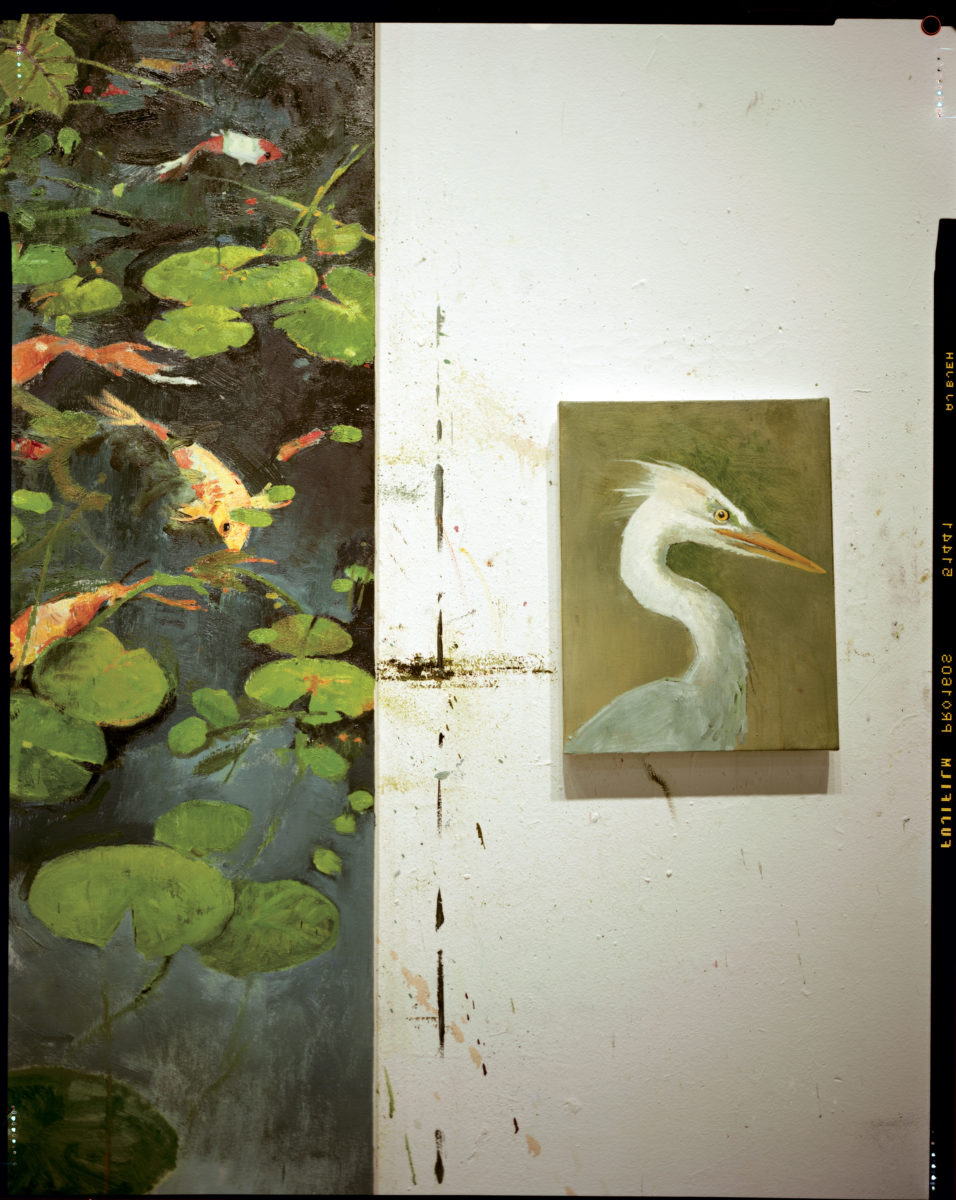
Photo: Erika Larsen
It is the first day of the second weekend of the New Orleans Jazz & Heritage Festival, and I am in my car with John Alexander. Like most of the music-loving tourists in town, he is dressed in jeans and sneakers and armed with a camera bag, but unlike them, and pretty much everybody else we both know, we are not headed in the direction of the fairgrounds. It’s not that he’s not a fan—he flies down for it almost every year. It’s just that on this particular day, he has chosen to forgo the arguable pleasures of, say, the ARK-LA-Mystics or the Creole Zydeco Farmers in favor of the abundant flora and fauna of the Audubon Zoo.
To say that Alexander is a nature buff is to vastly understate the case, a fact that becomes immediately apparent upon looking at almost any of the works from his thirty-odd-year career. There are the swampy, palmetto-choked landscapes of the 1980s, so teeming with life you’d swear the canvas was humming, and the stunning flower paintings of the 1990s. There are the more recent dazzlingly pristine renderings of a single specimen—a perfect crab claw, a shimmering flounder, a regal marabou stork—along with the masterly views of Montauk Point or The Mighty Bog. More recent still are the epic “still lifes” that are anything but—my own includes shrimp and crabs skittering across the canvas while an interested turkey buzzard looks on. All of them are vivid evidence of the depth of his obsession. Most also feature recurring motifs (mackerels and snakes and egrets and crows, to name a very, very few) pulled not from an overactive imagination but from the occasionally lurid primeval landscape of his actual memory.
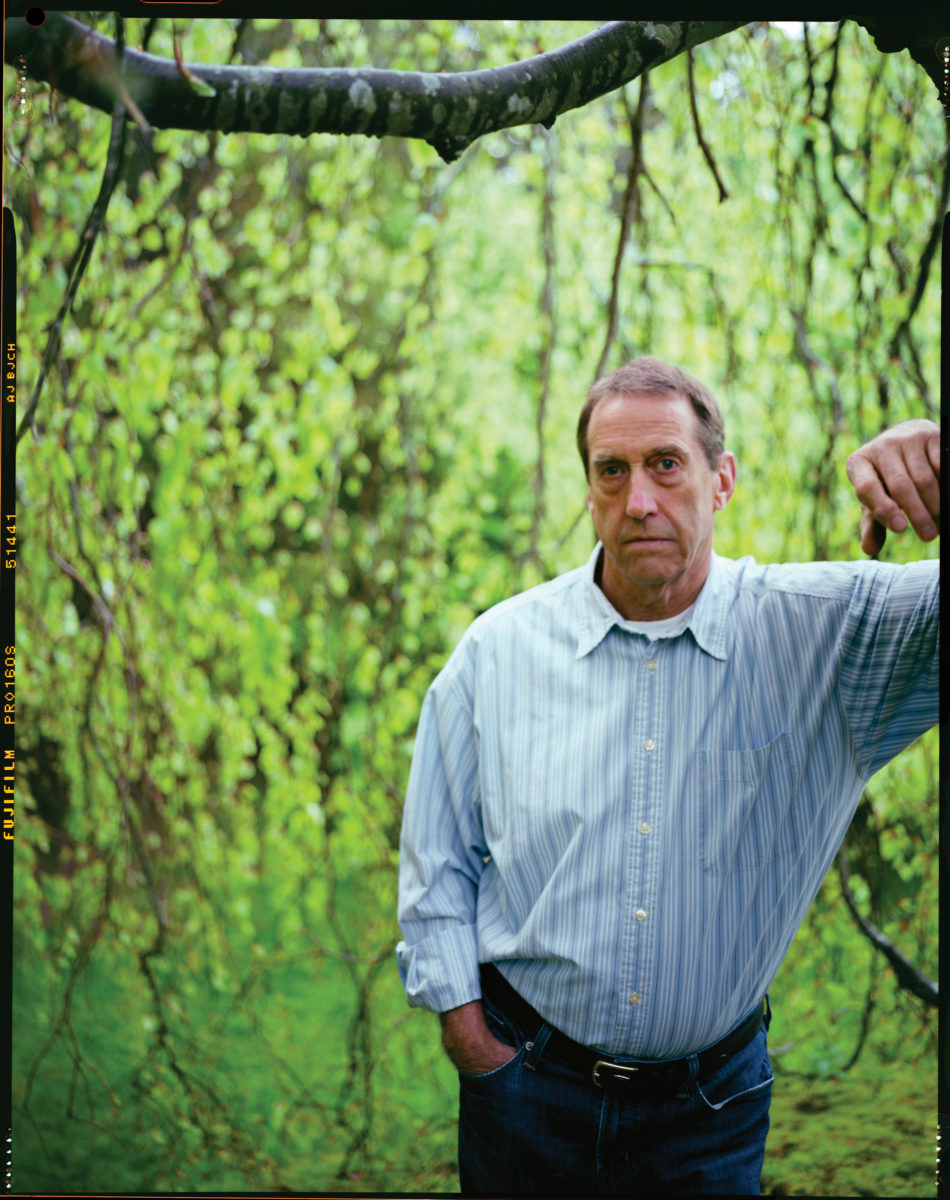
Photo: Erika Larsen
In His Element
The painter at his retreat in Amagansett, New York.
The only child of Zeila Thrash and John Alexander, Sr., the young John grew up in the East Texas town of Beaumont, a port on the Gulf of Mexico with a subtropical climate and an economy based on timber and the oil refineries that dotted the coast. His father, thirty-five years his mother’s senior, was sixty-eight years old and already retired as a construction engineer when his son was born. The elder Alexander was a Spanish-American War veteran who was born less than fifteen years after the end of the Civil War. Not only was he able to provide his son a window into the fantastical and bygone natural world of his own youth, he had the time to introduce him to the more tangible delights of the existing one. They fished the nearby bayous and swamps in a wooden boat he’d built with his own hands. They pitched tents out in the dense hardwood forests, accompanied by the kinds of creatures whose eyes stare back at you in so many of Alexander’s wild and painterly eighties works. Alexander revered his “early environmentalist” father: “He knew every bird, every spider, and every sound in the swamp.” Now sixty-two, the son could well be talking about himself.
After Alexander left Texas for a loft in downtown New York City in 1979, he also managed to find a weekend retreat in Amagansett, New York, on Long Island, a piece of the world that recalls his beloved boyhood territory. “There are not a lot of places you can go up there that resemble the Texas or the Louisiana Gulf coast,” he tells me. “But it’s got the water and the bays, the crabs and the oysters, the great fishing.” His house, which he shares with longtime companion Fiona Waterstreet and her son, Harry, sits on three acres that include a seventeenth-century barn-cum-studio and lush gardens of the roses and cannas and water lilies that often appear in his work. Though he’ll accompany Fiona and Harry on highfalutin spring-break trips to St. Barts and winter ski holidays in Aspen, he travels more often to locales like northern Australia, where he captured on paper the “beast” of The Beast, Arnhem Land, Northern Australia, a ten-foot-long crocodile idling among giant lily pads. When, a couple of years ago, he spent a month in Paris, it was not to dine or to sightsee—he had a fellowship at Giverny and spent his days painting Monet’s hollyhocks.
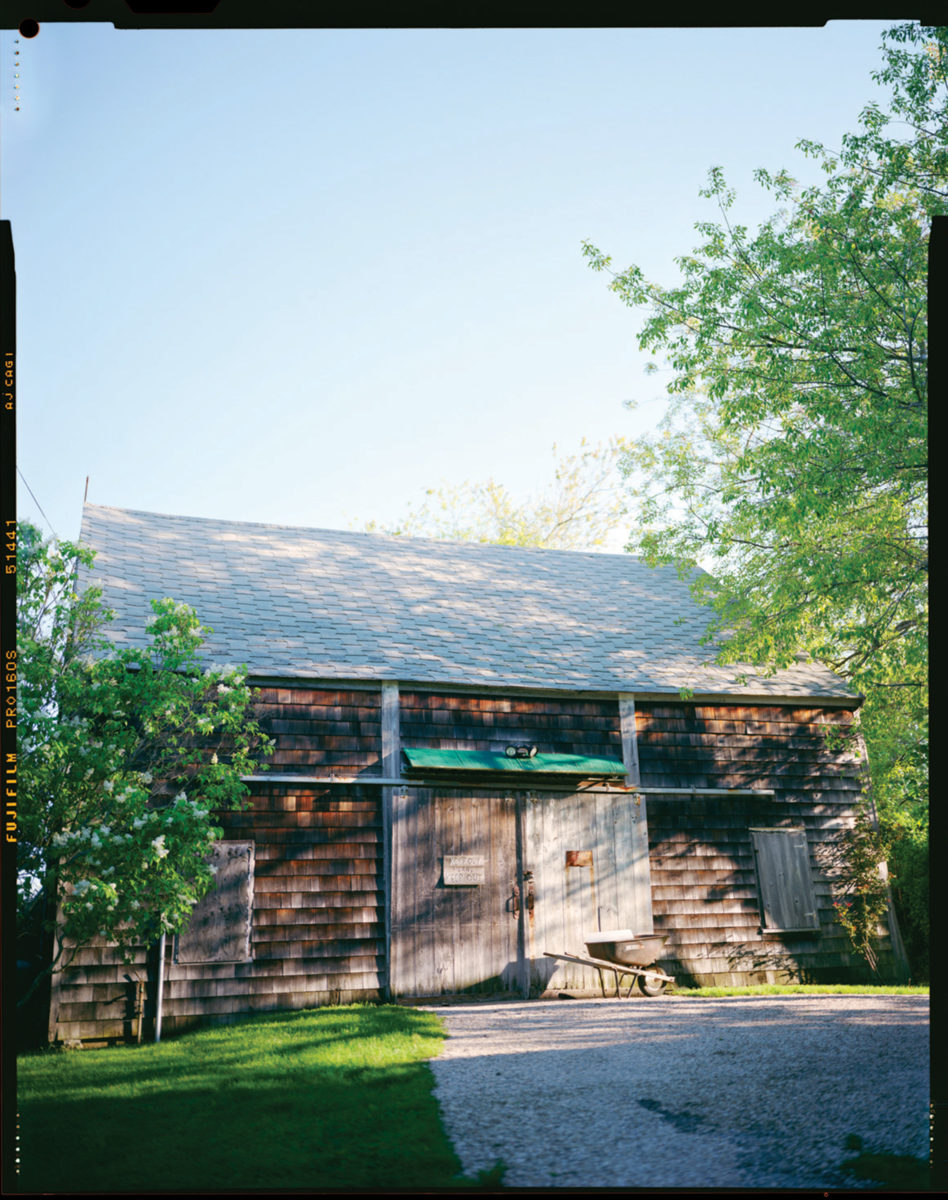
Photo: Erika Larsen
The Workshop
Alexander's studio, a converted barn, full of of skulls, snakeskins, cotton stalks, and other artifacts from the natural world
So it is that on this trip to New Orleans I am following him, a fanatic with an old Nikon, through yet another exotic landscape, albeit a pseudosimulated one. “Holy shit, that’s a money shot right there,” he says, pointing the camera toward an enormous flock of deep pink flamingos sunning on some rocks. “Can you believe those things are real?” By the time we’ve reached our second stop, a small community of whooping cranes, he has pronounced the zoo “paradise,” and when a ruddy duck suddenly disappears beneath the water in search of prey, he can’t contain himself. “Look at him go down! Did you see that?” After ten minutes marveling over an all but immobile flock of brown pelicans, he says, “Everything about those birds is in slow motion. They’re not worried about their BlackBerry responses, are they?” When yet another bird, a free-roaming peacock in full strut, suddenly blocks our path, he goes into a photographic frenzy. “That is one of the most dramatic things I’ve ever seen. This son of a bitch is serious.”
Curse of the “Southern” Artist
It is lunchtime, and we are practically the only people on the premises other than wide-eyed elementary school kids on class trips. Save for the profanity—“Look at that little old wiry-ass rhesus-looking monkey”—the boisterous Alexander would fit right in. But this is not all play for him. It’s business too—the images he is taking are not for a scrapbook. (My own ever-expanding collection of his work already includes a couple of heron heads, a dead finch, two cardinals, two monkeys, a kingfisher, a plate of oysters, and Grackle with Blue Balls, and now I’m already thinking peacocks, for example.) Utmost on his mind today is a possible commission he and his friend Jimmy Buffett have been seriously discussing: massive depictions of indigenous wildlife that will hang in the public spaces of the casino Buffett is building in Biloxi, Mississippi, with Harrah’s as a partner. Suddenly it is apparent why we stayed so long with the pelicans.
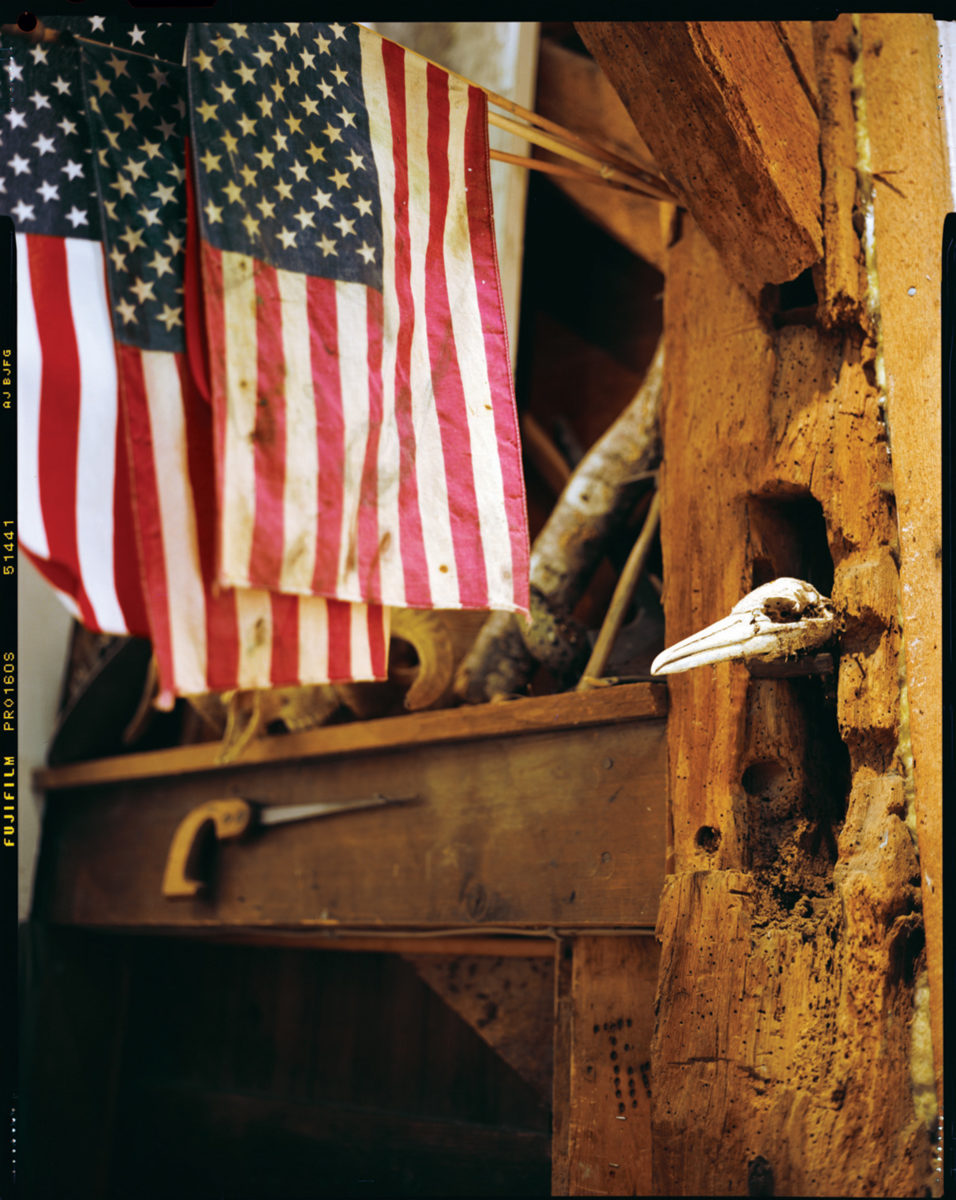
Photo: Erika Larsen
When he tells me about the project, he veers quickly into the grandiose: “Instead of a chicken in every pot, why not a print in every room?” he asks, grinning his almost impossibly wide grin over the material possibilities. But then, John Alexander nature boy and John Alexander capitalist have long been forced to go hand in hand. He is in major museum collections across the country, including the Metropolitan Museum of Art in New York, and in December 2007 a retrospective of his work opened at the Smithsonian American Art Museum in Washington, D.C., before moving in expanded form to the Museum of Fine Arts in Houston, which also produced a stunning coffee-table book of the show complete with a paean from the great Australian art critic Robert Hughes. Still, he has had to hustle to get there. For one thing, he is almost invariably described as “Texas artist” John Alexander, despite the fact that he hasn’t lived there in almost thirty years. “It’s pejorative,” he says. “It’s like being called a ‘black artist.’ It means you’re somehow not a full-fledged artist.”
Then there is the “problem” of much of his subject matter. In the eighties, when the art establishment was busy going gaga over the cartoon graffiti of “It” Boy Keith Haring or Julian Schnabel’s massive oils featuring plates that (unintentionally) fell off, Alexander was producing such works as Sabine Pass, Bayou Magic with Mackerel, and A Blue Jay and a Blue Fish. And while it is far easier for me to find resonance in any of those three paintings than the banal repetitions of Haring, that was not always the case for what constitutes the “art world,” a point that drives Alexander and many of his colleagues like the Mississippi-born William Dunlap crazy.
“Dunlap is an amazingly good artist,” Alexander says of his close friend. “But he suffers from the same problem I have. If you look at one of his paintings of the Blue Ridge Mountains in Appalachia, you can see the loneliness of an old barn that is about to fall down off the side of the road. But audiences in the Northeast have never seen it, and apparently they can’t understand what that is. In general that market buys what they are told to buy. They don’t buy from their heart. There’s a lemming mentality in art buying.”
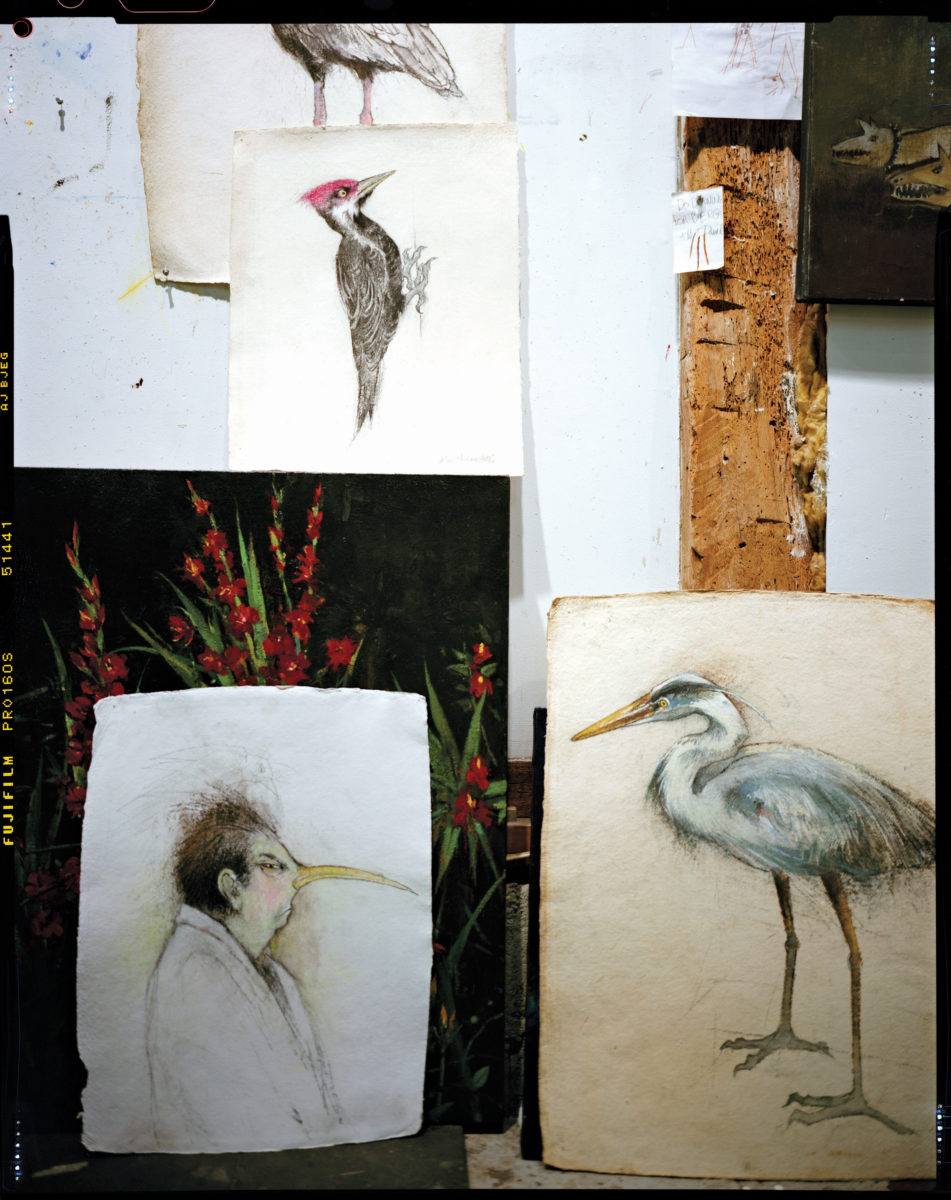
Photo: Erika Larsen
Even when his work tackles themes other than nature—chief among them vanity, hypocrisy, and greed—it often lampoons the very folks who make and break careers. La Casa de los Locos, for example, depicts a pompous, almost sinister art auction with the artist himself, wearing a mask, off to one side. Like a lot of even his most didactic works, it is also a very funny piece, but as curator Jane Livingston remarks dryly in the book that accompanied his retrospective, “Humor in art isn’t often taken seriously among recent consumers and experts in high art circles.”
For all that, he has forged ahead. “I have tenaciously kept at this my whole career, through highs and lows, and I’ve built my own following,” he says. “If you’re a young artist and you’re just starting out, and you don’t have the courage and stamina to wait this thing out and stay with it, it will eat you up. It’s still a battle for me. The hard part is finding a niche for yourself.”
His early followers included some of the hipper members of the New York showbiz community, many of whom he met through his second wife, Rosie Shuster, who was a writer for Saturday Night Live. A short list of his collectors reads like a pantheon of American comedy in the late twentieth century: Lorne Michaels, Bill Murray, Steve Martin, Chevy Chase—people, in other words, who weren’t exactly put off by his humor. Chase owns one of my favorite pieces, Mama Wanted a Dancer But All He Wanted to Do Was Fish, a portrait of a scrawny-legged boy (whose goggle-eyed, open-mouthed expression bears, like that of most of his characters, a startling resemblance to the artist’s own) in a white tutu, a gold crown, and red nail polish, holding what looks like a giant mackerel.
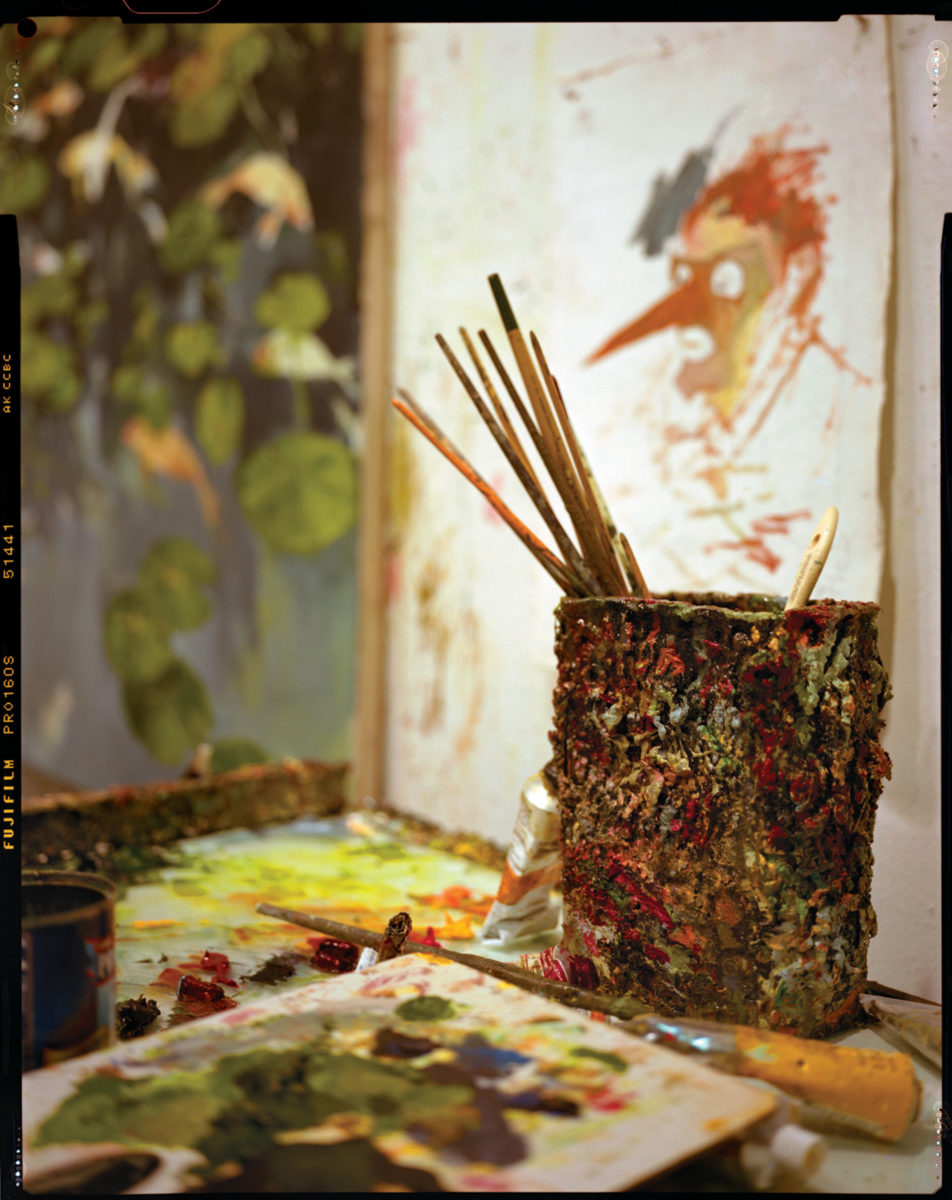
Photo: Erika Larsen
Something Primal
It was in the mid-eighties, when he was still married to Rosie, that I first met Alexander. At the time, I shared a house in Bridgehampton with another Southern friend, and Alexander was definitely the only person I knew in the Hamptons whose mother grew up as one of ten children in a sharecropper’s shack in Wetumpka, Alabama, and I was likely his only neighbor who knew that Beaumont was also the birthplace of George Jones. I had also heard enough maniacal evangelist preachers going full throttle to know that the images of devils and hellfire that appear so often in his work were at one point very real to a boy whose religious mother dragged him to the First Baptist Church every Sunday.
When I first saw his work, it reminded me a lot of the Mississippi Delta landscape of my own childhood, and I was astounded by the literal, almost muscular force of his talent. But what made him most appealing was his great Southern charm and generous sense of humor. (He has not lost it—recently, when he knew I was going through a bit of a rough patch, he sent me a color photocopy of The Beast with the head of the bloviating Lou Dobbs clamped in the beast’s mouth.) He may resent being called a “Texas artist,” but he is Texan through and through, with a touch of his mother’s native Alabama, where he spent his boyhood summers, thrown in. He pronounces the word life, for example, with a long “i” sound, and though he often affects the countenance of a redneck who can’t quite grasp what he has just seen, it belies a lightning-fast wit and a voracious, restless mind. He seems to have the attention span of a gnat, but he’s taking everything in, and he works like a dog.
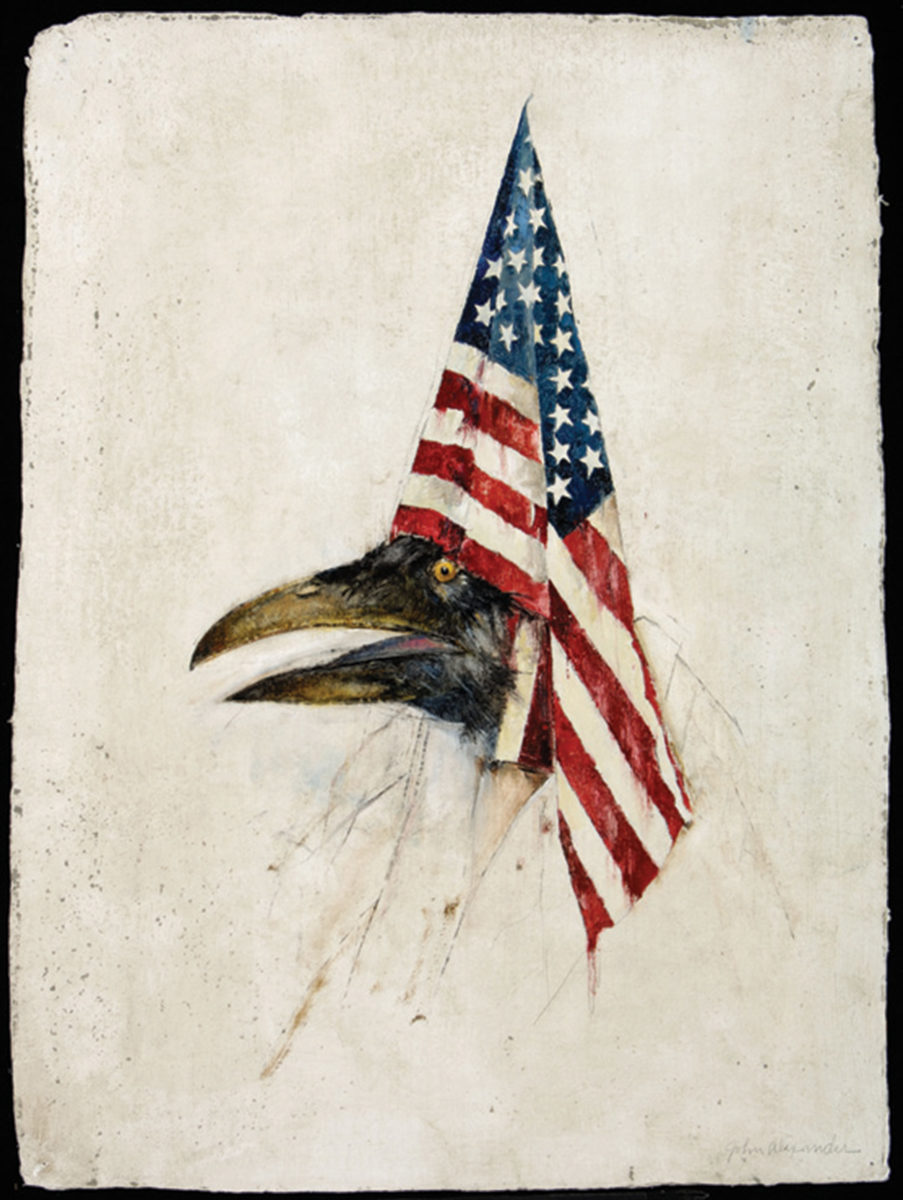
Raven Maniac
Oil on paper, 29 1/2" x 21 5/8" (2007)
A case in point is one of the more memorable nights of my life: We were in his Amagansett studio, and I was drinking Scotch while he downed one Diet Coke after another and worked—hard—on The Dinner Party. It was the first time I realized how intensely physical (at least as practiced by John Alexander) the act of painting is. The work, an enormous 1986 oil, was based on an actual dinner he’d attended at the home of a Houston hostess. Remembering it now, he says, “The people were ghastly and the place was ghastly and they had these stuffed animal heads all over the house. It was the craziest, most insane environment, and I started imagining that the things on the wall were alive while listening to this bullshit that was going on at the table.”
Alexander is passionate about almost everything—pretentious dinner parties, baseball, how much he hates the Bush administration—but mostly he is passionate on the subject of art. Almost ten years ago, I heard him give a talk to some students at New Orleans’ Tulane University about his latest career phase, in which he was concentrating again on the fundamentals of drawing and painting. He told the group he’d had an epiphany after giving an earlier talk at the Rhode Island School of Design. He’d been advising those students, who were just starting out, but on the train trip home he realized he didn’t really know what he wanted to do with the remainder of his own career. “I’d reached an impasse, and I decided the best thing I could do was not try to make any great creative statement but to work from observation and master my craft in a more professional way.” He bought books of Old Master drawings. He went to the Met and pored over its archives. “I tried, as an academic would have two hundred years ago, to master the craft of drawing, and I found that it not only worked, it’s remarkable how much faster my work got in terms of drawing from observation and then also how much it helped me with my painting.”
A short list of his collectors reads like a pantheon of American comedy: Lorne Michaels, Bill Murray, Steve Martin, Chevy Chase – people, in other words, who weren’t exactly put off by his humor
In the aftermath, he has also done what he considers some of his best big oils. After our zoo visit, we are having a late lunch at Herbsaint, and Alexander is telling the brilliant chef/owner Donald Link about the genesis of one of his recent “epic” works, High Cotton. Alexander grew up around cotton farms in Alabama and had long had in mind the idea to do a painting, so the two of us drove through my home turf in the Delta and paid a visit to my friend Ralph McGee in Panther Burn. His cotton that year was almost five feet tall with enormous fluffy bolls fully opened when we got there in October. “I thought it was such a strange combination of the beauty of these things when they’re ready to be picked and the history of what that meant in the South,” Alexander says. He took what seemed like a thousand photographs and then filled the trunk of our rented Cadillac with stalks that he asked my mother to send him in Amagansett. “I got back to New York, and two huge cardboard boxes that looked like washing machines were supposed to be in them arrived with about sixty stalks stuffed inside. So I hung them up with fishing line in my studio and spent an enormous amount of time drawing and painting those plants.” The resulting painting, complete with subtle touches of chains and barbed wire at the bases of the plants in a breathtakingly rendered field of cotton, was included in his retrospective. “A lot of people think it’s one of the best paintings I ever did.”
As he and Link talk about their crafts, words like commitment and devotion keep coming up. Link is telling Alexander, an inveterate lover of frog legs, about the hard time he’s had getting the genuine article from Louisiana, that most of the product he’s been serving has been farm-raised and imported, so he’s planning a trip to Rayne, Louisiana, near where he grew up, to go out and gig them himself. Alexander, whose first meal at Herbsaint was a plate of frog legs he reduced to matchsticks, is impressed. “The idea that you want to go out to Cajun country and do that is fantastic,” he tells him. “What we both do is primal. If you have a big restaurant in New York and you’ve never been to the South, never been to a swamp, and you get all this stuff out of a catalogue, it’s got to lose something.” The same, he says, is true of art. “I don’t understand how you can pretend to be an artist who paints nature, the landscape, if it’s something you don’t understand or haven’t experienced. How can you paint the coastline of Maine or the swamps of the Louisiana/Texas border if you’ve not been out in it and you don’t know what it smells like, you haven’t been in the darkness with all those eyes reflected back at you?” I tell him one of my favorite of his drawings is a flawlessly—but somehow soulfully—rendered pencil drawing of a cardinal’s head. “If you haven’t held in your hand a dead cardinal,” he says, “if you haven’t watched them feed or watched the way their heads move and the way their eyes glisten in the light, you can’t do that.”
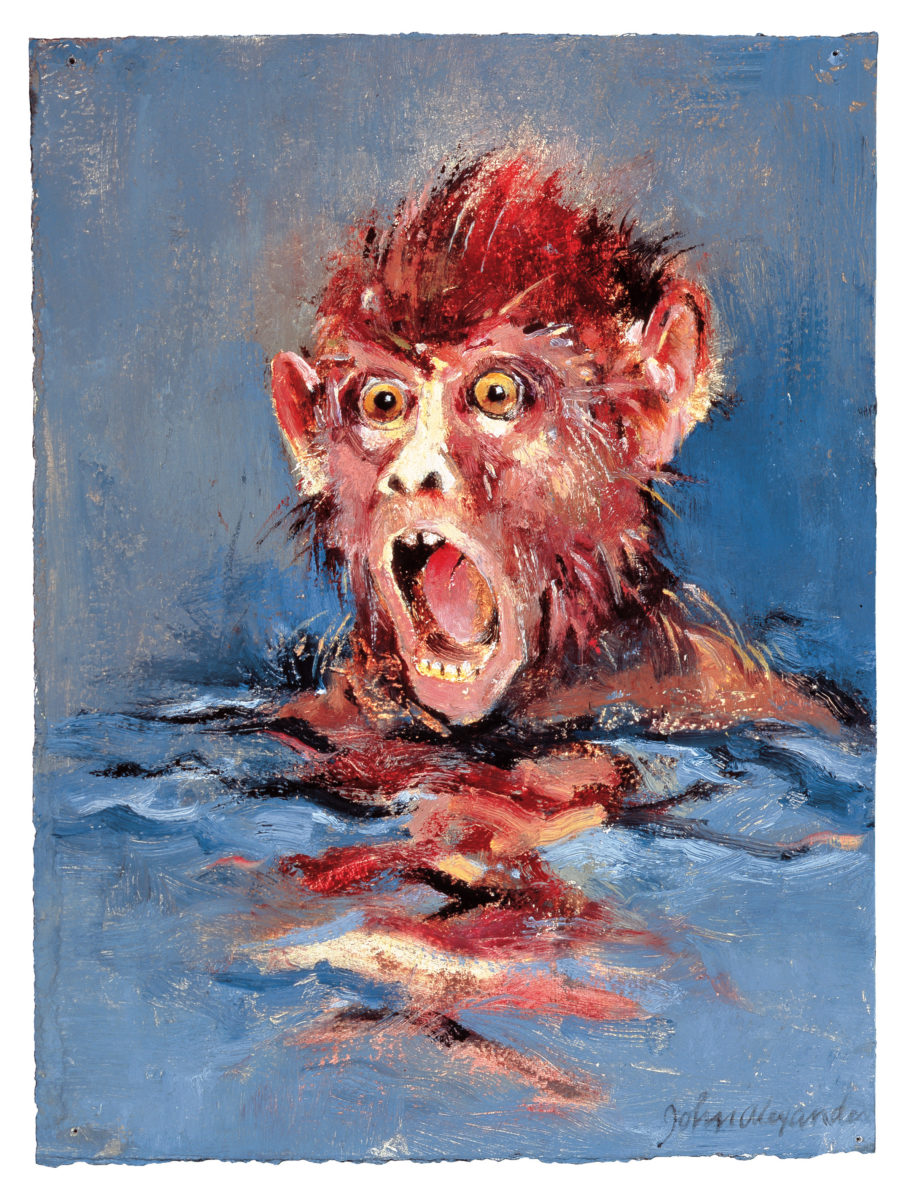
Icy Plunge
Oil on paper, 13 1/2" x 10" (2007)
One of Alexander’s great influences is Manet. “He did The Execution of Maximilian, which is a ten-foot epic painting, but he also painted a bunch of asparagus on a plate that has the same kind of power and resonates in the same way. You have done something remarkable as a painter to be able to pull that off—that’s making paint work in a magical way. It’s like what Donald does. Any chef in New Orleans will tell you they can make frog legs. The challenge is to make frog legs special. Then you’ve done something.”
With the success of the book and the retrospective, Alexander finally feels like he has been recognized for having “done something” too. Friends and curators and fellow artists flew in from all over the country to be at both the Washington and the Houston openings. But it’s still hard for him to wrap his head around. “A thousand people a day saw the show in Washington for three months,” he tells me. “That’s thirty thousand a month. That’s amazing.”
Next he says he may go back toward abstraction again. “I figure I’ve got a couple of good decades left. Every decade it changes. I started out fairly abstract and then I got very realistic. I’ve only got so many cycles left in me. If I’m going to do the more abstract stuff, I might as well start moving in that direction.” I tell him I am already dying to see what that will bring. But first he wants to go get some frogs with Link. “You don’t actually want to try to gig them—you’ll make yourself crazy if you try to stab them like that. You just get a boat paddle and get right up on ’em, keep that light on ’em, and just pop ’em. It’s called frog slapping.” He and Link both laugh. I do too, mainly because I feel a painting coming on.
View more Works by John Alexander.