

Arts & Culture
Wrestling with the Legend of Sheriff Buford Pusser
In Southern lore, and for this crime novelist especially, the tale of the Tennessee sheriff went from “Walking Tall” to dancing with the devil
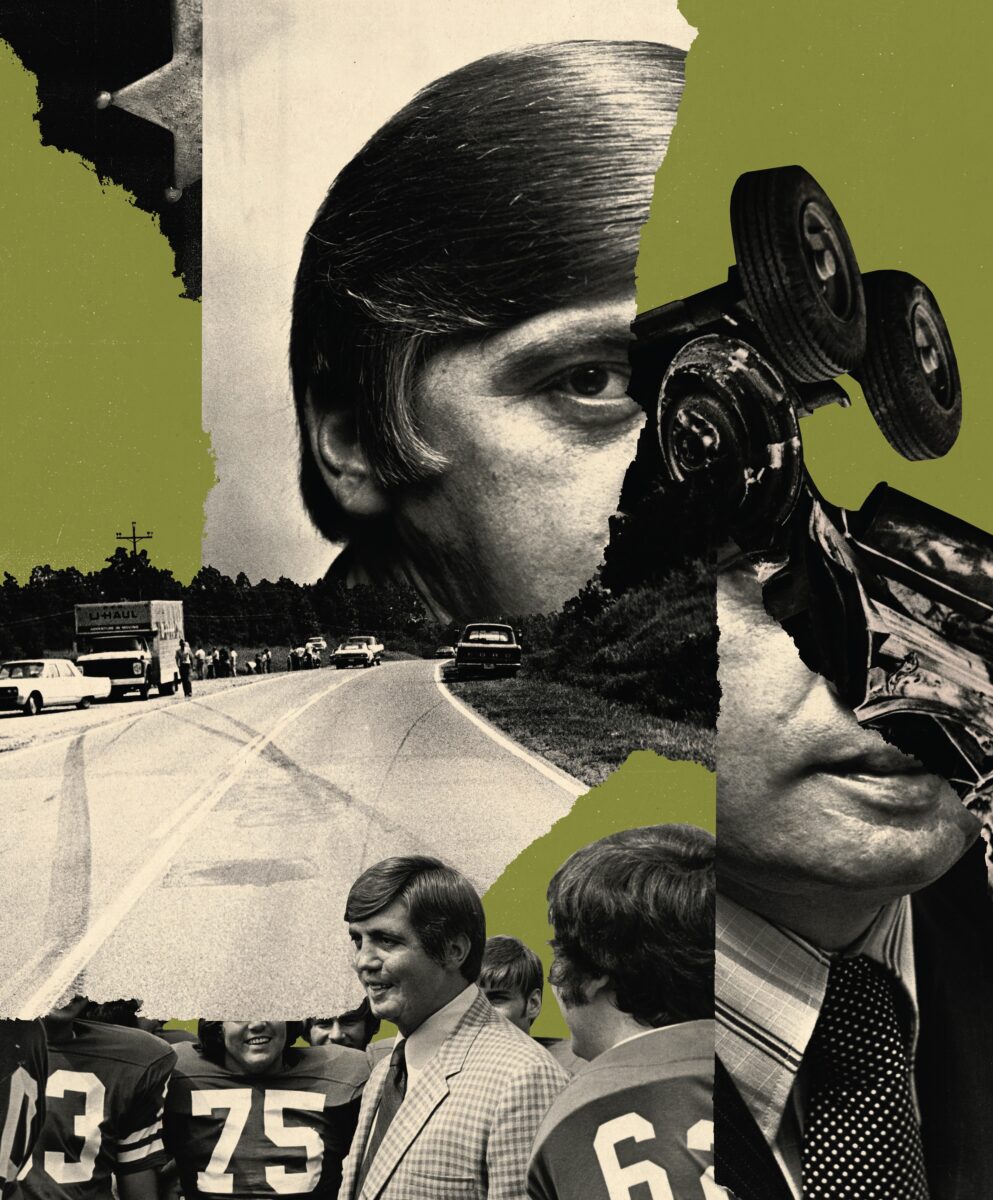
Illustration: Cristiana Couceiro | Badge by Alan Levine/Wikimedia; other images courtesy of Special Collections Department, University of Memphis Libraries.
It’s hard to recall a time I didn’t know of Buford Pusser. He stood tall as one of my real-life Southern heroes, alongside the fictional Atticus Finch, Dave Robicheaux, and Gator McKlusky. He was a champion of the New South I’d been promised as a kid of the 1970s. In the 1973 film Walking Tall, Pusser—as portrayed by Joe Don Baker in a tour de force performance—smashes corruption, crime, and racism with the blunt force of a big-ass hickory stick. He confronted lawbreakers, no matter their crony connections in the capital. He was sensitive and vulnerable, bold and courageous, and he couldn’t tolerate injustice. People in the theaters stood and cheered. Down south, Walking Tall even outgrossed The Godfather.

For years, I kept a PUSSER license plate in my office window in Oxford, Mississippi. I owned not one, but two official Buford Pusser sticks from his house museum in Adamsville, Tennessee. I have the DVD box set of Walking Tall and its two sequels, plus a made-for-TV biopic, and the 2004 Walking Tall remake with Dwayne “The Rock” Johnson. My turntable often featured the 1973 tribute album—Eddie Bond Sings the Legend of Buford Pusser—that helped kick-start the myth. If you haven’t heard “Christmas in Heaven,” about Pusser’s murdered wife, Pauline, then you don’t appreciate good country music. “She’ll spend Christmas with Jesus this year…” I even based the hero of my long-running crime novel series on Pusser. But what makes a hero? After dark revelations about Pusser’s life have come to light, I’ve had to rethink just about everything I thought I understood.
Most of you know the legend of Buford Pusser, but for the uninitiated, from 1964 to 1970 he was the sheriff of McNairy County, Tennessee, a hotbed of illegal liquor, gambling, and prostitution. At the time of his election, he was twenty-six, one of the youngest sheriffs in state history. Yellowed newspaper clippings herald him as a moonshine still buster and uncompromising lawman who fought the Dixie Mafia and State Line Mob, ragtag groups of thugs who operated beer joints and clubs as fronts for illicit activity along the Mississippi-Tennessee border. In the process of delivering justice, the legend says, he was shot and stabbed several times. The story comes to a crescendo when his wife dies beside the hero (whose jaw was half shot off) in a Dixie Mafia ambush on August 12, 1967, a day long remembered in the infamy of Pusser lore. In the original film, Pusser cradles Pauline’s bloody body and pleads with God not to let her die.
The real Buford Pusser loomed even larger than Joe Don Baker. Pusser stood six foot six and weighed 250 pounds. Before turning to law enforcement, he’d been a pro wrestler in Chicago who competed under the name “Buford the Bull.” “He was like Hercules or Zeus or something,” Baker once said in an interview. “Crime was starting to really kick in in those days, the early seventies. I think a lot of people wanted to take a stick to Nixon and all those Watergate guys. It touched a nerve somewhere, the vigilante type of nerve that’s in everybody that would like to do in the bad guys. But we don’t have the power to do it.”
Basically, you can’t make this shit up. Or maybe you can.
I started to get hints of the real Buford Pusser twenty-five years ago, when I moved to Mississippi. One of my friends was the federal judge Neal Biggers. Judge Biggers (I never called him Neal) frequented a darkened corner of the City Grocery bar, my favorite watering hole on the Oxford Square. Between bourbons, we’d talk about college football and books. He was well aware of my admiration for Pusser. I’ve written eleven books about an honest, tough-as-nails sheriff named Quinn Colson, who is basically a twenty-first-century Pusser. Quinn is an Army Ranger who returns home to fictional Tibbehah County, Mississippi, to find the area riddled with crime and corruption. I even have a villain in the series named Fannie Hathcock, in tribute to the infamous Louise Hathcock who battled Pusser when she ran the Shamrock Motel on the Mississippi-Tennessee line. One happy hour, Judge Biggers and I were talking about the parallels between Colson and Pusser when he asked me, “You do know Buford Pusser was a bigger crook than anyone he ever arrested?”
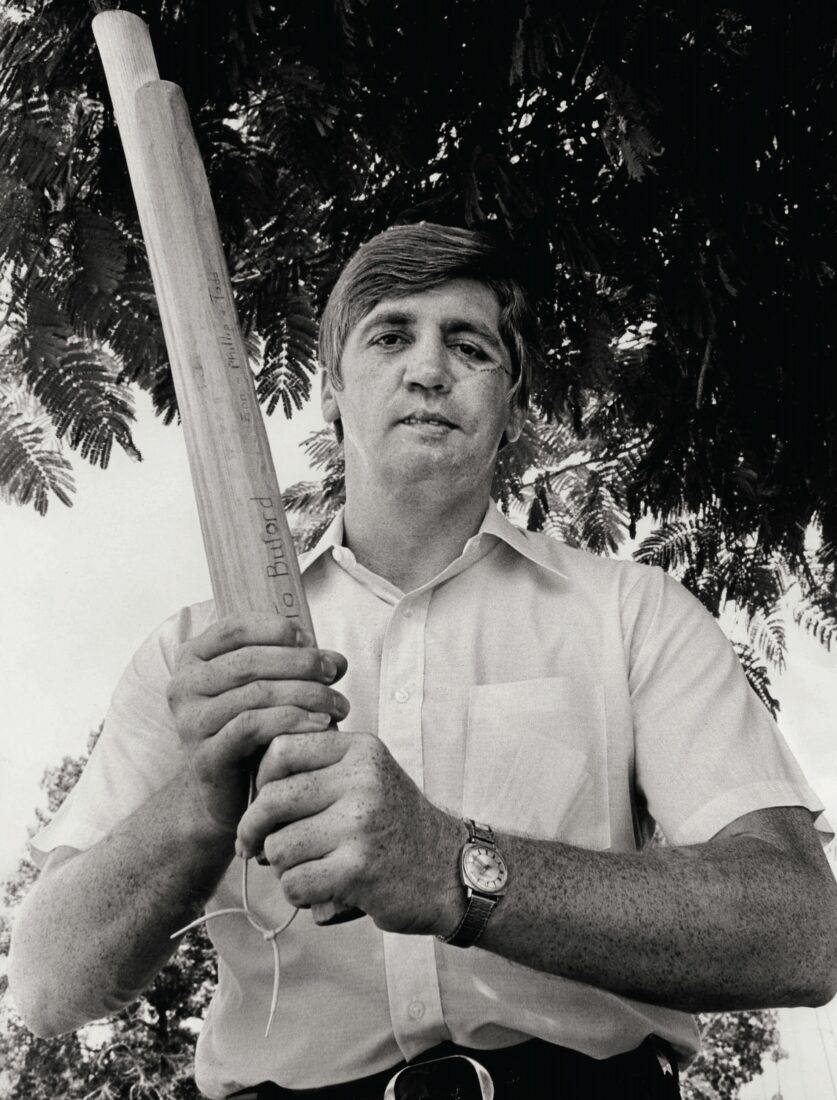
Photo: ©Gerald Holly-USA TODAY NETWORK via Imagn Images
Buford Pusser strikes a familiar pose at his Adamsville, Tennessee, home in 1973.
I’d heard rumors from folks who’d lived on the edges of Pusser’s territory. But a young Judge Biggers had worked as a prosecutor in Corinth, Mississippi, during Pusser’s time as sheriff. He knew all the criminals, from Hathcock to Junior Smith to Towhead White. And of course, he knew Pusser himself. Judge Biggers told me that when I wanted to hear the whole story to let him know. I never did. Maybe I preferred to keep the hero image intact. Like what’s said at the end of The Man Who Shot Liberty Valance, starring John Wayne: “When the legend becomes fact, print the legend.”
Judge Biggers died in 2023 at eighty-eight. Two years later at a press conference, the Tennessee Bureau of Investigation announced the shocking conclusion of a cold case investigation into Pauline Pusser’s murder. New interviews, exhaustive ballistics tests, and a first-ever autopsy of Pauline’s body pointed to none other than Buford Pusser as his wife’s killer. If Pusser had been alive, the district attorney general said, they had more than enough to indict him.
For the Pusser faithful, it was an earthshaking moment. But for many people in McNairy County, the TBI’s statement verified what they had long suspected. The news nearly knocked me out of my boots, as it confirmed what Judge Biggers had tried to tell me. All those dirty details were now out in the public record.
Pusser himself died in 1974 after skidding off Highway 64 near Selmer in his souped-up burgundy Corvette. (Don Page sings about the event on his regional hit single “Died on Route 64.”) Witnesses had spotted him drinking liquor out of a Coleman’s Bar-B-Q cup at a county fair. After Joe Don Baker dropped out of the sequel, Pusser had signed a contract to play himself. He had been feted at a press conference at the Rivermont hotel in Memphis on the very day he died. He was buried next to Pauline in the Adamsville Cemetery. A massive headstone with both their names reads, HE WALKED TALL.
Plenty of people in McNairy County have celebrated Pusser since his death. Visitors can stop into the old courthouse in Selmer where he held office and ran the jail. The old Pusser family ranch house in Adamsville is like a mini Graceland for the faithful, the dark wood paneling of 1974 frozen in time. The Adamsville water tower features a silhouette of the man, and every spring, its city park hosts the Sheriff Buford Pusser Festival, with bus tours and a carnival. There’s even a Walking Tall Trail where visitors follow Pusser’s famous exploits.
After the news broke on the investigation, people vandalized metal signs on the trail, and Adamsville held meetings about what to do with the city-run house museum and festival. Online, Pusser fanatics raged. They directed a lot of their ire toward a cop turned internet sleuth named Mike Elam, who first directed TBI investigators to holes in Pusser’s story and discovered new leads.
I studied the crime scene photos, listened to many of the interviews, and watched videos of the ballistics testing and multiple angles of gel-filled dummy heads, eerily set in cars, exploding. Some of the TBI’s six volumes with nearly 2,500 pages are available online, with the full report accessible only at the University of Tennessee at Martin. The mountain of evidence against Pusser is strong and convincing. Investigators say Pusser murdered his wife, staged the scene as a fake ambush to blame his enemies, and then stuck a pistol in his mouth and blew out his own cheek. For the rest of his life, he’d try to only take pictures with his head turned or the disfigured half of his face in shadow.
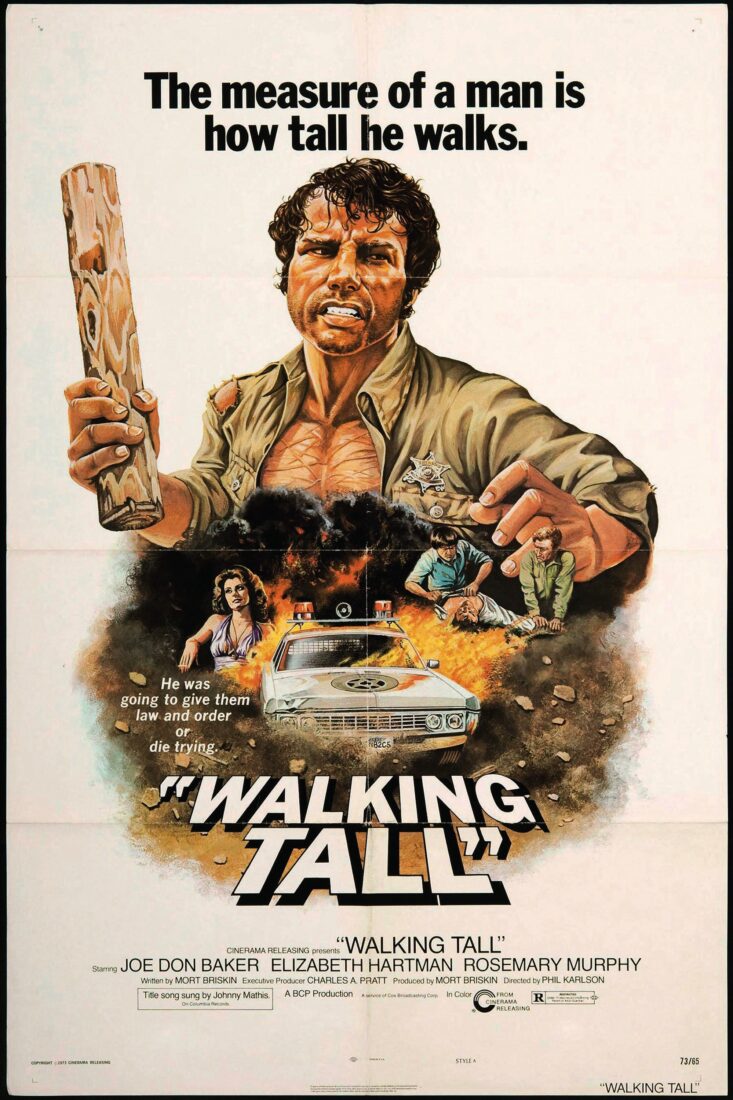
Photo: lbum/Alamy. New Hope Road: ©Gerald Holly-USA TODAY NETWORK via Imagn Images
A movie poster for 1973’s Walking Tall, starring Joe Don Baker as Pusser.
Pauline’s death had cemented the status of a man who had always wanted to be—and for many years was—the most famous lawman in America. He blamed the Dixie Mafia or the State Line Mob for the ambush, but in truth, the “mob” was just a loose group of folks hustling liquor to make a buck. My own grandfather had been a bootlegger in Lamar County, Alabama, and two of my uncles ran ’shine for him. They didn’t run liquor because they loved it. They ran it because times were hard. It reminds me of a line from Drive-By Truckers’ “The Buford Stick,” about Pusser busting up stills and ruining the livelihood of poor families: “To me, he’s just another crooked lawman from Tennessee.”
On a balmy October day shortly after the TBI press conference, I returned to McNairy County to retrace the story myself. The old state-line bars are gone now. The White Iris. The Ole Hickory. Willie B’s. You can ride out to the border and see a pole that once held flashing lights to beckon truckers into the Plantation Club. If you walk deep enough into the tangled woods, you can even find where the Shamrock Motel’s swimming pool has been filled in and grown over.
McNairy County is a beautiful place lined with old farmhouses, quaint down-towns, and rolling green pastures. Pusser’s legacy still looms large, but after all these years, only a few living connections remain: a former deputy of Pusser’s; two ex-girlfriends who’d rather stay anonymous; kids of some of the lawbreakers. They tell a different account. “Now that we know Buford killed Pauline,” Kim Bienash, the county’s archives director, told me, “you have to question everything.” According to TBI witnesses, Pusser’s many affairs pushed Pauline over the edge. Before she died, she had threatened to expose the payoffs he’d been accepting, packed her bags, and was staying at a nearby motel.
It’s a very different tale from Walking Tall, even beyond Pauline’s murder. For a crime reporter turned novelist like me, the truth of Buford Pusser as outlined in the full report tells a more complex, more authentically Southern story. It may not get people standing up in movie theaters and applauding, but it should make them rethink who and what we exalt.
There’s no denying Pusser was corrupt. He took bribes from the moonshiners and club owners. The ones he busted were the folks who wouldn’t pay or those he had a personal vendetta against. Paying off the law was a rite of passage that went back decades in McNairy County. Pusser simply pretended to be one of the rare good guys as he took the money. He had girlfriends while married. He was a known liar, possibly a sociopath, and he ruled with an iron fist and a gun.
Over the past few years, I’ve spent a lot of time with Dennis Hathcock, whose parents ran the Plantation Club, across the highway from the Shamrock Motel. That’s where Dennis’s aunt, Louise Hathcock—a tough redhead rumored to wield a ball-peen hammer against unruly drunks—was shot dead by Pusser on a snowy February night in 1966. Pusser claimed self-defense, even though she’d been shot three times. Once underneath her jawbone.
“He never thought about carrying a stick,” Hathcock, who is now seventy-six, told me. “He once took a fence post, okay, and beat a car all to hell. That’s where that came from. In his early days, he stopped some guys from Mississippi, and they didn’t know who he was, because he didn’t wear a uniform. They was smarting off and he picked the damn stick up and beat their car.”
When he was a child, Hathcock and his family lived in the back of the club, where he would tune the television to Howdy Doody and Winky Dink and You. Hathcock knew all the players. As a teenager, he tried to evade Pusser’s modified Plymouth Fury in his V-8 “Nickey” Chevelle back in the day when there were more back-roads car chases in McNairy County than in all seven seasons of The Dukes of Hazzard.
Hathcock’s father, W. O., is core to the Pusser legend. In the popular account, a young Pusser gets robbed at the Plantation Club. He’s knocked around and stabbed and left for dead but returns later to get his money back. Not a penny more. In truth, there’s no evidence Pusser was ever robbed or beaten at a state-line club. However, newspapers and police records do show he was charged with robbing the Plantation with two buddies in late 1959. Pusser, who was living in Chicago at the time, went to trial for the robbery but was exonerated because his factory time card showed he had been at work, hundreds of miles from McNairy County. Later on, Pusser admitted that a friend had punched his card.
Some have even questioned the circumstances surrounding the death of incumbent sheriff James Dickey, whom Pusser ran against in his first election, from a car accident just days before the vote. Rumor is Pusser and Dickey were back-roads racing and Pusser ran him off the road and into an elm tree.
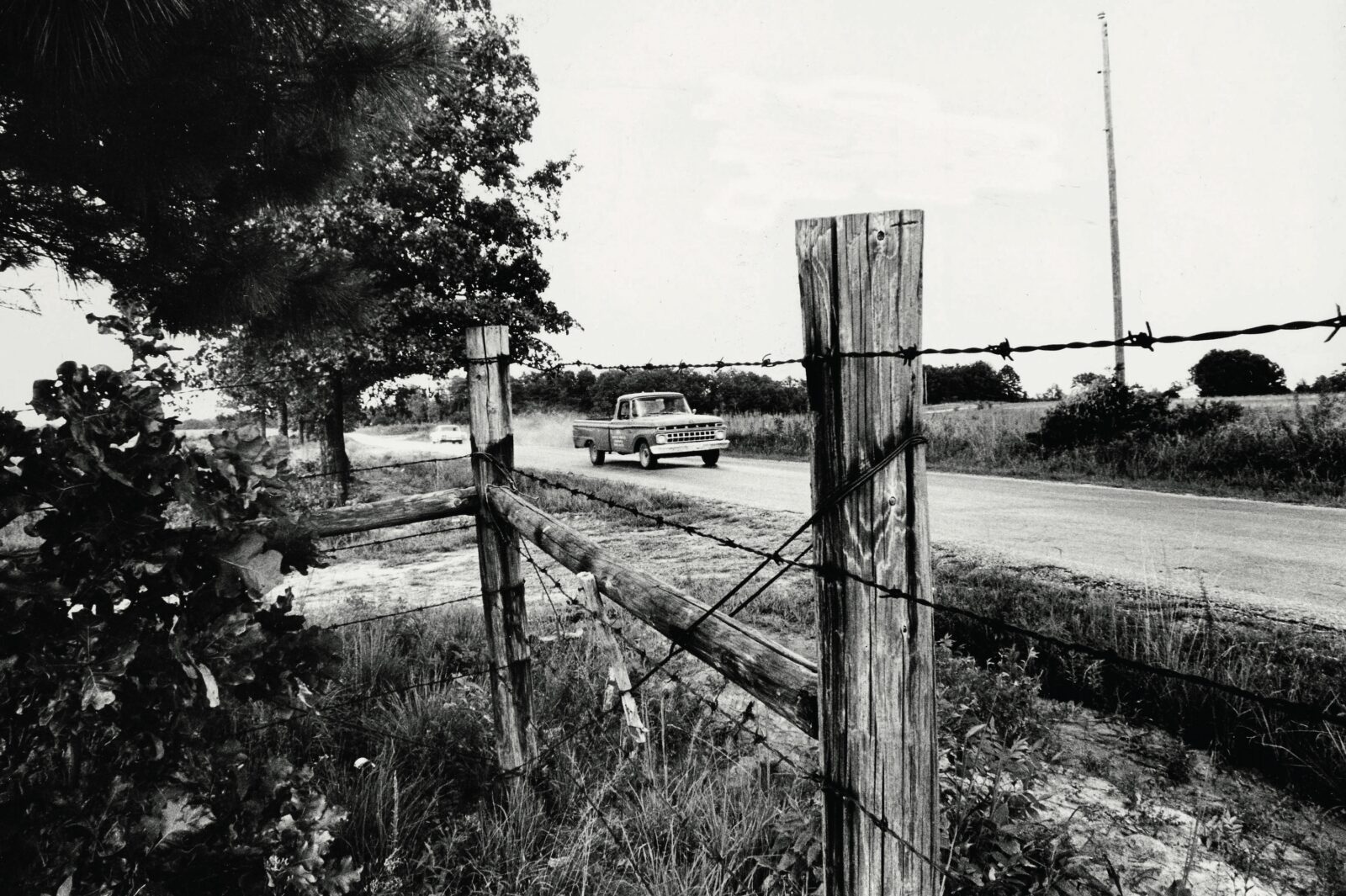
Photo: ©Gerald Holly-USA TODAY NETWORK
The spot along New Hope Road where Pusser said he was ambushed in 1967.
When Hathcock and I drive down New Hope Road at sunset, he’s quick to point out what’s changed and what hasn’t since the fateful night of August 12, 1967. The New Hope Methodist Church, where Pusser said a mysterious Cadillac pulled behind him and Pauline, looks the same. He notes several new houses and trailers among the rolling hills and old oaks. Sunlight flickers through the branches, pastures shadowed, as we take my F-150 along the supposed ambush route and over a small bridge. Way too narrow for the Cadillac to pass Pusser’s car.
Down the road, Hathcock tells me to slow down and stop. We get out of the truck and cross the quiet road where he points to a ditch. After word spread of Pauline’s murder, many residents came out to view the crime scene—the Pussers’ bloody car—including Hathcock. Later that morning he drove a couple of miles down New Hope and spotted a pile of bullet casings and what he believed to be part of a human skull and brain matter. Now he points to the place beside the road, far away from where Pusser said they were ambushed and shot.
Attached to the skull was “long, peroxided hair,” he says. “I knew it was Pauline’s.”
So how did a crooked Southern sheriff who many suspected murdered his own wife become the South’s Paul Bunyan? The newspapers of the time didn’t help, as they never questioned the official version—Pusser’s version—of events. And then CBS News took note in 1969 and came to town, airing a national segment about Pusser’s heroics and tragic backstory. A seasoned Hollywood writer-producer named Mort Briskin saw it and reached out to director Phil Karlson. Karlson was known for gritty, socially relevant Westerns and noirs like The Phenix City Story, a 1955 film about Alabama’s own Sodom or Gomorrah, which I researched and wrote about in my 2008 novel, Wicked City.
As Karlson told The New York Times in 1974, after the segment aired, Briskin called Pusser that night and flew to Tennessee the following day. “He became enormously excited by the idea of Pusser: a man who had been a peaceful citizen until the local syndicate harassed him and his family. He turned on the syndicate, literally armed with a big stick, and smashed up their whole world. When he became sheriff, he drove them out.” That’s Walking Tall: largely a Hollywood invention for a place and a time that needed to believe in a hero.
Here in the South, we’ve done this before. Charles Reagan Wilson, a professor emeritus of Southern studies at Ole Miss who wrote Baptized in Blood: The Religion of the Lost Cause, reminded me that even a century after the Civil War, during the civil rights era, the image of Southern law enforcement was in the toilet. Officers were usually portrayed as racist, fat, and stupid. (The Andy Griffith Show was an exception.) “It’s hard to separate Pusser from the 1970s,” Wilson says. “I think the nation was willing to embrace a kind of positive, Southern, white working-class hero. Think of Burt Reynolds. Walking Tall was not far from Smokey and the Bandit. Pusser was part of something bigger going on.”
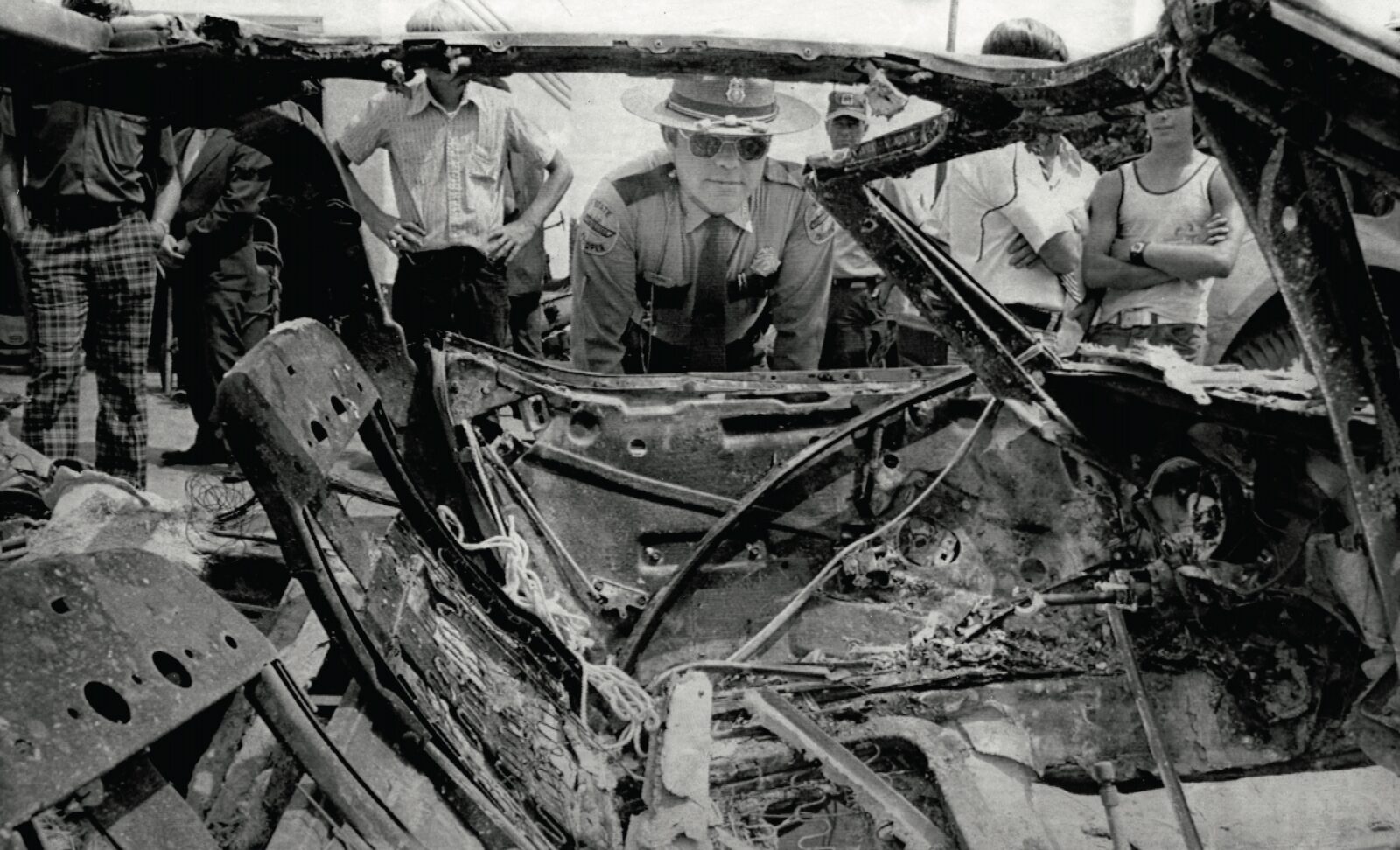
Photo: ©Robert Kollar-USA TODAY NETWORK via Imagn Images
On August 21, 1974, a trooper examines the deadly wreckage of Pusser’s Corvette.
Last year, I became fast friends with my fellow Pusser collector Robert Hoskins, although his collection is a hell of a lot more impressive than mine. Over thirty-five years, he’s scored two license plates from Pusser’s county vehicles (real ones, not my cheap fakes), one of Pusser’s guns, the PUSSER FOR SHERIFF sign displayed on the back of Joe Don Baker’s truck, and even one of the film’s prop sticks. “I try to tell people I’m really not a fan of Buford Pusser,” Hoskins says. “I don’t dislike him. I’m more of a fan of the whole story that encompasses him.” That means the good, the bad, and the ugly. I think I can understand that. The Buford Pusser in my stacks of books and memorabilia was the hero the South needed at the time. Rather than light up a nice bonfire, I chose to keep them as a reminder of how a pretty lie can become more powerful than the ugly truth. Besides, I still love the movie.
Hoskins says that he, too, became obsessed with Walking Tall after watching it many times with his father. As a kid, he was curious about the real Pusser and sought out books like The Twelfth of August by W. R. Morris. But they only celebrated the fable. Hoskins always figured there had to be more to the story. “People need to remember Buford was a wrestler,” Hoskins says. “And wrestling looks rough on TV. But really, it’s all staged.”
As for my Quinn Colson, he lives on as his own complicated character, with his most recent installment released as The Heathens in 2021. Since then, I decided to take a short break from that Southern lawman, and I’m still trying to figure out his place in our modern era. I’m currently writing a new series about a Black private investigator in Memphis who works outside the law and a broken system. That doesn’t mean I’m done with Colson or the man I based him on. I’m concurrently working on a big, fat nonfiction book about the real Buford Pusser.
In the meantime, the festival goes on and the museum remains open. A new self-published book disputes the TBI investigation and Pusser’s involvement in Pauline’s death. Whatever’s next, the legend will only continue to grow as the arguments rage. And I’ll still drive the back roads of McNairy County, with the voices of Dennis Hathcock, Robert Hoskins, and Judge Biggers guiding my questions, many still unanswered.
An anecdote I often recall comes from the seventies when Pusser and a business partner threatened the singer Eddie Bond’s life if he didn’t relinquish his royalties from Pusser-related projects. But even after seeing Pusser’s shadowed profile up close, Bond just kept singing his ballad:
He can whip a mountain lion with a cat-o’-nine-tails
Pick up a bale of cotton, throw it over a still
Hits them moonshiners in his bare feet
Not a crook in McNairy County that this big sheriff can’t get
He’s Buford Pusser!
Ace Atkins is an award-winning, New York Times best-selling author who started his writing career as a crime beat reporter in Florida. Don’t Let the Devil Ride is his thirtieth novel. His previous novels include eleven books in the Quinn Colson series and multiple true-crime novels based on infamous crooks and killers. He lives in Oxford, Mississippi, with his family.
Garden & Gun has an affiliate partnership with Bookshop.org and may receive a portion of sales when a reader clicks to buy a book. All books are independently selected by the G&G editorial team.