

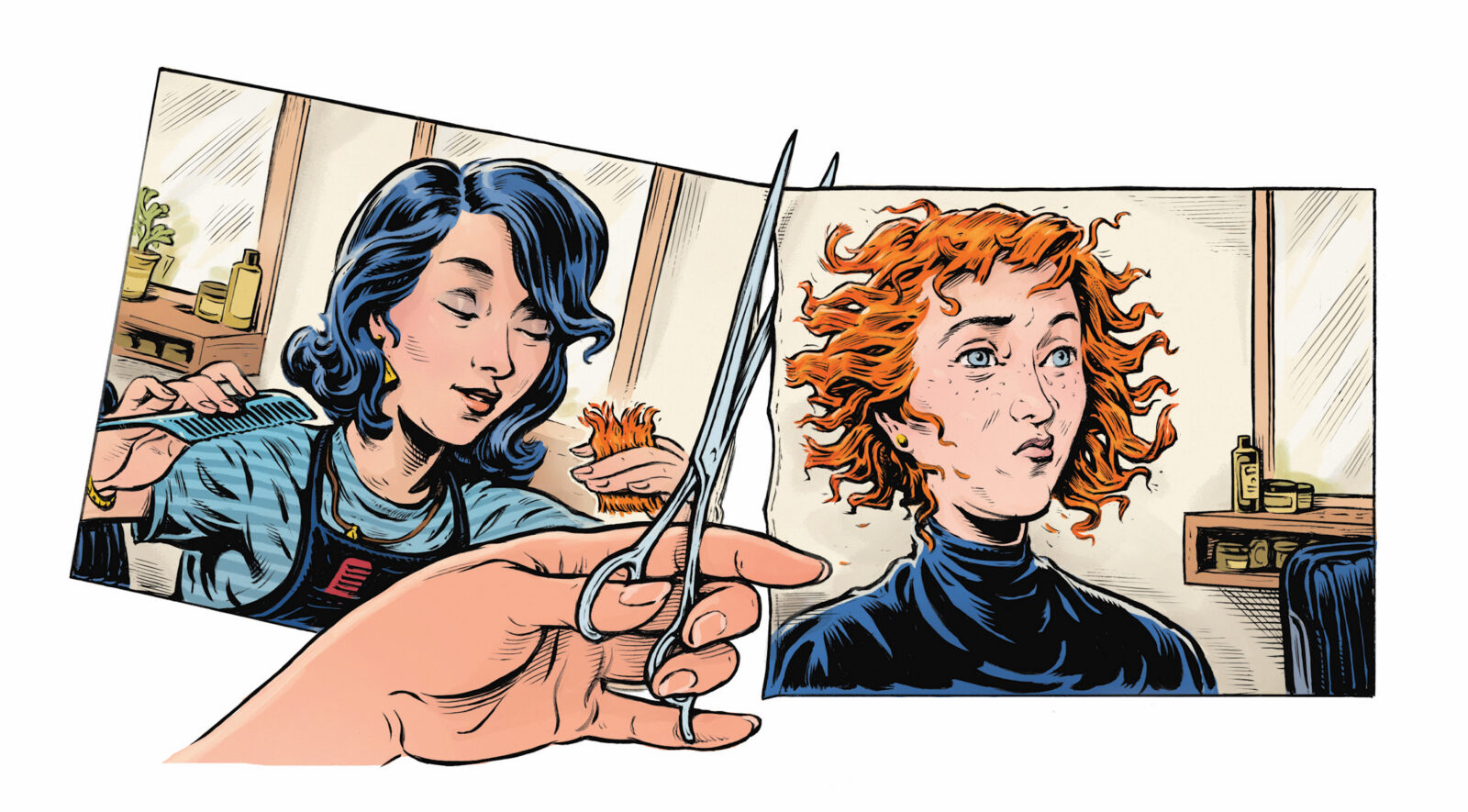
I was thirteen when it happened. Brace-faced and crowned with unruly red curls, I was treated by my well-meaning mother to a “day of beauty.” Things started promisingly enough. Thirty minutes at a Nordstrom Clinique counter successfully negotiated my blond monobrow into two respectable light-brown parentheses. A dab of rouge, as my grandmother would say, added a wholesome glow, and a swipe of now-discontinued Ripe Raisin lipstick had me flirting with self-esteem. Then we moved on to phase two: the salon. Fellow wavy-curly-kinky-haired readers will know where this is headed. I was young. I was naive. I was far too polite to object when the stylist raised her shears and declared with the authority of someone about to ruin my eighth-grade school photos, “What you need are layers!” I exited the salon looking like a Ronald McDonald wig caught on a chain-link fence.

I cried the entire ride home, informing my mom through sniffles that I would never, under any circumstances, return to that stylist. There was just one small wrinkle: She was my mother’s beautician. And thus began my earliest lesson in the complicated politics of hair relationships. Turns out, you can’t always ghost someone over a bad cut…or can you?
A highly unscientific survey of my friends suggests that we have all unceremoniously ditched a hairstylist—not only once, but repeatedly. And not just by quietly failing to rebook. I once spotted a hairdresser I was determined to dump grocery shopping and fled to the frozen food aisle, where I clutched a Hungry-Man chicken-fried steak over my face like a witness in protective custody.
But why? Why is it so hard to say, “I’m sorry, but I think we should see other people” to a stylist instead of vanishing? Maybe it’s the intimacy. A salon appointment can include hours of uninterrupted eye contact and scalp touching. We confess. We gossip. Catholic schooling aside, it’s the closest I’ve ever come to a confessional.
To my relief, I found some support from Lizzie Post, the great-great-granddaughter of etiquette guru Emily Post. As the millennial voice of the Emily Post Institute, Lizzie gamely weighed in on the fraught ethics of hair care. “While ghosting is not always the best behavior, it is an option,” she says. But if you live in a small town and might actually run into your stylist at Target or church or the grocery store’s TV dinner aisle, Lizzie warns, it’s probably worth having the uncomfortable conversation.
Lizzie suggests a softer exit for those like me who break out in a stress frizz over confrontation: Wait until after hours and leave a voicemail citing a neutral reason like, “I found someone more in my price range,” or “I need to switch salons for proximity.” Translation: It’s not you, it’s geography. But if you’re hoping to switch stylists within the same salon? That’s not a quiet exit—that’s walking into a social minefield with foils in your hair and gossip already blooming at the shampoo bowls. If the salon even allows it, another gentle reason, like a better schedule fit, could smooth ruffled tresses.
Alas, sometimes the only option is cutting and running. In that light, ghosting your hairdresser may be less a breach of etiquette than an act of self-preservation. After all, a surprising number of us are living with PTSD—Post-Traumatic Stylist Disorder—diagnosed after someone promised Jennifer Aniston’s Rachel cut and delivered a crime scene. In cases like that, I’d argue, split ends justify the means.
For more solutions to burning questions, explore our Southern Conundrum collection. Have a conundrum of your own? Email [email protected].
Kinsey Gidick is a freelance writer based in Central Virginia. She previously served as editor in chief of Charleston City Paper in Charleston, South Carolina, and has been published in the New York Times, the Washington Post, Travel + Leisure, BBC, Atlas Obscura, and Anthony Bourdain’s Explore Parts Unknown, among others. When not writing, she spends her time traveling with her son and husband. Read her work at kinseygidick.com.