

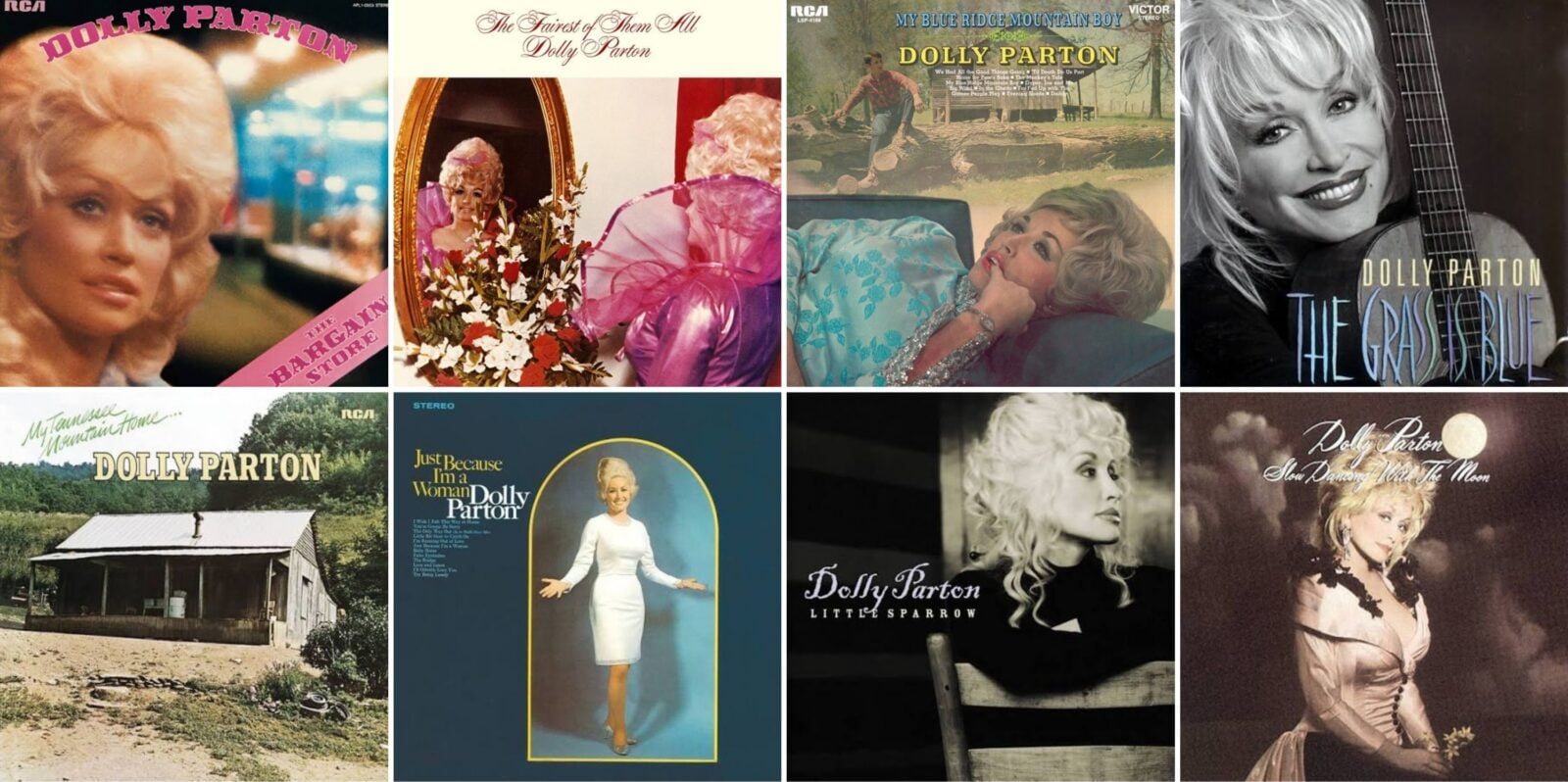
Dolly Parton wrote more than three-thousand songs during her seven-decade career, an extraordinary output that touched on her hardscrabble childhood, female empowerment, and brutal heartbreak. And that’s just for starters. “Writing’s just as natural to me as getting up and cooking breakfast,” she told The New York Times in 2002. “I ain’t never far away from a pencil and paper or a tape recorder. I write every day, even when I’m on a plane, in the tub or on the bus. It burns in me.”

Below is a playlist of some of Parton’s greatest songs, but ones that are sometimes overlooked amid the cultural phenomena of classics like “Jolene” and “Coat of Many Colors.” All were written by Parton save for the final track, “Slow Dancing with the Moon” (penned by Mac Davis), which is too poignant to leave off. I hope Dolly is doing that right now with her husband, Carl Dean, who passed away in 2025. She deserves it.
“Down from Dover” (1970)
A pregnant girl is cast out by her family and left waiting for a man who’s never coming back. When the baby arrives stillborn, the whole song drops out from under you. The idea came to Parton while she was riding through Dover, Tennessee, on her tour bus. Country radio wouldn’t touch a record about unwed pregnancy in 1970, but she cut it anyway and revisited it decades later.
“My Blue Ridge Mountain Boy” (1969)
On the surface it’s a love song, but the ache underneath is really homesickness for the hills—the kind of mountain longing that runs throughout her early work. You can hear those roots in her phrasing here.
“The Bargain Store” (1975)
A woman casts herself as a secondhand shop full of worn and damaged goods, then quietly dares a new lover to come in and buy what’s left of her. The metaphor was too pointed for some radio programmers, who mistook it for a reference to prostitution and pulled the record—even as it climbed to No. 1.
“Marry Me” (2001)
A breathless, banjo-driven rush of a song about a girl half out of her mind with the thrill of getting hitched. Coming near the end of Parton’s early 2000s bluegrass trilogy, it’s proof of how alive and unguarded she still sounded once she stripped everything back to the pickers.
“Down on Music Row” (1973)
The origin story sitting underneath every Parton song: A young woman steps off the bus in Nashville and gets turned away at the very doors that would later beg for her songs. She sings it with the wry distance of someone who already knows how it ends.
“Just Because I’m a Woman” (1968)
She wrote this one straight from her own marriage, after husband Carl Dean asked about her past relationships early on and couldn’t hide his disappointment at the answer. Her reply became the song: “My mistakes are no worse than yours / Just because I’m a woman”—a challenge to the double standard that landed years before the rest of the culture was ready to have the conversation.
“Gypsy, Joe and Me” (1969)
A drifter, the man she loves, and a stray dog wander through a hardscrabble life until the ending pulls the floor out in a single verse. She kills you in three short scenes, without ever raising her voice to do it.
“In the Good Old Days (When Times Were Bad)” (1968)
She looks back at her own childhood of genuine poverty and refuses to sweeten it, insisting there was nothing good about being that hungry and that cold. It’s the clear-eyed flipside of the warm-cabin nostalgia she’d sometimes trade in elsewhere.
“Little Sparrow” (2001)
A mountain-modal lament that warns young girls against trusting men, sung in a high, keening register that sounds centuries old. Her voice sits fully exposed at the front of the mix, and it’s some of the most naked singing she ever committed to tape.
“Endless Stream of Tears” (1999)
One of a handful of originals she wrote for The Grass Is Blue, this heartbroken bluegrass number turns the band loose while she aches over the top of it. Though the song rarely gets mentioned in her greatest-hits conversations, it absolutely belongs in the mix.
“The Grass Is Blue” (1999)
The album’s title track finds a narrator reeling from a breakup, insisting the whole world has gone upside down—the sky green, the grass blue, the rivers running backward—as a way of refusing to accept she’s been left. Parton wrote it in a half-hour lunch break on a film set and still called it one of the best things she ever put on paper.
“Slow Dancing with the Moon” (1993)
Inspired by Parton and written by her longtime friend Mac Davis, it’s a love song about life itself. A particularly poetic line captures Parton’s signature bright outlook, which somehow never felt at odds with a world that can feel heavy: “I’ve lived my life like a lovesick clown in a bittersweet cartoon / Just a dreamy-eyed kid slow dancing with the moon.”
Read more from G&G about Dolly Parton through the years.
Matt Hendrickson has been a contributing editor for Garden & Gun since 2008. A former staff writer at Rolling Stone, he’s also written for Fast Company and the New York Times and currently moonlights as a content producer for Ohio University’s Voinovich School of Leadership and Public Service in Athens, Ohio.