

Home & Garden
This Stunning Sewanee Home Is Almost as Spirited as Its Owner
Step inside a Tennessee priest, sailor, artist, writer, and hostess extraordinaire’s colorful, ever-evolving abode
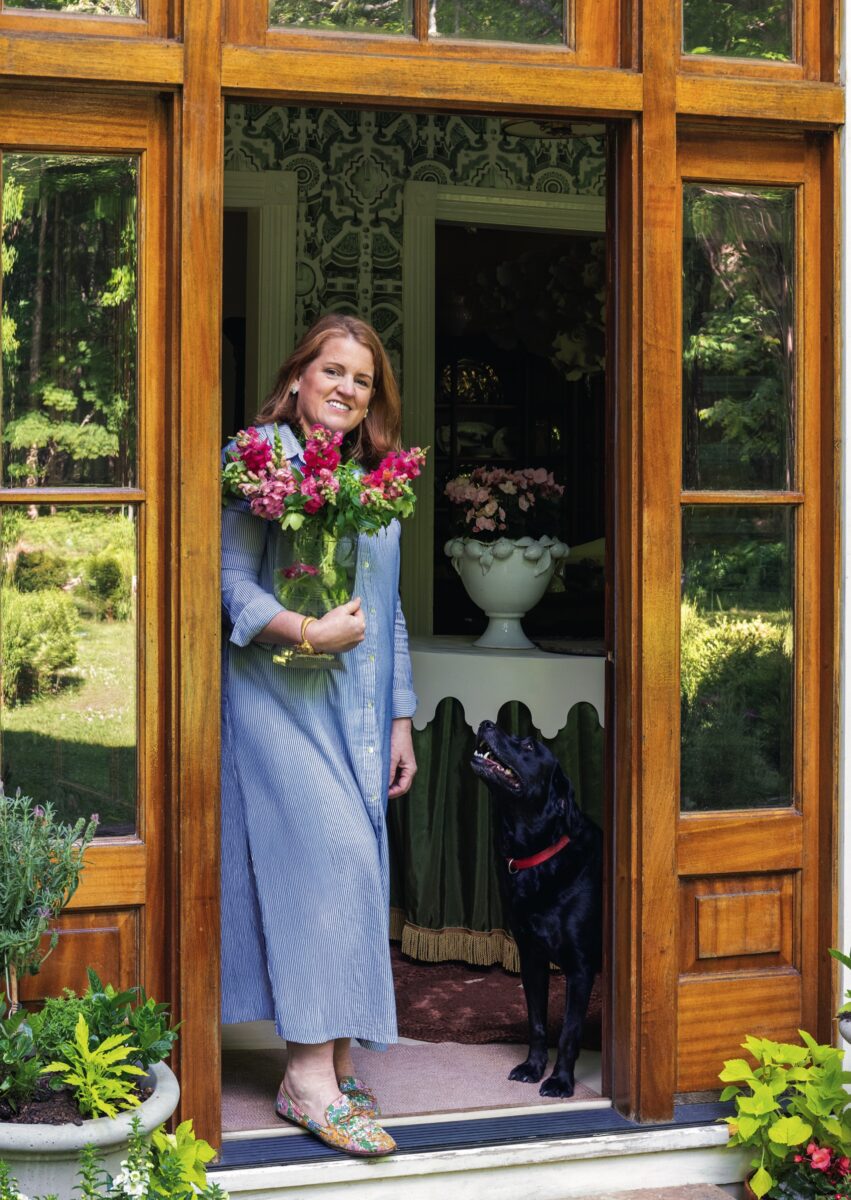
Photo: Caroline Allison
I don’t know Maryetta Anschutz, but I call her out of the blue to tell her I’ve been assigned to write a story about her and the house she restored in Sewanee, Tennessee, a sleepy university town atop the Cumberland Plateau. Within three minutes, it’s decided that there’ll be no need for me to book the fancy campus hotel, because why wouldn’t I just stay with her? A minute more, and we conclude that it would only be appropriate to throw a little party while I’m there. A week later I drive up to a towering white clapboard Victorian house and she’s nowhere to be seen, but the burnished mahogany door is standing wide open, so I walk right in.

My host; her floppy black Lab, Dolly; and a pitcher of iced tea materialize, and I learn the following: Anschutz is just what you think of when you think of a middle-aged Episcopal minister—that is, if when you think of a middle-aged Episcopal minister you think of someone who both cusses like a sailor and is, in fact, an actual sailor; someone who relishes wielding power tools and paintbrushes; someone who cheerfully broadcasts “a long and committed relationship with both alcohol and coffee”; and someone who will sift through your deepest secrets and anxieties with you to offer sage advice punctuated with phrases like “f **k a duck.”
This house—officially named Arcadia, though Anschutz thinks of it more fondly as her Sewanee Folly—has weathered a host of eccentric residents. “Let’s put it this way,” Anschutz says, “I’m not the first crazy woman to own it.” Miss Sallie Milhado, the initial owner after its construction in 1888, operated the home as a boardinghouse. She’s remembered for wearing a squirrel-tail hat, riding a horse named Maud, hiding under her bed during thunderstorms, and publicly accosting President Woodrow Wilson during a trip to Washington, D.C. (“My kind of girl,” Anschutz says). Arcadia cycled through a few proprietors over the decades, but after a heyday under the Craven family, who were highly involved with the University of the South (known as Sewanee) in the mid-twentieth century, it sank slowly into a disrepair so complete that despite a coveted location near the center of campus, it stayed on the market for a full three years after being listed in 2013.
When Anschutz first saw it around 2016, the clapboard had achieved an advanced state of decomposition. The basement turned into a veritable river in the rain, and raccoons “had gotten their hands on some kind of drugs I’ve never been able to find,” she says, and torn it apart. The kitchen was cramped and dark. The electric system was a tangled and hazardous mess. Balconies had rotted off, so second-story doorways opened to twenty-foot drops. Anschutz will be the first to admit: “It was a nuthouse, I was not in my right mind, and it was a midlife crisis purchase.” But she wanted a retreat from the breakneck pace she’d been keeping since graduating from Sewanee, working for a D.C. think tank, getting ordained as a minister and serving as a parish priest in Connecticut, becoming an associate dean of the Berkeley Divinity School at Yale, and founding and running the Episcopal School of Los Angeles. Where better to flee than to the peace of her alma mater?
Besides, Arcadia had promising bones, high ceilings, ample natural light, and endless potential for hosting—if she could only manage to evict the raccoons from the walls and bring the plumbing and wiring up to snuff. A few years before, she’d read One Man’s Folly by Julia Reed (both Anschutz and Reed attended the Madeira School in McLean, Virginia), about Furlow Gatewood’s smattering of whimsical buildings across a farm in Georgia. She dreamed of a place of her own in which to make delightful, surprising things and to live out her firm belief in the power of bringing people together around a table. Signing the deed to Arcadia called for a party: She invited a posse of Sewanee academics and assorted locals and told them to bring along their favorite demolition tool. She served Harvey Wallbangers while the guests knocked out the walls.
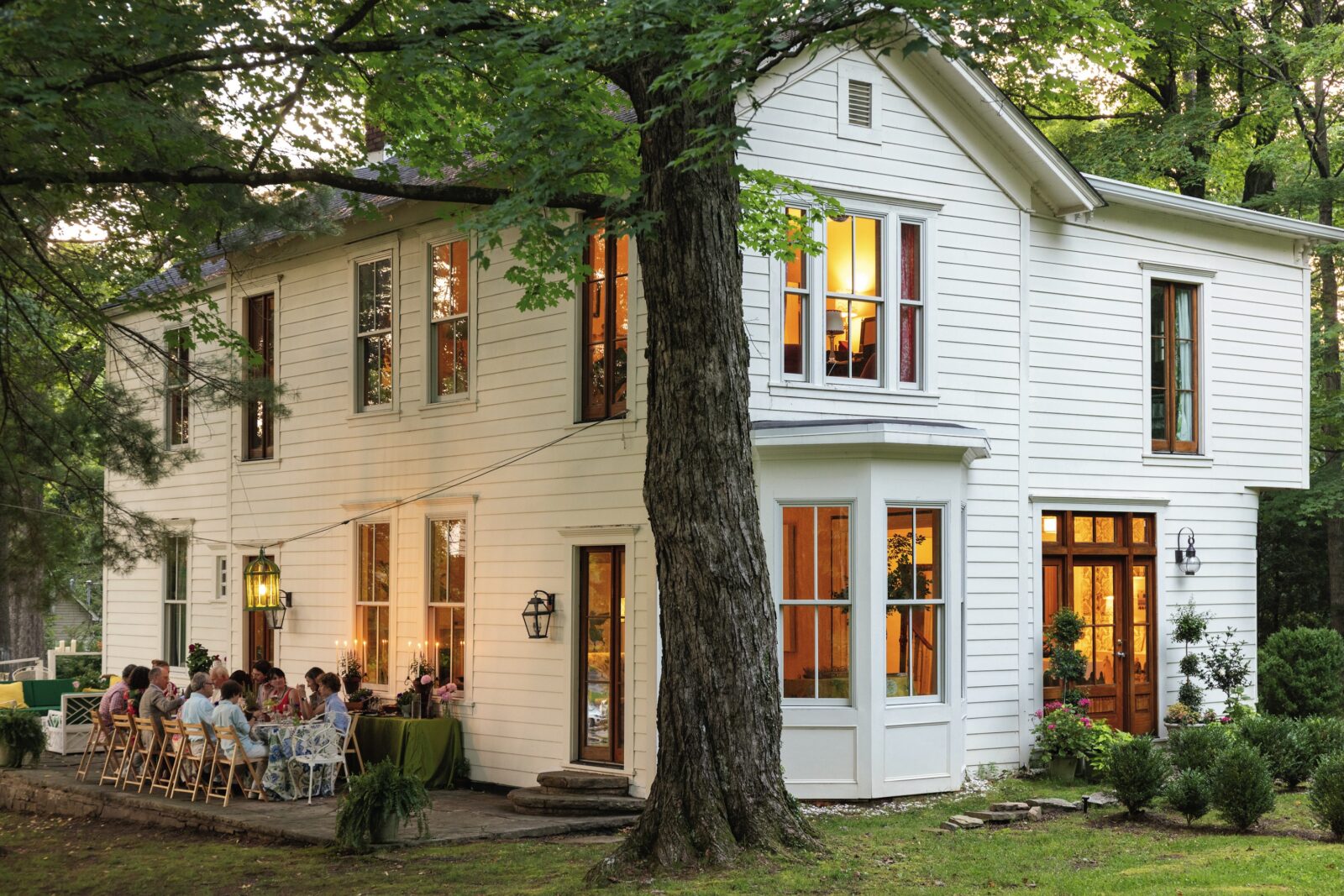
Photo: Caroline Allison
An outdoor dinner party.
“And that’s how we made the back porch into the kitchen,” she tells me as she stands barefoot in that sunny kitchen today, extracting meat from lobsters and dropping their shells into a pot to make a stock on the giant Wolf commercial-grade range that was required to fit her hosting needs—despite “costing roughly more than my car.” Arcadia has come a long way since the Harvey Wallbanger party, thanks to a troupe of handymen who helped Anschutz off and on for a while, and then full steam ahead when she decided in 2018 that she’d had enough of Los Angeles and moved across the country full-time, splitting her time between D.C. and the mountain. When the major work was finished, she invited the whole crew—whom she’d come to know over countless lunch breaks—and their families over for a dinner party.
One the lobster meat is prepped and the stock is bubbling, we take an out-of-order house tour, starting in the bedroom upstairs where I’ll be staying. Books that capture Anschutz’s ethos overflow the bedside shelf: Bunny Williams and Suzanne Rheinstein on home design; cookbooks from Frank Stitt, Thomas Keller, and Melissa M. Martin; and one of her favorite titles, Being Dead Is No Excuse: The Official Southern Ladies Guide to Hosting the Perfect Funeral.
We head back downstairs to the dining room, where a huge china cabinet holds all manner of thrifted plates; for tonight’s shindig, she’s selected ones featuring green florals and graceful fish. Above the wooden table hangs a tumbling chandelier-meets-sculpture of papier-mâché flowers that Anschutz fashioned herself, inspired by dogwood and magnolia blooms. More flowers wait on a table to be hung; eventually, she plans for the display to creep across the ceiling and down the walls.
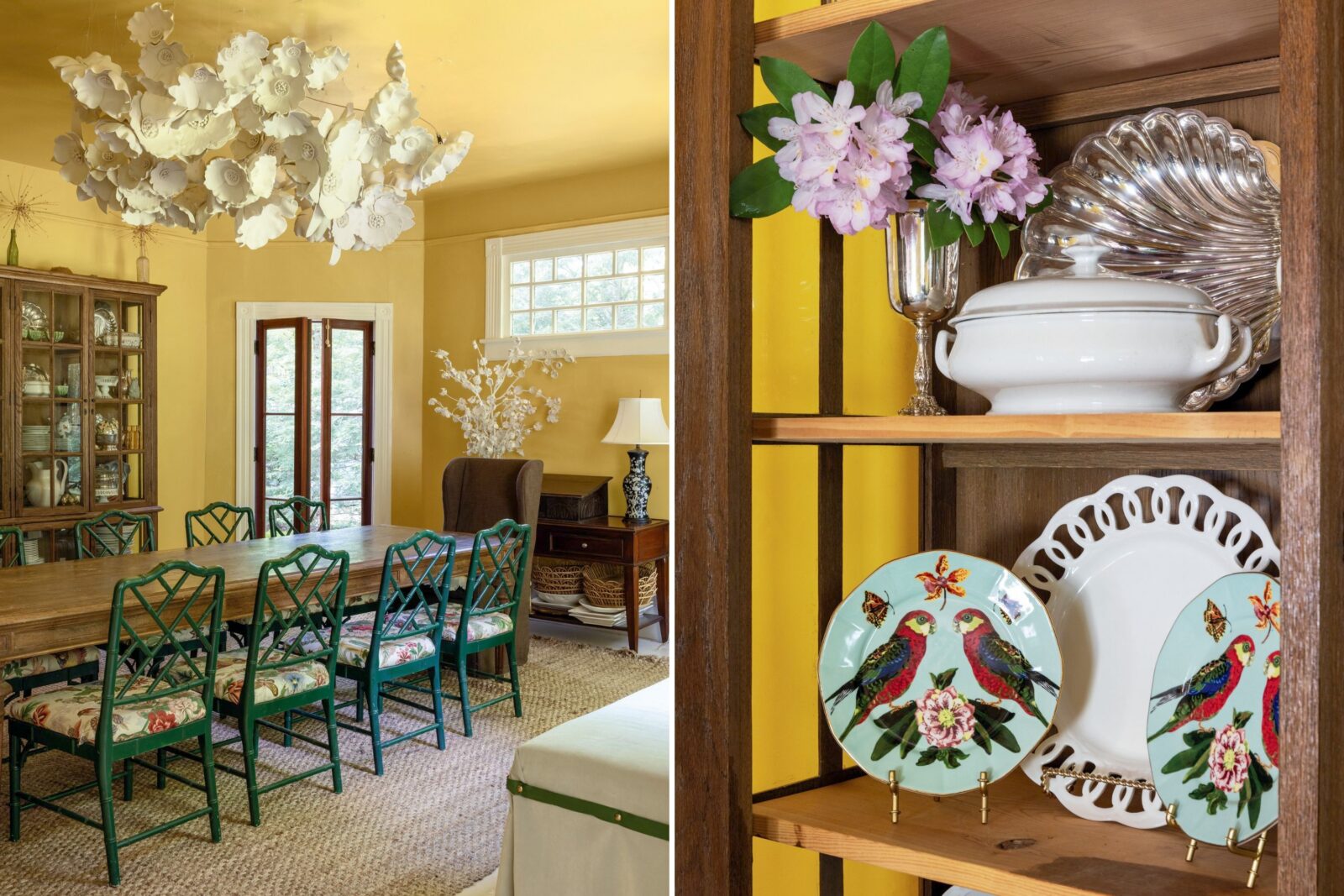
Photo: Caroline Allison
A handmade papier-mâché chandelier and a corresponding flower arrangement may someday spread to fill the dining room; collected serving platters, a casserole dish, and a silver goblet.
A pattern starts to emerge: Each time I see something that jumps out at me, she’s painted it or carved it or reworked it herself. A portrait of an angry osprey presides over the living room. “I painted that while my sister was fighting cancer,” she explains. “He’s mad and he’s molting and he’s in a mood.” She covered the English-style drop-arm couch, which former parishioners gave her, in a bright fabric of florals and butterflies. A vase shaped like a giant wineglass holds foraged branches blooming with feathery white hydrangeas. A huge, blank canvas hangs on the wall, marked in pencil with Summer 2026 for when she’ll paint it. More than anything, that rectangle of white, and another just beyond the living room that cheekily reads something fabulous will hang here once the damn drywall is finished, reflects her approach to making a home: It’s a constant and unabashed work in progress.
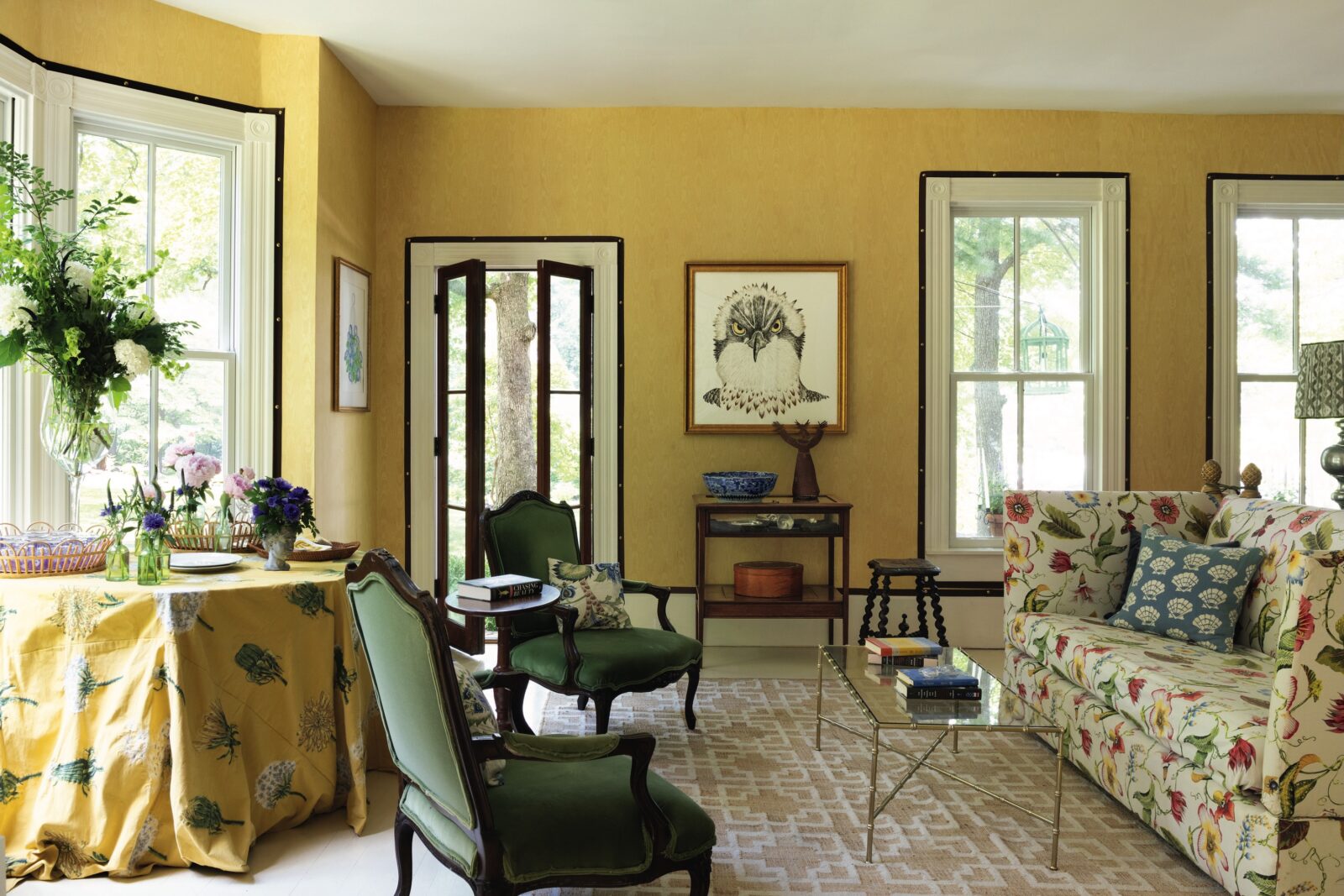
Photo: Caroline Allison
Anschutz crafted much of her home’s decor herself, including a painting of an angry osprey, a recovered couch, and floral arrangements in the living room.
A downstairs bathroom pops with the sprawling red florals of Cole & Son’s Tivoli wallpaper, a backdrop for an old claw-foot tub that came with the house. Just beyond it lies Anschutz’s office, from which she runs her company, Unconditional Media, which produces faith-based stories meant to spark conversation. The office brims with books, art, and random artifacts like a custom Muppet, made to look like Anschutz with red hair and pearls by her friends at Jim Henson Studios, which was down the road from her school in California. Anchoring it all is the ornate oak desk that belonged to her great-grandfather, who served as governor of Oklahoma, then to her grandfather and father, both Episcopal ministers (getting ordained is a genetic disease, she says).
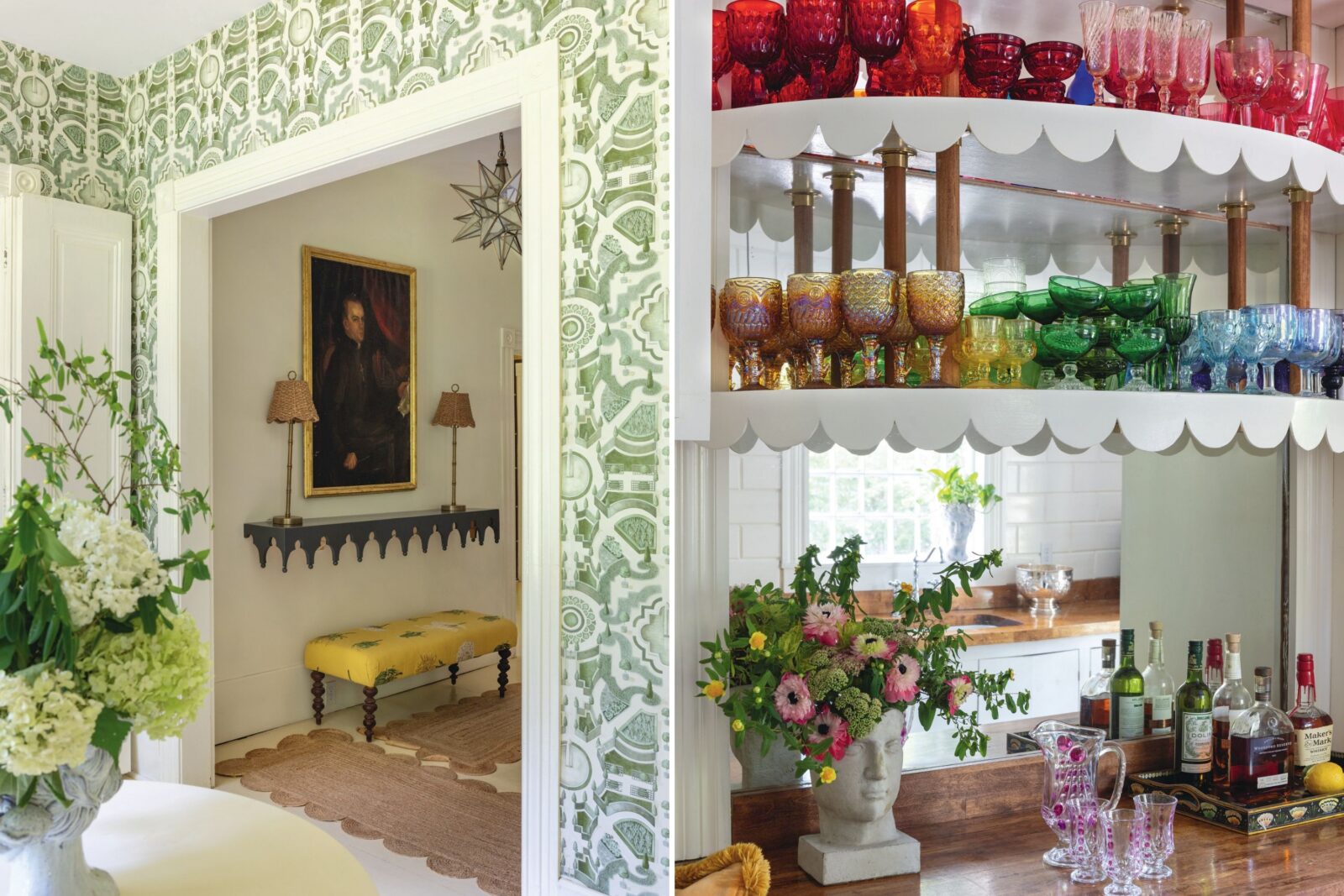
Photo: Caroline Allison
A portrait of Anschutz’s grandfather painted by her grandmother hangs in a hallway of her home in Sewanee; shelves in the kitchen display Anschutz’s vintage glassware collection.
In the foyer, where soft greens echo the natural wonderland of Sewanee’s campus, an easel holds a large wooden painter’s palette caked with dried paint. Oranges, blues, and creams swirl across it in sculptural whorls. This is Anschutz’s favorite piece in the house; it belonged to her grandmother, who battled alcoholism and severe bouts of depression. Frozen in time from the last time she painted before she died, the palette is both a celebration of Anschutz’s connection to the person to whom she owes her artist’s aptitude and a warning of the dark side of creativity and addiction.
We don’t linger too long on that train of thought, because guests are arriving in a few hours, and Anschutz sends me off to the store for a bottle of good tequila while she washes butter lettuce, whips up a light vinaigrette, hangs fresh-made pasta noodles to dry, and trusses up whole chickens for smoking.
Anchutz’s work as a host comprises equal parts grace, strategy, and chaos. She arranges an artful drinks station—its centerpiece a decorative silver bowl filled with ice and bottles of white wine—outside, so guests can mingle away from the action of the kitchen. And though she shouldn’t be able to hear or see new arrivals from her vantage point by the oven, each time someone joins the fray, she’s suddenly at their elbow, offering a cocktail. The university’s vice-chancellor, Rob Pearigen, tries to decline to save her the trouble; she reappears a moment later with his favorite bourbon. After just the right amount of time, we’re seated for dinner. Wine is flowing, Anschutz appears with the salad—she’ll tell me later that seconds before serving, Dolly jumped up and gobbled the crispy pancetta meant to top it—and the conversational dynamics of her well-curated guest list start to emerge. There’s the vice-chancellor and his elegant wife; the head of Sewanee’s creative writing program and her husband, a National Geographic photographer; the owner of the nearby music venue the Caverns; another writer from Nashville; and the couple who opened Lunch, a three-year-old, Michelin-recognized spot, which quickly became a local go-to.
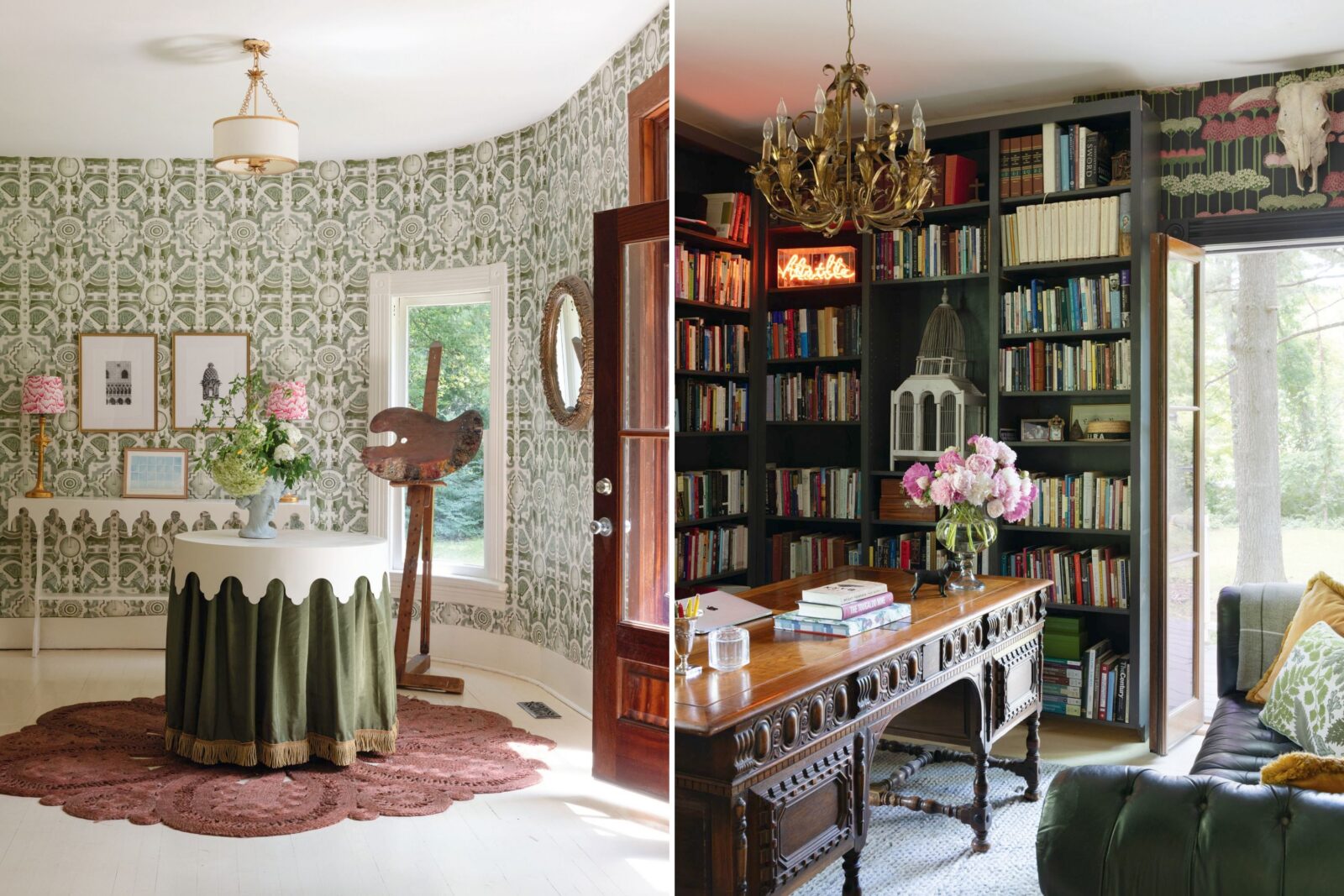
Photo: Caroline Allison
Anschutz’s grandmother’s paint palette stands in the front entryway; the desk in Anschutz’s office first belonged to her great-grandfather, who, while serving as governor of Oklahoma in the 1920s, was impeached for opposing the Ku Klux Klan.
When Anschutz disappears to plate the food, my tablemates sing her praises. “Maryetta has a huge heart,” says Mallory Tubbs, the chef-owner of Lunch. “She’s a special part of the community here.” Pearigen has known Anschutz since her days as a student at Sewanee, when she convinced the university to buy an old house on campus and transform it into a coffee shop—it’s still a beloved hangout among students today. “It might look effortless, but Maryetta makes things happen,” he says. Indeed, each year Anschutz selects a campus building to power wash, a small gift for the university she loves. She saw a need in Los Angeles and conceived her school to be intentionally diverse and inclusive, pulling students from across the economic spectrum. She once counseled a family through the loss of their daughter, then played music and poured cocktails graveside at the daughter’s request. And it all begins here. As she says: “Most of what I’ve done in life has come from conspiring around a table.”
By the time I’ve finished my lobster taco, I’m barely writing notes. By the time Anschutz brings out the fresh pasta in cream sauce and the smoked chicken—she’ll tell me later that Dolly sniffed too close to the smoker and got chicken drippings all over her head—I forget my notebook altogether. I’m just enjoying the party.
Once everyone is gone, we pour bourbon and debrief. I’ve spent less than twenty-four hours here, but already, Anschutz feels like a very old friend. Maybe it’s because she’s gathered my life story as much as I’ve gathered hers. Maybe it’s because for all her whimsy, she believes that parties are sacred and that chocolate chip cookies are a form of pastoral care. Maybe it’s that she takes her faith so seriously she doesn’t need to talk about it—and that if she’d planned the Last Supper, there would have been a large gospel choir and several clay jars of batched cocktails. Maybe it’s because of how she kicked off her heels to rough chop pasta noodles, how Dolly’s head is still a little slick from chicken fat, how she paints in her kitchen, or how she named her stove Ryan Gosling (because, she says, “who doesn’t want to turn on Ryan Gosling?”). She didn’t try to show me a curated version of her life, because that wouldn’t have been half as fun or half as interesting. She just invited me in, and this may be her superpower.
The next morning, I’m off to catch a flight to report another story. Anschutz packs me a lunch and gives me the code to the back door, so I can just go ahead and let myself in next time I’m in town.
Maryetta’s Guide to Mildly Reckless Hospitality
Curate the guest list. Venture beyond your go-to circle and mix it up. “The goal is to invite interesting people whom you don’t already know. A good dinner needs people who don’t share the same life stage, haircut, Spotify algorithm, or cholesterol concerns.”
Leave a few simple tasks undone. If there’s someone you or other guests don’t know well, pair him or her with a buddy and ask them to slice lemons for garnish or chop tomatoes for the salad. “It’ll make them feel part of things and give them something to do while the ice is broken.”
The night before, send a quick text to each guest. Share some details about the party, including a few personal lines about who else is coming. “That way, the guests arrive curious about each other.”
Set the table. Assign seats. Mismatch plates (“this lowers expectations in all the right ways”). Use real linens and colorful glassware. Offer a toast or grace to kick things off.
Feed people without losing your mind. Don’t drive yourself crazy over an unnecessarily complex dish or dietary restrictions. “Do a pan of simple roasted vegetables. Make a hearty salad so vegetarians don’t feel like decorative urns at the table. Serve a protein that doesn’t confuse anyone.”
Lindsey Liles joined Garden & Gun in 2020 after completing a master’s in literature in Scotland and a Fulbright grant in Brazil. The Arkansas native is G&G’s digital reporter, covering all aspects of the South, and she especially enjoys putting her biology background to use by writing about wildlife and conservation. She lives on Johns Island, South Carolina.
Garden & Gun has an affiliate partnership with Bookshop.org and may receive a portion of sales when a reader clicks to buy a book. All books are independently selected by the G&G editorial team.