
Sporting
A Novelist Remembers the Fish That Made Him an Angler
David Joy on the elemental pleasures of bluegill days
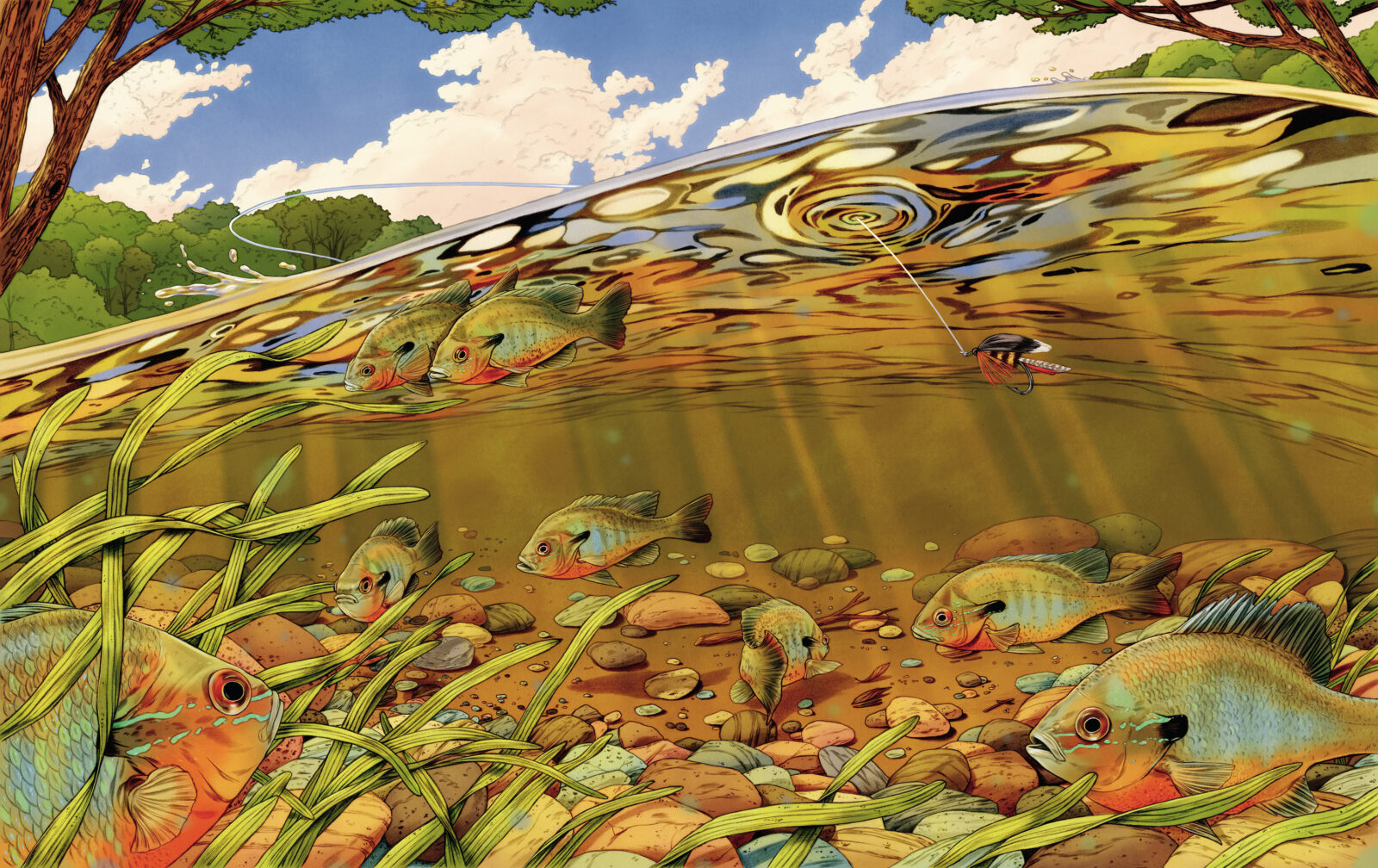
Illustration: MICHAEL HOEWELER
In the beginning there were bream.
Most all of our stories start the same. Maybe it was a bluegill, maybe a redbreast or shellcracker. But unless you grew up on the salt or in a trout stream, your earliest fishing memory probably looks like this.
For some it was a cane pole and a bottle cork. For most it was a button cast reel and a white-and-red plastic bobber that took on water and never floated quite right. Maybe you dug worms. Maybe you caught crickets. Maybe you pulled night crawlers from a light blue tub bought from a gas station that kept them in a refrigerator beside the Sun Drop and cold beer and sold hot dogs and probably isn’t there anymore.
The float nods then dips. It slides across the muddy surface and cuts a line in the film. When it finally disappears, the person who’s brought you, maybe your father or grandmother, tells you to set the hook and you do, and for a few short moments something tugs at you from a place you cannot see. For a few short seconds, the world is reduced to magic, and then it is flopping on the bank at your feet.
When I walk into the shadowed woods of my childhood, there are too many fish to count. The ones I remember most were caught on the fly in a half-acre farm pond that served as a watering hole for cattle.
I grew up in the North Carolina Piedmont, but Johnston Pond could have been most anywhere in the red-clay South. Hop a barbed-wire fence that bows between cedar posts years have weathered to bones. Run through field grass that summer sun beats golden. The water is dark, the color of root beer, and to your dipped hands feels as warm as a bath.
My mother gave me my first fly rod one Easter when I was nine or ten years old. Up until that point, all my bream fishing had been done with a hand-me-down spinning rod. I had no one to show me how to fly-cast or explain details like line, leader, and tippet. It was the bream that proved to be eager teachers. The first had most likely been carried to Johnston Pond in buckets from the nearby Catawba River, but by the time I came along, it was flat overrun with sunfish.
Sometimes I would catch them on tiny balsa-wood poppers with rubber legs that floated on the surface and moved like water striders. Other times I ran grasshoppers onto Aberdeen hooks, too young and uncorrupted to be a purist. My favorite way to catch them, though, was fishing wet flies on the fall—black gnats, Zug Bugs, brown hackles, Mickey Finns. I’d tie on a McGinty, its body striped black and yellow like a bumblebee, a pattern that was a century old the year I was born. A tall white oak shaded one corner of the pond. The water there pressed against an earthen dam. This is where the pond was deepest and the place I would start.
I flip the fly into a small pocket of water that carves a bowl into the bank. The McGinty hits the surface like a raindrop, remains visible as it sinks the first inch or two, then disappears. The line jumps and jerks, then runs and curves as the fish takes the fly and swims away. I lift the rod and feel weight, but this isn’t some epic battle. This is more like one of those old windup fishing games where the fish spin and you drop the magnet into their open mouths and pull them out one by one.
The bluegill that lies in my palm is almost black along its back, that darkness fading into a purple haze that lightens down its flank. I hold the fish in my hand with my thumb keeping the spines of its dorsal fin pressed down so that they cannot poke me. The tiny fly nearly fills the fish’s mouth, and as I work the hook loose, there is almost a grimace of frustration in its eye. A yolk yellow glows dim on its chest like the moon shown through a curtain.
I walk the fish back to the water. I kiss it on the nose and let it go.
The word bream is a remnant of colonization, from when early British settlers came to what would become America and found water filled with fish reminiscent of species from home. What they called bream were actually sunfish, a family of ray-finned freshwater fishes native only to this continent. That family breaks down into a large group that includes everything from largemouth bass to crappie. But the term bream refers to a specific genus of fishes. Lepomis. The only true sunfish.
There are fifteen species that make up this genus, and the waters of North Carolina are home to eight of those. I have caught warmouth and pumpkinseed, bluegill and redbreast, green sunfish and redears. The only two in North Carolina that I haven’t caught are spotted sunfish and dollars, species found only in the black water at the eastern end of the state.
For the most part, the others are found farther west. These include orangespotted sunfish and bantams, redspotted sunfish, longears, and northerns. One day I will travel to catch a longear, undoubtedly the most beautiful of the bunch. They look like something plugged into a 120-volt outlet, a sunset red speckled and spotted by aquamarine that glows like neon.
As far as the bream I have caught, I have always been partial to the colors of redbreast and greens. The redbreast is named for the tangerine that explodes on its chest, but for me the most marvelous features are the pale blue vermiculations that mark its cheeks like war paint. At times the green sunfish goes as dark as wetted moss, while its fins along the belly burst goldenrod with white lining the front edges as if it were a brook trout’s blood kin.
My father grew up just a handful of miles down the road from where he raised me. His earliest fishing memories come from Burr’s Pond, a puddle of water just through the woods from his childhood home. He remembers stringers lined with bream the old men called potato chips. Where we come from, those fish were always fried whole.
When I was a child, he and I would fill buckets with bream from the Catawba. We would take them home and clean them in the backyard on a piece of plywood placed on the roof of the well house as a makeshift table. Dad would have the knife. I would have the scaler. To this day I can scale fish at a speed that would blind you.
I was fifteen when my dad bought a boat, a seventeen-foot Starcraft Starcaster with a 40 hp Force. He named it The Breeze after the Lynyrd Skynyrd song. But even in The Breeze, we stuck to fishing the banks because that was all we knew.
Almost every time that we put in at South Point boat landing, we would head north up the river toward the powerhouse and hot hole, then shoot off shy at Brown’s Cove. In summer we’d toss anchor near a mimosa tree with flowers that bloomed like hot pink fireworks. The tree overhung the water. The flowers brought bugs. The bugs brought bream.
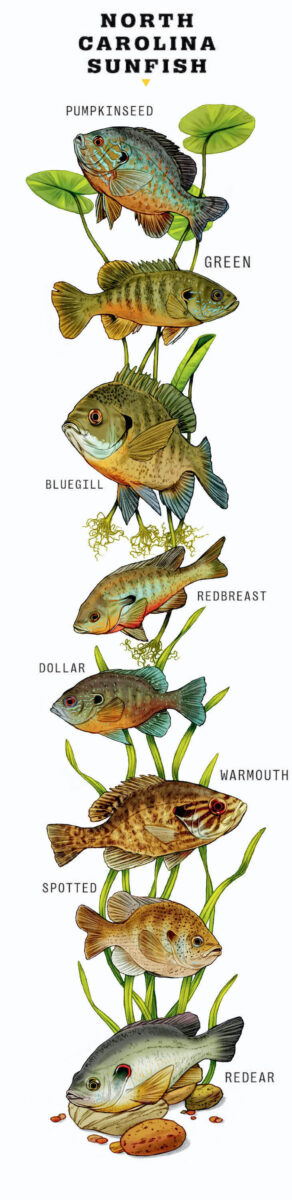
Illustration: MICHAEL HOEWELER
This is the place where my father was happiest, watching a bobber disappear into a river his family had fished for generations. I see him with sunglasses hiding his eyes, a desert camo boonie hat shielding his face and head. He pinches off a piece of night crawler and runs it onto a hook. He wipes the black soil from his hands onto an old golf towel. The day is filled with fish that all look the same, broken up by the occasional good one.
Sometimes a channel cat slips through the shallows and takes him for a ride. Every time, he pulls a drink from a small teal-and-white Playmate cooler. He wipes the ice from the sides of the can and passes me a Cheerwine that is so cold it hurts my teeth.
My girlfriend has two little boys, and the younger one is obsessed with fish. At six years old, Floyd has caught everything from mangrove snapper in the Florida Keys to king salmon in Michigan. Last spring and summer, he and I put The Breeze to work chasing bream and crappie and yellow perch and catfish and bass across the North Carolina mountains.
There are two moments I remember most from those trips together. One is him hanging off my back like a monkey as I take the boat across Lake Junaluska. The sunset rim-lights the edges of a small hole ripped in rain clouds, the pocket of sky just as blue as his eyes. His face is nuzzled against mine, and he is laughing so loud that my ears ring.
The other moment is us hiding under a bridge on Lake Chatuge while the bottom falls out of the sky. The wind is howling, and I tie the boat off to the riprap to keep us from drifting. Floyd is shivering, and I give him my shirt to keep him warm. It fits him like a full-length dress. We catch bluegill against the pilings. It takes hours for the rain to stop.
Our last trip happens in early fall on Fontana, a ten-thousand-acre reservoir one county west from where we live. The leaves are still green, but the air is crisp with autumn.
We launch The Breeze from Old 288, a small landing where the Tuckaseigee River empties into the lake. The last ripples of freestone stream open into a bend of stumps and stone and overhanging trees. Floyd stands on the deck beside me as I parallel the bank, each of us making casts toward structure and eyeing our floats for bites. I hook up first, and when the fish is on, I hand him the rod so that he can fight it to the boat. It’s a small bluegill that doesn’t break six inches.
All along that shore, the fish look the same, one after another then another. When I cast next to a snag, the float disappears, and when I lift the rod, there is more fight and more weight than before. Floyd takes over, and that 1970s glass rod I’ve fished with since I was his age doubles over. Soon enough there is a fourteen-inch channel cat thrashing next to the boat, and I scoop the fish into a net.
Floyd has eyes like lagoons. They glow as he smiles and holds the fish up for a picture to send to his mother. What we do not know in that moment is that we will not catch another. When we take off into the main lake, the wind is up and we have to tuck behind points to find shelter to cast. We spend the next few hours beating the banks, trolling with jigs along the rock cliffs for anything suspended. In the end, we come up empty, but on the way to the landing, he sits in my lap and I let him drive us home.
As we pack up to leave, an old man in the parking lot is tightening down the straps on his trailer. He strikes up a conversation, asks if we’ve done any good. He looks to be pushing seventy, and before I can answer, Floyd rambles off every fish we caught. I figure the man’s been after bass or crappie and isn’t all that interested to hear.
When he calls us over to his boat, he opens a large ice chest half filled with bluegill stacked like a pile of dishes. I pick Floyd up so that he can see. The old man tells us they were holding against the cliffs at about twelve feet, and he caught them on crickets. Floyd turns to me and says he thinks we should probably try that. I look at that old man standing there smiling as he slaps the lid shut on the cooler. Some kids never grow up.
David Joy, a twelfth generation North Carolinian, is the author of five novels, most recently Those We Thought We Knew (winner of the 2023 Willie Morris Award and the 2023 Thomas Wolfe Prize). Others are When These Mountains Burn, The Line That Held Us, The Weight of This World, and Where All Light Tends to Go. He is also the author of the memoir Growing Gills: A Fly Fisherman’s Journey and a coeditor of Gather at the River: Twenty-Five Authors on Fishing, a book that raises money for the CAST For Kids Foundation. Joy lives in Tuckasegee, North Carolina, with his dog, Edie Munster. Read more at his website.