

Land & Conservation
One Snake at a Time, the Indigo Makes a Comeback
Among the longleaf pines of Alabama’s Conecuh National Forest, biologists have spent decades trying to save the inky, elegant, and elusive “emperor of the forest”
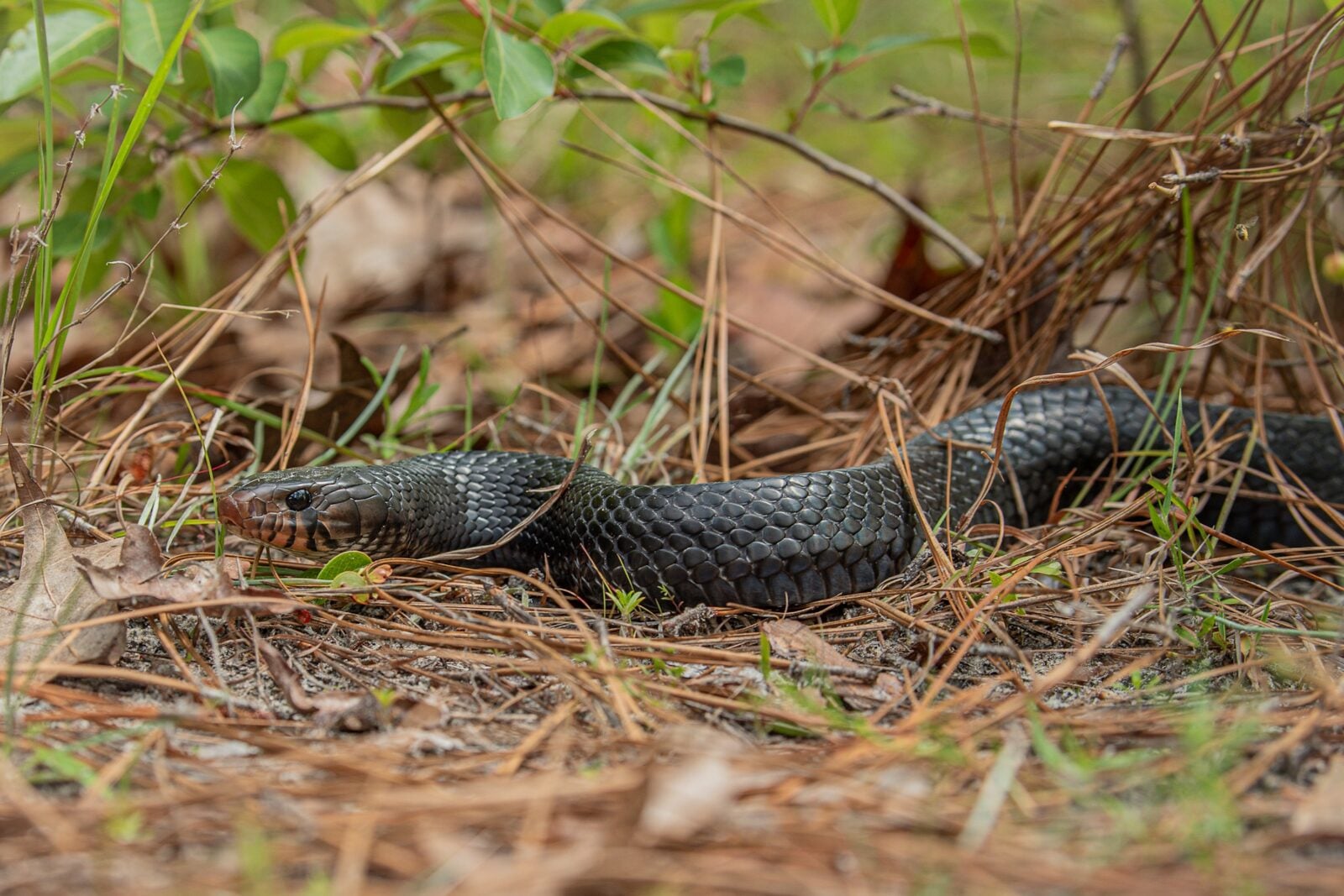
Photo: Michelle Hoffman
Indigo snakes are known for their dark, iridescent coloring and the splash of red on their faces.
A pileated woodpecker laughs overhead and sunshine filters down through the feathery needles of longleaf pine trees as I walk through Conecuh National Forest on a spring morning, gingerly carrying a pillowcase filled with precious cargo. In my hands I can feel the dense weight of my passenger coiling and winding against the thin fabric. Around me, twenty other people trudge through the Alabama pines, each toting a pillowcase of their own.
We’re here for the annual release of young indigo snakes in one of the longest-running snake reintroductions projects nationwide, orchestrated by Alabama herpetology legend Jim Godwin, a biologist with Auburn’s Alabama Natural Heritage Program, and a small army of conservation partners. Godwin started this program two decades ago, but efforts to save this imperiled apex predator have been underway for even longer.
For millennia, indigos thrived across the coastal plain of the Southeast, in longleaf pine sandhills, scrubby flatwoods, wet prairies, and tropical hardwood hammocks. Nonvenomous and stretching up to eight feet long, they are America’s longest native snake. But to humans they are almost invisible; a person could walk the forest and never suspect their presence. To other mammals, amphibians, birds, and snakes, though, an indigo is a fearsome hunter.
Indigo snakes are often mentioned in the same breath as gopher tortoises, another threatened species, whose burrows they use for nesting and shelter from fire or cold. The dramatic clearing of longleaf pine forest for timber—only 3 percent of it remains in the country today—coupled with the pressure of car strikes and the decline of gopher tortoises sent the snakes’ numbers into a nosedive so dramatic that by the late 1950s, they were completely gone from Alabama. A few populations hung on, and in the 1970s biologist Dan Speake tried to start a captive breeding program, releasing snakes where they had been found before in Florida, Georgia, and Alabama, but to no avail.
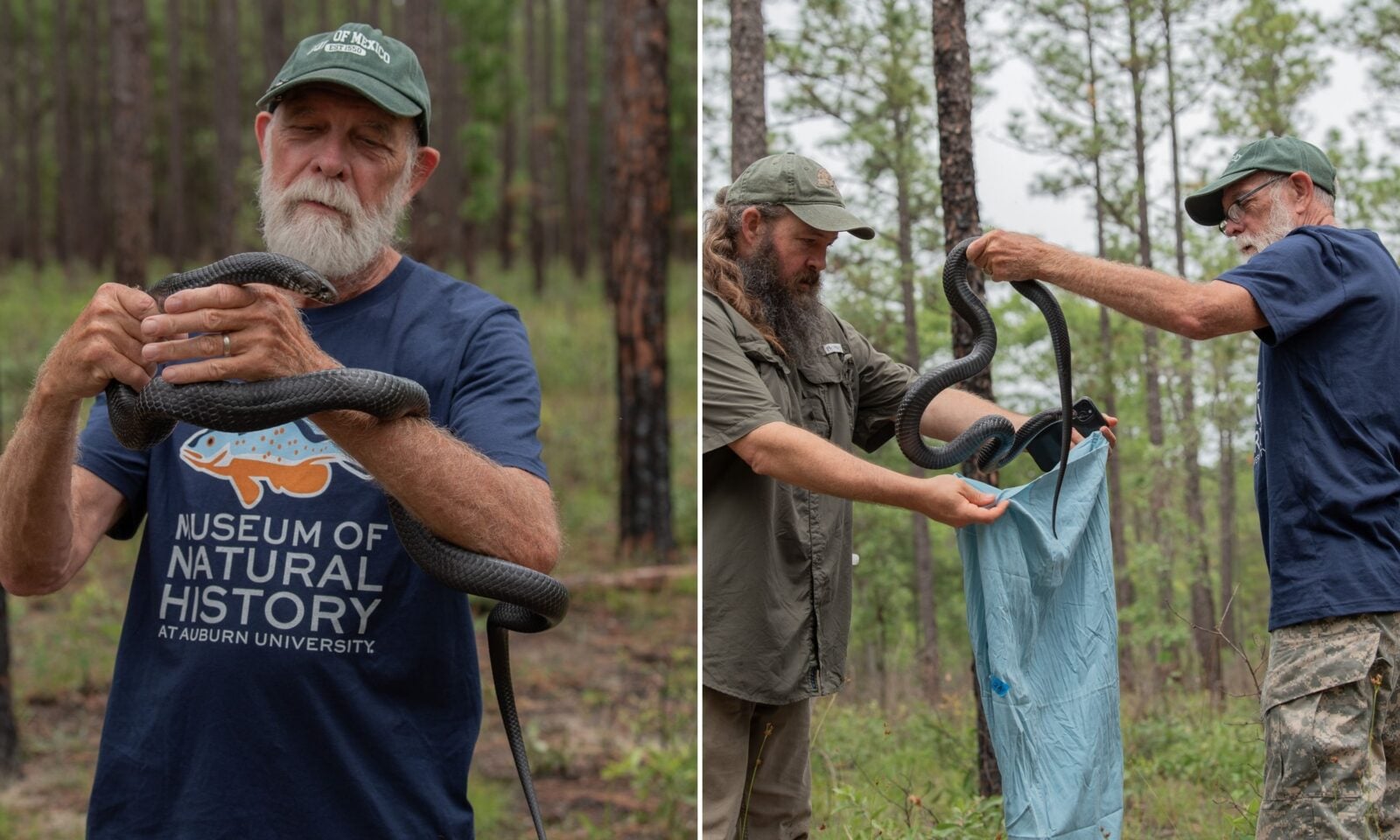
Photo: Michelle Hoffman
Jim Godwin and an indigo; Godwin and Jimmy Stiles, who has been involved with the project for over a decade, remove a snake from a pillowcase for release.
“We know now it isn’t enough to just put snakes back out on the landscape where they used to be; it has to be more strategic than that,” Godwin says. “For the snake to thrive, the habitat has to be there.” And in Conecuh National Forest, the habitat is here. The Forest Service periodically burns the longleaf savanna to mimic historic fire; a healthy population of gopher tortoises makes burrows in the sandy soil; and there’s a solid prey base.
The night before the release at Conecuh, the conservation team gathers at a research cabin to prepare the twenty-one young snakes. To see this elusive creature in person is to be let in on a secret. When a biologist from Zoo Atlanta pulls out the first young snake to be weighed, measured, and photographed, I have one thought: I knew they would be beautiful, but not this beautiful. An indigo snake is not indigo and it’s not black; it’s an iridescent and nameless color that rests on the smooth scales and catches the light, rippling between rich purples, deep blues, and the color of a very dark night. Then, past the inky eyes and under the elegant chin, is a sudden splash of scarlet that one biologist says makes them look as if they’re wearing makeup. Snake after snake receives a workup. One sheds in its bag and emerges sleek and shiny and new.
Godwin stands back and lets the process unfold. As we all gush over our companions, he mutters with his customary wry humor, “When you have one vomit up a rodent in the back of your car, you’ll question why everyone finds them so beautiful and wonderful.” But joking aside, he’s been invested in this snake for a very long time.
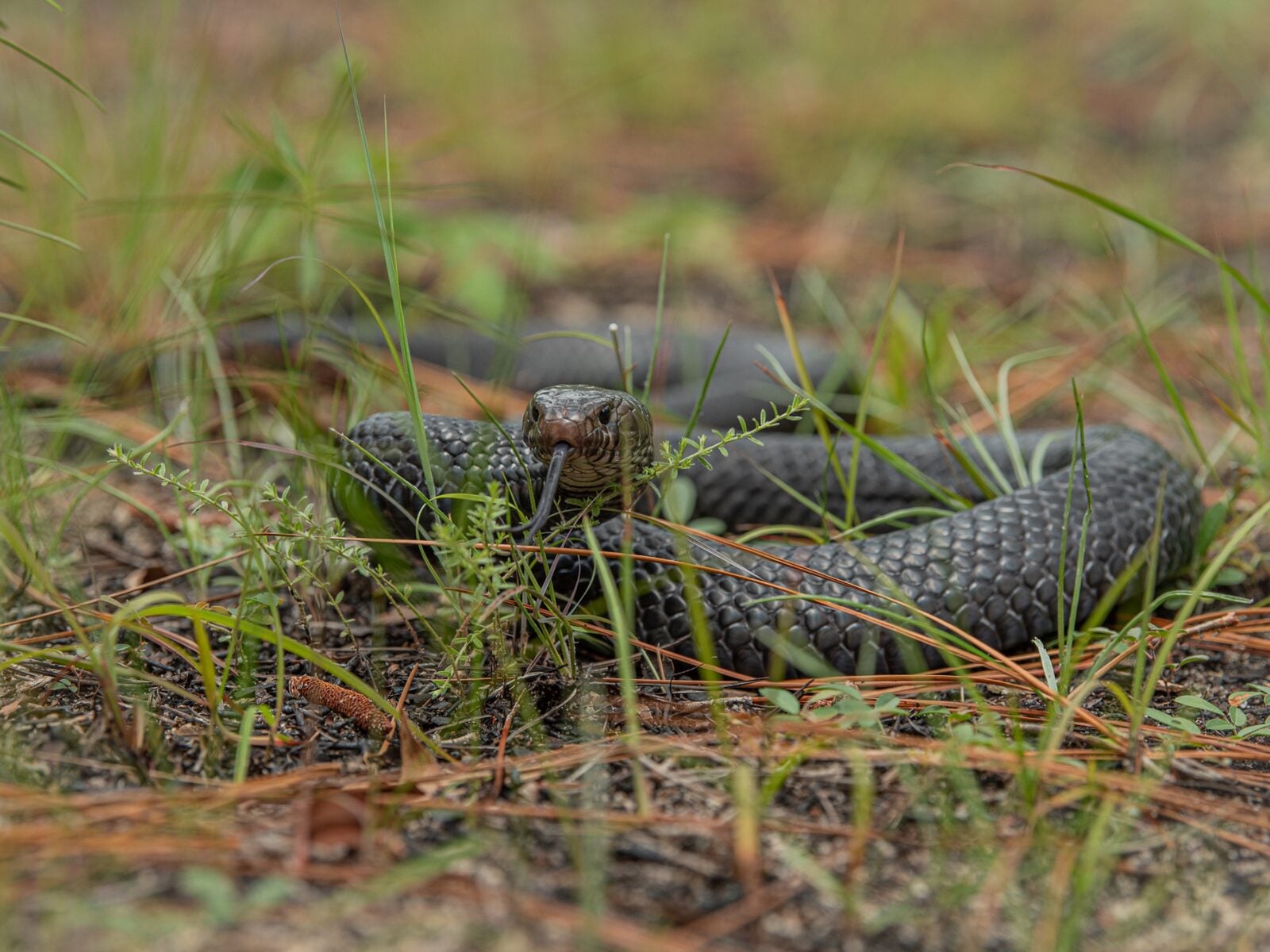
Photo: Michelle Hoffman
An indigo snake in Alabama’s Conecuh National Forest.
Indigos, known for being intelligent, curious, and docile, tend to have an odd hold on people. Ask those who have spent time around them what is special about the species, I learn, and you’ll get different answers.
“They have great taste in habitat, and they’re so huge, yet you can’t see them. There’s a reason they’re called the emperor of the forest.”
“They’re so active to handle, and their behavior is cobra-like. Each one has a personality.”
“If you think dogs have a great sense of smell, indigos are on another level. I released an indigo that tracked where another indigo went, a full year later.”
“They’re just so damn beautiful.”
In 2006, with their populations steadily declining, Godwin decided that such a special snake couldn’t be lost. He and his team captured pregnant wild female indigos from Georgia, waited until they laid their eggs, and returned the females to the wild. The eggs they kept: This would be the start of a captive breeding colony that would safeguard the snake from extinction in a worst-case scenario and provide indigos for reintroduction into the wild. Meanwhile, a donation from philanthropist Thomas Kaplan led to the founding of the Orianne Society—based in Georgia, led by Chris Jenkins, and dedicated to saving the indigo—in 2008. Godwin earmarked some of the captive-bred snakes for release at Conecuh. The others he funneled to the Orianne Society, and in 2012 a dedicated captive breeding facility called the Orianne Center for Indigo Conservation opened in Eustis, Florida.
Today, the OCIC is owned and operated by the Central Florida Zoo, where Michelle Hoffman—whose elegant tattoo of an indigo winding around her arm evidences her love for the species—has spent the last eleven years working on the project. At a year old, the OCIC’s young snakes are transferred to Zoo Atlanta for care until, at two years old, they’re past the most vulnerable stage of their lives and ready for release—a strategy called headstarting. Most every year since 2010, the biologists have then introduced the snakes at Conecuh. They’ve logged over three hundred releases over the years, but in all their secrecy, indigos are difficult to monitor, and biologists aren’t sure of a population estimate.
On this year’s release day, I reach into the pillowcase and feel the cool, smooth scales of indigo number 880. I pull the snake out and hold it for a moment, feeling that particular, alien way that a legless creature made of solid muscle moves. It doesn’t fight or bite or even try to escape my hands. Instead, this indigo seems simply curious to explore its situation.
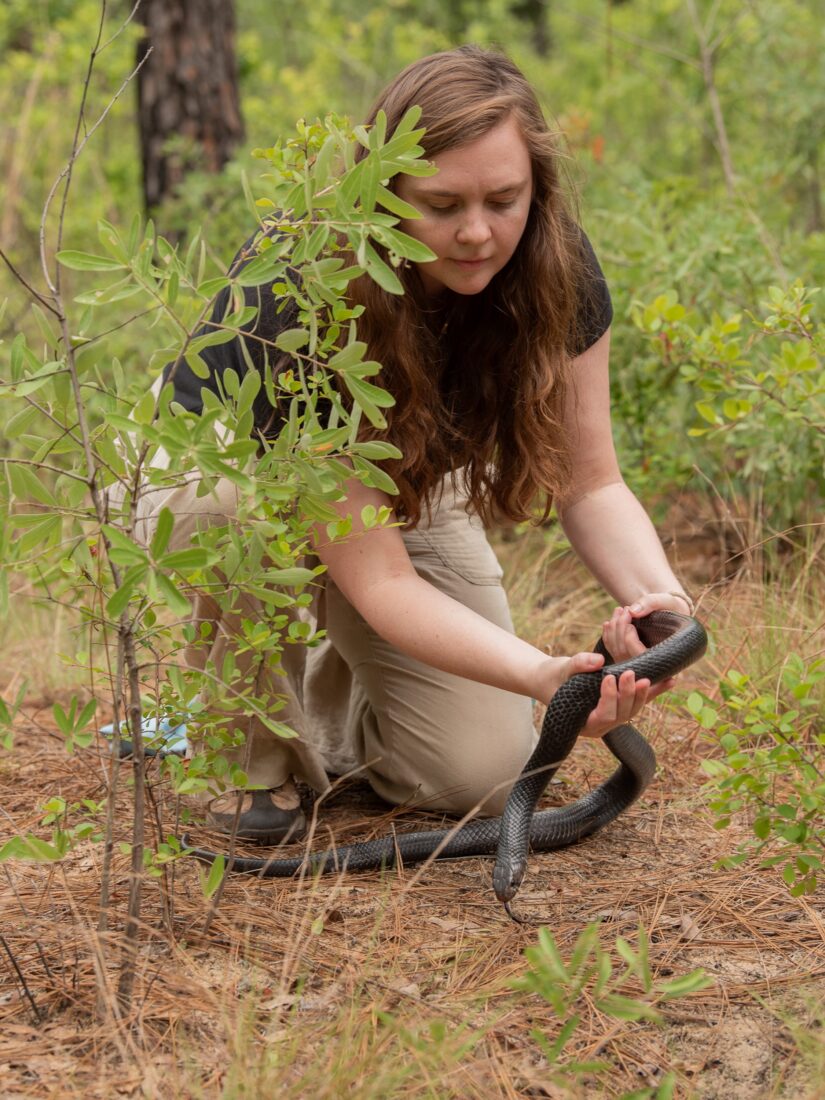
Photo: Michelle Hoffman
The author releases an indigo.
To ease the snake’s transition to the wild by providing it with the cover it needs, the biologists have earmarked indigo 880 for a gopher tortoise burrow. I kneel in front of the burrow, its small opening belying the deep tunnel beyond, and think of the long history between tortoise and indigo, and of how so many moving parts add up to an ecosystem in all its glory. The snake slithers out of my grasp and into the burrow, its winding body making no noise on the forest floor. I blink and it’s gone, leaving only a surprisingly pungent odor—mingling notes of hamster, roadkill, and soy sauce, one biologist jokes—behind on my hands.
Now that this snake is in the wild, the monitoring begins. Each one bears a PIT tag, a tiny, battery-free microchip, and in the past few years, the biologists have set up PIT tag readers along drift fences—long, low barriers that funnel moving snakes past a reader. Ingeniously, the biologists also photograph them using motion-censored cameras fixed to the bottom of upside-down buckets along the fences. An indigo that shows up on camera but doesn’t ping to the reader is a sign of success. It means that the individual was born in the wild—that the snakes are reproducing on their own.
Captive-bred indigo snakes are also venturing out into Apalachicola Bluffs and Ravines Preserve in Florida, a Nature Conservancy tract modeled after Conecuh. In total, some sixty snakes a year, split between the two sites, receive a chance at life in the wild. Biologists hope the two populations will eventually become self-sustaining, and that they can establish more such sites across the region. For now, monitoring the furtive animals to try and determine how many are surviving after the releases is the priority.
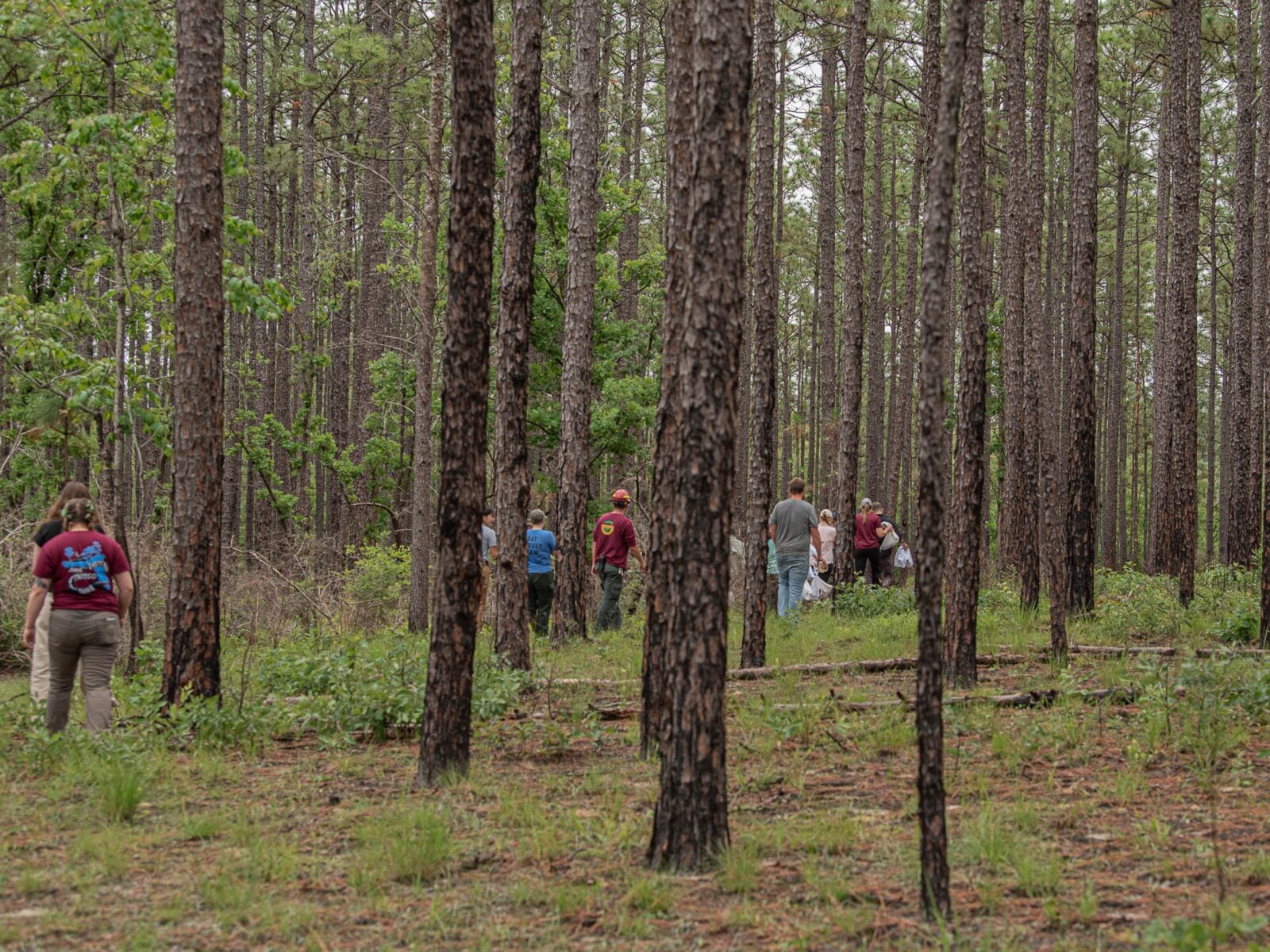
Photo: Michelle Hoffman
Program partners make their way through the longleaf pines of Alabama’s Conecuh National Forest.
Over the course of two days in Conecuh, I begin to appreciate how many people and partnerships it takes to save a species; how much trial and error; how much thinking outside the box and sheer determination. As Godwin points out, “this snake has been here for millions of years before us,” sustained by ecosystems that blanketed the South long before humans crowned themselves emperors of the forest. Yet within our comparative blip of time, we have managed to do extensive damage to a complex ecosystem—and the livelihood of its many residents—that we are only now scrambling to understand and repair.
These are difficult times for conservation biologists. Funds are frozen; agencies like the Forest Service are being trimmed back; future grants are uncertain. Meanwhile, roads crisscross and the pressures of human development increase. Godwin fears that real habitat connectivity beyond public lands might never happen. But each time someone kneels and unties the knot of a pillowcase it’s a gesture of hope—that maybe, just maybe, we can still make space for wild things in our Southern landscapes, and that maybe a thing is worth saving even if we can’t see it. We all stop and watch, twenty-one times, as each person offers a young indigo back to the forest, to disappear into a landscape made to receive them.
The indigo snake project in Alabama relies on partners including the Alabama Department of Conservation and Natural Resources, U.S. Forest Service, U.S. Fish and Wildlife Service, the Orianne Center for Indigo Conservation, Zoo Atlanta, and the Orianne Society.
Lindsey Liles joined Garden & Gun in 2020 after completing a master’s in literature in Scotland and a Fulbright grant in Brazil. The Arkansas native is G&G’s digital reporter, covering all aspects of the South, and she especially enjoys putting her biology background to use by writing about wildlife and conservation. She lives on Johns Island, South Carolina.