

Land & Conservation
The Quest for the South’s Most Ancient Cave Art
Like Indiana Jones with a camera, the photographer and adventurer Stephen Alvarez descends into otherworldly caves to discover, illuminate, and preserve millennia-old drawings
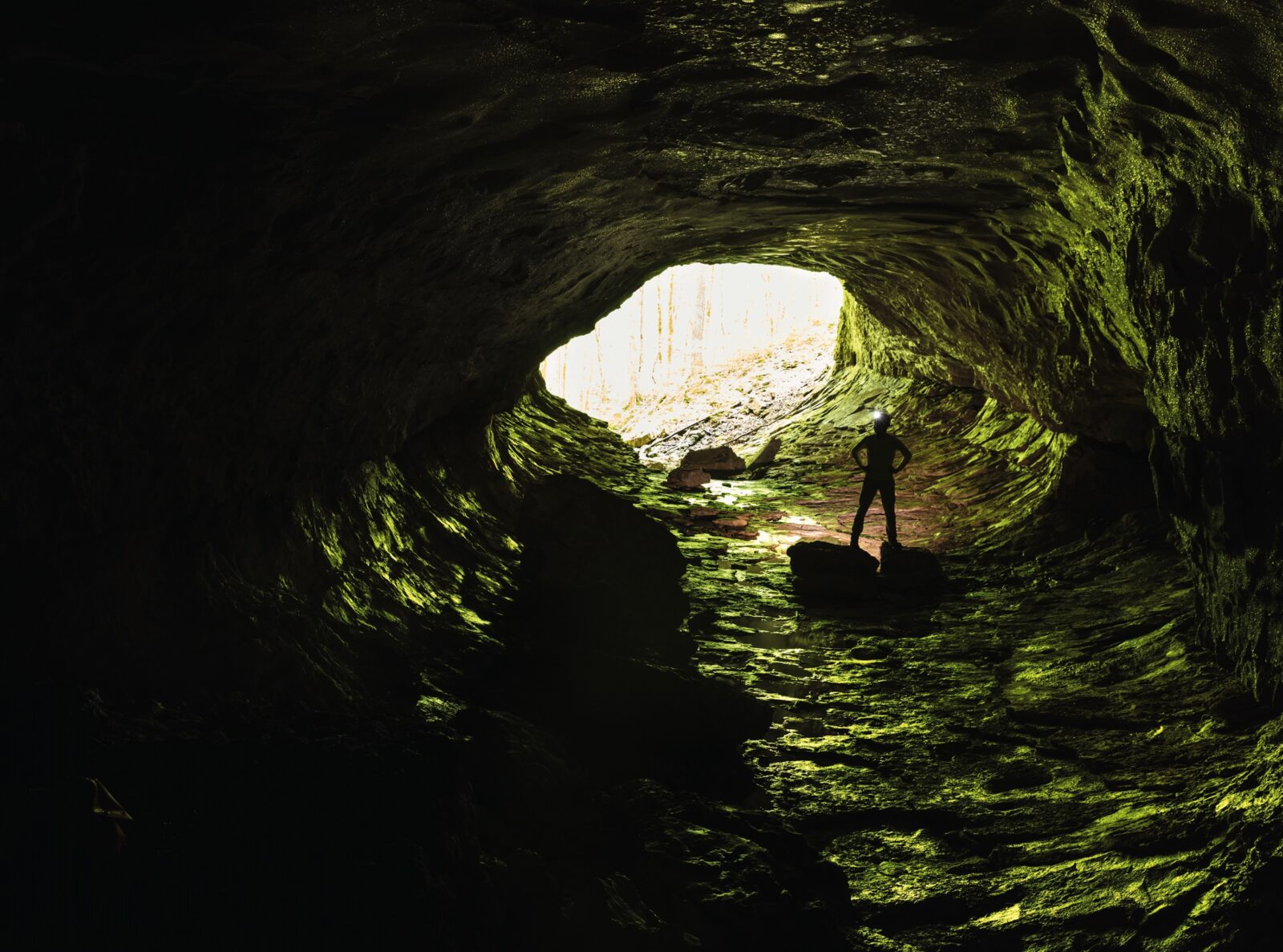
Photo: Stephen Alvarez
Stephen Alvarez inside the 19th Unnamed Cave.
We’re walking in a wooded ravine, cold December sunlight soaking through the trees, when the mouth of the cave appears. It’s a sudden, gaping hole in the landscape, an invitation into another world that no curious mind could resist. Stephen Alvarez, wearing his customary red caving coveralls and knee-high boots, leads the way, entering the darkness as he has countless times before. Archaeologists refer to this three-mile underground system in Alabama as the 19th Unnamed Cave, keeping its location and real name secret. That’s because this site contains the most expansive known set of dark-zone cave art in the Americas, rendered by unknown people of the Woodland period, the predecessors to Mississippian culture, more than fifteen hundred years ago and documented by Alvarez, an award-winning photographer and lifelong caver.
The air changes right at the entrance—warmer, at a cave’s customary fifty-five degrees, than the winter air outside, and more humid. We stoop against the ceiling and make our way along the uneven, often slippery floor, our headlamps illuminating puddles of still, muddy water as the light from the cave’s mouth dims until it’s a distant glow. Alvarez is sixty-one but could pass for forty, so lean and athletic that he appears to flow rather than walk through the cave. “When you’re a long way from the entrance but you can still see daylight, that’s where the art begins,” he says into the silence.
He crouches and raises a hand, holding a flashlight at just the right angle, and faint lines appear, dancing across the ceiling where before I saw nothing. The glyphs, drawn by ancient hands tracing shapes into the mud on the cave wall, start here about 150 feet in and seem to go on forever. Geometric patterns and symbols rise and fall with the irregular slopes of the ceilings. The head of a bear crowns the trapezoid-shaped body of a humanoid figure, and the lines of a rattlesnake curve into a recognizable coil.
“I see something different every time I’m here,” Alvarez says. And to say he has been here a lot is an understatement. Since cave explorer Alan Cressler discovered the 19th’s cave art in the late nineties, he, Jan Simek, an archaeologist at the University of Tennessee, and eventually Alvarez have spent untold hours detecting its secrets. More recently, Alvarez spent months painstakingly photographing the cave to reveal its wonders to the rest of the world.
The 19th Unnamed Cave, of course, is by no means the first ancient, sacred, hidden, delicate, or mysterious place that Alvarez has borne witness to with his camera. As a celebrated photographer and longtime explorer for National Geographic, the Tennessee native has seen things most could only imagine and set foot in places most would not dare to go. But his mission to document the country’s twenty thousand years of human history through the photography of ancient art—including that of the 19th Unnamed Cave—has been a lifetime in the making.
Upon first encounter, Alvarez comes across quiet and reserved, as if he could melt into any background. But spend time in conversation with him, and a complex, wicked intellect unfolds, punctuated with a deadpan delivery of jokes and astounding asides (“When I was hanging upside down in a waterfall in Papua New Guinea…”). As his friend Gregory Crouch, an adventure and nonfiction author who first met him on a caving expedition in Oman, puts it, “Stephen is certainly one of the more interesting dudes wandering the country these days.”
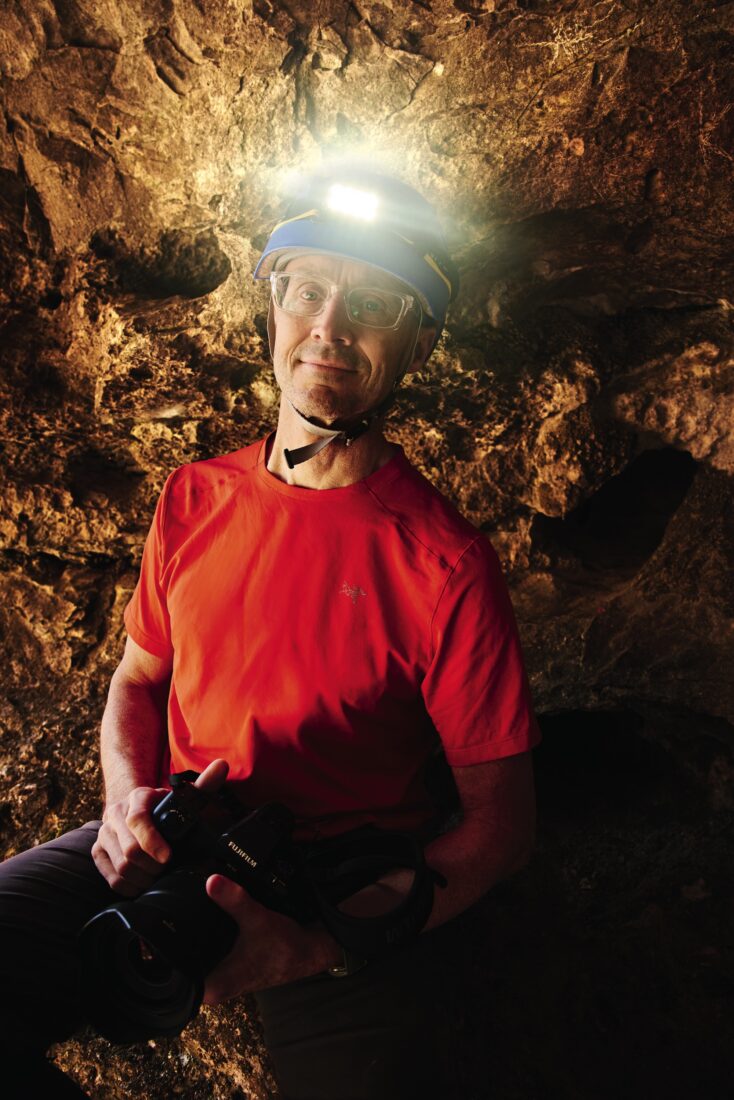
Photo: Robby Klein
Alvarez at Tennessee’s Lost Cove Cave.
Alvarez grew up in Sewanee, Tennessee, where under forests and carpets of soil lies an extensive network of subterranean spaces. This is the heart of the TAG region, where Tennessee, Alabama, and Georgia meet at the Cumberland Plateau, an area world-renowned for its caves. The chambers formed millions of years ago as rain, just a touch acidic and falling over an inconceivable timescale, slowly ate away at limestone, carving passageways of all shapes and sizes. Entire ecosystems bloom there underground, complex worlds all their own. Tennessee alone has some ten thousand known caves. As a child, Alvarez was no stranger to them, and they provided training grounds for the exploration that would come later. “Some people kayak, or hike, or bike as kids,” he says. “I caved.”
After graduating from the University of the South, he set his sights on a career in photography. He began working with such publications as Outside, shooting portraits of businesspeople to make ends meet, and shopping his work to National Geographic. In 1995, his break came when a mentor recommended him to Nat Geo’s photo director for a dangerous and difficult archaeology assignment in Peru. Although Alvarez went temporarily blind in one eye from the altitude, the story became one of the magazine’s most popular of the year. Before long, he was putting together expeditions funded by the magazine, sometimes months long, to far-flung places, always pushing the limits of wildest, highest, deepest—superlatives that often led him to caves.
The images from those trips feel like postcards from another dimension: someone on a rope, descending into the belly of the deepest cave in the world in the Republic of Georgia; a caver, soaking wet and gasping for air, emerging from raging white water in a cave in Papua New Guinea where no human had ever set foot before; a figure perched on a towering stalagmite in Central America’s longest cave system, in Belize.
Through two decades of extreme travel—plus a yearslong consulting role with Microsoft and Nokia to help develop the camera phone—his home in Sewanee grounded Alvarez. He married and had two children; his wife, April, whom he met at National Geographic, trusted that he would safely return from expeditions based on his conviction that “if you have an adventure, you’re doing something wrong.”
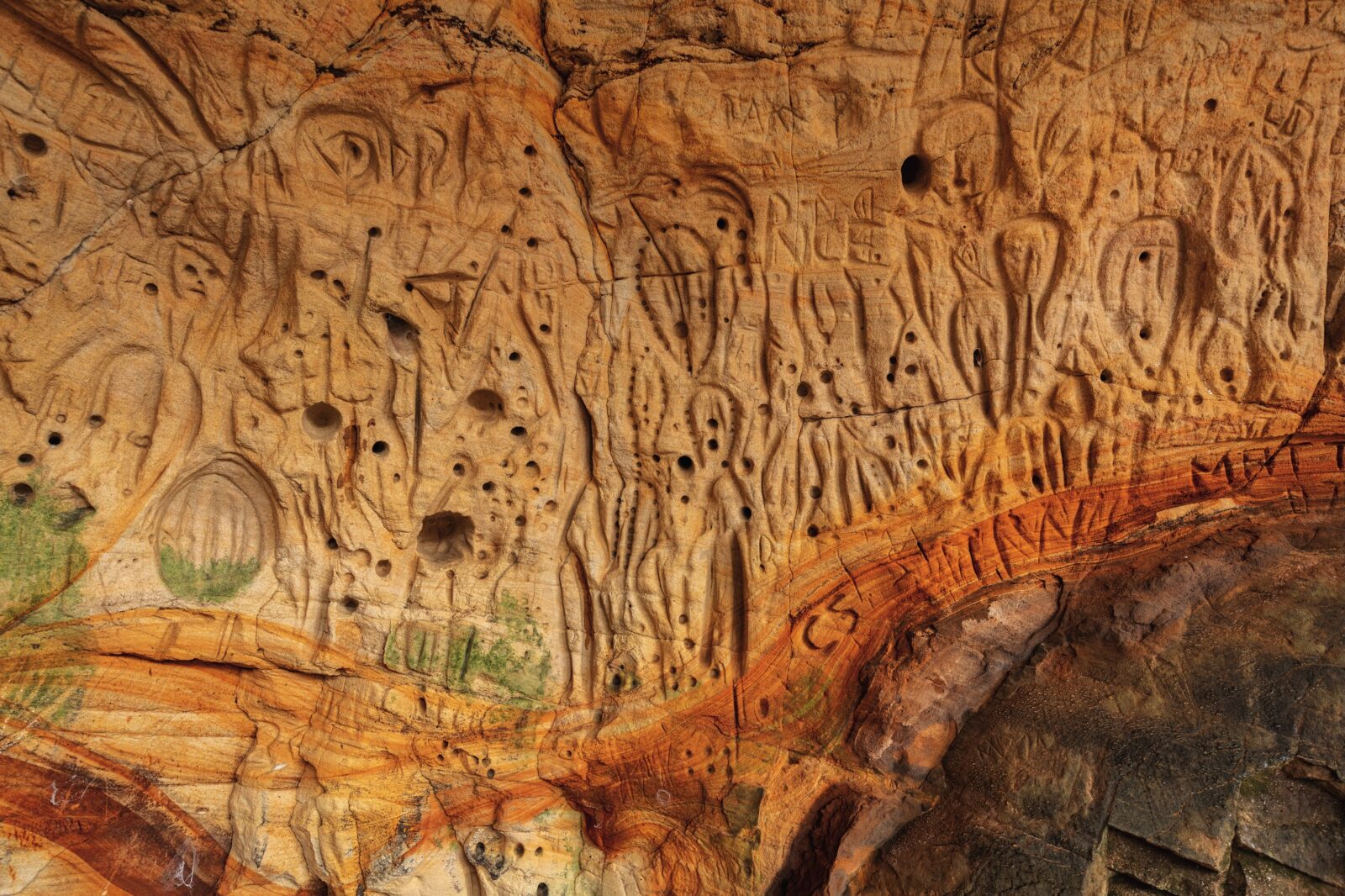
Photo: Courtesy of Stephen Alvarez
Petroglyphs at Tennessee’s Indian Rockhouse Shelter.
Still, his assignments were hardly free of risk, especially the trip to Papua New Guinea, which he considers the pinnacle of his exploration. He remembers thinking—while suspended by ropes in that underground waterfall, after he had misjudged a rappel landing—that he’d never expected his life to end that way. But all that travel, and all those stories, awakened Alvarez to a new perspective. “You start to realize that the way we do things is just a way of doing things,” he says. And that maybe humans, even in their many variations, share far more similarities than differences. While in a small town in Mexico to photograph modern Mayan people’s interactions with the spiritual world, Alvarez made a resolution: to approach all cultures and belief systems with tolerance and respect—and to accept that there were many things he did not understand, “or even have the hardware to understand.”
His next most transformative experience would come, perhaps not surprisingly, in a cave. “When you’re young, you like the idea of being the first one to go somewhere,” Alvarez says, “but it’s really hard to find places you can do that in this world. At some point, you get interested in the people who came before you.”
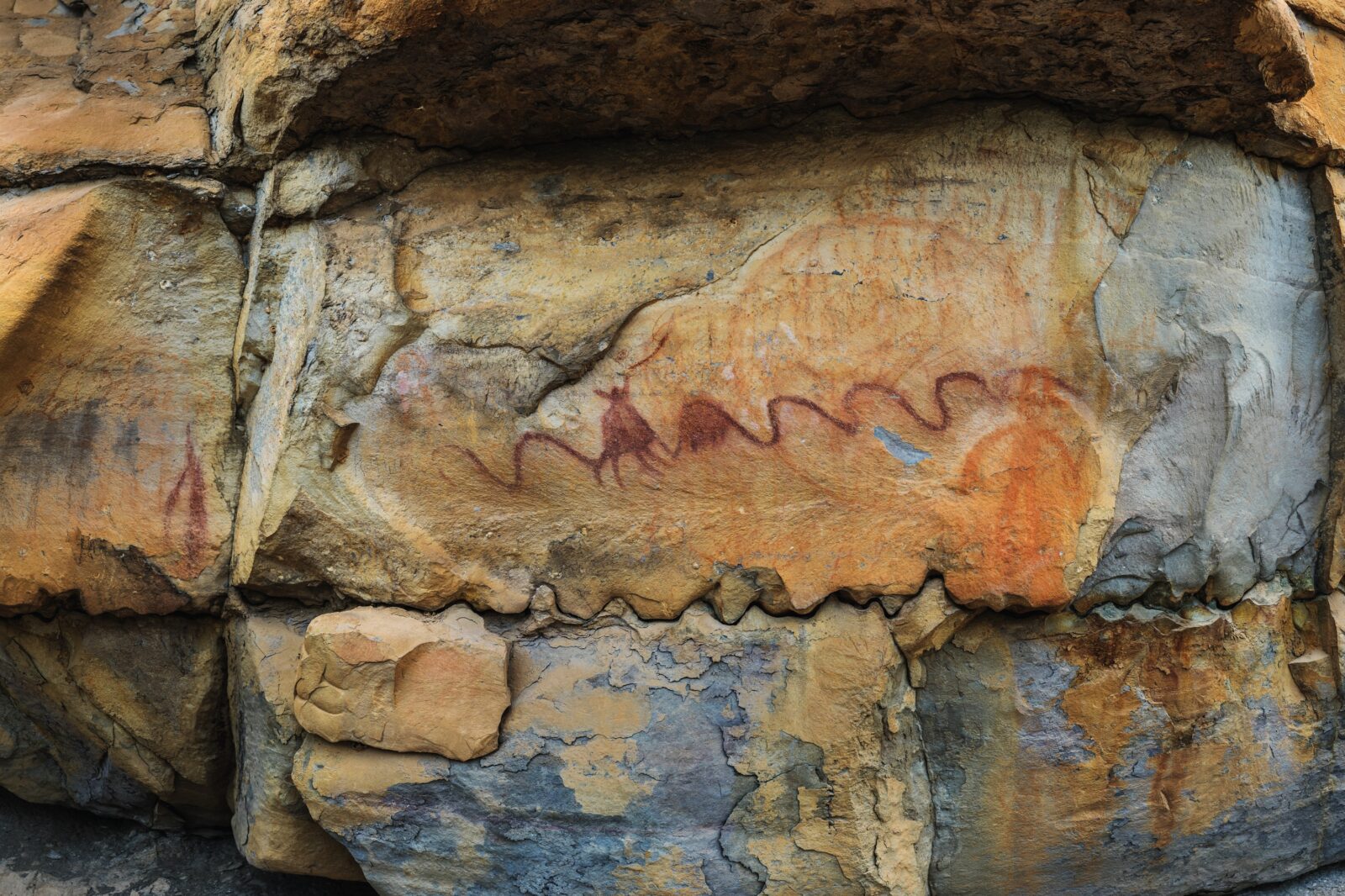
Photo: Courtesy of Stephen Alvarez
Red ocher rock glyphs at Alabama’s Painted Bluff site.
After a 2010 assignment to shoot the Paris catacombs, April convinced him to visit the Lascaux cave in southwestern France, where the walls contain shockingly sophisticated paintings—bulls and horses leap across the rock in shades of red and black. Radiocarbon dating places them at around seventeen thousand years old. There, Alvarez saw only a replica of the artwork—the real cave is closed to visitors—but he was nonetheless struck speechless. The sight shattered his belief that early humans were somehow “primitive”; anyone capable of producing such beauty was not a being simply fighting to survive. These Paleolithic artists were human as he knew humans, complex and driven to create. The question of when we became artists floated into his mind and stuck—and he began to consider durable symbols in the form of art as the greatest and most powerful innovations of mankind, the ones that allow us to communicate with one another, and live in the intricate societies we do.
He spent the next four years researching a story on the origins of art, and forging the connections he would need to enter and photograph another French cave, Chauvet-Pont-d’Arc, where drawings of lions, rhinoceroses, mammoths, and aurochs date to a mind-boggling thirty-two thousand years old. He was allowed only six hours inside, due to the extreme sensitivity of the art—he remains one of precious few people on the planet who have ever entered—but six hours was enough. “I felt as if time collapsed,” he recalls, “and that the artist was speaking to me across an unimaginable gulf of time.”
“He came out of Chauvet a different man,” his friend Crouch remembers. Over oysters and wine in 2015, the two discussed a new idea: a nonprofit dedicated to documenting ancient art all over the world. “Stephen is different from most in that he follows through on his big ideas,” Crouch says. April agrees: “He had always had an interest in art, archaeology, culture, and caves, and in exploring humans’ place in the world. You could say that this project was the natural culmination of all of his questions.”
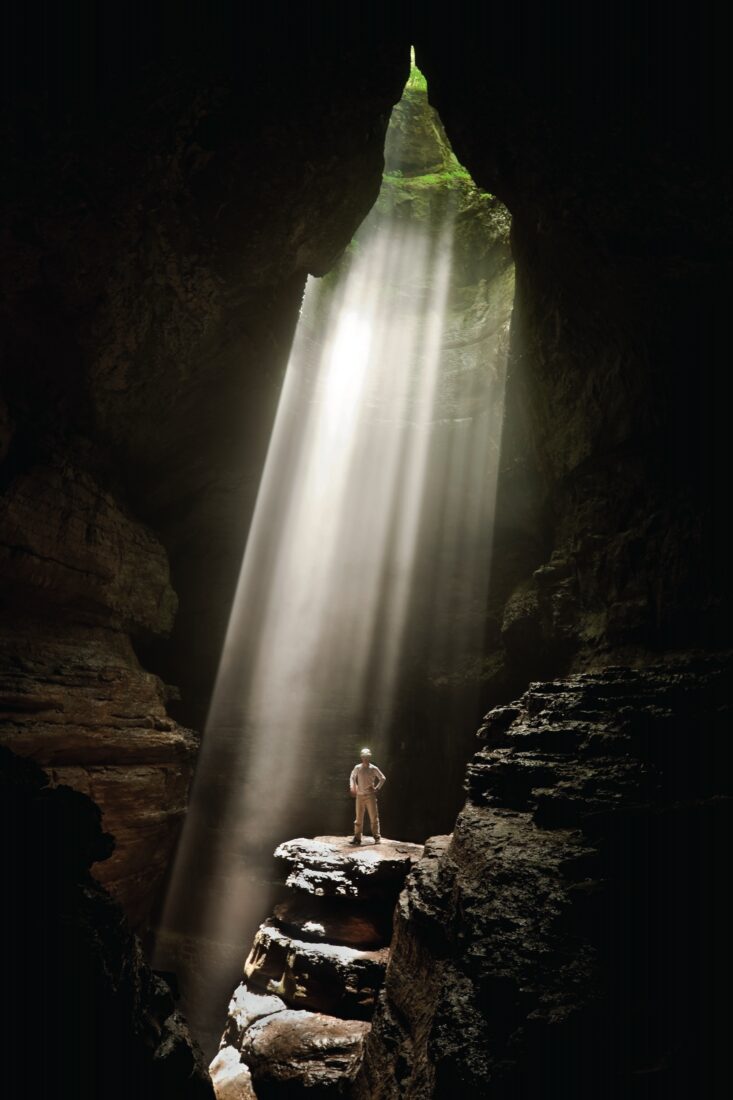
Photo: Courtesy of Stephen Alvarez
Fellow caver John Benson inside Alabama’s Stephens Gap Cave.
In 2016, Alvarez launched the Ancient Art Archive, a nonprofit that preserves, documents, and shares rock art, some of it in caves and much of it on rock aboveground, from tiny figures carved into rock faces to vast effigy mounds best seen from above. In the lead-up to the nation’s 250th birthday, he has focused the Archive’s efforts on our own continent’s many-millennia-old and mostly unknown (and ignored) human history, whether found in Southeastern caves or in the deserts of Texas and Utah. Alvarez has spent a decade traversing the country, using still images, advanced 3D modeling, and virtual reality to create full experiences of the most amazing examples of U.S. rock art. While the nation may be celebrating its semiquincentennial, Alvarez points out, “this artwork offers us a direct connection to twenty thousand years of successful experimentation of what human society can look like.”
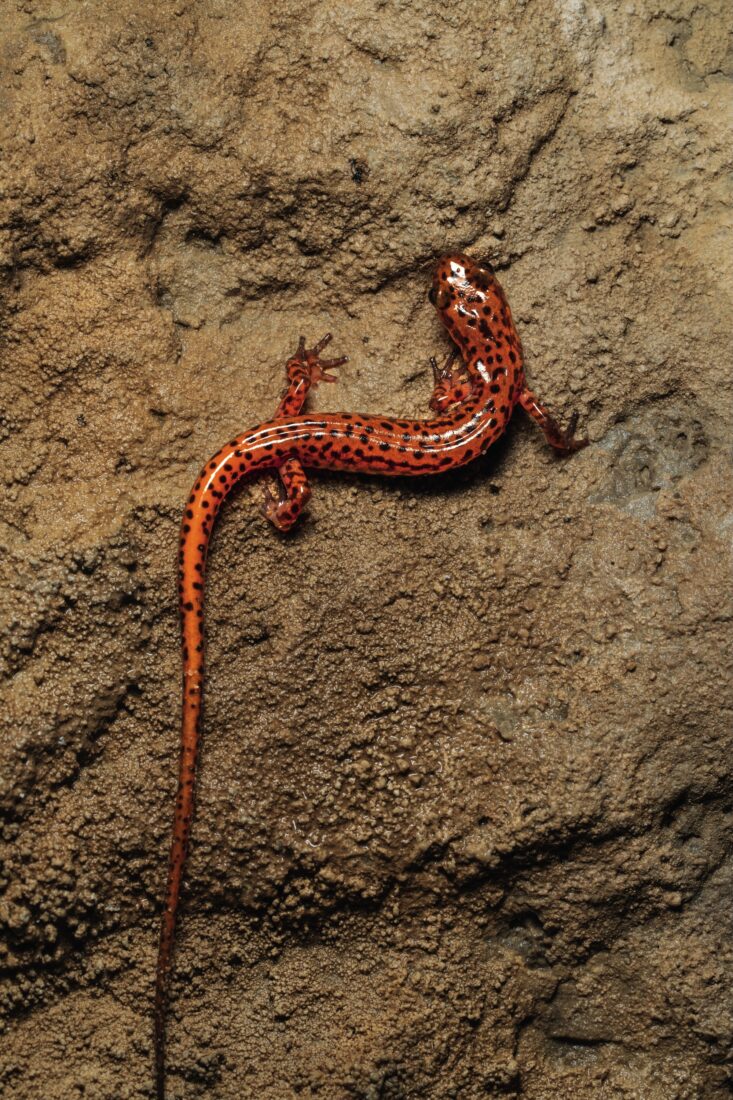
Photo: Courtesy of Stephen Alvarez
A cave salamander.
With the help of a largely Indigenous team, Alvarez brings his virtual reality experiences and photography of caves into classrooms of young people. One exercise in particular always sparks a lively discussion. Each student receives a piece of chalk and a question: If you could only leave behind a drawing or symbol to represent your time on this earth, what would you choose?
To understand the Ancient Art Archive’s mission, I meet Alvarez in Sewanee for two days of caving. We first visit the Caverns, a venue with live music above- and belowground growing wildly in popularity in nearby Pelham Valley. The owner, Todd Mayo, wants to ensure that rock art in the venue’s adjacent spaces is preserved, and Alvarez has called in his longtime friend and colleague Alan Cressler to investigate.
“You have to look at a cave as a total jungle gym that utilizes every muscle in your body,” Cressler says. He’s entered some five thousand of them, many of his own discovery; Alvarez assures me that a good portion of what we know about Southeastern caves came from the sixty-eight-year-old about to duck into the low opening in front of us wearing only gray sweatpants, a T-shirt, and a pair of shin guards. Back during his years of hardcore exploration, Alvarez often tapped Cressler for expeditions, relying on his natural caving abilities, innate sense of direction, and photography know-how to help capture, say, the near-perfect skeleton of a Pleistocene-era cave bear in Belize, cavernous chambers in Oman, or that deepest cave in the world in the Republic of Georgia (where falling rocks ended up maiming Cressler’s hand).
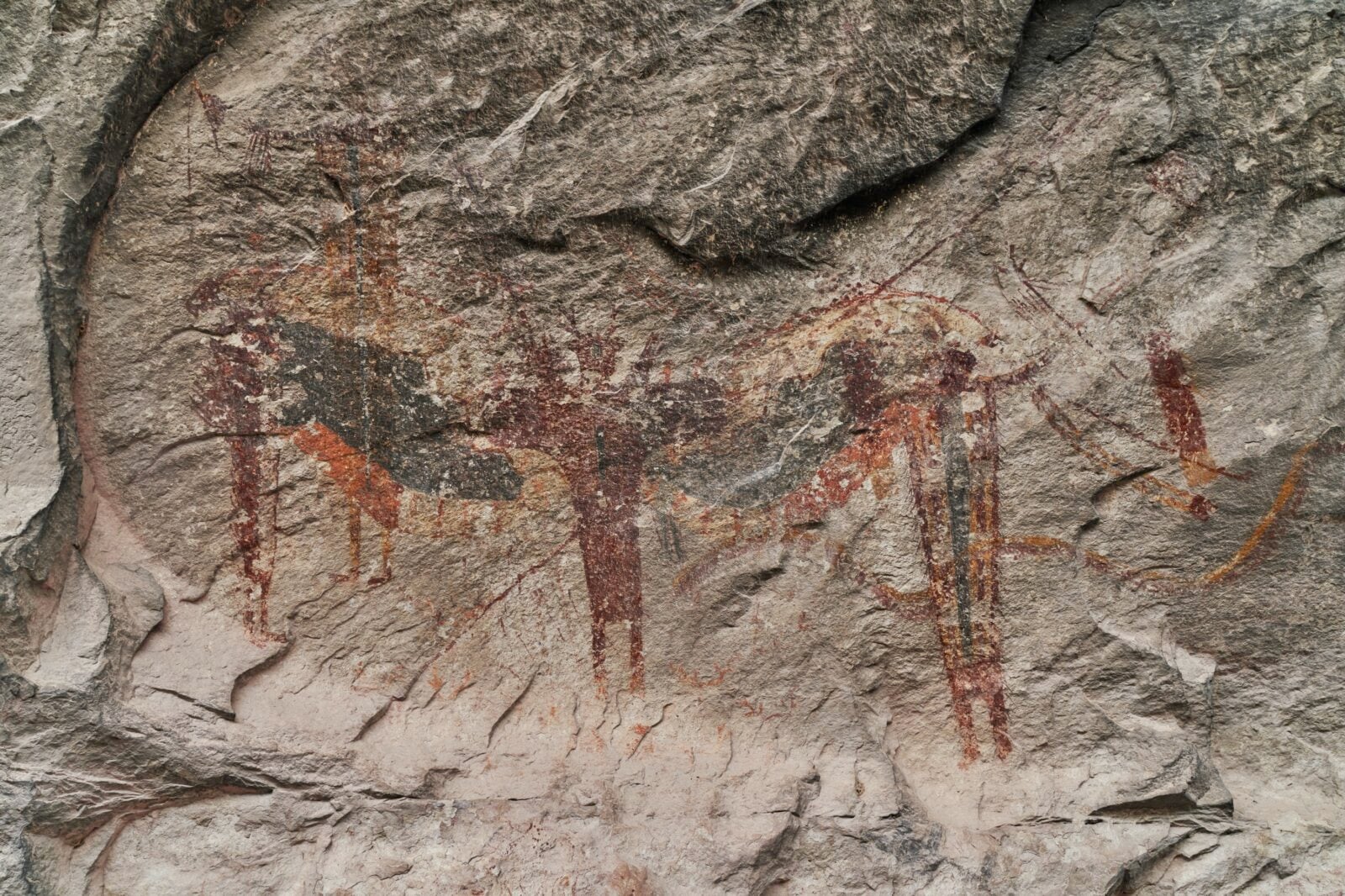
Photo: Courtesy of Stephen Alvarez
Classic Pecos River–style pictographs in Texas’s Seminole Canyon State Park, dating back more than four thousand years.
I follow the pair into the cave. First we stoop, then drop to all fours into what’s called the dark zone, where light from the entrance fades out completely; then, after a few minutes more, as the ceiling slopes down, we flatten ourselves into a belly crawl that makes me all too aware of the tons of rock above me. Alvarez has brought a “light” version of his camera gear to photograph anything we find, a still-heavy dry bag he has to either push in front of him or drag behind him—giving me a sudden inkling of how hard it must be to move through immeasurably more difficult caves with immeasurably more complicated gear. Ahead of us, Cressler merrily worms his way along. “I can’t count the number of times I’ve watched Alan’s ass disappear ahead of me,” Alvarez remarks dryly.
As we forge ahead, Cressler keeps an expert eye out for stoke marks, telltale signs of prehistoric activity. Native Americans in this area who traveled into caves used bundles of river cane as torches, and as they tapped them against the wall to knock away ash, they left behind a distinctive black charcoal mark. Sometimes they would even stash these bundles at strategic points within the caves to replenish their light. My electric headlamp will last for hours and hours and frees up my hands. Crawling through this cramped route holding a burning torch is simply unfathomable.
Even so, early explorers crept “extraordinarily far back with these light sources,” Cressler says. “It was extremely dangerous. We’ll never know how many people went into caves and didn’t make it out.” We can’t be sure of the full range of their motivation, either—other than to create art.
About fifteen minutes into the dark zone, the passage opens into a long chamber tall enough to stand in, and Cressler and Alvarez study what we’ve come to see: abstract lines made with charcoal around a naturally occurring hole in the cave wall. Without radiocarbon dating, they can’t assess their age, but they’re definitely not of this time. The art stands in stark contrast to pre-spray-paint graffiti elsewhere on the walls, a reminder of how sensitive these sites are and how easily a careless visitor could erase something priceless and irreplaceable. Alvarez sets up a tripod and lighting and carefully photographs the lines before we head out the way we came.
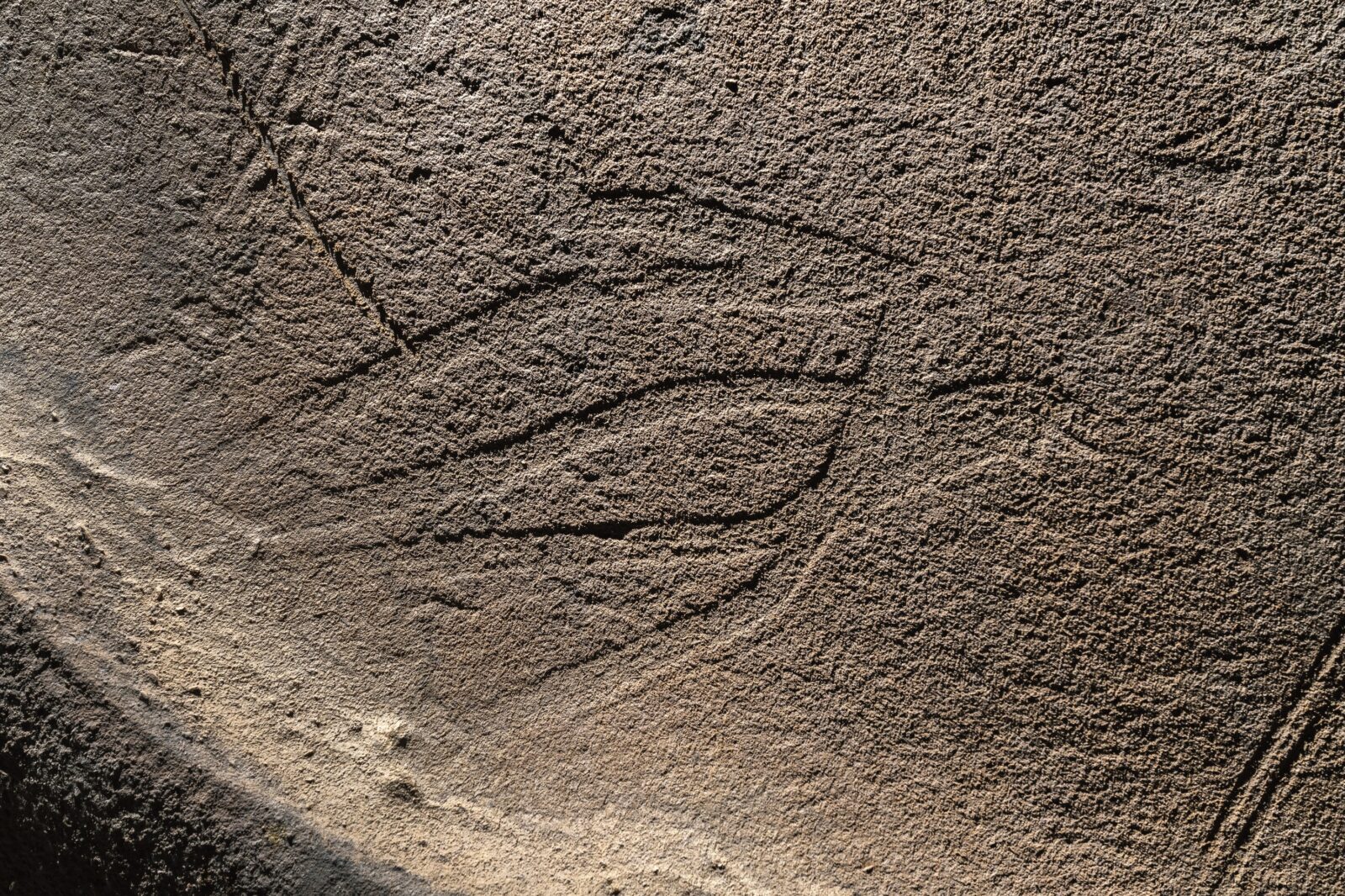
Photo: Courtesy of Stephen Alvarez
A mud glyph in the 19th Unnamed Cave.
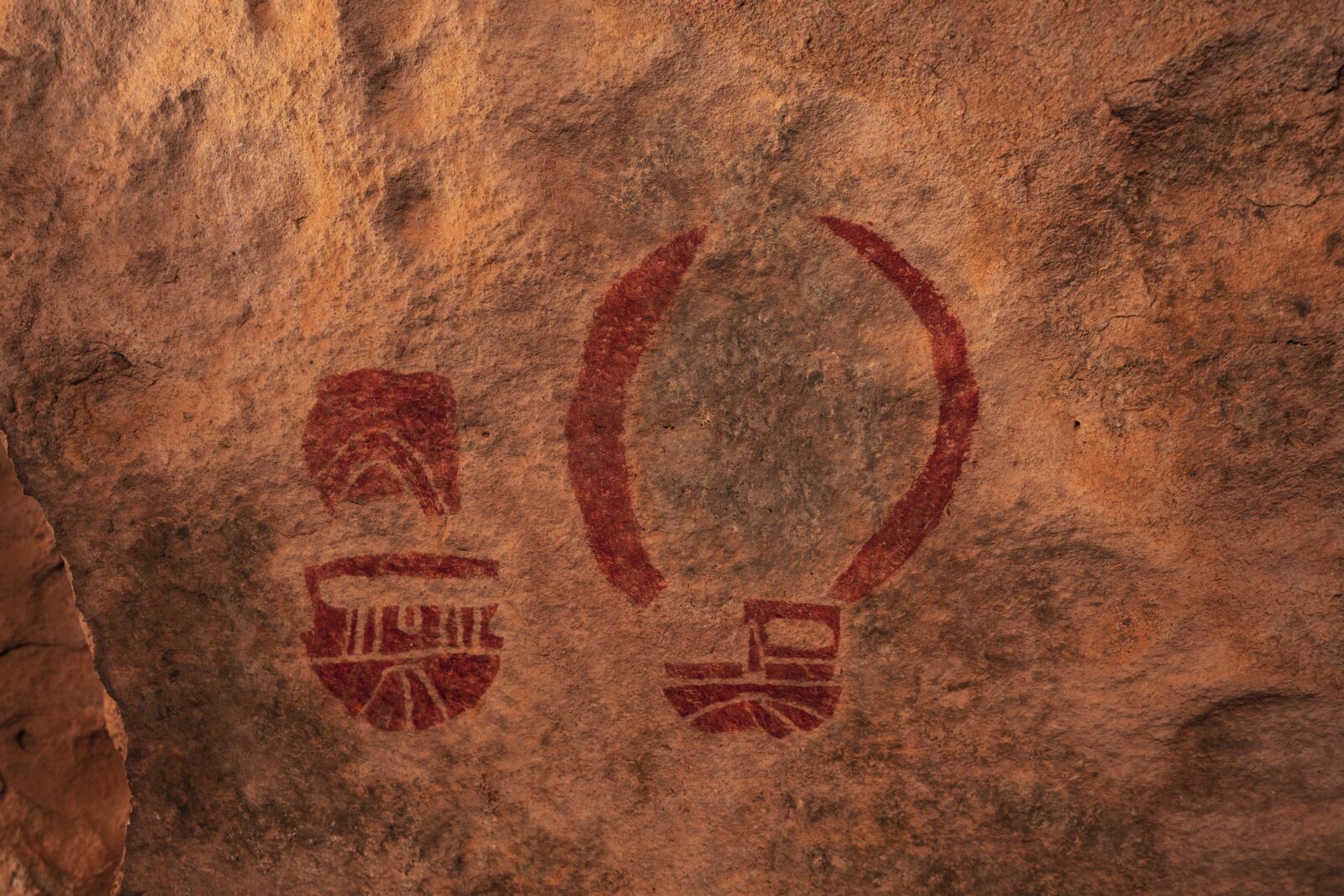
Photo: Courtesy of Stephen Alvarez
Mask pictographs in Hueco Tanks State Park, in Texas.
The next day holds more artwork in Alabama’s 19th Unnamed Cave. Cressler noticed the extensive, but faint, mud glyphs on a trip to the cave in 1998, after years of searching trained his eye. “It’s an art gallery,” he says simply of his discovery. What remains of that art, which radiocarbon dating from inside the cave places at around seventeen hundred years old, is incredibly fragile. A swipe of a hand or a bump of a helmet, and pieces of it could be lost forever, a major fear that Cressler, Alvarez, and archaeologist Jan Simek share. Eventually, the earth itself will reclaim the art as the cave keeps growing and the mud continues forming, making the chance to document it even more precious.
To best view some of the larger drawings, we lie down on the muddy cave floor, the ceiling a few feet above us, and let our lights illuminate the lines of a huge serpent with a crossbanded pattern emerging from the wall and stretching eleven feet long: a rattlesnake.
It’s impossible not to wonder, with the sort of intense, frustrating curiosity sparked by listening to a language you don’t understand, why and when and how this snake came to be. I say as much. “Those details are the unknowable,” Alvarez says, a fact he’s made peace with. What we do know of the Woodland people, he explains, involves their economics, farming, and trade routes. But “if you only knew that I like Reese’s Peanut Butter Cups, and that I bought them at Food City, and used gas from the Middle East to get there, what would you know about me, really?” he asks in the darkness. “Then…there’s artwork like this. It’s all we have left that is a window into their humanity. I believe that they mapped out their worldview here, and it was important enough to them that they engraved it on a quarter acre of cave ceiling.”
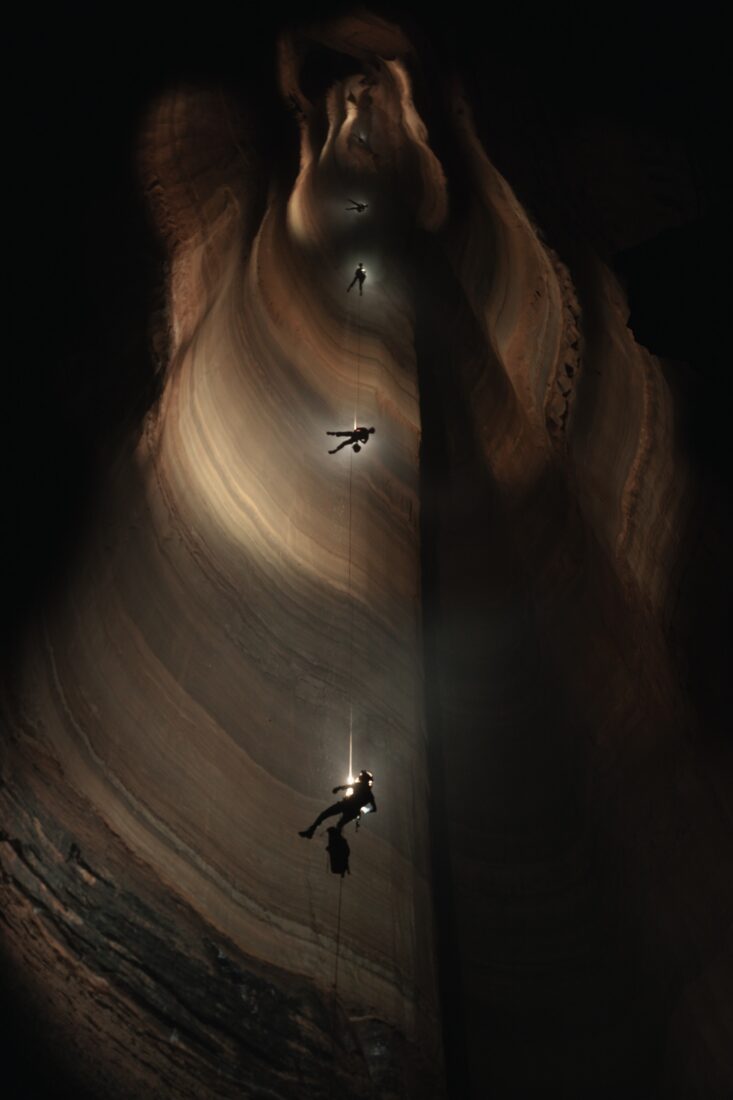
Photo: Courtesy of Stephen Alvarez
Rappelling in Fantastic Pit, one of the country’s deepest free-fall cave pits, in Georgia’s Ellison’s Cave.
To capture the scale of the work, Alvarez used a method called photogrammetry, whereby he set his camera on a track to take thousands of overlapping images, a process that took more hours of crouching than he cares to count. But the result was worth it: Software knitted the images together, creating a three-dimensional model that allowed the team to identify engravings that were otherwise invisible and to see the entire ceiling as one whole. An almost seven-foot figure was among the most dramatic to emerge. The Southeast’s humid conditions have been unforgiving to the art; when it was first drawn, a stark color differential would have made the lines pop. Today, though the lines are barely visible, the image is still striking, a denizen in mysterious regalia from some other time when experts surmise that concepts of spirituality, science, art, and magic most likely mingled. This figure was—and perhaps still is—immensely powerful.
The 19th Unnamed Cave is one of many such places across the country. A hundred known dark-zone cave art sites exist in the Southeast alone. Alvarez has also worked extensively in Devilstep Hollow, a Tennessee cave owned and gated off by the state. Devilstep enjoys a natural layer of protection too: Its entrance is a sinkhole, framed by wispy ferns and mosses—beautiful, mysterious, and a little terrifying all at once. After the sinkhole, dangerous to descend in its own right, comes a space barely big enough for a person to squeeze through. Eventually, the cave expands into a vast chamber before narrowing again and ascending to another chamber above. Inside that space hides a plethora of art, younger, at a thousand years old, than that of the 19th—recent enough that Native people today recognize some of its iconography.
“When Stephen showed me one of the images he’d taken at Devilstep Hollow, I immediately said, ‘That’s Falconman,’” says Dustin Mater, a Chickasaw artist who provides the Ancient Art Archive with an Indigenous perspective, a key part of Alvarez’s mission. Mater likens the cave to a cathedral, a sacred and ceremonial space. The last upper chamber contains a clear drawing, in charcoal, of a woodpecker, “one of the holiest animals in the Southeastern diaspora, a symbol of tenacity and willpower and of protection,” Mater explains, speculating that those who drew it or viewed it were perhaps calling upon that strength. “When I looked at this art, I felt bubbles popping in my mind with all these connections,” he says. “It leaves you with more questions than answers but fills you with wonder and awe.” Other caves, like the 19th, don’t include marks recognizable to modern tribes. For Alvarez, that mystery doesn’t lessen their relevance—he believes in the power of an image to stand alone and speak.
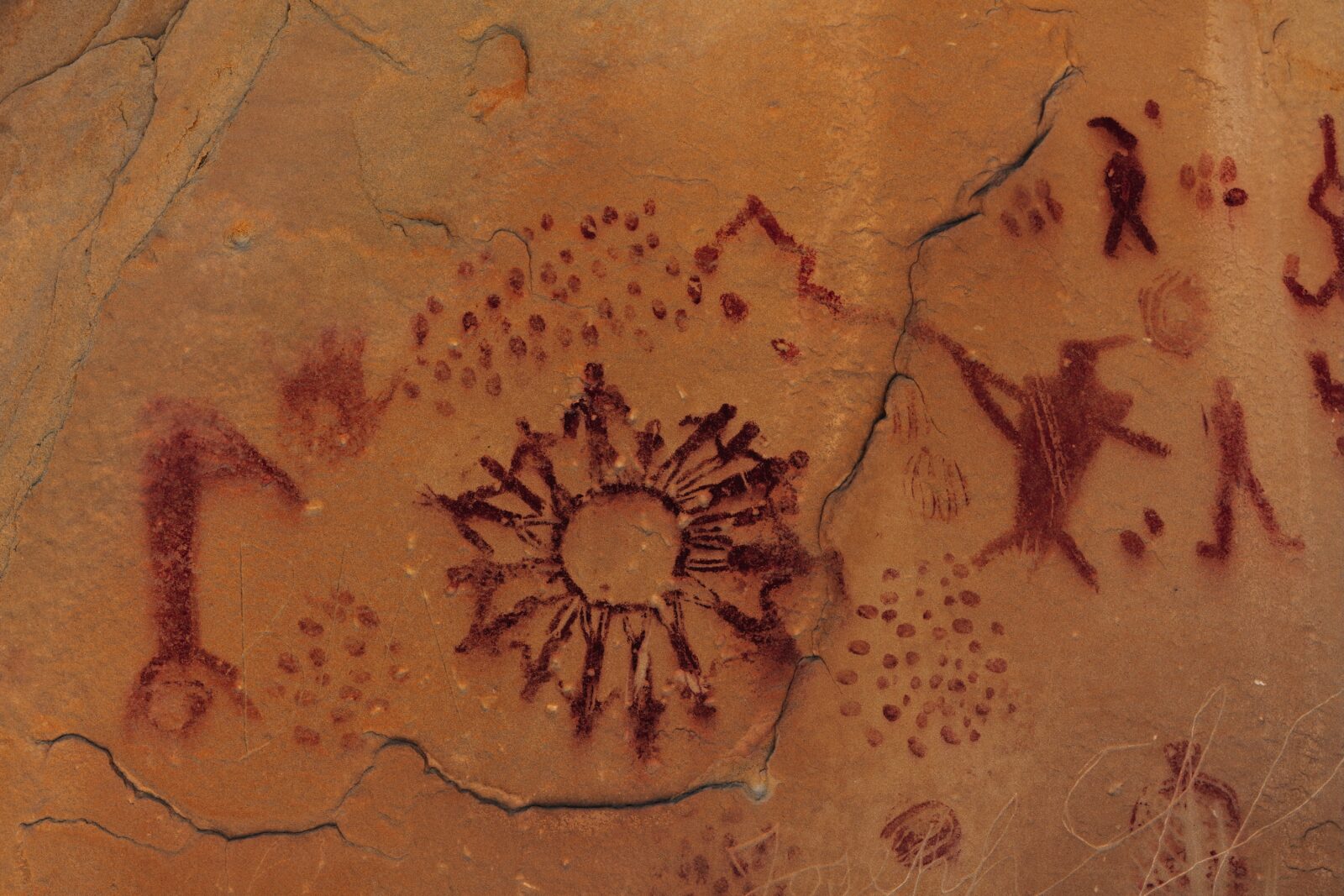
Photo: Courtesy of Stephen Alvarez
A pictograph called Circle of Friends in Utah.
That philosophy extends to his own work. “If I have to talk about a photograph to explain it, that means I failed,” he says. Indeed, a thread of anonymity runs through his images; many feature humans as tiny figures, faceless in the distance, dwarfed by awesome landscapes even as their presence denotes scale. His subject matter is so captivating that the man behind the lens and the circumstances that led him there melt away. That’s what Alvarez wants: to inspire awe and reflection—to show people that “the world is much weirder and more wonderful than they imagine.” He holds two truths comfortably: that his work reflects his worldview and who he is on a profound level, and that everything he is and does is simply a blip in the long view of time.
This spring, Alvarez debuted Mural of America, an in-depth, multimedia exploration of the country’s most astounding rock art, on the Ancient Art Archive’s website. He also published Rock Art: An American Story, the culmination of his American photography for the nonprofit, a collection of images meant to provoke viewers to feel what he did during his own transformative experience in Chauvet. “I am less interested in pinning down what these things mean than in understanding how we engage with them now,” he says, “and what they make us feel and show us about ourselves.”
One powerful image from Rock Art is not of rock art at all. Alvarez took it at night. The Milky Way splits a blazing abundance of stars, all of them shining over a lone tree that grows above Devilstep Hollow. Below the roots, below the soil, below feet of solid limestone, Falconman and a woodpecker preside over the darkness. The tree, juxtaposed with Alvarez’s images of those beings, carved into the walls by anonymous hands, gives a sense of the world below and the vast sky above. If you study the images long enough, some other level of consciousness tickles the mind in a seesaw of conflicting, beautiful feelings—insignificant and important, tiny and powerful, enlightened and lost. If words were necessary to accompany the images, they might say something like this: Each of us is part of a chain of thousands of years of people before us who also lived and left their marks on the landscape, and who also looked at the sky, and wondered what it meant to be human.
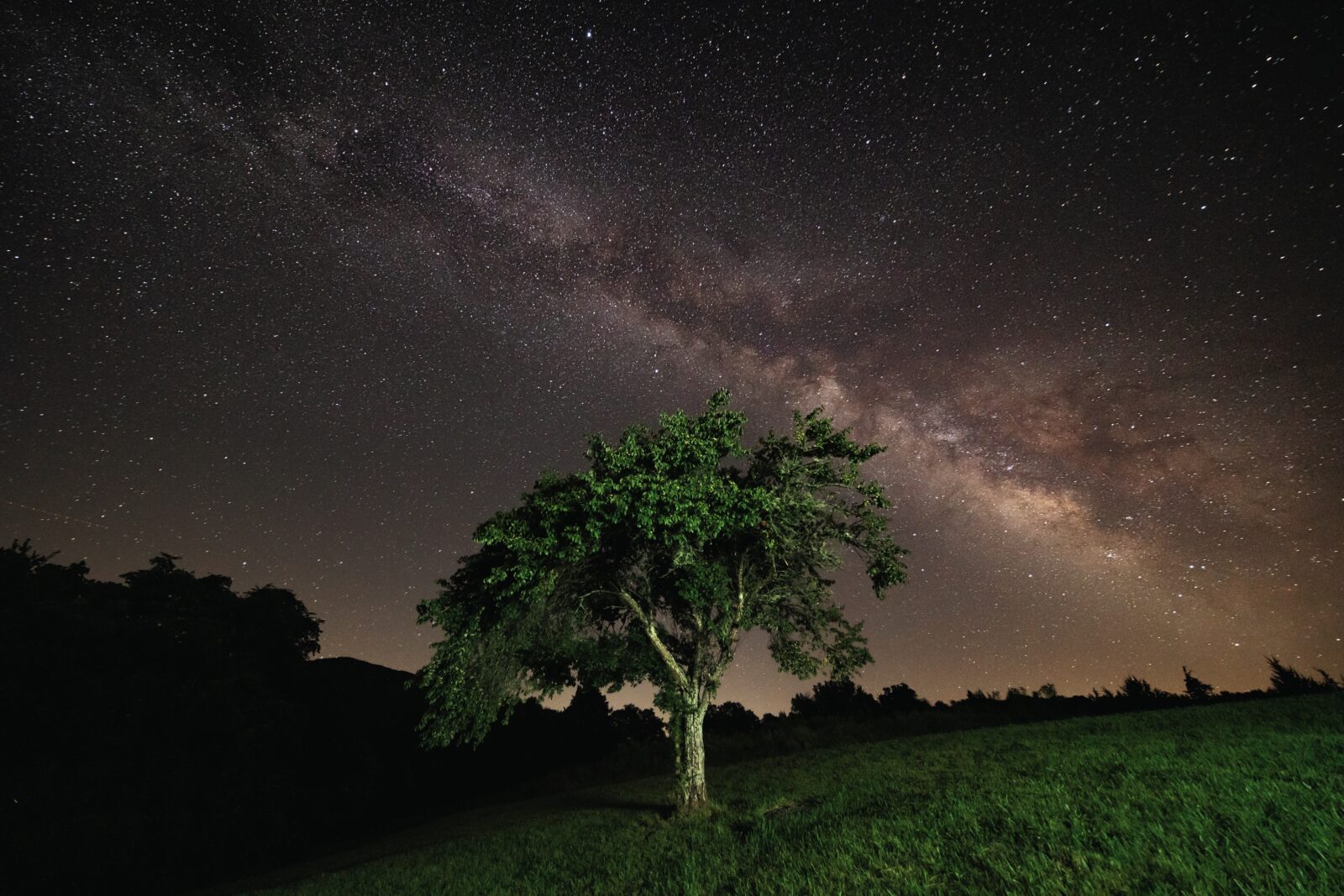
Photo: Courtesy of
The Milky Way above Devilstep Hollow.
In Alvarez’s company, I come to understand the nuance of his dichotomies, too. He’s both a hard realist and a dreamer; someone who will drop a philosophical bomb on you and then placidly eat a turkey sandwich. Above all, I realize he poses questions so vast and tangled that he isn’t searching for answers at all. As he tells me after sharing his Chauvet epiphany, “When we became human, what makes us human…those are concepts worth spending some time on.” And he has spent more than a decade on them. The resulting body of work speaks for itself, just as the rock art does. As the Chickasaw artist Mater says, “Our mausoleum is not where our bodies lie. It is in the work we leave behind.”
Lindsey Liles joined Garden & Gun in 2020 after completing a master’s in literature in Scotland and a Fulbright grant in Brazil. The Arkansas native is G&G’s digital reporter, covering all aspects of the South, and she especially enjoys putting her biology background to use by writing about wildlife and conservation. She lives on Johns Island, South Carolina.