
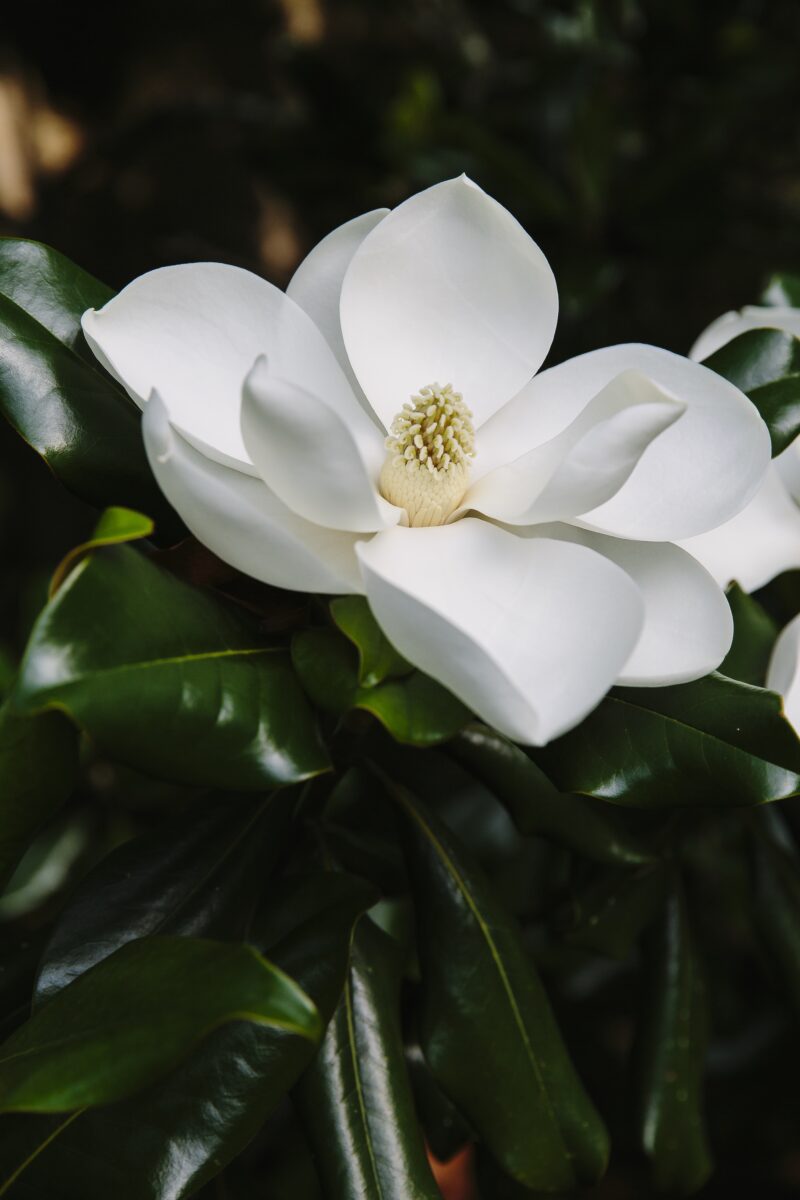
Full disclosure: If you read How Flowers Made Our World: The Story of Nature’s Revolutionaries, you will never smell a magnolia, admire the petals of an orchid, eat your cereal, or consider a weed growing in the driveway the same way you did before—and that’s just the point. “If you learn all these fascinating stories and uncover new connections, you start to see the world in new ways,” says author and professor David George Haskell.
Haskell, who spent decades teaching ecology at Sewanee: the University of the South and now works at Emory University in Atlanta, is no stranger to telling stories about the natural world. An evolutionary biologist and ornithologist by training, his 2012 debut book, The Forest Unseen, chronicles a year he spent observing a one-meter square patch of Tennessee old-growth forest; the resulting lyrical essays earned him a finalist nod from the Pulitzer board. From there he tackled soundscapes in Sounds Wild and Broken: Sonic Marvels, Evolution’s Creativity, and the Crisis of Sensory Extinction (another Pulitzer finalist) and the way trees shape our lives, memories, and emotions in Thirteen Ways to Smell a Tree. Now, this spring, he’s brought his trademark biologist’s eye and artist’s sensibility to flowers.
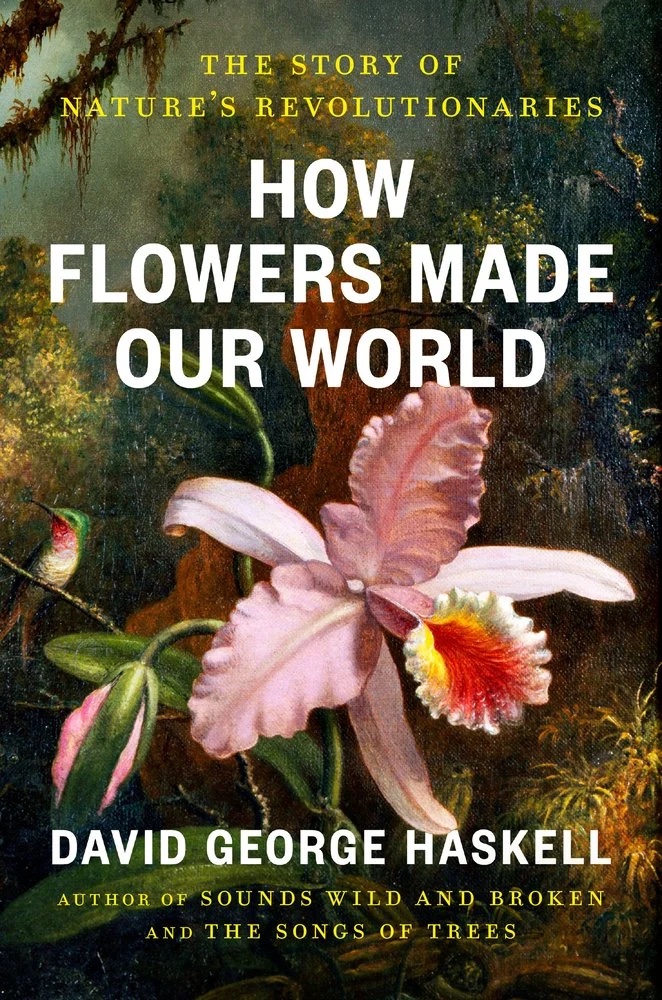
“When flowers evolved, they upended and transformed the planet,” Haskell writes in the new book’s preface. “Today, 90 percent of all plant species on the planet are flowering plants. They provide food and habitat for much of life on Earth. Without them, humans would not have evolved, nor could we feed ourselves today. Flowering plants are some of life’s great revolutionaries. They belong at the center of the story of how our world came to be.”
So why in the world do we tend to think of them as merely ornamental?
Haskell quickly dismantles that notion, and proceeds to lead readers through marvel after marvel organized by meticulously researched chapters on magnolias, goatsbeard, orchids, grass, seagrass, rose, tea, and pansy. “Scientific journals are packed with extraordinary dramas,” Haskell says. “Because of my technical background, I can read those and not get bogged down in the jargon. What I’m trying to do in my writing is to distill out the jewels of insight and beauty and stories to share with people.”
Below, he shares some of those jewels with G&G.
You open the book by turning the current Western idea that flowers are somehow “feminine” on its head.
Every culture that we know of uses flowers in various symbolic ways. It’s part of being human. In our culture right now, flowers are boxed into a fairly narrow role, as being feminine and associated with the pretty and ephemeral, but also essentially as powerless and just ornamental. The problem with that is twofold. One is it that stops us from seeing an essential truth, which is that flowers are world makers and world changers. Second, it also boxes humans into limited roles. When I was a young boy, it was totally not cool to express any interest in flowers. And that’s such a loss. Why should flowers be something that just women can appreciate? Ninety percent of flowers have both male and female in their structure, and in fact many flowers are at their most aromatic and their most colorful when they’re shedding pollen. So it’s actually a form of hypermasculinity, if you like. With this book, I want to reclaim flowers for everyone.
Before we get into their beauty, let’s talk about them as revolutionaries.
I call them world changers because they form the basis of everything from rainforests to salt marshes to prairies and human agriculture. Flowers had this amazing effect of spurring animal evolution and just increasing diversity generally. They catalyzed the evolution of really important groups of animals, like all the bees, all the butterflies, all the grazing mammals—none of those existed without flowering plants. For creatures that were here long before flowers evolved, like beetles and even birds, their evolutionary trees also fanned out in great profusion when flowers appeared. The planet itself was transformed by the appearance of flowering plants, because once you add rainforests and prairies and seagrass meadows and mangroves to planet Earth, the climate is different. There’s more carbon storage; the rainfall patterns are completely different. They changed the biophysical nature of the world in a way that few other organisms have done.
And we—humans—are a result of grasslands.
Most people don’t even think of grasslands as flowers. But they are—the flowers are just very inconspicuous because they’re wind-pollinated and a very specialized kind of flowering plant that had this genius idea of developing a really humble body plan, where they essentially creep along the ground and send up these temporary, very cheap leaves, which we call grass, that can then ignite. During fire, all their competition gets burned away. When grasses figured this out, they took over lots of the planet and created prairies and steppes and savannahs. When grasslands appeared, lots of other animals started to move into that habitat—importantly, lots of grazing mammals like zebras and horses and bison.
But then this little group of apes came down from the trees and started hanging out and becoming bipedal and leaving their ancestral home of the forest and wandering around in the grasslands. Those were our ancestors. Without grasslands, they would not have left the forest and evolved large brains. From analyzing the molecular composition of their teeth, we know that what they were eating was totally grassland-based, either eating grasses themselves or eating the animals that eat the grass. And that continues to the present day, right? Two-thirds of the food we eat is from three species of grass: rice, maize, and wheat. So, you know, we are still grass apes. And it is humorous because it’s like, who’s in charge here? We think we are, but really we’re working on behalf of these wild grasses. They have us where they want us. We’re just diligent servants of these plants.
We benefit from that enormously, of course. I’m very grateful when I bite into my sandwich and eat my bowl of rice. It’s not just a one-way street. And that’s the original genius of flowering plants, to work mostly collaboratively with animals.
We also do just love flowers for being pretty.
The great power of flowers is actually in their beauty. That beauty speaks to animal senses and puts us in a trance. The effect they have on humans is really powerful. Now imagine how powerful their hold is on bees; a bee’s whole life is about flowers. Flowers are amazingly good at using communicative language that is essentially animal to draw animals into productive partnerships. Often a flower is the most intensely hued, most contrasting thing that we will see all day except for our cell phone, which has horrible little algorithms in it.
Why do flowers have such a hold on us?
We don’t eat any flowers. We’re not pollinators. And yet we have this incredible fascination and we literally spend billions of dollars on cut flowers and the horticultural industry for our gardens. So there’s something deep there. Part of it is cultural and symbolic. We recognize flowers as life givers. We want to bring them to the grave when we bury someone. We want to bring them on Valentine’s Day or when someone gets married, and we want to put them on the altar of the place of worship. There’s cultural importance, but biologically I think there’s a lot going on as well. The aromas of flowers actually are some of the same aromas you’d find in the aroma of our skin. I’m not talking about body odor, but how our skin produces dozens and dozens of different volatiles that mostly act on us below the level of consciousness. Flowers can become part of that conversation. Visually, they’re bright and lively and attract our eye.
And then there’s smell.
Floral perfumes have this amazing ability to give us a really intense burst of connection to plant life. It’s all the good aspects of being in a forest or a prairie or whatever habitat gathered in one little bottle that we can deliver at will to our noses. The aromas of flowers are kind of like a concentrated drug that takes us out for a walk in nature. They transport us into the world of more-than-human and we can then put that on our wrists or on our neck or in a candle.
It’s funny how some flowers have more of a following than others—like orchids. I loved the way you wove in the Shakespeare references when writing about them.
It’s probably an indication that I’ve just been to way too many Shakespeare plays. But knowing about the history of flowers has changed my experience of the world. Before, the flower in A Midsummer Night’s Dream was just like, okay, whatever, it’s a flower. It’s just a little love potion. And now I’m thinking, oh no, this is what flowers actually do out there in the world. They beguile other species to fall in love with them, sometimes in very deceptive ways.
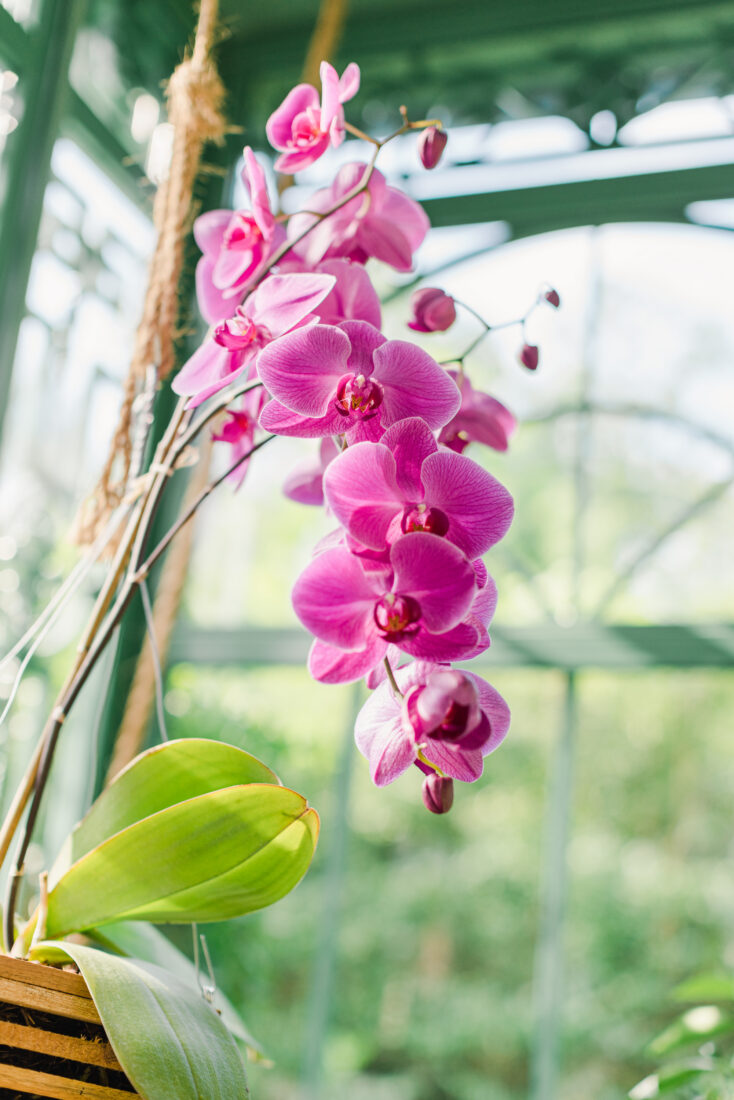
You make the point with orchids that nothing ever operates in isolation.
It is a general truth in biology that all creatures in this world are living communities, even when we give them individual names. And orchids take that to the extreme in ways that are also aesthetically really extravagant. For me, they’re really exciting and wonderful to write about. They have these insane blooms that are sometimes deeply cooperative with other creatures and other times completely exploitative. For me, an orchid is like a nineteenth-century, three-hundred-page novel packed with drama where it’s not clear who’s falling in love with whom and who the good people are and the bad people are. Orchids are just this big old soap opera, and it’s all in one flower.
Do you feel that understanding all of this on such a deep scientific level actually makes flowers—and anything else for that matter—even more beautiful to you?
There isn’t a compartment of the brain that is science and another one that is poetry or beauty or love. It’s all kind of mixed up. People who work in ecology are very much attuned to the beauty of the animals and plants and landscapes they work in, but it’s appropriate for some of that sense to be walled off a little bit. If I’m reading a report on the status of an endangered orchid, I don’t need a bunch of poems telling me how pretty it is. So some of that division is okay and helpful, but I think as human beings, we experience the world in a much more integrated way. What I try to do with my writing is to bring the big picture of evolution and of ecology—how the planet came to be the way it is—into focus by looking at things that seem like obscure details. How does a magnolia flower smell? Why are its petals arranged this way? Through those details, you see the big picture. For me, that’s an experience of beauty. Beauty is a place where the intellect and the emotions and our culture and our sensory experience all come together. We all have that within us, that basic impulse of finding beauty in the world and in its rich, intricate details.
At one point, you write about going to see preserved plant specimens as a sort of religious pilgrimage, as something spiritual.
Connecting to these stories that go back so deep into time and go so far beyond the human is humbling in a good way, in that it puts my story into perspective of the bigger arc of Earth’s evolution. It’s a quiet sense of belonging; that if I understand, say, the story of the magnolia tree that grows outside my house, then I’m stitched into the stories of the living Earth in a way that feels much more rooted. I think that is complementary to human religion in its best sense, when it puts us in touch with stories and wisdom that far transcends our moment, and comes from scholars and prophets and so on over thousands of years who were thinking about what it means to be human and to have a livelihood in this world.
Of course, those religious stories can get distorted and simplified and turned into wars and all kinds of negative things. But within all religious traditions, I think, is a call to get outside of the self—to get over ourselves a little bit and to realize we’re part of a much bigger story. Encountering those specimens in the herbarium was amazing for me because it connected me to those bigger stories. It was also kind of funny. I grew up in France where there are religious relics in every church. Biologists are doing exactly the same thing: Here’s the original specimen that we use to describe this new species.
What else do you hope people experience when reading your work?
The goal is partly for people to have a sense of celebration of living on this absolutely fascinating, wondrous planet that continues to give us life. Joy is one outcome I would hope for. Curiosity and rootedness is another. To me they go hand in hand. If I’m curious about the weeds growing in my driveway, that curiosity then allows me to understand the stories of these humble little creatures and feel more connected to my home. They become neighbors. I realize my kinship with them. Biology teaches us that ultimately we’re all family. You might have to go back a couple of billion years to find the common ancestor, but family nonetheless.
I also hope for nuance to come across—like with orchids, how you can have exploitation and cooperation happening in the same flower, in the same meadow. And that feels more like the reality of life, since there’s often ambiguity and moral tensions and light and darkness combined with one another.
The supplemental section, which closes out the book, encourages everyone to get up close and personal with flowers by doing things like dissecting them and making perfume.
Flowers are all about participation. They want the bees to come visit them. They want their pollen to be carried far away or their fruit to be attractive to a bird. So playing with flowers is part of the spirit of flowers themselves. Our appreciation of the tulip or the lily or the rose goes so much deeper if we engage our curiosity. I want to encourage people to have experiences that go beyond the mind, that actually get our fingertips onto rose petals and consider the world from the flower’s perspective, which sounds simple, but once you start doing that, it leads to all sorts of experiences of reconnection with the living world. These days, I think we need more curiosity and fun because there’s a lot of other stuff that’s hitting us. My hope would be that people would do some of these things together, like go to the department store, or the duty-free store at the airport and just study how flowers are represented in perfumes there. That’s goofing around and having fun. It’s bringing the sensory delight. It’s playful.
Any final takeaways?
We don’t have to go it alone. A really key message in this book is that the narrative of revolution and of how flowers changed the earth happened in community. And we can be part of that, and we are part of that through our conservation actions. Even through agriculture and through the work we’re doing in our gardens. In knowing these stories, who would want to poison the bees in their backyard? Who would want agriculture that degrades the possibilities for the future, rather than one that builds soil and builds up fruitfulness in future years? Joy and curiosity are great foundations for figuring out how to do the right thing. Nobody wants to bequeath to the people who come after us a degraded earth that is less beautiful and less fruitful than the one we have now.
Lindsey Liles joined Garden & Gun in 2020 after completing a master’s in literature in Scotland and a Fulbright grant in Brazil. The Arkansas native is G&G’s digital reporter, covering all aspects of the South, and she especially enjoys putting her biology background to use by writing about wildlife and conservation. She lives on Johns Island, South Carolina.
Garden & Gun has affiliate partnerships and may receive a portion of sales when a reader clicks to buy a product. All products are independently selected by the G&G editorial team.