

Conservation
Hatching the South’s Rarest Fish
Tennessee biologists race to save the tiny, endangered—and stunningly beautiful—residents of our waters
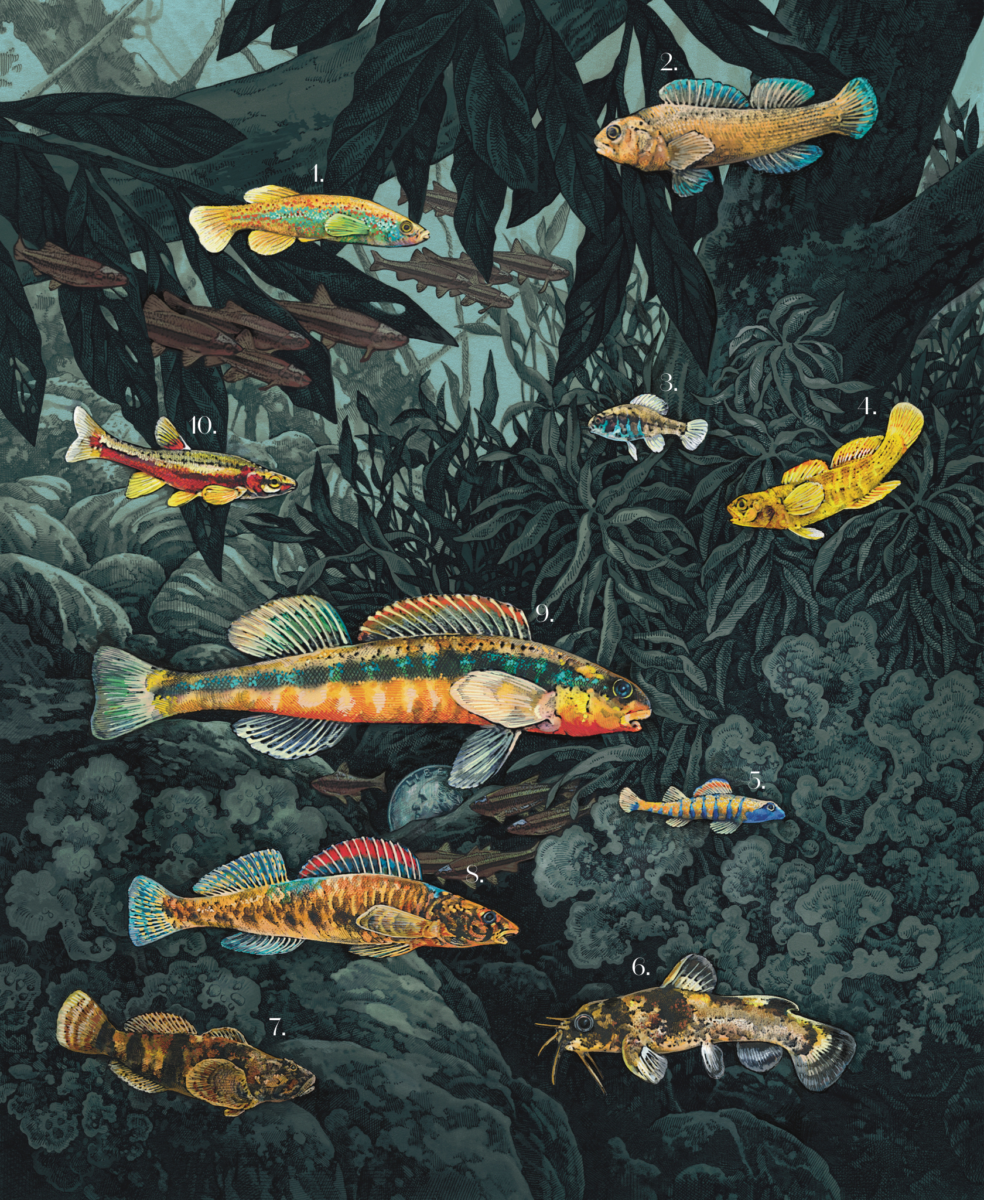
Illustration: Song Kang
1. Barrens Topminnow
Only three small original populations of this federally endangered fish remain in pockets of Tennessee’s Barrens Plateau, threatened by agricultural runoff and invasive mosquito fish. CFI propagates them for stocking and to create ark populations; to catch them, Rakes and Shute use binoculars to scan the water for the bright white stripe along their backs.
2. Boulder Darter
These endangered fish get their name from the moderate to fast-flowing rocky sections of the Elk River they call home in Tennessee and Alabama. Over fifteen years, CFI has released more than five thousand of them into Shoal Creek, a tributary of the Tennessee River near the Elk, and hopes to soon declare the population established.
3. Spring Pygmy Sunfish
Staff favorites because they’re just plain cute, these inch-long fish have a temperature-controlled room of their own at CFI, which keeps an ark population in case they go extinct in the one place they are found: Beaverdam Creek watershed, which drains into Wheeler Reservoir near Huntsville, Alabama.
4. Buck Darter
Native to the cool water of Kentucky’s Buck Creek watershed, Buck darters attach their eggs to the undersides of rocks, making them vulnerable to water polluted with silt from mining or development. CFI started propagating and releasing them in 2016, and last year the team observed some of the fish reproducing on their own.
5. Bluemask Darter
To catch bluemask darters, CFI biologists often have to lie on their stomachs in the tributary streams of the Caney Fork River system in central Tennessee with their heads ducked under the shallow water, nets at the ready.
6. Carolina Madtom
This dwarf catfish, listed as endangered last year, lives in North Carolina’s Tar and Neuse River systems. A male guards his nest fiercely; if he thinks a predator has breached his defenses, he’ll eat the eggs himself. At CFI, one male is so notorious for this behavior he has earned a nickname: Hannibal the Cannibal.
7. Banded Sculpin
Over millions of years, many mussels evolved elaborate lures to attract just one or two fish species to which their larvae could attach and travel to start new populations. If that fish disappears, so do its mussels. The banded sculpin hosts the slippershell mussel, and CFI, with the North Carolina Wildlife Resource Commission, releases them in the Cheoah River.
8. Roanoke Logperch
A breeding pair of Roanoke logperch carefully consider where to lay eggs, pointing with their noses to discuss sites. They live only in five disjunct areas in Virginia, and CFI is propagating them to expand their range back into North Carolina. “They are the king of the darters,” Baxter says. “They wear their fin like a crown.”
9. Tangerine Darter
“This is a fish that demands notice,” Shute says of the neon “river slick,” as it’s also known. They favor cool Southern Appalachian streams, and since 2003, CFI has tried to restore populations to Tennessee’s lower Pigeon River. “They’re a reminder that we are in the rain forest of the temperate world.”
10. Tennessee Dace
“Their color can change like that,” Shute says, snapping his fingers. The males streak brilliant red and yellow during breeding season in the Tennessee River system. In 2021, the Forest Service gave CFI a population to propagate for reintroduction into the Cherokee National Forest.
Lindsey Liles joined Garden & Gun in 2020 after completing a master’s in literature in Scotland and a Fulbright grant in Brazil. The Arkansas native is G&G’s digital reporter, covering all aspects of the South, and she especially enjoys putting her biology background to use by writing about wildlife and conservation. She lives on Johns Island, South Carolina.