

My mother found the knife in one of the cardboard boxes that seem to replicate in her attic like the biblical loaves and fishes. The more old boxes of old stuff we go through, the more emerge in their place. But the knife was something special, and my mom thought I might know something about it.
I did. It was my dad’s knife. It had to be. I just knew it.
My father died when I was thirteen years old. He was a small-plane pilot and fatally crashed in the North Carolina foothills in 1974. I don’t have a huge storehouse of recollections about my dad, which has more to do with my famously poor memory than anything else. But I do know that we camped a lot, and I do recall following Daddy on mountain trails, and I do think I remember this knife on his belt. I’m pretty sure I do. It had to be that knife. Of course it was.

But I also know that memory is a suspect guide to history. It’s a subject with which I have an uneasy relationship. As an adult, I’ve deeply pondered the memories I have of my dad. Some scientists who study memory have concluded that memories are not fixed in our brains like files in a filing cabinet. Instead, each time we recall a memory, our brains rebuild the incident through “reconsolidation.” During that process, the memory can be altered by internal or external inputs. Emotion. Loss. A strong feeling of wanting something to be true, even when there’s insufficient evidence to back up the claim.
I brought the knife home, determined to refurbish it. I’m not what you would call a handy guy, but I do know knives; I even wrote a book about them. As a kid, I saved money I earned as a paperboy for The High Point Enterprise to spend on an annual trip to the Acorn knife shop in downtown Gatlinburg, Tennessee. The knife I most clearly remember my father using was a heavy bowie made by Puma. It was monstrous. I recall his cutting kindling with that knife. After he died, my mom gave me the knife, and my brother, our dad’s binoculars. Both were stolen when someone broke into and ransacked our childhood home. I mourned the loss of my dad’s knife. And still do.
So there was, to say the least, strong medicine mixed with my memories. Was the attic knife truly my dad’s? Could he have carried it as a young boy—a boy about the age I was when I lost him? Or did I merely want it to be my dad’s so deeply that I bolted that possibility onto whatever faint memory I could conjure?
These mental gymnastics could happen with any item freighted with personal history—a grandmother’s rolling pin or an uncle’s set of wrenches. There was no way to know. But lacking enough factual basis, a certain kind of heart-truth stepped into the gap, and remains there, like a patch, until contradicted by new information.
Was this Daddy’s knife when he was a kid? It’s impossible to say. I’m still trying to figure out how much it matters.
The most salient clue to the provenance of the knife was obvious: the words “Poll Parrot Shoes” stamped into the leather sheath. The inscription initially meant nothing to my mother or me, but a little digging teased out some details and a possible family connection. Poll Parrot was a children’s shoe brand founded in 1920s St. Louis. Poll Parrot shoes were a huge hit, thanks in part to a Technicolor talking-bird mascot. The shoemaker eventually kicked off a kids’ adventure radio show, The Cruise of the Poll Parrot, that ran from 1936 to 1940, and via sponsorships, the jaunty parrot hung out with Howdy Doody on both the phenomenally popular television show and in comic books.
Naturally, for years Poll Parrot pumped out tons of advertising tchotchkes—buttons, whistles, popguns, coin banks, and noisemakers. And knives. Ultimately, the hapless parrot got steamrollered by other cordwainer upstarts and Buster Brown and went out of business decades ago.
Now for that family connection: My paternal grandfather, Hubert Edward Nickens Sr., managed the Goldsboro, North Carolina, location of Charles Store, a small-town, small-time department store chain that, like so many others, is now defunct. But it’s very close to a sure bet that my grandfather gave my father that Poll Parrot knife at some point, and my dad carried it and used it long and hard enough to bend off the tip, beat up the sheath, and leave the blade corroded and chipped and forgotten. Until my mother found it, like a pearl in a cardboard oyster.
Spiffing up the old knife wasn’t difficult, even for a humanities major. I used a rotary tool to grind the broken tip into a sharper point. I soaked the blade in white vinegar to loosen the rust, then used a wire brush, fine sandpaper, and a hank of leather to polish it to a pleasing patina. The bone handle scales had loosened, but I didn’t want to remove the brass bolsters in case I couldn’t fit them back together. Instead, I pried loose each handle scale from the full-length tang, and then dripped into the gap a medium-viscosity cyanoacrylate glue to serve as both adhesive and filler. I pressed the scales to the tang and tapped the bolsters back into place, snug. A little more glue set the double-sided finger guard firmly in place. Then I scrubbed the sheath and treated it with leather conditioner.
Throughout the process, more questions arose. How did the knife tip get broken? I loved throwing knives when I was a kid—did Daddy break the blade with an errant throw at a hard oak? Deep scratches etched one edge of the blade. Did he learn to sharpen a knife with the Poll Parrot blade, and get overly aggressive with a file or whetstone? I sure did, early on in my knife-love phase.
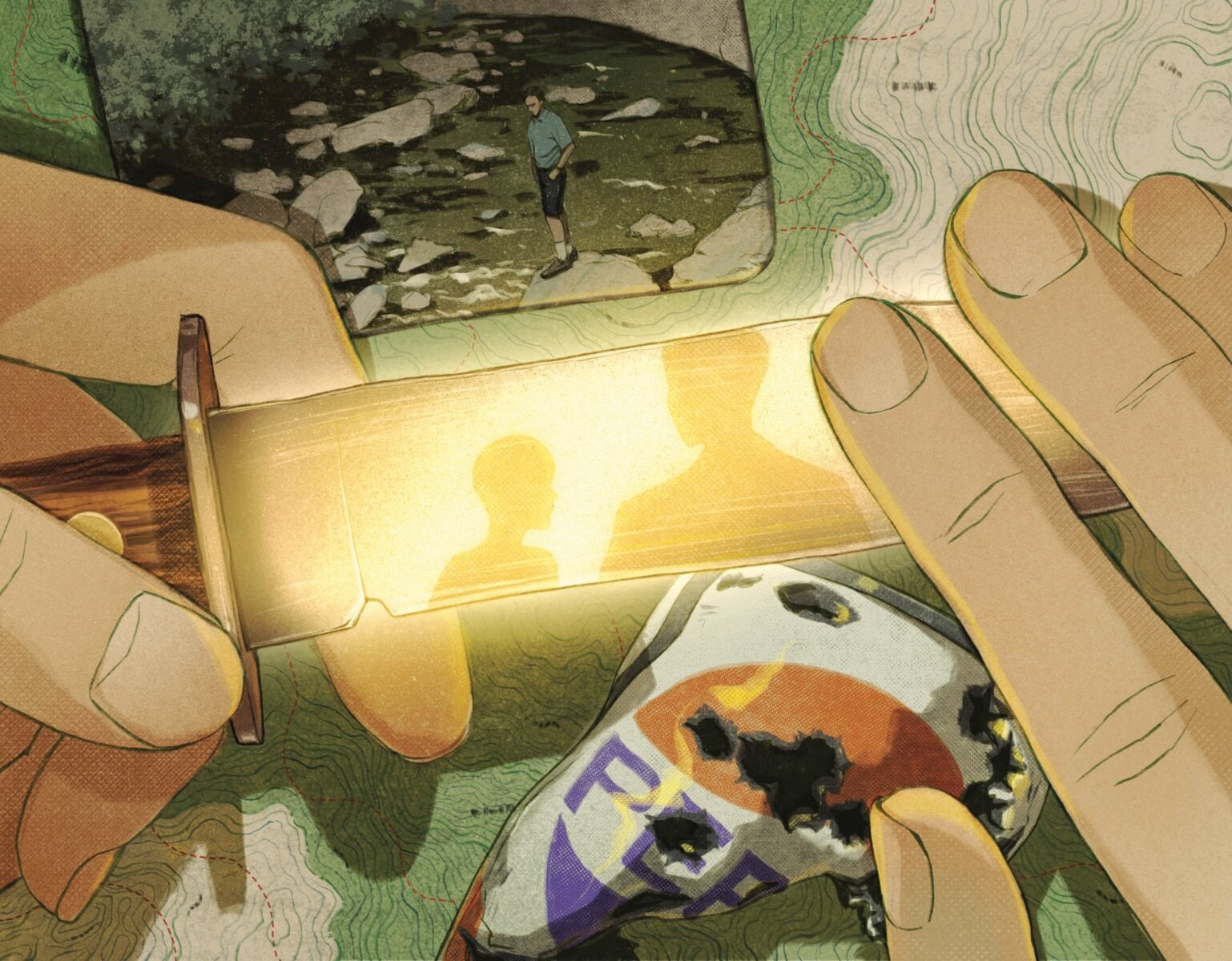
While I was working on the knife, I pulled out a few of the physical totems I have of my father’s life. A photo of him skinny-dipping in a creek in the Great Smoky Mountains, on perhaps the last family camping trip we took together. His marked-up topographic map of Linville Gorge, one of the most rugged landscapes in North Carolina. A steel Pepsi-Cola can peppered with bird shot, from the one time we went target shooting together. I had begged for months, and he borrowed a friend’s Iver Johnson single-shot 12-gauge to placate his son.
For nearly a week, my brain went into memory consolidation overdrive.
The last step was to sharpen the knife. The blade steel was soft and wouldn’t hold an edge for long, but I knew I could get that knife wicked sharp. I have a process: Thirty swipes on one edge bevel, then thirty swipes on the other. Then twenty. Then ten. Then five-four-three-two-one. Switch to the next-finest whetstone. Repeat.
With the completion of each set of strokes, I drew the knife edge between my thumb and forefinger to wipe off the sooty swarf—the metal dust removed by the whetstone. With each successive stroke on the stone, and with the progression from coarse stone to medium to fine, the swarf left behind on my fingers winnowed away to nearly nothing.
As did my doubts about the knife. When I tested the edge along a thumbnail, it immediately caught in the cuticle. A sure sign of a keen blade. It was the last of an accretion of possibilities whose collective weight turned irrefutable.
This was my father’s knife.
T. Edward Nickens is a contributing editor for Garden & Gun and cohost of The Wild South podcast. He’s also an editor at large for Field & Stream and a contributing editor for Ducks Unlimited. He splits time between Raleigh and Morehead City, North Carolina, with one wife, two dogs, a part-time cat, eleven fly rods, three canoes, two powerboats, and an indeterminate number of duck and goose decoys. Follow @enickens on Instagram.