

Travel
A Southerner’s Guide to Nantucket
Vacationers have long escaped summer’s fury by venturing northward to the luxe New England island that launched a thousand ships and, 175 years ago, “Moby-Dick.” But those who seek true relief should answer the call of autumn.
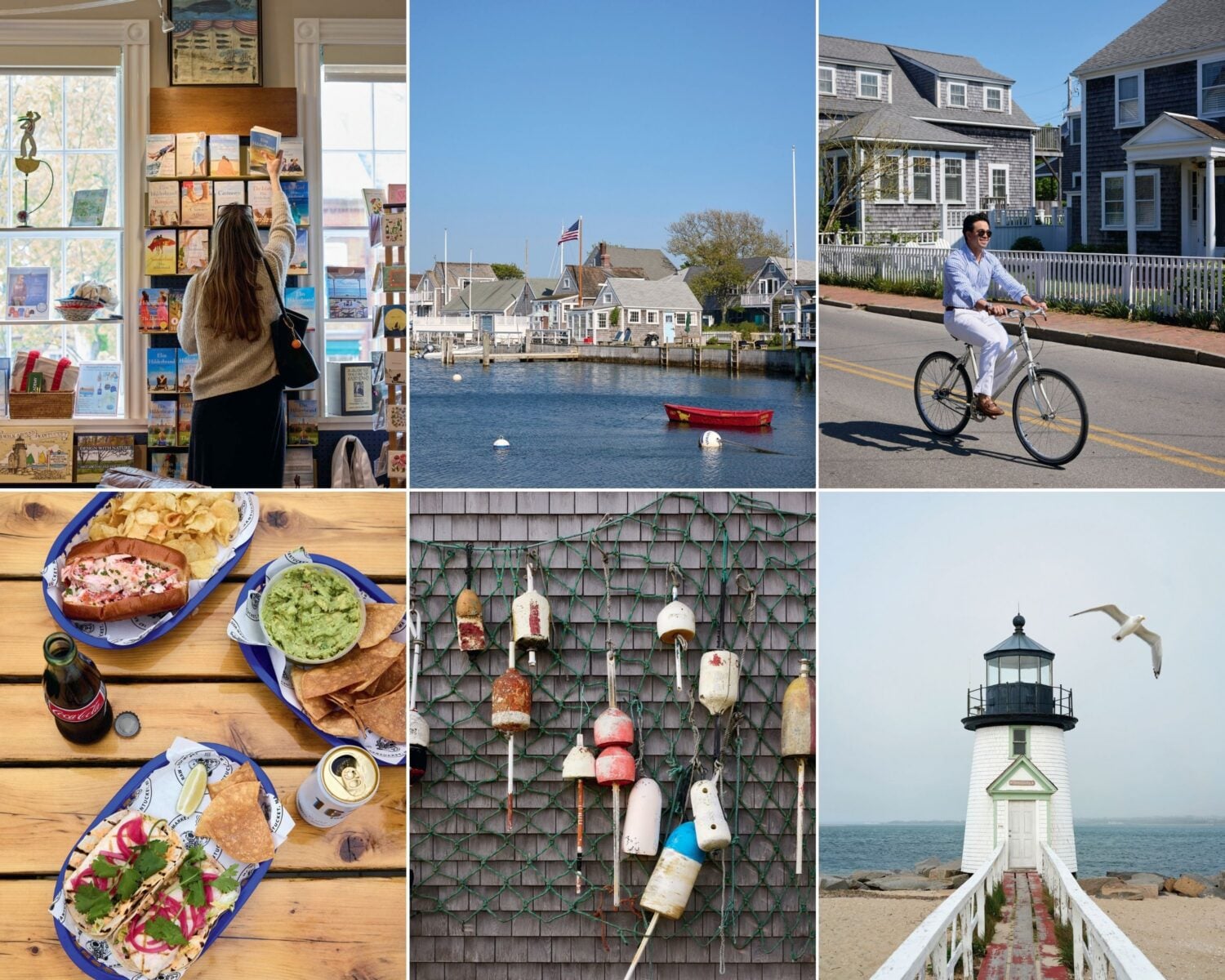
Photo: Elizabeth Cecil
Clockwise from the top left: Mitchell’s Book Corner features local authors and lore upstairs; a view toward Old North Wharf; cycling comes easy on Nantucket; the lobster roll, guacamole, and fish tacos at 167 Raw’s food truck; vintage buoys adorn a cedar-shingled shop; the Brant Point Lighthouse greets ferries arriving in Nantucket Harbor.
The Wampanoag stood here too in this bay, hundreds, thousands of years ago, the people scouring the eelgrass as I am now for scallops, tossing their fanning shells postprandially into great heaping middens alongside those of quahogs, whelks, oysters, clams. Technology has since advanced for the Nantucket scalloper in search of a meal, but just barely. Waders and biceps-length gloves, to fend off the salt-whipped chill of October, when the Massachusetts island’s recreational scalloping season opens. A rake, so-called but really a long pole ending in a rectangular net, to gently push across the harbor floor.
I have seen Nantucket before, but not like this, amid the exquisite bliss of fall. Wading waist-deep at low tide between the mid-island downtown of postcards and the eastern tony tip of Wauwinet will become a moment I recall often as a balm, a revelation, a respite, whether from the general rush of life or the specific swelter of my home in Charleston, South Carolina. Bluebird sky, the warming sun rising behind me from the Atlantic into which so many whaling ships once ventured. Beach and bog and marsh and heath and moor stretching out beyond me, an astonishing number of habitats within this fourteen-mile-long sandy crescent waxing and waning some thirty miles south of Cape Cod. All of it, seemingly licked ablaze with crimsoning black huckleberry as our Cape Air Cessna descended over it into the tiny ACK airport yesterday.
This sustainable scalloping field trip, offered regularly by the Maria Mitchell Association science center in October and November, both educates and feeds, provided you pick up the fifty-buck permit required for keeping your catch. Lovely though our lodgings are at the Brant, one of only two Michelin Key hotels on Nantucket, they lack a kitchen, so I offer my haul to a family renting a home nearby. The father, an avid fisherman from Biloxi, Mississippi, tells me he has landed stripers on the Pascagoula and dived for spiny lobsters in Key West; and even though surf casting exhilarates here this time of year, with blitzes of albies and bonitos and bluefish, he wanted nothing more than to experience the world’s last commercially viable wild-caught bay scallop fishery.
“It’s one of our delicacies,” Jesse Sandole explained to me before my trip. The restaurateur jibes between Nantucket, where he expanded his father’s 167 Raw fish market to an oyster bar and food truck, and Charleston, where he runs three perpetually jam-packed seafood joints. “It’s something we look forward to every October.” For year-rounders, scalloping also signals the end of summer’s tidal wave of tourists—a madding crowd pouring off ferries and puddle jumpers from the mainland, vacuuming up reservations to the Nautilus and Galley Beach, swarming chic designer shops like STAUD and Erica Wilson, walking backward down the cobblestones in LoveShackFancy dresses while telling selfie sticks, “Follow me for the perfect day on Nantucket.” As a Southerner, I certainly get the instinct to head to this storied New England haven in June or July. I did once, too.
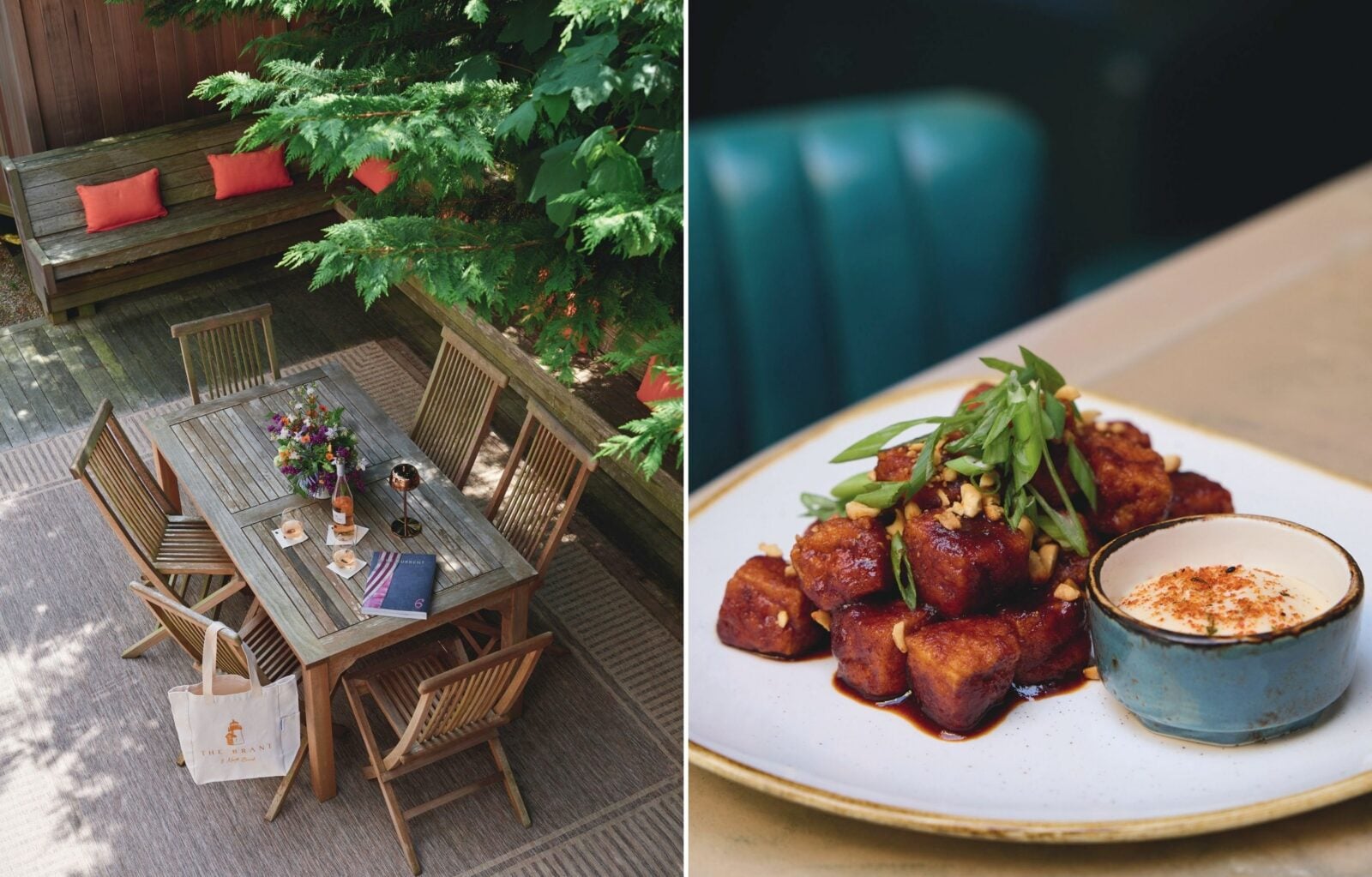
Photo: Elizabeth Cecil
One of the Brant hotel’s alfresco hangout spaces; gochujang-glazed popcorn tofu at the Nautilus.
Indulge me a little backstory. Whenever I receive an L.L.Bean catalogue, I send a photo of it to my friends and say, “My Playboy arrived.” That at forty-four I fantasize about walking rocky beaches in duck boots and a fisherman’s sweater would shock the teen me who basted herself in Panama Jack tanning oil at Myrtle Beach. But that’s only a small part of what first attracted me to Nantucket-set fiction and nonfiction—a mental spray of frosty salt water to offset heat-induced doldrums.
Mostly, though, I was having a hard time letting go of something. The bucolic Upstate South Carolina community I grew up in was, is, giving over from farms to subdivisions, leas that once held cows and horses and peach orchards now crowded with, ironically, prefab modern farmhouses. My parents’ longtime next-door neighbor, an English teacher who owned eighty of the prettiest acres, once told me that our souls need an anchor in the world. Now her heir had sold my anchor to a developer with plans for a hundred homes. I couldn’t stop thinking about it. Crying about it.
Call me crazy, but to rein in what I understood was becoming an unhealthy obsession, I turned to “Call me Ishmael.” Captain Ahab and his monomaniacal, life-ruining pursuit of the great white whale would surely hammer home the dangers of fixation. But reading Herman Melville’s Moby-Dick, an unmooring tempest of writing still remarkable 175 years after it was published, begot a new fascination: that “elbow of sand” called Nantucket and the whalers who set off “like so many Alexanders” to declare “everlasting war with the mightiest animated mass that has survived the flood; most monstrous and most mountainous!”
And so over the past handful of years, I devoured like Jonah’s fish the National Book Award–winning In the Heart of the Sea, Nathaniel Philbrick’s excellent retelling of the sinking of the whaleboat Essex, the real-life story that inspired Melville. Then Philbrick’s equally excellent treatise Why Read Moby-Dick? and Away off Shore, his history of Nantucket and the generations of native people and (mostly) Quaker families who settled and intermarried and whaled there. Throw in a reread of Edgar Allan Poe’s eerie The Narrative of Arthur Gordon Pym of Nantucket, and it became clear: I had to see Natockete, the “faraway land” of the Wampanoag, for myself.
Because my mind had been so stuck in Nantucket’s past, I did not quite grasp its modern milieu of billionaire’s playground and Instagram influencer’s paradise until my husband, Justin, and I took the high-speed ferry from Hyannis in July 2024 only to disembark into the well-heeled throngs on Straight Wharf. Yet no number of Ferretti yachts and crocheted Prada totes could obscure the island’s old-salt charm and natural beauty. Every five steps, I squealed, “Look at those hydrangeas!” Electric maroons, delicate chartreuses, violent violets breached exuberantly from yard after yard of cedar-shingled cottages with names like ACK Last and Whale of a Time.
Amid intricately carved scrimshaw and a looming sperm whale skeleton, the Nantucket Historical Association’s Whaling Museum fulfilled my every lance-sharp desire to better fathom the industry. The artifacts and storytelling give no quarter: This was brutal, nasty work, for the seamen and their quarry; an enterprise whose insatiable hunt for blubber and spermaceti oil both fueled the Industrial Revolution and decimated species, including the North Atlantic right whales that still struggle to calve off Southern coasts. When I spotted the only object to famously survive the “stoving” of the Essex by an enraged whale, I shook a nonplussed Justin till his brain rattled. “It’s the twine! The Essex twine!!!” If only Jennifer Garner had been my first mate that day; the actress attended no fewer than three lectures at the museum while filming Peacock’s adaptation of islander Elin Hilderbrand’s The Five-Star Weekend last fall.
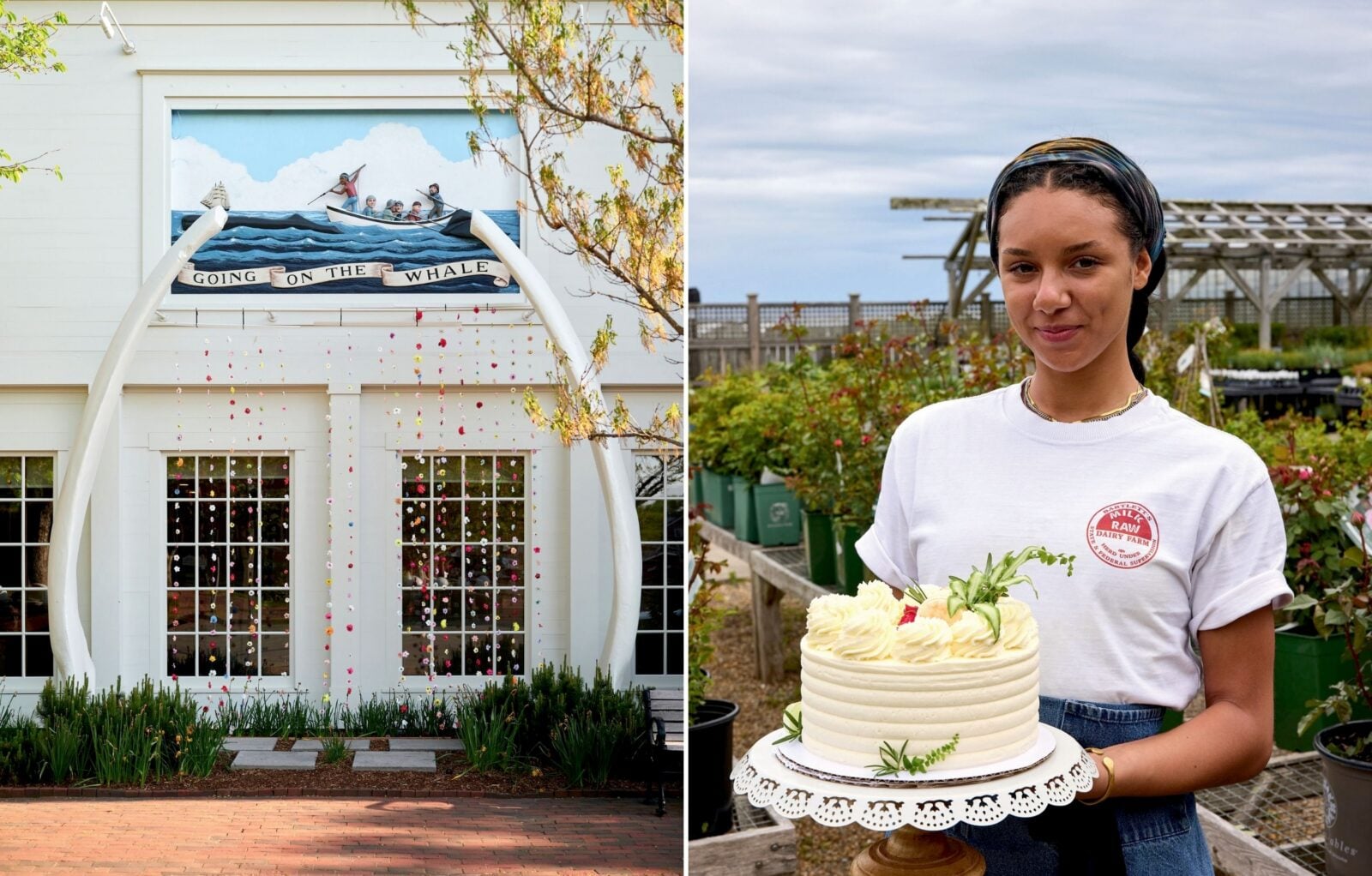
Photo: Elizabeth Cecil
The Whaling Museum, which offers visitors a 360-degree view from its rooftop deck; Azaylei Brown with a cake at Bartlett’s Farm.
Appropriately, we split our two nights between the darling Life House Nantucket, a short stroll from the walkable downtown, and the stately, in-the-thick-of-it-all Jared Coffin House, former residences built in the mid-1800s by whaling bigwigs. We supped on rich clam chowder and lobster prepared every which way—tucked in grilled brioche, stuffed into spring rolls, poached in miso butter—at the 1840s whaling pub Brotherhood of Thieves and sunset seaside hot spot Galley Beach. Queued at the Juice Bar with the rest of Nantucket for scoops of toffee crunch and marshmallowy S’Morton Sea Monster, a nod to Morton, a 1937 Nessie-esque hoax perpetrated by local artist (and original Macy’s Thanksgiving Day Parade balloon creator) Tony Sarg. Browsed Mitchell’s Book Corner, with its upstairs dedicated to local lore and authors, including sections for (and signed books from) Philbrick and beach-read idols Hilderbrand and Nancy Thayer. Oohed over lightship baskets at Four Winds Craft Guild, debated the wisdom of acquiring Nantucket red pants (the island’s dusty-rose version of khakis) at Murray’s Toggery, and dipped into dozens more adorable indie boutiques (the island allows few chains) and antique shops.
Our free shuttle ride to Cisco Brewers, toward the southern coast, particularly surprised me. The summer jam of downtown quickly gave way to the soft, romantic haze of moor and farm. More than half the island’s land, we would come to find out, is held in conservation, the result of efforts to ensure Nantucket is no longer the place, as Melville snarked, where “one blade of grass makes an oasis.” As we drained ice-cold Whale’s Tale pale ales among the food trucks and live bands at Cisco, we decided: Two days simply weren’t enough to explore the island. We had to come back.
Palatial oceanside second (or third) homes that tempt lookie-loos strolling through their manicured backyards on the scenic ’Sconset Bluff Walk. A fleet’s worth of vintage Land Rover Defenders roving the Bartlett’s Farm market parking lot. More nautical-chic inns than you can shake a harpoon at. All Nantucket luxuries, yes. But when Justin and I return in October 2025, we discover the best island indulgence is simply being here in the autumn, period.
It’s almost as though Nantucket has let out a collective breath. The pace is leisurely, laid-back, small-town. We walk straight into restaurants we would have waited hours for in the high season—breakfast favorite Black Eyed Susans, for huevos rancheros and a spicy Thai curry scramble, and the crazy-fresh Lemon Press, where I sip a gin cocktail with just-reamed juices that still makes my mouth water to contemplate. Reservations are not the usual imperative for überpopular dinner spots like Bar Yoshi, for lemongrass dumplings and beef burger bao, or Ventuno, with its toothsome strozzapreti. Do book ahead, however, for the Nautilus, where we sit packed cheek by jowl, scarfing down beef tataki, lobster salad and roe on hash browns, and popcorn tofu as neighbor greets neighbor at the bar.
The light-and-bright Brant, our boutique hotel home base, has earned a Michelin Key for its warm, nimble service (even more attentive, we found, with few of the rooms and suites occupied) and slate of goodies: a generous breakfast and coffee bar in the lobby “barn”; happy hours with whites and reds from local Épernay Wine & Spirits and s’mores around the firepit; everything one needs to hit Children’s Beach just steps away, boogie boards and coolers included; and what turns out to be our favorite amenity, access to electric bikes we use to sail around the island.
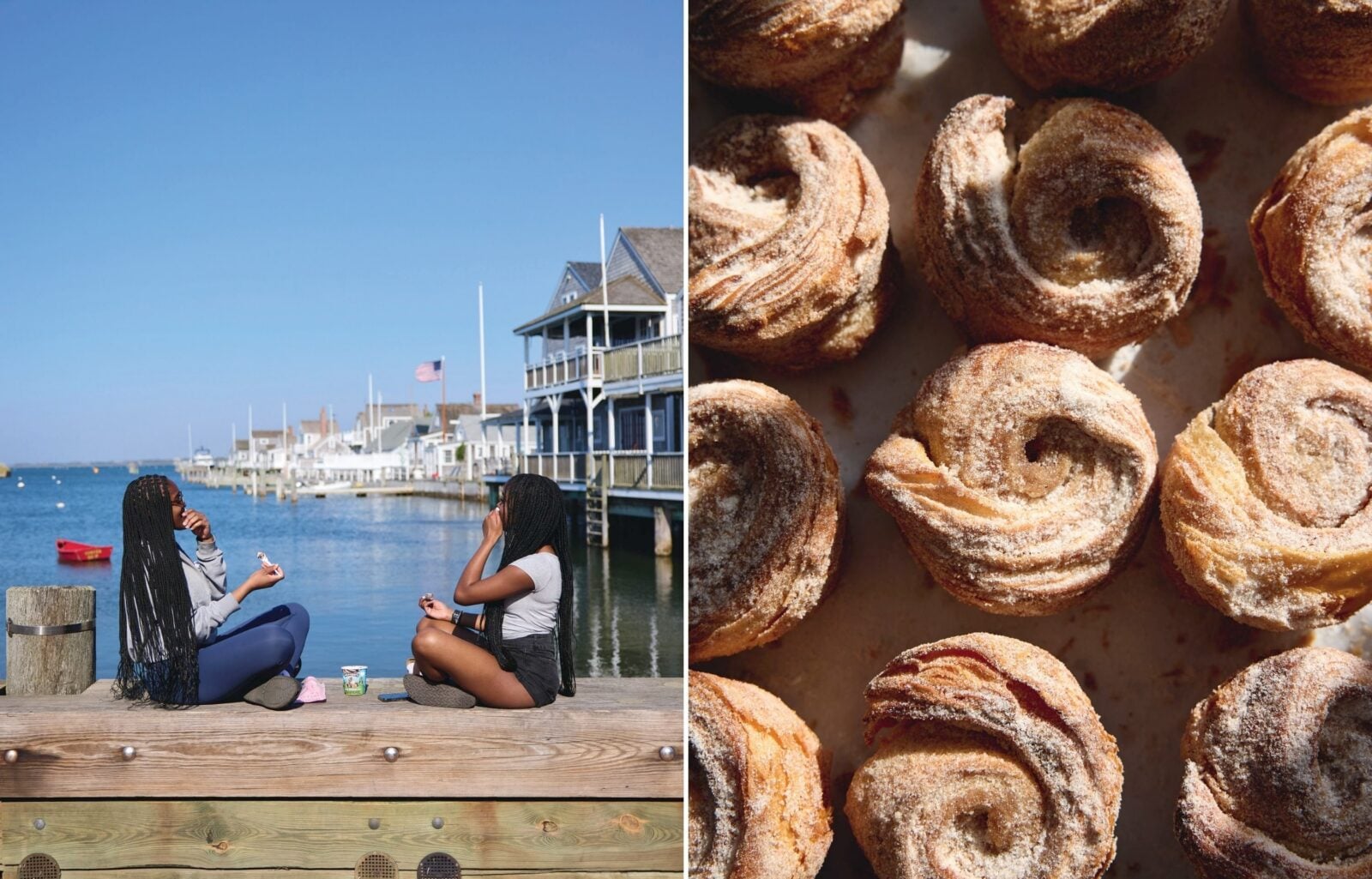
Photo: Elizabeth Cecil
Relaxing on Easy Street; Wicked Island Bakery’s wicked-good morning buns.
A pedal up Sunset Hill brings us to the literally named Oldest House, open in season for tours; we dismount to peek around the circa-1686 structure and pet Lucy and Ethel, two wiggly white goats clearly hoping we’ll ignore the PLEASE DO NOT FEED WE ARE ON A SPECIAL DIET sign. We zoom south to New North Cemetery, where Essex first mate Owen Chase lies with myriad other sea captains and Folgers and Coffins and Gardners. Wind down the Cisco path to Bartlett’s Farm, to acquire a fresh raspberry pie we later eat in bed with two forks like little piglets. Jitter over the sand to Ladies Beach to live out my L.L.Bean dreams, filling my flannel pockets with surf-tumbled beach stones as we stroll arm in arm down the deserted shoreline.
Where the bikes don’t take us, Nantucket’s free WAVE shuttle does. We hop it to wee Wicked Island Bakery, south of downtown, for cinnamony morning buns so deliciously crisp with Vermont butter that you’ll often find a line outside before the 6:00 a.m. opening time. On the shuttle, we strike up a conversation with two of Nantucket’s almost fifteen thousand year-rounders (the population more than quintuples at its peak). They have each lived on the island for decades, have seen the place progress from sleepy, bohemian seventies idyll to a Xanadu increasingly out of reach for the working class that keeps it running. “Everybody down here had a nickname,” one reminisces. “Pat the Rat had a restaurant. There was Jalopy Coffee. A guy that rode motorcycles we called Easy Air. Who was Richard who used to work at the dump? I don’t remember.” The other responds: “It’s lost to the mists of time.”
Nantucket is the kind of place where those mists work their enchantment at every turn. Look one way, to the recently restored Brant Point Lighthouse, the nation’s second oldest, as golden hour descends, and it’s 1746, when the lantern first beckoned ships returning from Newfoundland, the Azores, Brazil, farther, farther. Look the other way, and CRU’s patio at the tip of Straight Wharf bumps with beautiful people toasting with rosé in the present. Look toward the Atlantic, alone on the windswept ’Sconset Bluff Walk, the waves crashing below you onto the slowly eroding sands, and you’re Maria Mitchell, America’s first female astronomer, and it’s 1847, the year she discovered a comet. Look the opposite direction, and you might have the unfortunate luck of espying a trespassing couple, ahem, christening the porch of a multimillion-dollar mansion, just one of the incidents that have the public footpath’s adjacent homeowners fed up with the more than six hundred people who traipse daily through their backyards in the summer.
Even so, the tight-knit community of Pat the Rat’s day endures, says Anna P. Jay, a Virginia-born gemologist who owns a literal jewel box of a shop near Main Street and snowbirds in the offseason in Charleston. Take, for example, her jaunts to the famous nightlife dive the Chicken Box, a roadhouse first opened by Kentuckian Willie House in 1949, primarily for people of color. (While you won’t find it listed on the Museum of African American History’s Nantucket Black Heritage Trail alongside the worthwhile African Meeting House, one of the country’s oldest remaining Black church buildings, I’d argue it’d make a lively addition.) “What’s great about Nantucket,” Jay explains, “is you’ll be dancing with someone who’s in college on one side, and then on the other side, you’ll be dancing with someone who could be your grandmother. Age is only a number here. You’re not too old to do something, you’re not too young to do something.”

Photo: Elizabeth Cecil
Pulling a pint at Cisco Brewers; the weaving studio at Nantucket Looms.
Must be those mists of time again. On our last night, we feast on roasted oysters and hazelnut-crusted halibut at Òran Mór Bistro, as cozy as a captain’s quarters, already reliving our trip in the past tense. I can’t help but think, though, of all the ports of call we’ve lacked time to visit. The upstairs studio at Nantucket Looms, where weavers turn out the shop’s downy soft alpaca throws and scarves. The top of Sankaty Head Lighthouse, open just two days a year for the pleasure. A Nantucket Historical Association heritage craft workshop—to make a sailor’s valentine, perhaps, or a lightship basket. The Loines Observatory, to stargaze into the blistering heavens.
Justin interrupts my musings, his eyes as feverish as old Ahab’s. “I want this to be our place,” he says. “I want to make coming here an annual thing.”
Melville’s Ishmael says he must take to the sea, “whenever I find myself growing grim about the mouth; whenever it is a damp, drizzly November in my soul.” Nantucket has shown us, perhaps, that what we need in such circumstances is the opposite: to return to this bit of land, every October. To set a new anchor in the world.
A Navigator’s Guide to Nantucket in the Fall
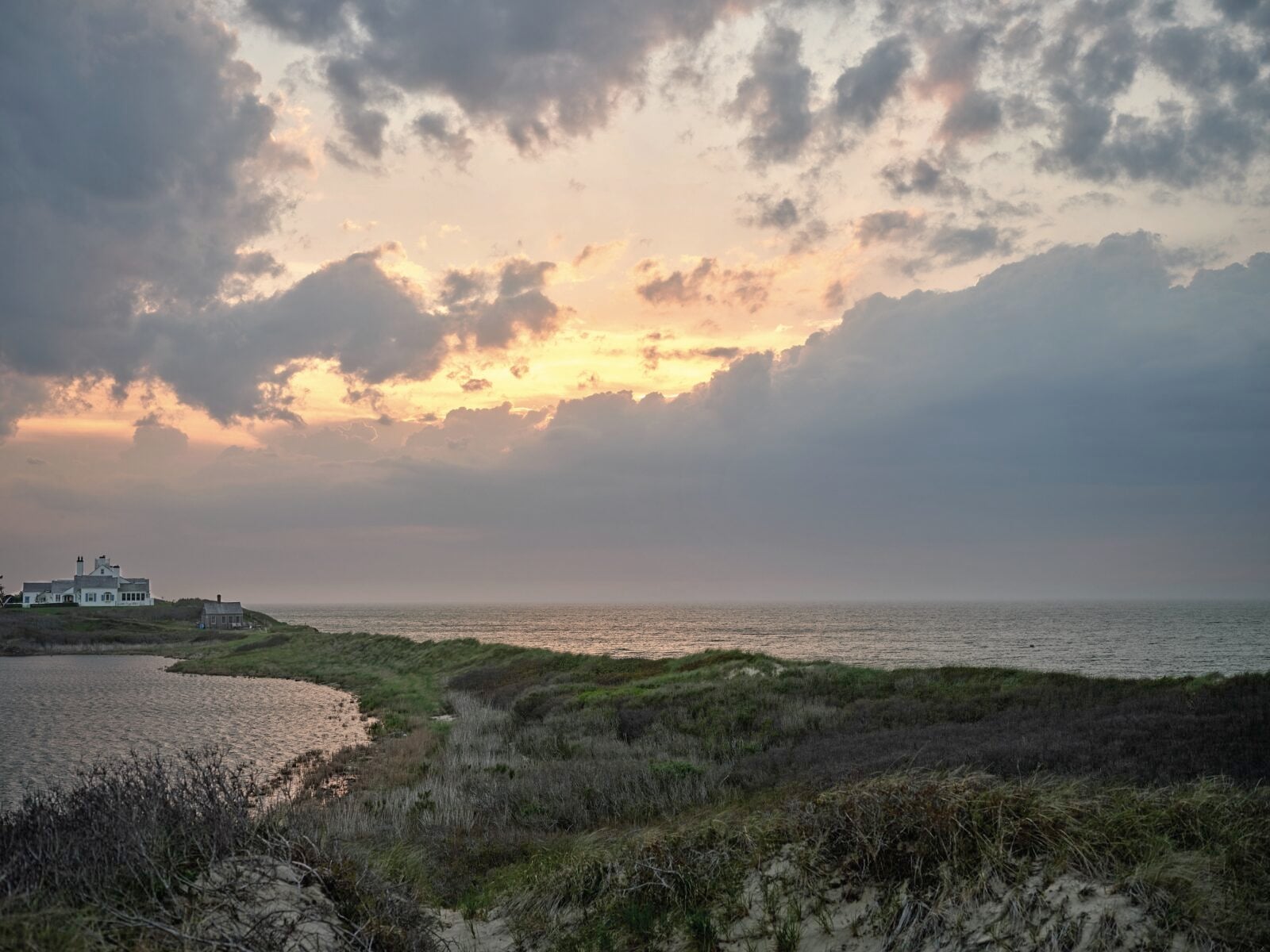
Photo: Elizabeth Cecil
Sunset at Cisco Beach, on the island’s south side.
When to Go: Aim for the shoulder months of September and October, ideally between the final rush of Labor Day and Indigenous Peoples’ Day (the second Monday of October), at which point some businesses and museums hang their CLOSED FOR THE SEASON signs. That being said, we went the last weekend in October and still found plenty of restaurants, shops, and hotels open (I even easily booked our room at the Brant only a week out).
How to Get There: By water or by air, and I’ve enjoyed both. Highspeed ferry options from Hy-Line Cruises run year-round out of Hyannis, Massachusetts, roughly an hour and a half from Boston Logan International Airport in a private car or on a (surprisingly nice) Peter Pan bus. If you prefer to fly into Nantucket Memorial Airport (ACK) in the offseason, you’ll need to transfer at Logan onto a Cape Air Cessna, so make sure your constitution can handle hurtling four thousand feet above Nantucket Sound in a plane the size of a minivan. Pro: Stunning bird’s-eye views of the island.
Scooting Around: The usual vehicular suspects (Uber, Lyft, taxis, rentals) exist, but consider the slogan of sustainability-minded nonprofit Remain Nantucket: LEAVE THE KEYS, PLEASE. The group encourages visitors to bike (many hotels offer classic cruisers and e-bikes), walk (easily done downtown), and hop the free, year-round WAVE shuttle, which offers island-wide routes (including to the airport), the convenient “Greenhound” depot downtown, and an app for requesting rides.
Stays Beyond the Cobblestones: If downtown’s slew of inns don’t suit, the Michelin Key–winning Wauwinet boasts a more secluded, resort-style stay on the island’s northeastern tip, surrounded by beaches and a wildlife refuge. For those desiring a rental among, say, the rose-covered cottages of Siasconset (known as ’Sconset) or in sunset-basking Madaket, 167 Raw’s Jesse Sandole recommends checking with a mom-and-pop real estate company before Airbnb or VRBO: “Atlantic East, J Pepper Frazier, Lee Real Estate—you might do better with the local guys, and have an easier time renting for a full week.
Amanda Heckert is the executive editor of Garden & Gun and the editor of the magazine’s book Southern Women. A native of Inman, South Carolina, she previously served as the editor in chief of Indianapolis Monthly and as a senior editor at Atlanta magazine. She lives in North Charleston with her husband, Justin, and their dogs, Felix and Oscar.
Garden & Gun has an affiliate partnership with Bookshop.org and may receive a portion of sales when a reader clicks to buy a book. All books are independently selected by the G&G editorial team.