

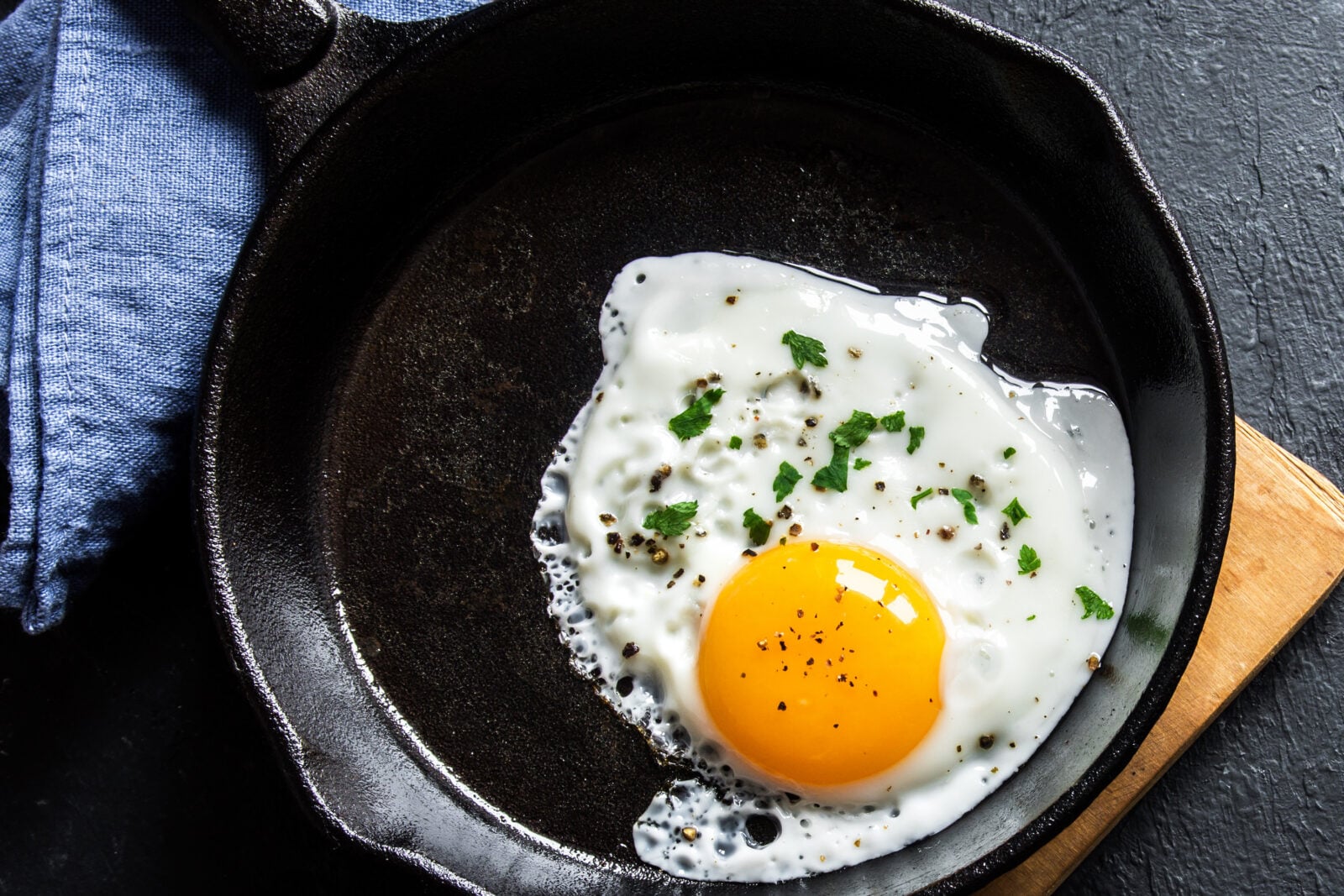
I have a kitchen confession: I was over forty when I learned how to cook an egg.
It’s not that I haven’t produced cooked eggs in my younger days. It’s just that I’ve been relying on the forgiveness of a nonstick skillet to mask my haphazard technique.
The trouble is, good nonstick cookware is hard to find. Many brands come coated with toxic chemicals, while others lose their magic after repeated use—and the only thing worse than scraping burnt egg residue from a pan is scraping it from an overhyped, expensive pan.
It was that very scenario that sent me reaching for my cast iron, daring to hope, on a recent weekday morning. Now, I love my cast-iron skillets, but here’s another kitchen confession: They are not always luxuriously seasoned. Because I use them often, I scrub them often (yes, with soap). What passes for seasoning in my house is usually a dot of oil rubbed in with a paper towel between washes. That gets the job done for most foods, but not finicky eggs.
Or so I long assumed. After a brief period of testing, I’m thrilled to have mastered a method that results in perfectly cooked eggs and, most importantly, glistening black skillets with hardly a morsel left behind. Yes, even my skillets.
I should emphasize brief, because the method is really quite simple and searchable. But a casual poll of friends and colleagues convinced me that not enough people are searching. Which is exactly what I told Kris Stubblefield, the culinary manager for Lodge Cast Iron, when I consulted him for validation.
“Many people assume you have to use a nonstick pan, right?”
“Well, we wouldn’t have put an egg on our logo if we didn’t expect people to cook it,” he told me.
Oh.
Maybe it’s just me then. (Egg on my face.) Here’s how to do it, anyway.
How to Cook an Egg in a Cast-Iron Skillet
Prep step: If necessary, rub a small amount of seasoning oil onto the surface and inner sides of the pan.
Skip this step if your skillet is well seasoned. But if the metal is looking a bit matte (hey, it happens), pour a drop of avocado, canola, or other high-smoke-point oil into the pan and spread it around with a paper towel, rubbing it in thoroughly so that the surface is glossy but there’s no residual oil. “I’m a product of the eighties, so I like the Mr. Miyagi ‘wax on, wax off’ approach,” Stubblefield says. “You’re basically wiping the whole thing with oil and then trying to wipe it all the way off.”
1. Set the pan on low or medium-low heat for three to five minutes.
“There are skillets out there that are beautifully seasoned, but if you don’t have proper heat control you’re probably going to stick your egg,” Stubblefield says. The exact setting and duration will vary by stove—“medium-low is about as high as you’re ever going to get” —but the idea is to bring the skillet to a gradual, even heat over a few minutes. (This is a great time to pull out and prep any fixings you plan to serve with your eggs.)
2. Add oil of choice, enough to fully coat the pan when you swirl it around.
Aim to coat the surface and just a little bit of the inner sides. You’ll know it’s go-time when the butter has melted and started to foam or the olive oil has thinned out and started to shimmer. If there’s smoke, pull the pan off the flame and let it cool a beat. And don’t hesitate to lower the heat; if you’ve followed step one, the skillet will stay plenty hot for the job.
3. Crack your egg into the pan (or for scrambled eggs, pour in your whisked mixture)—and let it sit.
For the unenlightened, this step may seem heavens-opening-up revelatory. Prevent sticking by…leaving it alone? The proteins need time to coagulate, so resist the urge to disturb the egg for a full minute. “Just be patient and let the skillet do the work,” Stubblefield says. “It will release that egg when it’s ready.”
When the edges start to solidify and lift a little bit, gently prod them with your spatula (Stubblefield likes a fish spatula), which should slide easily beneath the entire egg. If it doesn’t, back off and let the egg keep cooking, checking intermittently for up to three minutes.

4. Flip, fold, or otherwise finish the job according to preference.
The nuances of every short-order egg style will have to wait for another article. Just trust Stubblefield that “once a minute has passed, it will make magic in your skillet right in front of your eyes.”
Elizabeth Florio is Garden & Gun's senior digital editor. She joined the staff in 2022 after nine years at Atlanta magazine, and she still calls the Peach State home. When she’s not working with words, she’s watching her kids play sports or dreaming up what to plant next in the garden.