

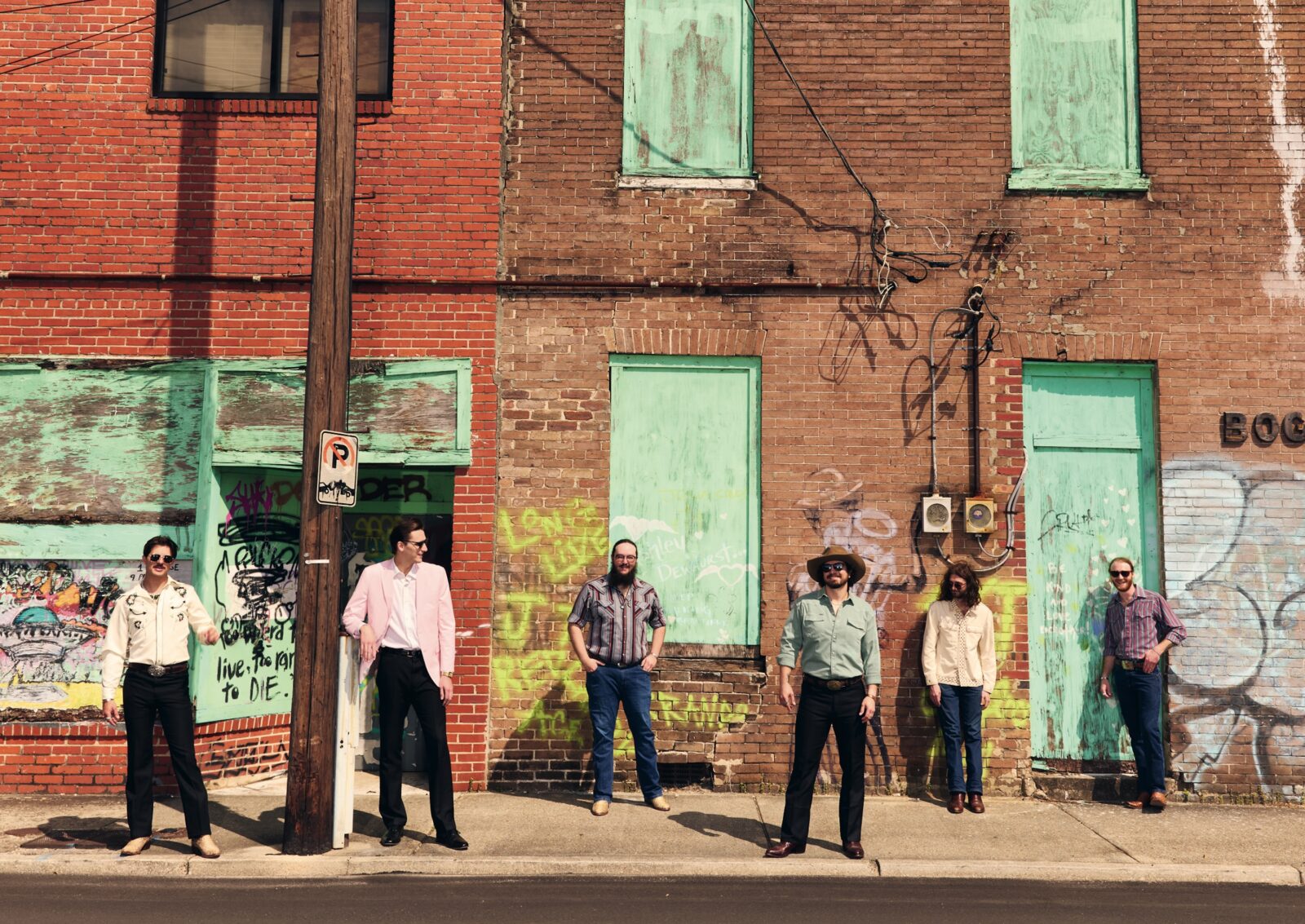
Inside the dark Cedar Street Social, a club in downtown Mobile, the good vibes are as thick as the spring blast of humidity outdoors. It’s the first time since early December that all of the members of the Red Clay Strays have been in the same room together, and in the interim, major life events have transpired: Lead singer Brandon Coleman became a father. Guitarist Drew Nix has shed more than fifty pounds thanks to changing his diet and hours of CrossFit. “CrossFit is definitely a cult,” Nix says. “But a very motivating one.”
“It might be a cult, but you look amazing,” says bassist Andrew Bishop. “Your pudding days are over.”
“Now he’s just pudding it in your momma,” deadpans Coleman. The room explodes into hysterics.

A sheepish grin curls onto Coleman’s face as he folds his six-foot, six-inch frame onto a leather couch next to his bandmates. The good-natured ribbing is a constant within the Strays, moments of levity that accompany the group’s meteoric rise from its start in Mobile, playing local clubs like Cedar Street, to headlining arenas. Blending gritty Southern rock, honky-tonk country, and lyrics with an emotional, literary bent, the band has become one of music’s hottest acts. Out in June, the Strays’ powerhouse third album, Grateful, sees them reuniting with producer Dave Cobb, who helmed their 2024 effort, Made by These Moments. That album followed on the heels of the viral success of “Wondering Why,” a song from their self-released 2022 debut that became ubiquitous on TikTok.
Coleman cuts an imposing presence. He’s pensive but inquisitive, with a potent voice reminiscent of Chris Stapleton. His coiffed hair and charismatic stage presence have shades of Elvis and others from the Sun Records milieu. But while he’s the front man, it would be a mistake to call the Strays his band. Drawing equally from gospel and Lynyrd Skynyrd, the group’s assured songs of faith and redemption come from a shared process. Each member contributes material, and one of the band’s main lyricists—Coleman’s younger brother Matthew—doesn’t appear onstage but sits in on recording sessions, scribbling lines.
“Most of the time when we’re in the studio, Drew can’t write, because he’s playing guitar,” Brandon explains. “So the whole time we’re sitting there working on music, Matthew’s hid away in the corner somewhere, just writing words down.” Grateful’s haunting opener, “Demons in Your Choir,” actually originated with the youngest Coleman brother, Dakota, then got finished by Matthew and Brandon, who landed on the missing line. “It used to say, ‘If I could pull you from the fire, from these demons in your choir,’” Brandon recalls. “It just felt empty. So I thought of ‘maybe I could save you from these demons in your choir.’”
The looseness creates room for discovery. The band wrote the funky “Fool’s Gold” the same day they recorded it, working off a riff Nix came up with a week prior that blossomed into a Rolling Stones–esque groove. A lick from 1970s country star Charlie Rich’s “Mohair Sam” inspired “Don’t Wanna Know”—the band even cut in the song’s writer on publishing after finding the track’s DNA in his rhythm. Meanwhile, “Can’t Fix You,” one of the album’s rawest moments, which Nix wrote in under an hour, is about someone close to him he’d exhausted himself trying to save. “There was a point where I was fed up,” he says, “and I was just like, ‘I still love you, but I can’t be here to try to fix whatever you’re doing to yourself.’”
In the early days of the band, before officially becoming the Red Clay Strays in 2017, Nix wasn’t yet a member, but he booked shows and served as manager while teaching himself to play guitar and write songs. In addition to Cedar Street, they played beach bars and dives up and down the Gulf Coast, where the crowds were generally more interested in watching a football game. Bar owners would threaten to pull the plug if they played too loudly. They performed four-hour sets, three nights a week, covering everything from Queen to Waylon Jennings to the Marshall Tucker Band while sneaking in a few of their own songs, waiting to see if anyone noticed, and scraping by from gig to gig. “Our tip bucket determined if we got a hotel or not,” Coleman recalls.
Pretty soon, they stopped playing covers, and the band’s current lineup took shape, with Nix as a full-time member, drummer John Hall, and guitarist Zach Rishel (they would later add keyboardist Sevans Henderson). They bought an old bus—nicknamed The Breeze—whose air-conditioning would conk out every summer, forcing them to stand in the beer caves of gas stations along I-10 to cool down. But “that’s where you learn how to work a crowd,” Coleman says of the group’s early shows. “How are you gonna play an arena if you can’t kill it at a beach bar?”
Their musical chops and stirring lyrics have clearly struck a chord with audiences. If there’s a theme throughout the Red Clay Strays’ music, it’s the idea of reckoning—taking stock of who you are, where you’ve been, and whether it’s still possible to change course. That kind of storytelling sits squarely within the Southern musical tradition. Artists from Johnny Cash to Jason Isbell have built careers around songs that wrestle with guilt, redemption, and faith. “Revival,” one of Grateful’s most affecting tracks, invites the wayward to try to find a renewed faith in themselves. Matthew wrote the song years ago, and the band held on to it until the moment felt right.
Religious references often appear in the Strays’ music, and while the members have been open about their faith, they resist the “Christian rock” label, saying their faith is not a marketing tool. “I’d rather be denied by man than denied by God,” Coleman says. “But that has nothing to do with whether you’re a fan of the music or not. Come hear the music.” He pauses. “I heard somebody say Christianity isn’t like some social hierarchy where I’m saved, I’ve got faith—I’m better than you. It’s none of that. Christianity is just one beggar telling another beggar where to find bread.”
That theology—humble, horizontal, but unwilling to flinch—gives Grateful its weight, and it’s why, on any given night, you’ll find someone in the front row of a show coming apart. “We get emails a lot about how our songs affect people,” Coleman says. “In some of the extreme cases, our songs have kept someone alive, kept them here.” He lets his words sit. “That’s worth everything.”
The money and the fame, he adds, are beside the point. Not because they’re unwelcome, but because they’re not what bring fulfillment. “If we were just doing it to try to be successful or get attention and make money, I don’t think I’d be doing it,” he says. “It’s just the fact that we’re expressing what we’ve been through, helping give people some hope, and letting them know it’s going to be okay. That’s really the driving force in all of this.”
He leans back. Outside, those beach bars down Mobile Bay are filling up with spring breakers. The Breeze has been retired, traded up through a succession of buses, tour budgets, and headlining slots that once seemed impossible. Last year: amphitheaters. This year: arenas. None of the members can quite picture what’s next, and they’ve learned not to try. “The only place you’ve got to make it,” Coleman says, “is the next show.”
Matt Hendrickson has been a contributing editor for Garden & Gun since 2008. A former staff writer at Rolling Stone, he’s also written for Fast Company and the New York Times and currently moonlights as a content producer for Ohio University’s Voinovich School of Leadership and Public Service in Athens, Ohio.