

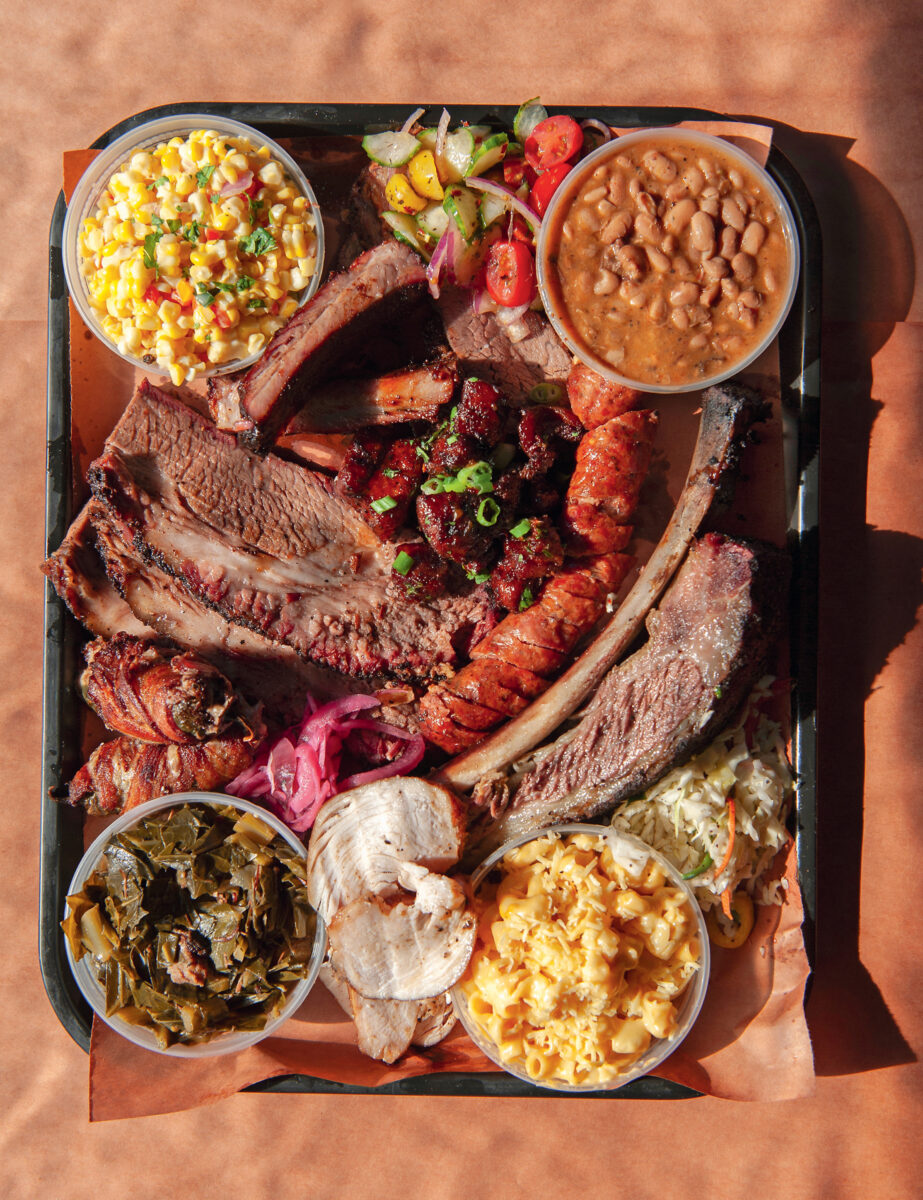
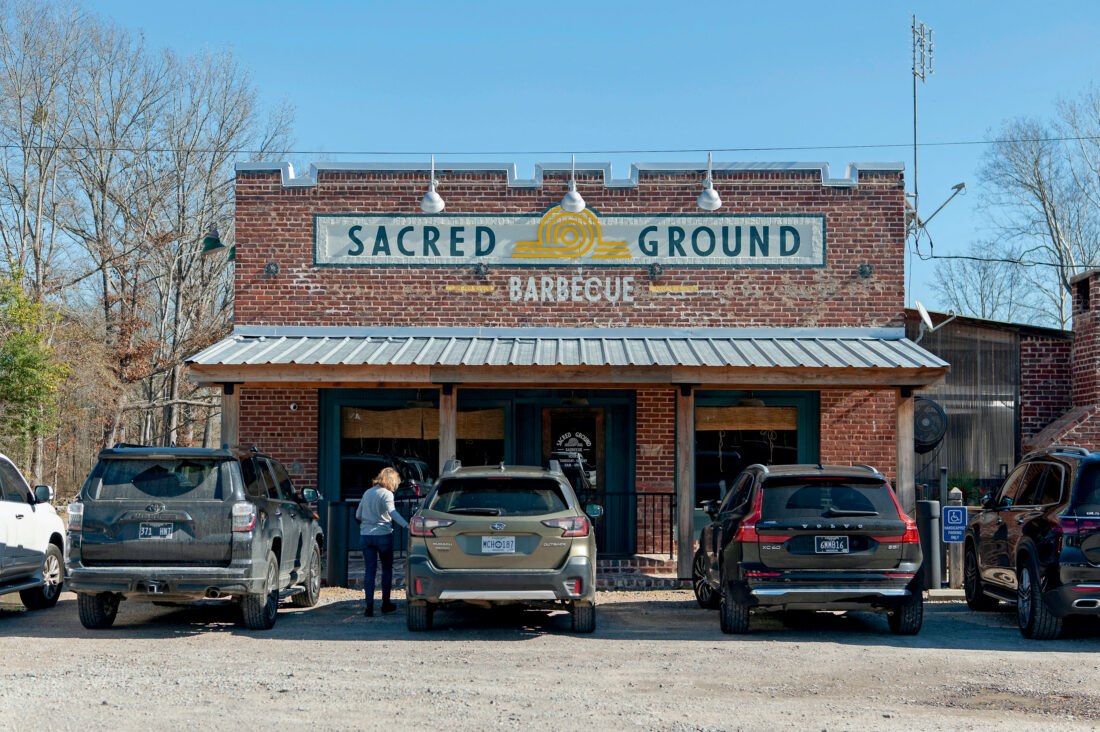
“This is my style,” says Majure Markow, who drove his family about twenty minutes north out of Jackson, Mississippi, to Sacred Ground Barbecue for a Saturday lunch of fat-rimmed smoked brisket, plush smoked turkey, and more, served on sheet pan trays lined with pink butcher paper. Majure grew up on pork ribs slathered in red barbecue sauce. “All that sweetness was too much; this is what we want,” he says of this new Texas-inspired destination, kitty-corner from a thousand-plus-year-old Native American mound in the railroad community of Pocahontas.
As Majure and his wife, Amanda, talk with friends, their children, Sudie, age eight, and Manning, eleven, play Ping-Pong in a metal barn out back, beneath a vintage sign for the Big Teepee B.B.Q. scrolled with the slogan BARBECUE SO GOOD IT STOPS THE TRAIN. Five shade sails, tethered to a repurposed telephone pole, flap at the center of the gravel yard, a gesture to the restaurant and roadside attraction that towered over the landscape here for three decades.
Life in Pocahontas has more recently revolved around a Dollar General store, a deer processor, and the seventeen trains that rush through town daily. Sacred Ground, which opened in November 2024 in a corner building painted with a mural of a tiny girl riding a giant armadillo, changed this place. What husband-and-wife owners Derek and Jennifer Emerson are doing here is also reshaping what we think of as Mississippi food culture.
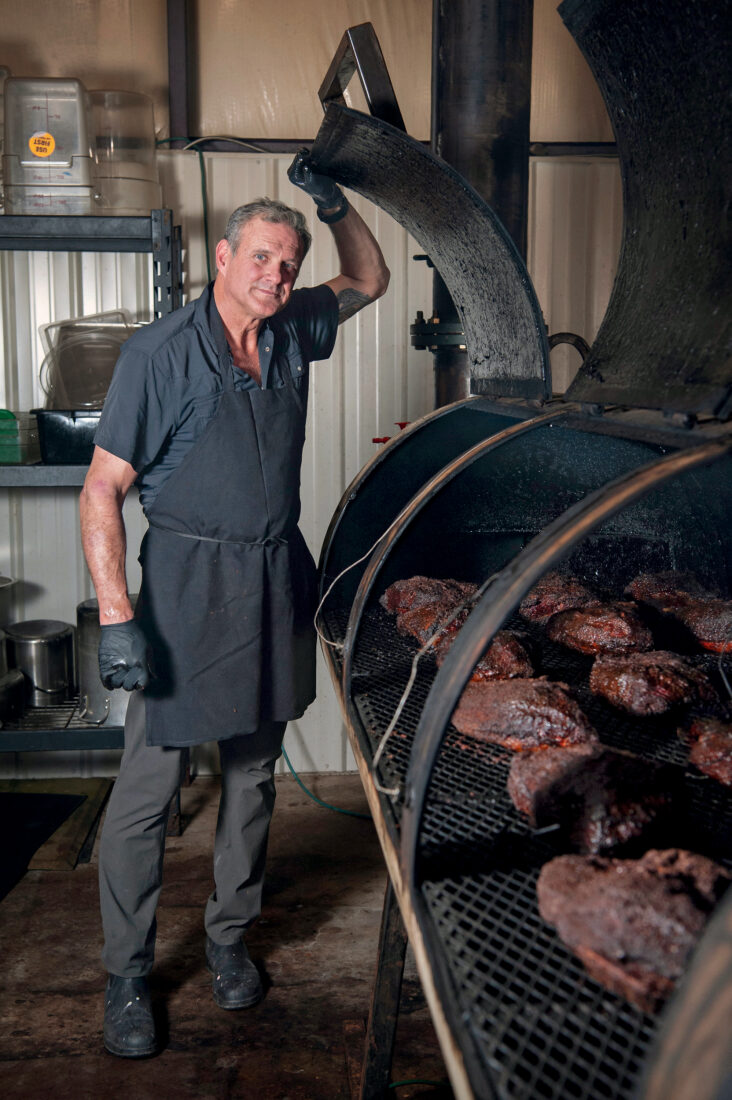
Their daughter Finley inspired the mural, Derek told me earlier that day. We stood beside a thousand-gallon offset cooker in a shed next to the restaurant. His face shone with sweat. Derek got here at four thirty this morning. He planned to leave when the last briskets were done that night, maybe at eight, maybe at ten. “Finley started to learn hunter/jumper,” he said, referring to the sport where riders and their horses navigate fences. “That brought us to Dripping Springs, outside Austin. Everything came from there.”
For two-plus decades, Derek and Jennifer owned Walker’s Drive In, a destination restaurant in Jackson, where Redfish Anna in charred tomato beurre blanc was their money dish. More restaurants followed. Over time, though, those family trips to Texas fed a new passion. After hunter/jumper competitions and on days off, the Emersons traveled to eat barbecue at famed Texas Hill Country spots including Louie Mueller Barbecue in Taylor and Kreuz Market in Lockhart.
In 2021, the family bought a farm near Pocahontas to keep their horses. For Jennifer, this was a homecoming. She grew up worshipping at Pocahontas Baptist Church and eating barbecue pork sandwiches from what everyone just called the Teepee. On the farm, Derek taught himself to cook briskets on a five-hundred-gallon offset he built. Last year, they sold Walker’s. For Derek, the move offered a sort of rebirth. “I didn’t even know I was burned-out,” he says. “With barbecue, everything changes, every day. The wood changes, the weather changes. I never get bored.”
Five minutes before Sacred Ground opened, Kellie Rae, a recent high school grad, pulled the first brisket from a hot box beneath the chopping block. For the first platter, she sliced hunks of that brisket, dripping with juice; a link of crackly-skinned pineapple-beef sausage; and ruby-cored slabs of tri-tip, the lone gesture to California, where Derek grew up and that cut of beef is popular.
“I’ve cooked a million redfish,” Derek tells me later that day, standing by the bar at the front of the restaurant. Three TVs air sports. One shows Bob Ross painting trees. “But I’ve only cooked two thousand briskets, so I’m still trying new things.” Lately, he’s been smoking his prime-grade briskets in tinfoil boats floated with melted-down tallow. Derek uses tallow the way some cooks use olive oil. Before Kellie stacks slices on trays, she paints melted tallow on the butcher paper and the meat.
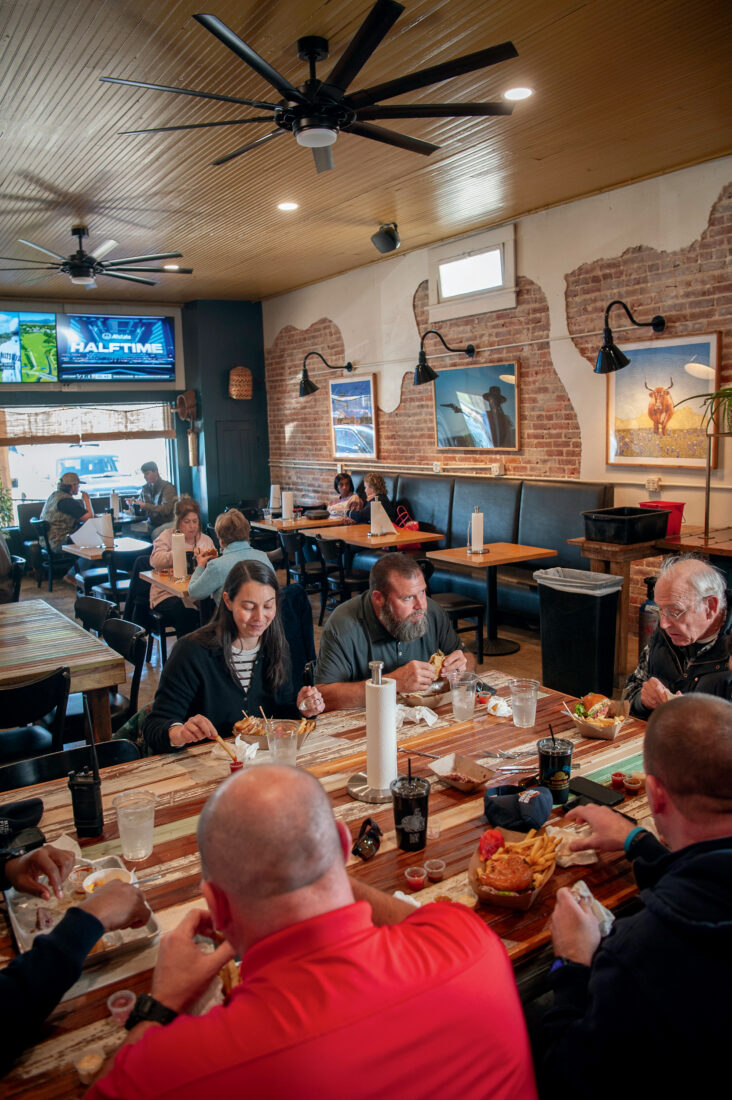
A decade back, when fine-dining chefs like Derek began to step into the pits, barbecue sides got a lot better. Sacred Ground buys most of its vegetables from nearby Two Dog Farms. Cooks here strip collards by hand and simmer them with hunks of brisket. To bind the corn salad, Derek uses white barbecue sauce, born of North Alabama. The goo in the mac and cheese is queso, goosed with green chiles.
“Southern barbecue is the closest thing we have in the U.S. to Europe’s wines or cheeses; drive a hundred miles and the barbecue changes.” John Shelton Reed, a chronicler of Southern culture, wrote that in 1988, when the move to electric- and gas-powered pits threatened localized barbecue traditions. Since then, dozens of wood-burning restaurants inspired by Texas Hill Country spots have opened across the South, from Wood’s Chapel BBQ in Atlanta to Wright’s Barbecue, with six locations in Arkansas.
Back in Pocahontas, Derek hasn’t given up on pork. Racks of ribs emerge ruddy and smoke suffused. But brisket is now his obsession. When he ran Walker’s, his Jackson customers didn’t want to talk about his beurre blanc. Now they walk around back to compare notes on cooking brisket. The style the Emersons are advancing, the one Majure Markow and his family have come to love, redraws the culinary map that Reed celebrated. By adding new meats, new techniques, and new people, Sacred Ground and other spots remind us that for all our talk about tradition, life in the contemporary South is best defined by ongoing evolution.
Plus: Smoked in Raleigh
Expanding North Carolina’s barbecue bounds
Inspired by his grandmother, Adam Cunningham, the owner of Longleaf Swine in Raleigh, serves Brunswick stew that’s thick with corn and butter beans. His classic pulled pork tastes of hickory and salt. “I would like to do all traditional,” he tells me over lunch. “But people want brisket; they want variety.” So Cunningham, who grew up in Eastern North Carolina, where whole hog is sacrosanct, smokes beef on an offset cooker made in Mesquite, Texas. And he sells smoked carrot sandwiches to the vegetarians.
John T. Edge, writer and host of the television show TrueSouth, began contributing to Garden & Gun in its first year of publication. He is the author of The Potlikker Papers: A Food History of the Modern South and House of Smoke.