

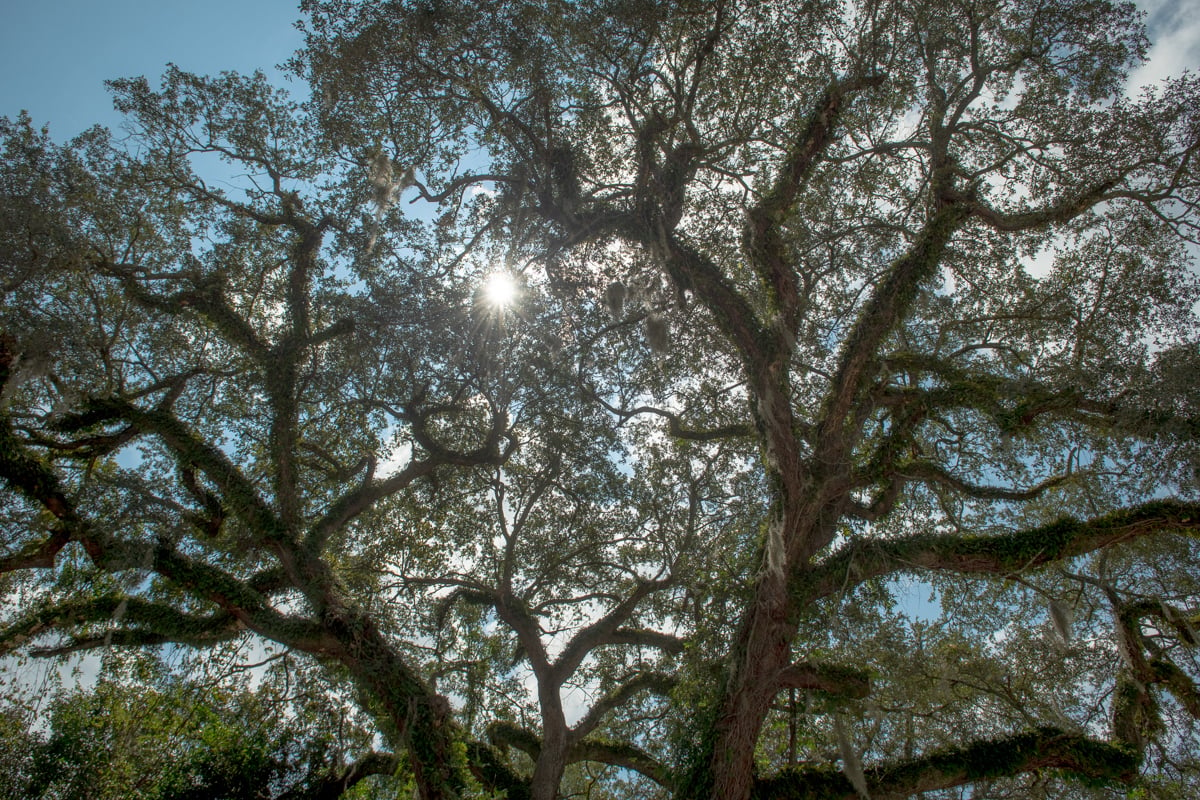
In its two hundred to three hundred years of existence, the massive live oak that presides over a field across from Eutaw Springs Battleground Park has seen a lot. South Carolina’s so-called Witness Tree was standing on September 8, 1781, when Nathanael Greene’s Continental forces clashed with British troops here—the last major battle of the Revolutionary War in the Carolinas. Then, five decades ago, it survived a major lightning strike that split it down the middle; as an emergency fix, someone wrapped steel chains and cables around its trunk and limbs. Though life-saving at the time, those same supports are now threatening the tree’s survival—and a rescue is planned for this week.
“If we lost this tree, we’d lose a direct physical link to the events at Eutaw Springs and a powerful connection to the people who fought and died on this land,” says Catherine F. Noyes, deputy director of land preservation for the nonprofit American Battlefield Trust. So she contracted the arborist firm SavATree to assess the giant oak, whose trunk measures six feet in diameter and whose canopy spreads to half the size of a football field.
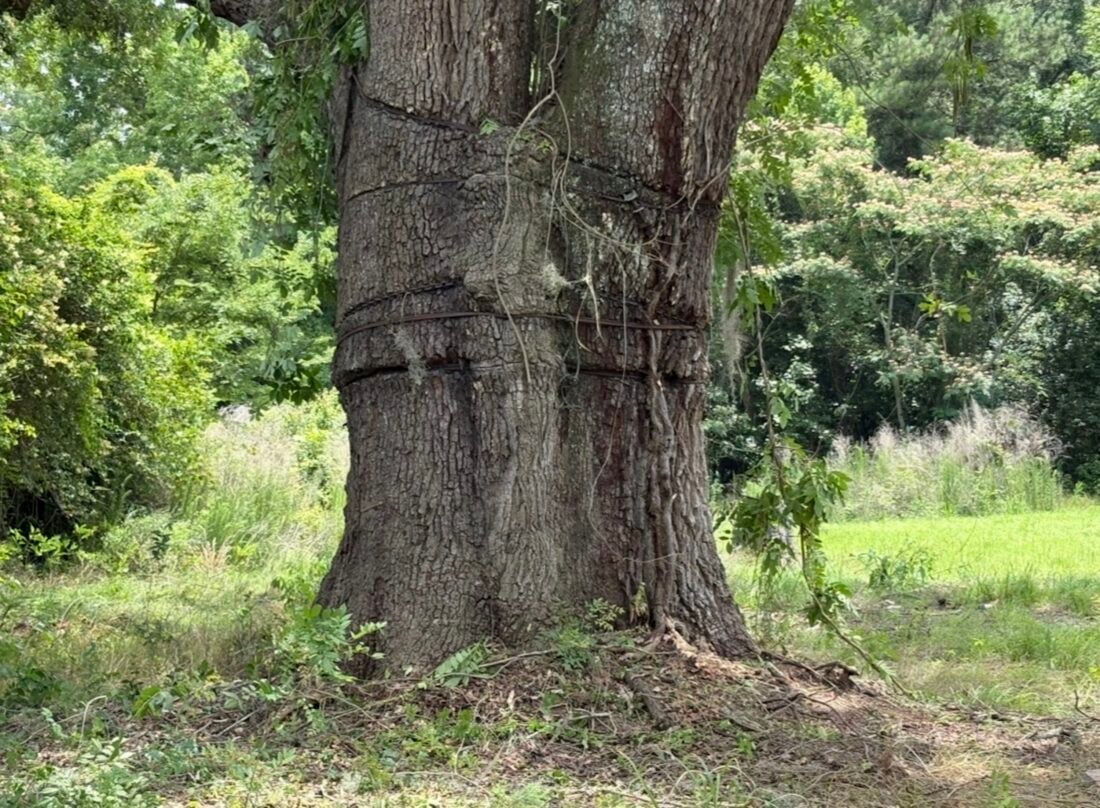
Arborist Aron Landsaw concluded that the tree was in serious need of help. “The chains are basically cutting off its circulation where it can’t draw water and nutrients up from the soil,” he explains. The tree has mostly swallowed the chains, but some of the metal still protrudes because the oak lacks the strength to cover it. He and his team have already removed dead and damaged wood, decompacted the soil around the roots, and begun a program of deep-root injections that will improve the tree’s access to nutrients. And this week, seven arborists will climb hundreds of feet into the canopy to surgically remove the chains from the living wood.
In the process, they’ll also install a new structural support system—using rods drilled through the limbs and cables connected to a central hub—to replace the old chains, and to help the tree sway and weather storms. Since a tree with metal running through it is ripe for a lightning strike, Landsaw will also add a system of copper cables to direct strikes safely into the ground.
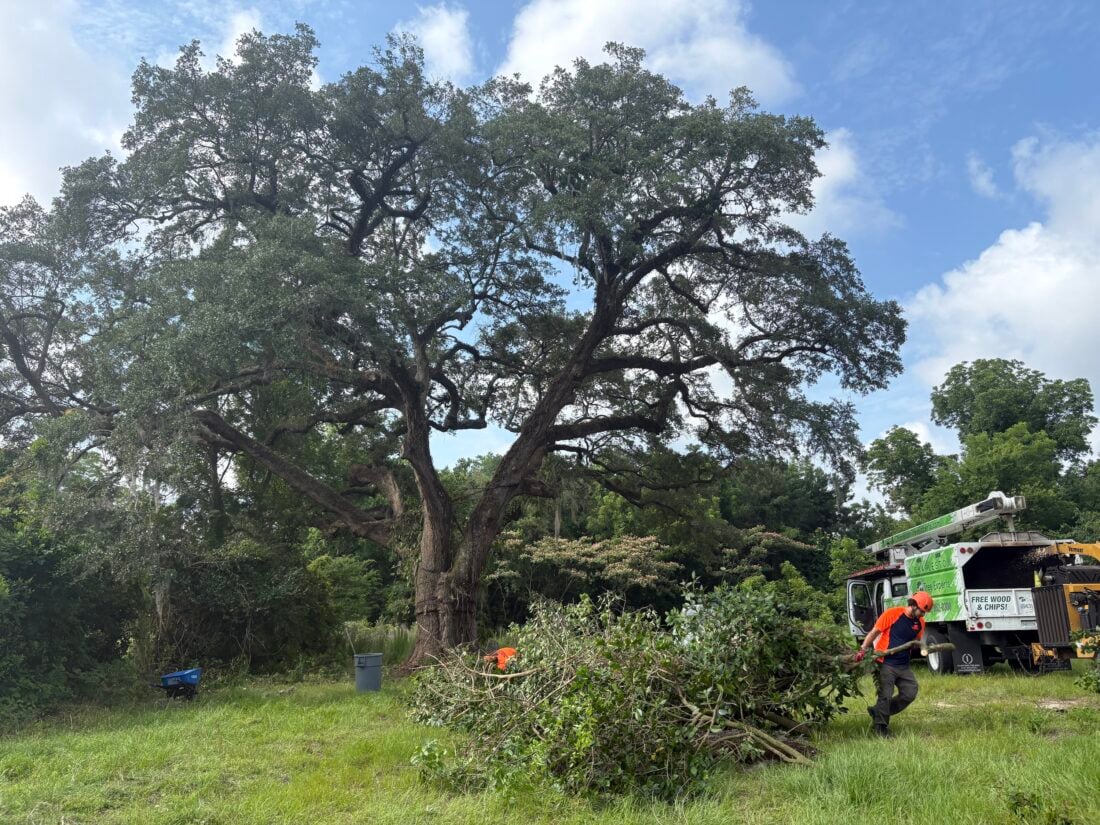
The work is delicate, and the most dangerous part for the rescuers will be cutting the tension-bearing chains—that stored energy, once released, can create a violent snapback. Still, Landsaw is confident in his team and determined to get the work done. “Working on something like this isn’t an opportunity that comes around very often,” he says. “I’ll do anything I can to save this tree.”
In 2023, the American Battlefield Trust incorporated the four-acre property where the tree sits into the Liberty Trail, a network of historic sites interpreting South Carolina’s Revolutionary-era history. In the future, Noyes hopes the oak will become the centerpiece of an expanded battlefield park, with additional protected acreage arriving ahead of the battle’s 250th anniversary in 2031. “The Witness Tree is a living connection to this history,” she says—and Landsaw is hopeful that after this week’s preservation work, it will remain a fixture on the landscape for at least another century.
Lindsey Liles joined Garden & Gun in 2020 after completing a master’s in literature in Scotland and a Fulbright grant in Brazil. The Arkansas native is G&G’s digital reporter, covering all aspects of the South, and she especially enjoys putting her biology background to use by writing about wildlife and conservation. She lives on Johns Island, South Carolina.