
On my first day as a deli boy at Atkinsons’ Market in Ketchum, Idaho, I made Jamie Lee Curtis a hummus, cucumber, and tomato sandwich on multigrain. On the second day, I nearly sliced off my finger while cutting an avocado with a knife that, unbeknownst to me, had just been sharpened. As my blood pooled on the cutting board, the woman waiting at the counter put her hand over her mouth and then said, “You know what? I don’t think I need a sandwich right now.”
I took the job at Atkinsons’ because the hours, three to nine, were perfect. I could fish Silver Creek in the morning and, with my moldering trout gear awaiting in the car, still have time to hit the caddis hatch in the evening alpenglow on the Big Wood River.
I’d just completed my first year of college in the East, and I didn’t know much worth knowing. But I did know that I wanted to go out West for the summer.
The West for me at that time was nothing more than an idea. It was a place, I thought, for dreamers and schemers and roughnecks and crunchies and, even, for aimless nineteen-year-olds looking for adventure. It was a place I’d always wanted to visit, a sort of manifest destiny of the mind.
Some friends from college were heading to Ketchum, the town that fronts the resort Sun Valley. They talked about the hiking, camping, mountain biking, and some of the best trout fishing in the world. I really only heard the last part. Though I’d done a little trout fishing, I was primarily a bass fisherman, brought up casting my grandfather’s old Orvis bamboo rods on a lake in Alabama and throwing big poppers on the algae-covered pond behind my family’s farmhouse in North Carolina. But trout—wild Western trout—were the ne plus ultra of the fly-fishing world to me then. The elegant casts, the sleek and beautiful fish, and the brawling rivers all populated the sporting magazines that had piled up in my bedroom over the years. They populated my imagination, too.
In late May, I’d packed up my Subaru in Birmingham, hugged my mother, and started north. A Diamondback fly rod—eight and a half for a five—along with a Pflueger reel strung with line that was God knows how old rode shotgun until I reached Scottsville, Virginia, where I picked up a friend. We veered west and to Chicago to collect another friend and took in a Cubs game, drinking warm beer in the Wrigley bleachers. Then it was Interstate 90 and mixtapes and cool air blowing in through the open windows. Finally, a week after I’d left Birmingham, we pulled into our rented house on the edge of town in Ketchum.
The mountain West turned out to be less a cultural shock than an environmental one. Gone was the humidity of the Southern summer, replaced by dehydrated, high-UV sunshine and bracingly cool nights. The brawny and sand-brown and still-growing Rockies differed starkly from the elegiacally retreating, tree-topped Appalachians. The sheer expanse of the West left me feeling diminutive in a good way, somehow put in proper perspective.
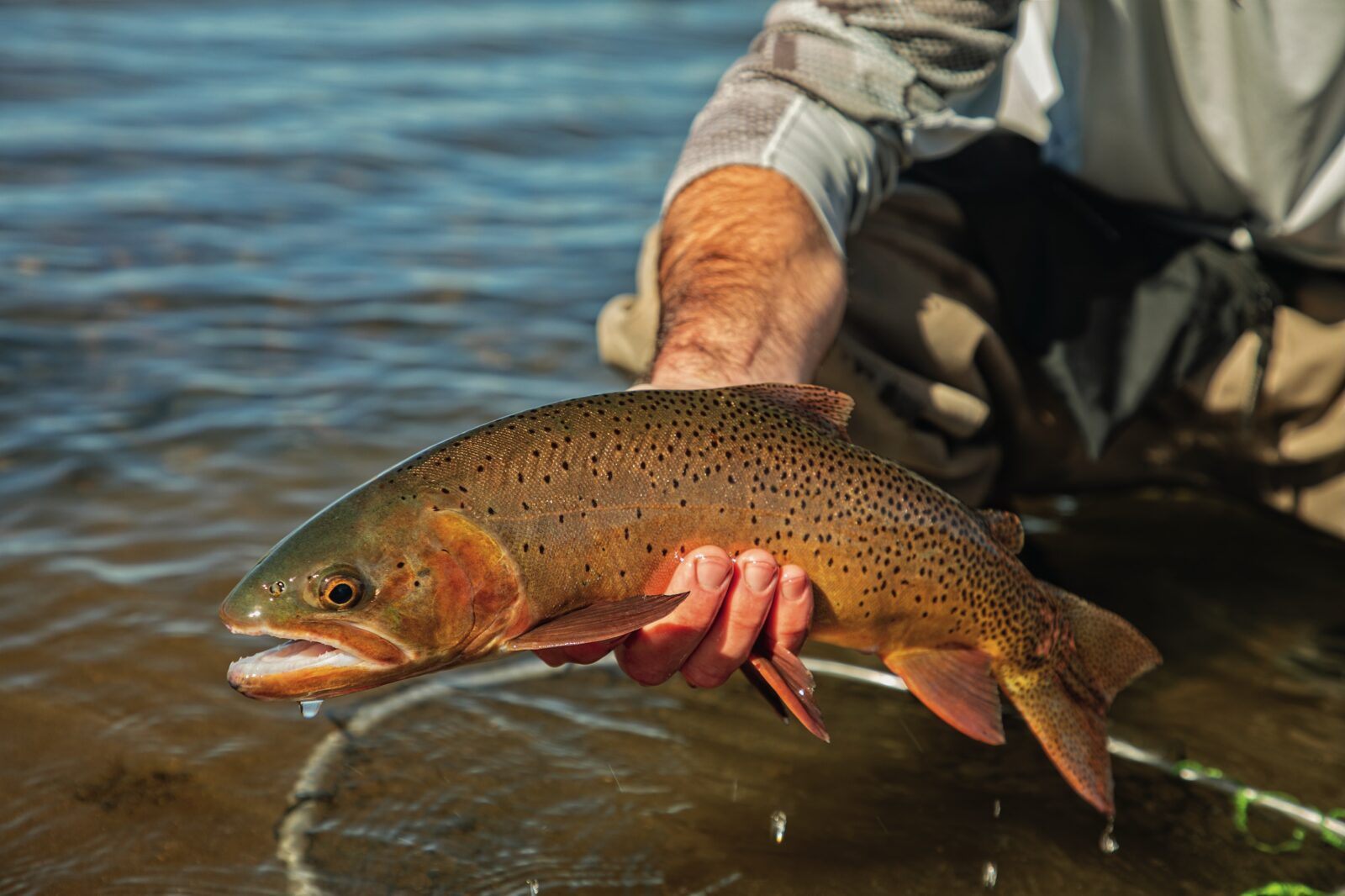
I certainly felt that way trout fishing. Much as I loved the freestone Big Wood, Silver Creek, with its cold, clear spring-fed water sluicing through what was essentially a desert, beguiled me. I learned how to fish it the hard way.
On my first visit to the Nature Conservancy water—known as the Silver Creek Preserve—my friend Charlie and I eventually found the pool that locals called the “shark tank.” It held dozens of the largest rainbow trout we’d ever seen, all nonchalantly swimming around and, occasionally, sipping an insect off the water’s surface. The pool was a siren’s call to newcomers to the creek. The fish were nearly impossible to catch, especially in the bright sunshine of midday and with the too-large flies and too-thick leaders Charlie and I were using. Still, just the sight of those fish was enough for me. Everything then became about trout and rivers. I saw rising fish in my sleep. Lightning on the horizon resembled an upside-down river system. Silver Creek, this small place, became my entire world.
I wore Tevas and shorts to fish, unable to afford waders, and sometimes had to peel a leech off my leg after a day in the creek. I had what one friend described as “relief pitcher hair,” the top shooting out of the sides of my hat, the back cascading down to nearly my shoulders. At the fly shop in town, I’d purchase one fly and then hang around to eavesdrop on the regulars to try to figure out what was hatching on the rivers. I was an amateur, which is derived from the French word meaning “one who loves.”
I began to outwork my dysfunction, thanks to that love. I got to the Preserve early to stake out my favorite spot, well away from the shark tank, and sat in the streamside grasses nursing a cup of lukewarm gas station coffee. I’d wait and watch the spring water, which looked as thick as baby oil, pass me by. A maze of microcurrents etched the surface of the creek, its bed anchored by swaying aquatic grasses. Soon enough, the Tricos—black-bodied, white-winged mayflies no larger than a grain of rice—began to gather in clouds above the creek. And then they fell, and the river would boil with feeding trout. I stood upstream and cast down to the fish and learned how to mend my line in the air to give the fly a longer, drag-free drift. Eventually, an act of my imagination became material, and I started to catch a few of those giant fish.
That summer taught me other lessons, too. I figured out how to live outside of the comforting confines of school or home. Budgeting proved to be an issue early on. In the first month, I’d resorted to eating potatoes and ramen noodles in the few days before I got my next paycheck.
Some nights after fishing, when my roommates and I were flush, we’d sneak into the Pioneer Saloon through the back door, spacing out our sorties to better blend in. We’d play pool with the Pioneer’s clientele, a mix of outdoorsy types clad in Patagonia, mustachioed men with weathered hands, and handsome middle-aged women with flushed cheeks and Wranglers pulled up above their hips.
On the nights I didn’t have the energy to fish or the money to go to the Pioneer, I stayed in and read, a habit picked up in high school, where I’d studied Faulkner in class and read Pat Conroy for pleasure. In Idaho, I devoured David James Duncan’s The River Why, a tale of young love and trout fishing. I picked through Hemingway’s short stories, paying particular attention to the Nick Adams ones, and even visited the troubled genius’s grave in Ketchum. And, of course, I read Norman Maclean’s A River Runs Through It, the revered tome on fly fishing and family tragedy. Maclean’s last line in the novella, “I am haunted by waters,” became something of a touchstone, and I wondered if Conroy’s opener in The Prince of Tides—“My wound is geography”—was some sort of response to it, ten years later.
That summer became my “spot of time,” as Wordsworth described it, a memory I would return to when needed. Years later, on a hot and crowded subway car coming home from work, I could close my eyes and find myself back out West, the rest of my life ahead of me.
I left Ketchum in early August, giving myself enough time to get back to Birmingham, repack, and then drive to college. I’d fallen in love with a place, caught some of the world’s most challenging trout, worked, read deeply, and expanded a horizon. It would still be some time before I really knew anything worth knowing. But, like so many seekers before me, I’d made a start.
Monte Burke is a Garden & Gun contributing editor and the New York Times best-selling author of Saban, Lords of the Fly and Men of Troy, among other books. He is also a contributing editor at The Drake. He grew up primarily in Alabama and North Carolina and now lives in Brooklyn with his wife and daughters.