Food & Drink

Pableaux Johnson’s New Year’s Feast

The late New Orleans community pillar taught me the surest way to spread luck in the new year

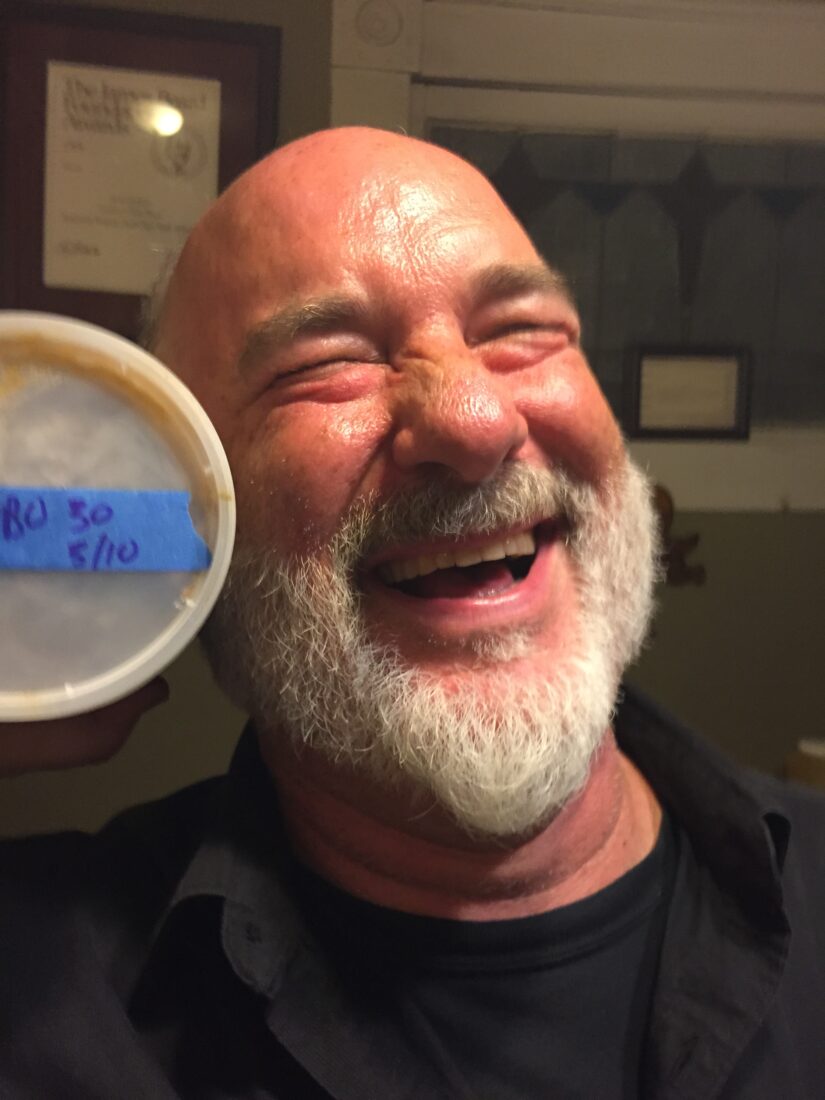
A portrait of a man with a tub of gumbo

Photo: John T. Edge

Pableaux Johnson.

On New Year’s Eve 2024, just as he had done every New Year’s Eve for nearly a decade, Paul “Pableaux” Johnson was preparing to feed his people. A social media post from that day shows Pableaux—a New Orleans writer and photographer and one of Epicurious’s “100 Greatest Home Cooks of All Time”—filling a shopping cart with big heads of green cabbage, andouille sausage, and bags of Camellia brand black-eyed peas. With hindsight, there’s a dark irony to the caption that I think Pableaux would’ve laughed at. “Kids, make sure you get your black eyed peas (for luck), cabbage/collards (for folding money) and cornbread (for gold). But mostly the luck. Don’t wanna take too many chances in ’25.” That night, as the revelers on Bourbon Street raised a toast to the new year, Pableaux had peas soaking in preparation for his traditional feast. 

For New Orleans the year did not start out lucky. We woke on New Year’s Day to concerned texts and the gut-punch of the news about the Bourbon Street terrorist attack. We told our friends we were all right; mourned for our city and the reason for its return to the national stage; and considered whether or not we had the capacity to go out and gather at Pableaux’s. 

By that time, he’d probably already been up for hours, slicing and caramelizing a heap of onions, dicing the pork he’d smoked himself to season his smothered cabbage (aka “pig-basted greens”), and tidying up his pink shotgun house. Sometimes you have to make your own luck. And Pableaux was doing just that, building it like a shelter with every ingredient he added to his big Magnalite pots. He had invited scores of people over to drop in throughout the day when they pleased, but in light of the news he didn’t know how many would come. 

When we arrived, red-eyed, tentative, and hungry at Pableaux’s front door, he embraced us and ushered us in, ordering us to grab a plate while simultaneously taking care of three or four other guests. The house was packed, the food delicious, the conversations heartfelt. We had arrived discouraged and sinking and took hold of the food and each other like we were grabbing onto a life raft. 

One of the guests, a photographer and computer engineer from India, invited us to his favorite restaurant, one he said made regional food that tasted like his grandmother’s. A shy truck driver who sat alone on a couch opened up to us about her love of superhero movies; said her uncle had persuaded her to come against her better judgment but she was glad she did. Pableaux—as good with a camera as he was in the kitchen—was famous for portraits of people in their most genuine moments. He let no one leave without first snapping a few photographs. Days or weeks later, he texted us those photos—a surprise moment of joy from a historically tragic day. 

New Year’s 2025 in New Orleans didn’t start out feeling like a good day. But those of us lucky enough to know Pableaux have something else to remember it by, something crucial and light to place on the scales opposite those other heavy facts. 

Now we are a full year out—most of it spent without our great friend there to care for us. Just weeks after that gathering, he was out photographing a second-line parade and had a heart attack. He was fifty-nine. Looking back at our bleary-eyed smiles in his photos, I’m overcome with a wholly new understanding of the power in the simple act of making food and inviting people over. The generosity of a soul-satisfying, delicious meal shared freely with your friends and neighbors. Acts like these can tip the scales.

Pableaux had sayings. One of his favorites was “Ain’t we lucky.” He made magnets with the phrase and passed them out. There’s one on my fridge. If I’m ever not feeling particularly lucky —if there’s an imbalance in the scales in the world—it reminds me of a way to make my own luck: Cook something homemade and share it with someone else. That’s it. Forge a connection. These recipes for Pableaux’s “good luck foods” represent the opportunity for all of us to do just that. 
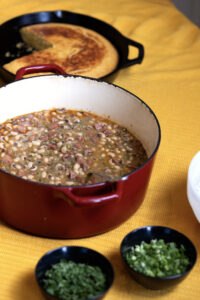

Black-Eyed Peas with Andouille

Yield: 6-8 servings

A pot of black-eyed peas.

Ingredients

    • 1½ tbsp. table salt for brining

    • 1 lb. dried black-eyed peas, picked over and rinsed

    • ¼ cup extra-virgin olive oil

    • 1 lb. andouille sausage, casing removed if necessary, quartered lengthwise and sliced ¼-inch thick

    • 2 lb. onions, chopped

    • 2 tbsp. plus 4 cups water, divided (or 5 cups if using stovetop method)

    • 2 tsp. Tony Chachere’s Original Creole Seasoning

    • 1 green bell pepper, stemmed, seeded, and chopped

    • 2 celery ribs, chopped

    • 6 garlic cloves, smashed and sliced thin

    • 2 tsp. dried basil

    • ½ tsp. black pepper

    • ¼ tsp. rubbed sage

    • 2 bay leaves

    • 1 tbsp. Crystal Hot Sauce, plus extra for serving

    • 6 cups cooked long-grain white rice, warm

    • 4 scallions, sliced thin

    • ¼ cup chopped fresh parsley

Preparation

  1. Instant Pot Method

    Dissolve salt in 2 quarts cold water in a large container. Add peas and soak at room temperature for at least 8 hours or up to 24 hours. Drain peas in colander and rinse thoroughly; set aside. (Brined beans can be sealed in a zipper-lock bag and frozen for up to 1 month.)

  2. Using highest sauté function, heat oil in Instant Pot until shimmering. Add andouille and cook until browned, 5 to 7 minutes. Using slotted spoon, transfer andouille to plate. 

  3. Stir onions, 2 tbsp. water, and Creole seasoning into the fat remaining in the pot, scraping up any browned bits. Lock lid in place and close pressure-release valve. Select high pressure-cook function and cook for 5 minutes. Quick-release the pressure and carefully remove lid, allowing steam to escape away from you. Using highest sauté function, cook onion mixture, stirring often, until water is evaporated and onions are well browned, 12 to 15 minutes.

  4. Stir in bell pepper and celery and cook, stirring often, until vegetables are just softened, about 2 minutes. Stir in garlic, basil, pepper, and sage and cook until fragrant, about 1 minute. Stir in remaining 4 cups water, scraping up any browned bits, then stir in bay leaves, drained peas, and reserved andouille. Lock lid in place and close pressure-release valve. Select low pressure-cook function and cook for 3 minutes. Turn off Instant Pot and let pressure release naturally for 15 minutes. Quick-release any remaining pressure, then carefully remove lid.

  5. Discard bay leaves. Stir in hot sauce, and season with salt and pepper to taste. Serve peas spooned over rice, sprinkling individual portions with scallions and parsley and drizzling with extra hot sauce. 

  6. Stovetop Method

    Brine beans using the same method as above.

  7. Heat oil in a large Dutch oven over medium-high heat until shimmering. Add andouille and cook until browned, 5 to 7 minutes. Using a slotted spoon, transfer andouille to a plate; set aside. 

  8. Add onions, 1 cup water, bay leaves, Creole seasoning, and pepper to the fat left in the pot. Cover and cook, stirring occasionally, until water has mostly evaporated and onions are softened, 7 to 10 minutes. Uncover and continue to cook, stirring often and scraping up any browned bits, until onions are well browned, 8 to 12 minutes longer. 

  9. Stir in bell pepper and celery and cook, stirring often, until vegetables are softened, about 5 minutes. Stir in garlic, basil, pepper, and sage and cook until fragrant, about 1 minute. Stir in remaining 4 cups of water, scraping up any browned bits, then stir in bay leaves, drained peas, and reserved andouille and bring to boil. Cover, reduce heat to low, and cook, stirring occasionally, until peas are tender, 1 to 1½ hours. 

  10. Discard bay leaves. Stir in hot sauce. Season with salt and pepper to taste. Serve peas spooned over rice, sprinkling individual portions with scallions and parsley and drizzling with extra hot sauce to taste.


Smoky Smothered Cabbage with Tasso, Olives, and Tomato

Yield: 6-8 servings

A bowl of smothered cabbage.

Ingredients

    • 6 tbsp. extra-virgin olive oil

    • 1 lb. tasso, cut into ½-inch pieces

    • 2 lb. onions, halved and sliced through root end ¼-inch thick

    • 1 cup chicken broth

    • 2 tsp. Tony Chachere’s Original Creole Seasoning

    • 6 garlic cloves, sliced thin

    • 1 tsp. black pepper

    • 1 (28-oz.) can whole peeled tomatoes, drained

    • 1 cup olive salad, drained

    • 1 large head green cabbage (about 3 lb.), quartered, cored, and cut into 1½-inch pieces

    • 2 bay leaves

    • ½ cup chopped fresh basil

Preparation

  1. Heat oil in a large Dutch oven over medium-high heat until shimmering. Add tasso and cook until well browned, 4 to 7 minutes. Using a slotted spoon, transfer tasso to plate; set aside. 

  2. Stir onions, broth, and Creole seasoning into the fat remaining in the pot and bring to boil over medium-high heat. Cover and cook, stirring occasionally, until liquid has reduced by about three-quarters and onions are softened, 7 to 10 minutes. Uncover pot and continue to cook, stirring often and scraping up any browned bits, until onions are well browned, 8 to 12 minutes longer. 

  3. Stir in garlic and pepper and cook until fragrant, about 1 minute, then stir in tomatoes and olive salad. Using potato masher, break tomatoes and any large olives into coarse pieces. Stir in cabbage, bay leaves, and tasso and bring to simmer. Reduce heat to low, cover pot, and simmer, stirring occasionally, until cabbage is fully tender, 1 to 1¼ hours.

  4. Remove pot from heat and let sit, covered, for 20 minutes. Stir in basil. Serve. 


tags: