

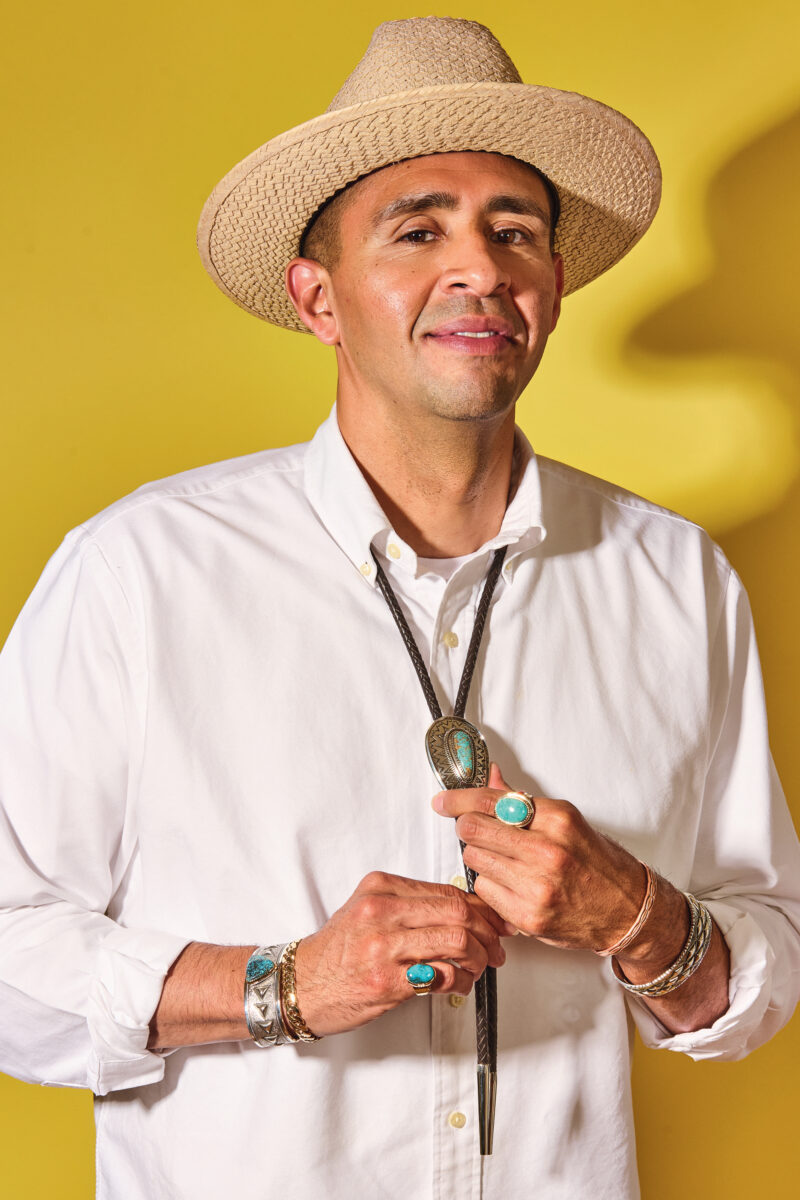
Isaac Dial is a busy man. The Navajo, Lumbee, and Tuscarora silversmith and jewelry artist has been traveling nonstop across the country to source pieces: combing shorelines for shells, examining gems. “I actually go to mines and pick material based on how those stones speak to me,” he says. “Highend turquoise is very rare. Some mines only produce about two hundred pounds of really exceptional material.”

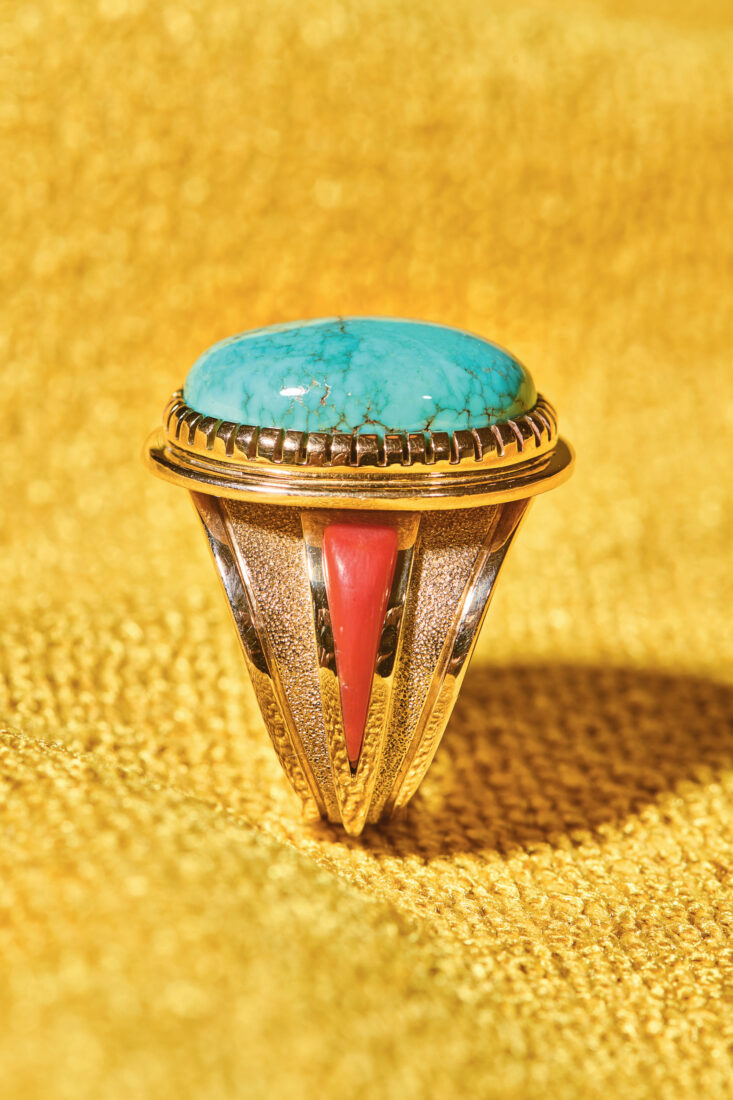
The exacting standards he sets for himself make his jewelry production taxing, but Dial is no stranger to pushing limits. He’s been crafting singular handiworks—delicately engraved silver cuffs; bold drop earrings inlaid with lapis and coral; high-end turquoise rings—since he began as a young apprentice in Robeson County, North Carolina, winning myriad competitions and the devoted fervor of collectors worldwide. His father, the late renowned master jeweler Grant Dial, was himself a tireless maker, and the reason Isaac welcomes hard work the way others might a hot bath.
“The most important thing my dad taught me was that you get up, you have purpose every day,” he says. For Dial, that means holding his contemporary Native American pieces to a museum-level benchmark—tough for an admitted perfectionist.
“One of my curses is my eyes,” he explains. “I see everything that I’ve done wrong.” As he works, Dial uses a macro lens to examine each piece—along with every minuscule flaw. Eventually, he made a rule: “If I can pass the macro lens test, I can submit it to the world.”
Though a third-generation artisan—his grandfather was a sand painter, his grandmothers were traditional Navajo weavers—Dial once harbored different dreams: “I’m six foot five. As a kid, I was focused on basketball and other sports.” It didn’t help that his early jewelry experience consisted exclusively of cleaning and polishing his father’s pieces. “It’s a very dirty job,” Dial says. “And I was stuck in this room buffing, polishing. I could hear everyone else outside laughing and having a good time.”
Dial became so adept at finishing, his dad didn’t want him to do anything else. “One of my tools is hyperfocus,” he says. “It doesn’t matter what I’m doing, I do it my absolute best. Even with jewelry cleaning, I didn’t enjoy it, but I took pride in it.”
Then in college, while studying molecular biology and chemistry at the University of North Carolina at Pembroke, Dial agreed to help his dad open a Smithsonian exhibition. The experience shifted something. “My dad was celebrated on a level I’d never seen,” Dial recalls. After that, “my artistic ambitions took off.”

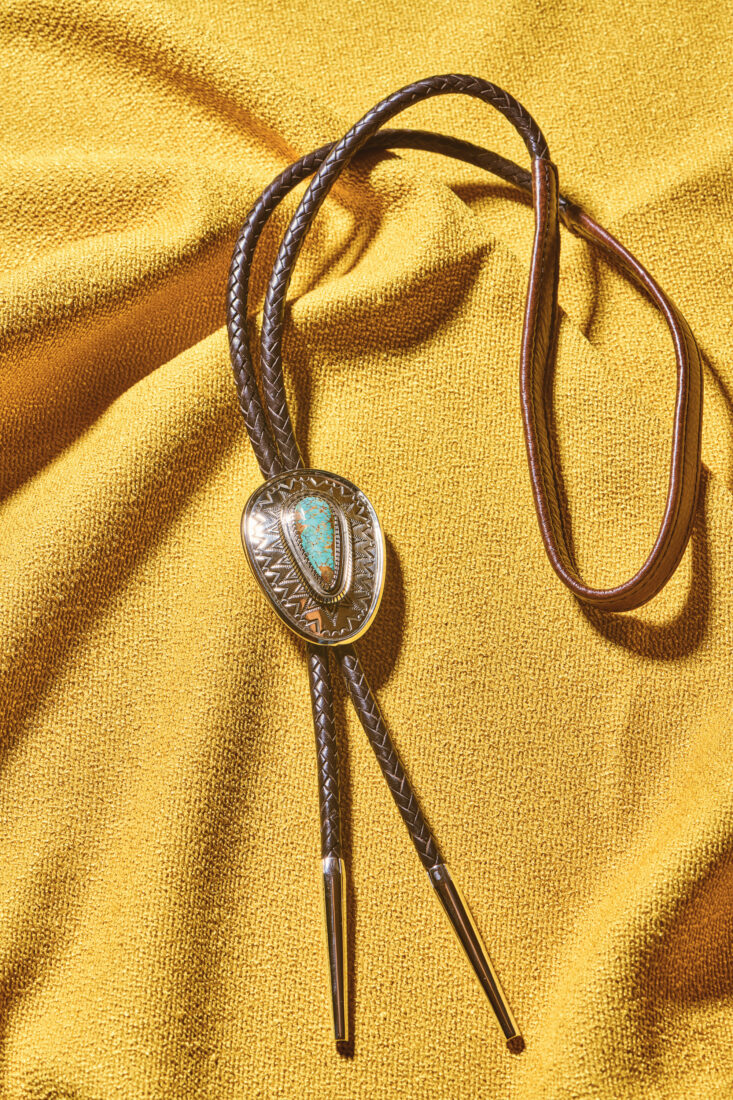
When he was twenty-five, Dial created his first solo piece: a bolo tie. “My dad was so blown away, he assumed my brother Jeremy made it.” When his father learned the truth, Dial at last graduated from the buffer room and began constructing jewelry.
From the outset, his pieces garnered rapturous critical praise and collectors’ attention. Today he sells his jewelry via private commission, and when clients contact him, “I ask if there is something that attracted them to my work. A color or a stone? Is this a daily piece or for something very specific?” From there, they discuss shape, size, and materials.
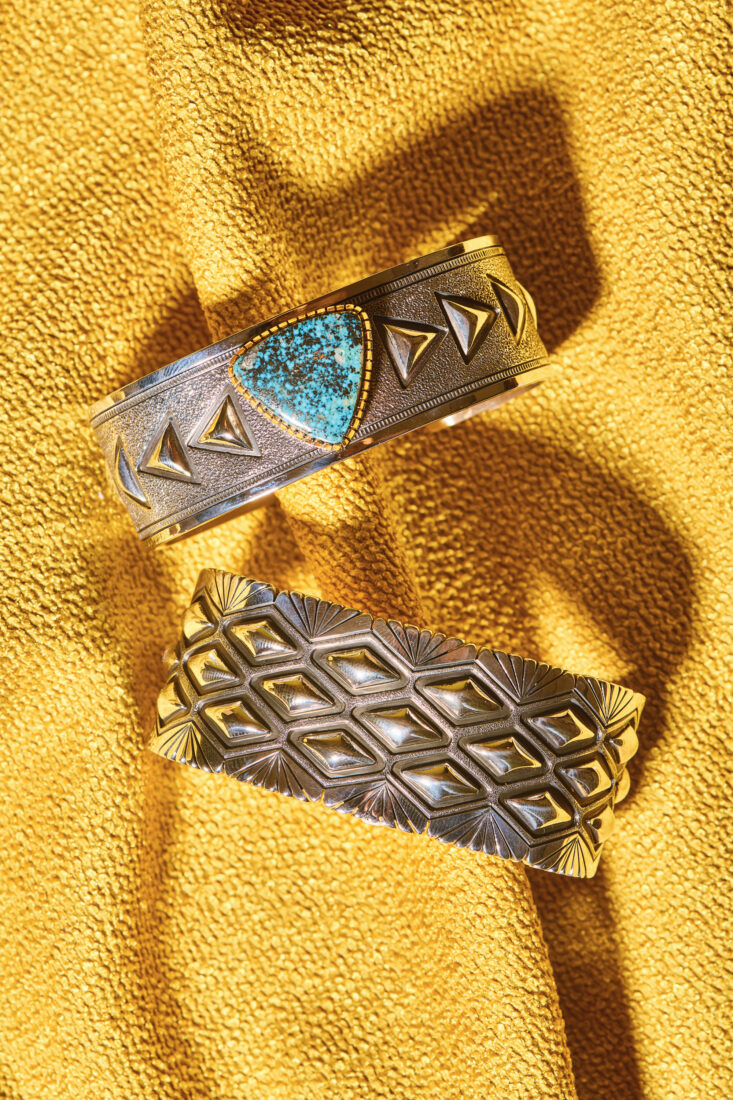
Even with the ever-increasing demand, Dial never rushes or cuts corners. “There’s this saying, ‘How you do anything is how you do everything.’” His meticulous approach is slower, “but I believe if you skip one phase, it tells on you in the next.” That painstaking pace once frustrated his father. “He wanted me to work faster, for his input to have more value,” Dial says. “But I felt like he had his path, and I had mine.”
That father-son dynamic led to some competitive skirmishes; the two would often hunch in their adjacent studios until two or three in the morning. “As long as I heard his fabrication process going, I kept mine going. If I heard him slack a little, I’d ramp mine up,” Dial says, laughing. “It was actually one of the most beautiful times.”
After Grant died in June 2024, Dial found solace in the long hours. Today his work honors his father—and other ancestors. He often implements the materials and techniques of his dad’s wampum jewelry, for instance; every summer, he culls shells from Eastern shorelines for rings and earrings. “Living off the land is specific to the Native American way of life,” he says, adding that his mother, Helen Longwhisker Clark, grew up as a traditional Navajo sheepherder, dyeing wool with lavender or coal and weaving it into garments. “We have clan systems in our tribes, and you represent that group,” he says. “There’s pride in carrying on traditions that were here before first contact.”
The profundity of creation isn’t lost on Dial. He remains keenly aware of his place in the continuum of time, of his responsibility, of his impermanence. “I have pieces I’m working on that I feel are going to change me,” he says excitedly. And he remains an avid student, eager to branch out—to engrave guns, craft public installations, make documentaries in which he and his people can tell their stories.
“I feel like I’ve surpassed my father,” Dial reflects. “Which is what I know he would’ve wanted.” As for the scrupulous obsessiveness, the multiplying asks, the swimming in history, and the duty to honor the past? “It’s taken me years to allow myself to enjoy the fruits of my labor,” he says. “But it’s all worth it.” Like father, like son. He gets up; he has purpose.
Allison Glock has been a magazine journalist and author for twenty-plus years. Her writing has appeared in the New York Times, the New York Times Magazine, Esquire, Rolling Stone, Men’s Journal, Marie Claire, GQ, the New Yorker, ESPN the Magazine, and many other publications.