
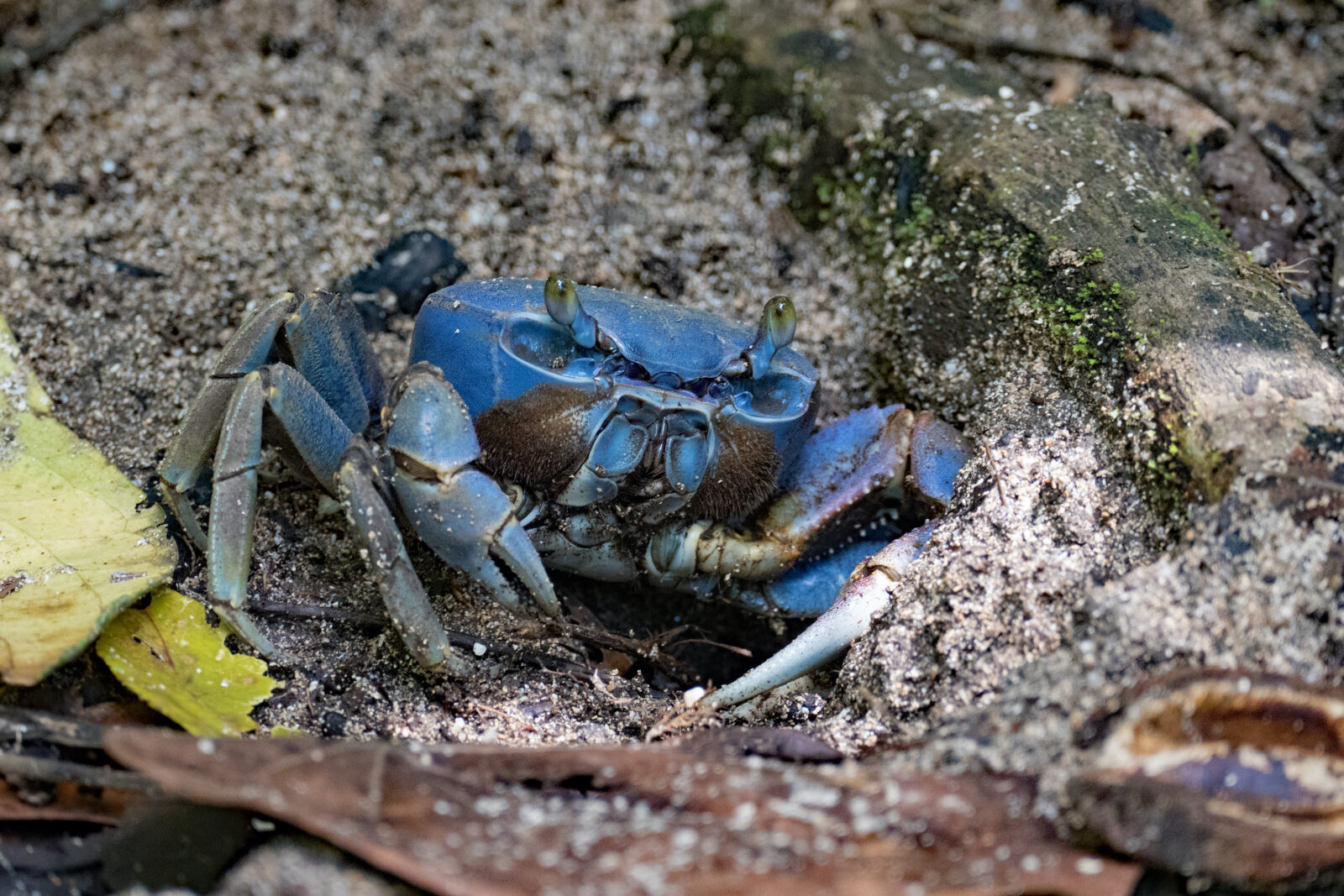
If you live along the Southeastern coast of the United States and see an enormous fiddler crab, it might not be a fiddler crab after all. You might be looking at a blue land crab, a larger relative native to northern South America, Central America, and the Caribbean. The burrowing species can range as far north as southern Florida, but it has been turning up with increasing frequency in North Carolina, South Carolina, and Georgia.
The first reports of blue land crabs in South Carolina arrived in 2008, with Georgia and North Carolina logging sightings in 2023. Since then, researchers have confirmed twenty-three blue land crab sightings in North Carolina along with another thirty-four unconfirmed reports. Two of the confirmed sightings happened this year, both in Emerald Isle.
Scientists don’t know exactly why the crustaceans are moving north; perhaps they were transported and introduced by people somehow, or they naturally increased their range due to climate change. As of yet, they aren’t classified as invasive. That designation comes when a species negatively impacts native species, and scientists don’t yet know how blue land crabs, which are primarily herbivores and scavengers, will interact with fiddler and ghost crabs and fit into the food chain.
But for researchers trying to gather information at this early stage, the public plays a key role in reporting sightings. Size is the biggest giveaway—blue land crabs grow to about five inches across the carapace—and they’re generally found within five miles of the coast, where they dig deep burrows to access saltwater, which they need to wet their gills to breathe on land.
“They can actually vary in color, despite the name,” says Scott Scripter, a biologist with the North Carolina Division of Marine Fisheries, who is overseeing the public reporting. “The adult males tend to have the characteristic blue gray coloring all around their carapace and onto their claw, but sometimes the females can be a little more white or even ashy gray.” And juveniles can be orange, dark brown, or even purple on the carapace.
With each new report, Scripter hopes a clearer picture of the blue land crab will emerge: how many there are, what habitat they’re using, how they might affect the environment, and why they’re expanding north. “We’re relying on community engagement to learn more,” he says. And while the crabs are considered a delicacy in parts of the Caribbean, they’re fast, they can disappear into burrows, and they have a formidable claw for defense. For now, the best way to capture one is with a camera.
Report your sighting of a blue land by filling out this form.
Lindsey Liles joined Garden & Gun in 2020 after completing a master’s in literature in Scotland and a Fulbright grant in Brazil. The Arkansas native is G&G’s digital reporter, covering all aspects of the South, and she especially enjoys putting her biology background to use by writing about wildlife and conservation. She lives on Johns Island, South Carolina.