

Land & Conservation
The Presence of Wonder: Our Season with the Foxes
After two devoted gray fox parents and their six kits moved into our backyard, we became obsessed with watching them grow, play, learn, and finally, move on
This past January out our kitchen window we saw what looked at first glance like a very strange, very large Persian cat. It was a fox, a small gray fox walking along the edge of our garden. We have our share of wildlife: We’ve seen raccoons and opossums galore. But in over twenty-five years living in our Chapel Hill house, this was a first. A fox! Seconds later she was gone.
Three months later, mid-April, we noticed that a few stones from the gravel border along the base of our deck were scattered: Something had been digging. Our first thought was a raccoon. Raccoons had been making themselves at home in our yard—and attic—for years. Curious, we bought a couple of trail cameras that snapped photos of anything that moved, every three seconds. The photos are transferred wirelessly to our phones. On the 24th of April, we set them up.
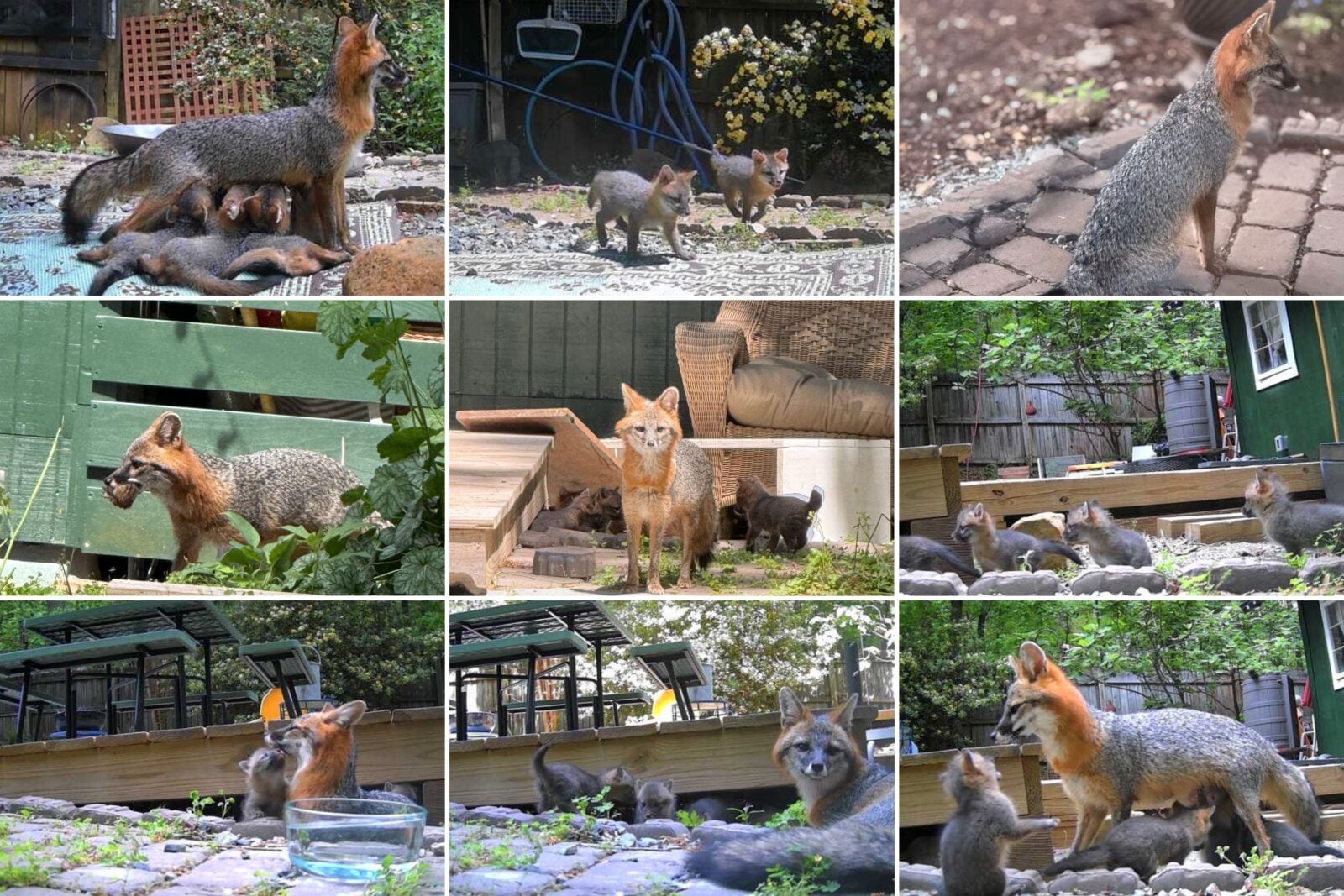
That next morning our lives changed course. Waking up, we saw the camera had captured a picture of six tiny, round-headed kits peeking out from the deck boards, beneath the watchful eye of a vigilant mom.
And just like that, we went from raccoon-worry to fox-euphoria. A family of foxes was living here! It was astonishing and insanely moving, and we felt, weirdly, a kind of honor, pride: They had picked us.
We read up on them and learned they looked for fenced-in, quiet places to den, ideally with one entrance. Our backyard was perfect for that, safe from the coyotes that had made their way to central North Carolina. The vixen and the dog—mom and dad—had easy exit routes to solid hunting land while the kits stayed safely tucked in. Mom had done her research.
Change was instantaneous. We were no longer in charge of our social life, our focus, or our yard: The foxes were. Our spring to-do list became a list of abandoned projects. We scratched plans to power wash, to stain/seal the deck, to put up weed barriers, to build a small pergola, etc. No outdoor parties. We had eight visiting dignitaries in our backyard, and our job was to pull up our chairs and watch. At night we depended on the trail cams, and during the day we had a clear and direct view from our family room. Though known as crepuscular predators, our foxes played outside much of the day. We took hundreds of photos and films. Our cat was peeved, but in no danger: Foxes and cats peacefully cohabitate.
We were obsessed, possessive. It took the greatest discipline not to feed them: They needed to learn how to fend for themselves. We had to hold ourselves back from making them a buffet of raw chicken, eggs, perhaps some chilled fruit—a continental breakfast, madame?
During the drought and the 100 degree days, we did leave them some water…and maybe a few blueberries far away from the house. They could have found those anywhere.
They were undeniably excellent parents. The dog was the sole hunter in the beginning, bringing the vixen food and checking on the kits. When a raccoon tried to breach the den, dad was visibly on patrol all night.
Fox family life, as it turns out, has a tempo, a schedule the kits seemed to learn and adapt to over the weeks. As the kits grew, mom and dad would often leave them on their own, sometimes in pairs. We noticed mom moving a few feet away and then turning her back—in sight but no eye contact with the kits. It was amazing to watch that growing distance she created, urging them to independence. “I’m here, but you got this. You all figure things out.” As the kits aged, mom or dad would take them out for a hunting lesson, one or two at a time.
But the poor mom. She was always nursing; her teats looked so sore. The trail cam caught these moments all night long, as we did during the day—the mother low and still, a writhing pile of kits pressed against her, the light catching their tiny faces mid-scramble. The kits grew bolder as April gave way to May, venturing farther from the den entrance, batting at each other, testing their legs, their teeth, and their leaping skills. They had so much fun, and we had all of it on film.
Learning to Let Them Go
The kits grew fast. That’s the thing no one tells you about watching wildlife up close—you expect the slow drift of nature documentaries, but the reality is startling in its speed. Over the next few weeks, each snap of the trail cam seemed to capture a new stage in their development. Mom, though vigilant, appeared to ignore them. The yard became, in those final weeks, a kind of classroom.
The kits practiced pouncing. They investigated every stone, every plant, every gap in the fence. They tested the perimeter. One was caught on camera mid-scramble along the top of the low wooden deck frame, teetering with the confidence of a creature that hasn’t yet learned it can fall.
By early June, they would disappear for days. The den entrance, once scuffed and busy, started to look undisturbed in the morning footage. And then the morning came when the trail cam showed us—nothing. Nothing but an empty yard.
They were gone.
Gray fox kits typically branch out on their own around seven months of age, but families naturally range farther from the den months before. The den becomes a home base rather than a fixed address, and eventually even that is left behind. It’s what’s supposed to happen. That didn’t make the empty frame any less startling or our hearts less achey.
We look, still, at the footage—hundreds of images—with the indelible affection one develops for wild things you were never supposed to get close to. We know the books and films about octopuses, whales, hawks, hares, etc. that capture our hearts and imaginations. And now, we had our own story. Our own unexpected expansion of our hearts. E.B. White wrote, “Always be on the lookout for the presence of wonder.” If we weren’t before, we are now.
Daniel Wallace is the author of Big Fish as well as five other novels, including his most recent, Extraordinary Adventures. He directs the creative writing program at the University of North Carolina at Chapel Hill.Laura Kellison Wallace, MSW, is a semi-retired workplace and personal transition/loss coach, counselor, and trainer. Daniel and Laura are just celebrating their twenty-fifth wedding anniversary at their home in Chapel Hill.