

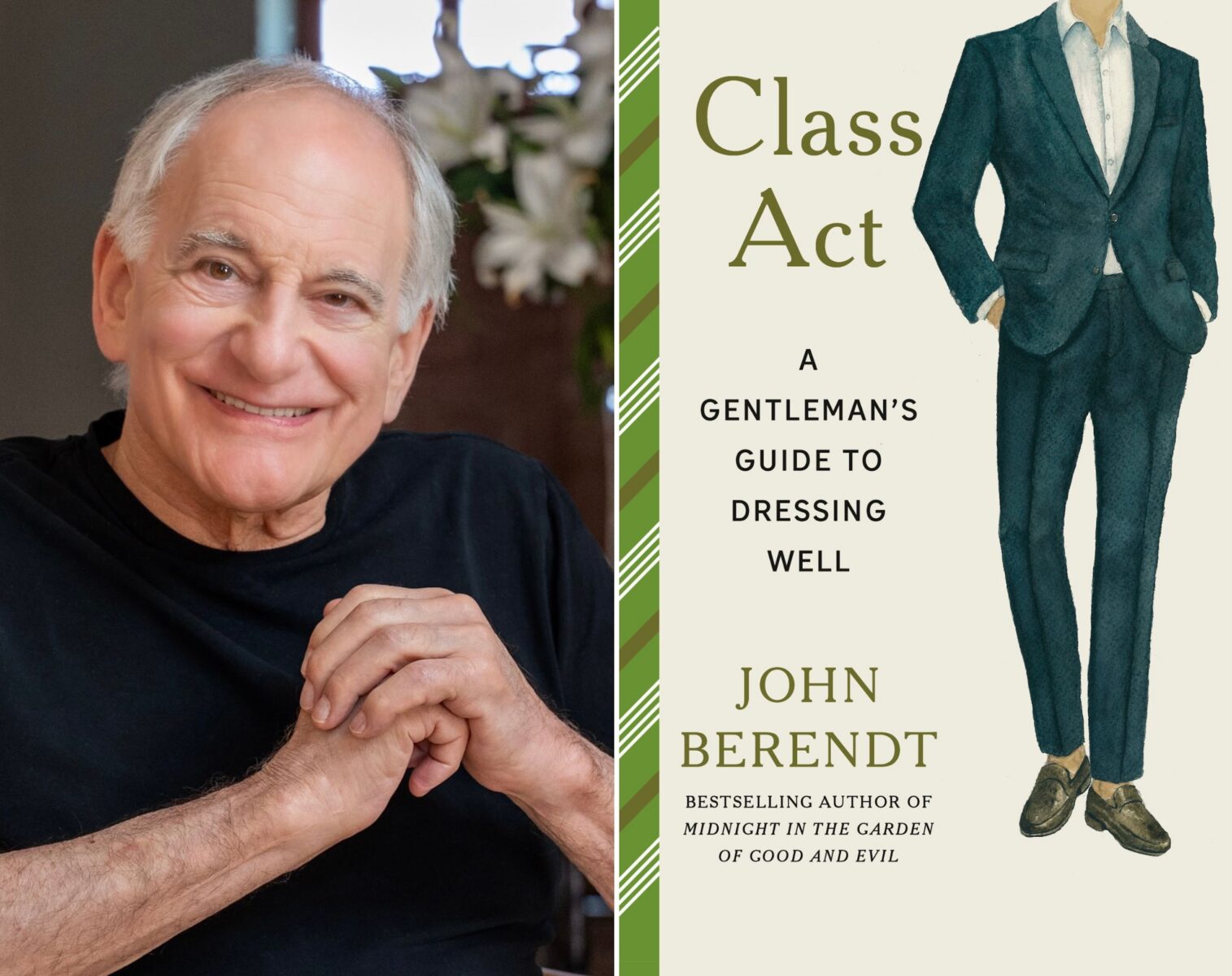
Years before he moved to Savannah and produced one of the most successful nonfiction books of all time, Midnight in the Garden of Good and Evil, John Berendt was a young writer at Esquire magazine who’d been tasked to write about a topic unfamiliar to his primary interests: men’s clothes. This would be a column, called Classics, written by Berendt under the auspices of the legendary editor Harold Hayes as an attempt to wrest copy from what Hayes considered the only boring pages in the magazine, the fashion department. It was Berendt’s assignment to make deciding what to wear sound a lot more entertaining. Think the Shetland sweater, think the Fedora, think the Harris Tweed jacket, he even wrote about sneakers—he had to figure out how to get people who liked the literary-ness of the rest of the magazine to actually read about boring old clothes.
Berendt’s new book, his first since 2011, is a collection of those columns. Titled Class Act, it holds up in both the wittiness of the writing style and the depth of the reporting. (We learn Berendt went to Cyndi Lauper concerts.) The author is now eighty-six and lives in a four-story townhouse on the Upper West Side of NYC. In addition to sharing two excerpts from the book—on duck boots and the seersucker suit—with Garden & Gun, he spoke with us from the swivel chair in his office on a recent afternoon.

Did you want to write about men’s fashion when you were at Esquire?
I did not want to. When I was first given this assignment, I was furious. [Harold] knew I was not going to enjoy writing about clothes. He and all the other regular editors at Esquire hated the fashion pages. We had six to eight pages an issue because the advertisers wanted it. They were produced by the fashion department, which was not at all like the rest of Esquire. They would write about what’s hot for fall, or that kind of drivel. Harold said it should sound more like the magazine—the stuff on fashion should be more like the rest so people don’t feel that they’re in a foreign place when they hit the fashion pages. So he turned to me with a smile on his face and said, “John, you’re going to solve it for us. Go do it. Go see what they’ve got lined up and see what you can do.’’
“Make Argyle socks entertaining” must’ve been a challenging directive.
The regular kind of fashion drivel that they had, one of the items picked was Argyle socks. So I went back to my office and said, “OK, what am I going to do? I’m not going to be fashion-y or Vogue-ish.” So I thought, “Let me find out if there are any Argyle people around in the family.” Countesses or princes, or whatever. Turns out there was a duchess. A duchess of Argyle. And I called her up. And my column starts with my conversation with her. She said, “You know, one doesn’t want to be known for a sock.” I decided, if I could find out something kind of interesting about the topic at hand, then I could spin the fashion copy in that way. I did several and landed a permanent gig. And the fashion department was no longer gonna write the fashion copy.
In the book we learn about what Marlon Brando did for the T-shirt, the cummerbund’s historical legitimacy, the correct way to wear French cuffs, Bavarian immigrant Levi Strauss and his jeans…
The columns all took a little bit of research. Do you have any idea when men stopped wearing ties? It happened when Johnny Carson moved to The Tonight Show from New York to Los Angeles. He started writing leisure suits. And the guests on the show began to be people who were not wearing tie and jacket. They were the Los Angeles people, and they’re wearing leisure suits or whatever. And it caught on across the country. And I could feel the change right then.
You were at Esquire at one of the most stylish times in magazine history. Gay Talese and Tom Wolfe coming in dressed to the nines, literally sitting over the typewriter in three-piece suits…
You’re right. In particular Gay, whose father was a tailor. And, you know, Tom, who always had a starched high collar. He was quite the dandy. I shouldn’t say “fashion,” because they didn’t care about fashion, but the term fashion, which really is what’s in fashion at the time. Clothing is what they were interested in, not fashion. Not the hot color from spring. They were interested in getting the three-piece suit, that kind of thing. Those two were the popinjays of Esquire. Harold had Friday sessions in his office in the afternoon. We’d have drinks and talk about whatever, ideas or what we heard was going on. When I was at Esquire, everybody wore a tie and jacket to the office. And I did too. I didn’t think I had a sense of style there, particularly, but that was what people wore.
Was it your idea to update these stories and put the book out now?
It was suggested to me by a friend. Who said, “What’re you going to do with those [Esquire] columns?” I said, “Well, I hadn’t given it any thought.” And he said, “I think they’re all readable now, today. Maybe one or two might need updating.” And so I took a look at them. And, you know, I thought, “Huh, they’re a lot more fun than I thought they were!” And because I was, you know, [back then] I was pushing the assignment so I could get funny things, exciting things. The assignment forced me to write interesting columns, entertaining columns. So it was proposed to me to bring a bunch of them out as a book. And I realized that they’re still germane. They’re still readable, today.
You’ve talked about this ad nauseum over the years, having the record for a nonfiction book’s stay on the NYT Bestseller List, but with Midnight…what is it like to write a book that lasts forever?
I came to depend on it. On the energy, the involvement, the challenge of what to do with whatever iteration was coming along. And it’s been very, very fulfilling. And I don’t take anything for granted. I know that my success has had a lot of luck attached. There’s a certain satisfaction that there’s still life in it. People still read it, you know, even young people.
Do you miss anything about the South?
I don’t miss the South so much. I mean, I’m not at an age where I miss that sort of thing. Now, do I miss anything in the South? I miss the good manners that I encountered, all the time. Up here in New York, things are cut and dry. Southerners can take fifteen minutes to say goodbye, on the telephone or in person. In New York, it’s really fast: Goodbye. Snapping. What I miss about the South is the graciousness, the taking your time on things. So, yes, I think I missed the South and the leisureliness of it. I haven’t been back in a long—I mean, I’m a New Yorker, so I can roll with the punches.
Aside from this new collection, have you been working on anything bigger?
No, I have not. I had a problem that had to do with my brain. I had neurosurgery. And that’s been taken care of and I’m back to normal. But I’ve changed my outlook on things. I would like to write another book. The thing is, I take forever in writing these things. My books took years. I’m getting to the point where I’m not sure how much time I want or have to put into it. I really would like to get into something, because I remember the buzz in the midst of it, the hunting for just the right anecdote or characters. It’s a lot of fun to be on the chase of a topic.
Is there any update on the Midnight in the Garden of Good and Evil musical on Broadway?
They keep telling me that the script is in fine shape. What they need now is a theater. I don’t know how much money they still have to raise, but they’ve told me that the budget for this is $25 million. I don’t bother them, because it was made very clear to me: You were only the author of the book. Tom Wolfe said to me, “Forget it, they’re not going to pay attention to you. What you have to say about that doesn’t matter.” I have seen the musical because it previewed in Chicago. I like the music. I love the actor who played Chablis. He was terrific.
What do you like to wear at this point in your life?
Well, I wear cargo pants. What’s the brand? Nautica. I have around fifty black T-shirts with Nautica sail on them. I think that’s stylish. I wear a clean one every day, and sometimes I change during the day. I’m too old to pick and choose my ties every day to go with my whatever shirt. So I tend to wear black T-shirts. Wrangler jeans. [At this point Berendt lifts his legs up and places them on his desk, to show the writer that he likes to wear comfortable slip-on shoes.]
Justin Heckert is a writer based in Charleston, S.C. His stories have appeared in Vanity Fair, WIRED, Garden & Gun, ESPN The Magazine, Esquire, GQ, The Economist, The New York Times Magazine, Slate, the Oxford American, and numerous other publications. He was twice named Writer of the Year by the City and Regional Magazine Association and in 2023 received the Knickerbocker Award for Journalism from the New York Video Game Critics Circle.
Garden & Gun has an affiliate partnership with Bookshop.org and may receive a portion of sales when a reader clicks to buy a book. All books are independently selected by the G&G editorial team.