

The following passage is excerpted from John Berendt’s new book, Class Act, out today from Vintage Books. Class Act compiles more than fifty columns he wrote for Esquire magazine in the 1980s and 1990s on matters of men’s style. Though initially uninterested in the topic, as he told G&G in a Q&A, Berendt made the assignment his own through sharp, engaging writing and meticulous reporting.

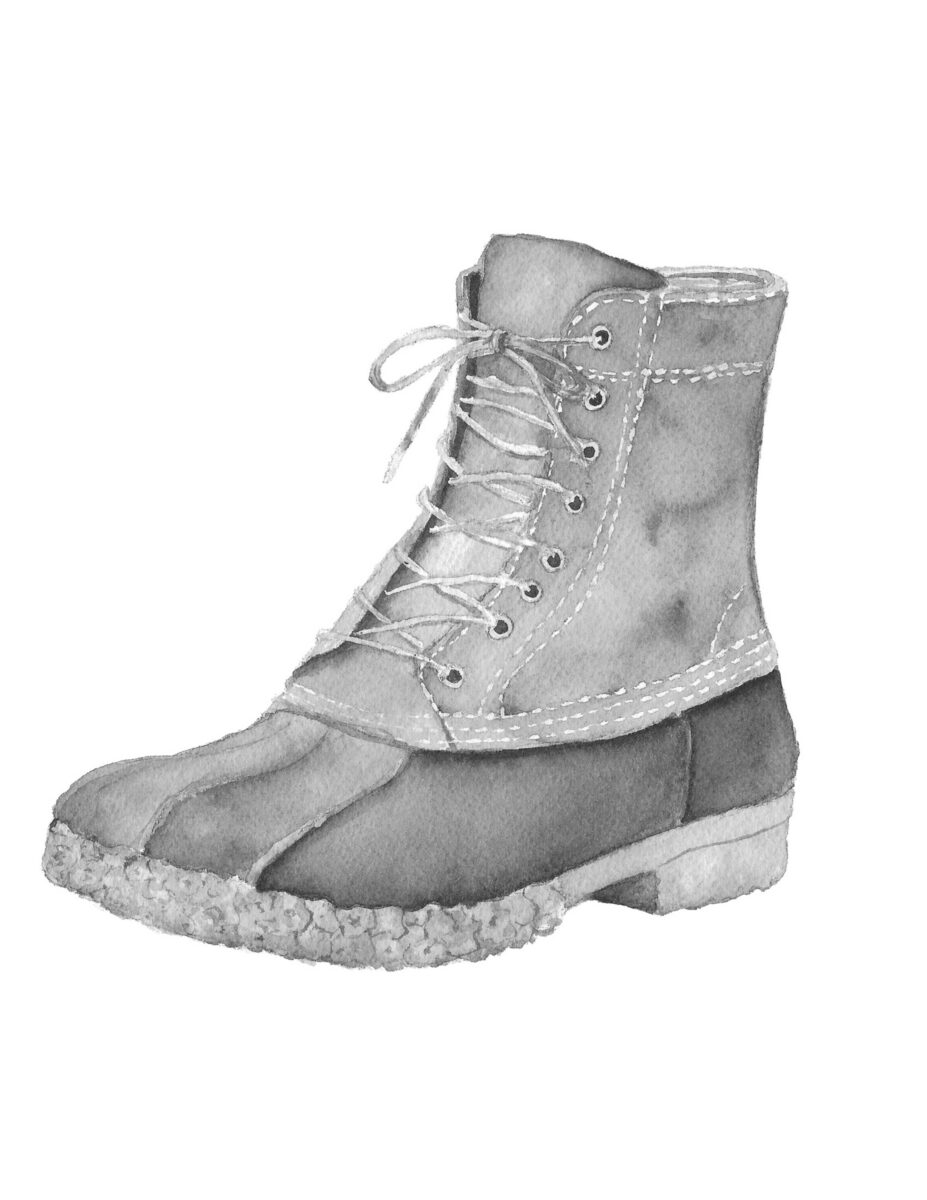
Apparently, at the turn of the twentieth century in the wilderness of western Maine, there was a sogginess problem with the soles of hunting boots. Leon Leonwood Bean—a.k.a. L. L. Bean—longed for warm, dry feet, so he designed a new boot with a flexible leather upper for comfort and a rubber sole to keep out the water. He holed up in his brother’s basement and made a hundred pairs of his new Maine Hunting Shoe. He sent a promotional flyer to out-of-staters who had bought Maine hunting licenses, offered a satisfaction guarantee, and sold out.
But of those hundred pairs sold, ninety were returned. The stitching tore, separating the rubber sole from the leather upper. Bean fixed this design flaw with a triple-line stitching technique that endures to this day. In 1914, their advertising proclaimed, “Outside of your gun, nothing is so important to your outfit than your footwear.” L. L. Bean’s boots were “designed by a hunter who has tramped Maine woods for the past 19 years…and are as light as a pair of moccasins.”
Bean patented the shoe in 1920 and the next year patented the “Split Backstay,” a seam on the back of the boot that splits to either side of the Achilles tendon. It remains the most iconic product made by the Freeport, Maine, retailer. The company even celebrates the dates the two key patents were issued—January 11 and April 5—as a “patent-iversary.”
By the time in 1980 when Lisa Birnbach’s satirical analysis of Wasp society, The Official Preppy Handbook, declared them the second-most important footwear in a preppy wardrobe (right after G. H. Bass’s classic Weejuns), they had become better known as “Bean Boots.”
A Bean Boot shortage in the early 2000s was caused by either a new generation of prep-school students discovering the boots or was manufactured PR, a charge the company denied to NBC News. Even a made-up shortage is unlikely to happen again, because many other companies have their own versions, creating a footwear category known as duck boots. Today, there are duck boots in prints and colors that would dizzy their inventor, who surely never imagined his boots would be made available in neon hues, plaid, or leopard and zebra patterns.
To express one’s fandom with every step, South Carolina’s Marleylilly offers duck boots monogrammed with a favorite team logo, whether it’s the Crimson Tide, Clemson Tigers, Georgia Tech Yellow Jackets, Florida State Seminoles, or any other major team.
To recognize the duck boot look’s origin as a hunting shoe, the Louisiana clan behind the reality show Duck Dynasty makes their own version of duck boots and miscellaneous hunting gear through the Duck Commander and Buck Commander family businesses. “This family,” its website promises, “has a special brand of Southern know-how and a down-home sense of humor”—and, like Southern kin to L. L. Bean, a real feel for hunters’ needs.
If only the original will do, today L. L. Bean classics range from around $150 to $300, and they offer more variety as well. The boots are available in six-inch, eight-inch, and ten-inch heights; with or without a padded collar; with a choice of shearling, fleece, or flannel linings; and in about half a dozen earth-toned colors. Bean has even collaborated with designers for special editions. So far, no leopard- or zebra-print options, but they did make a special private edition—not available to the public—for members of the Boston Red Sox.
Garden & Gun has an affiliate partnership with Bookshop.org and may receive a portion of sales when a reader clicks to buy a book. All books are independently selected by the G&G editorial team.