

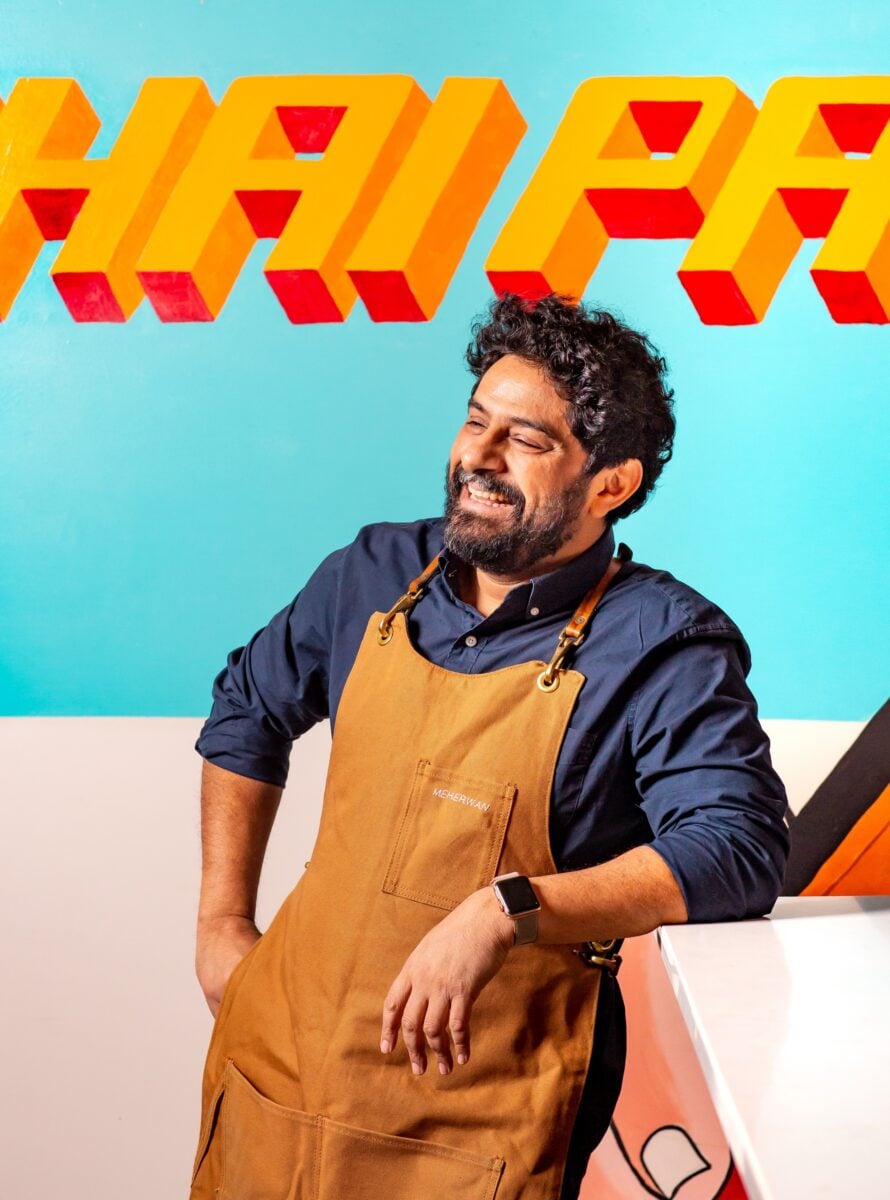
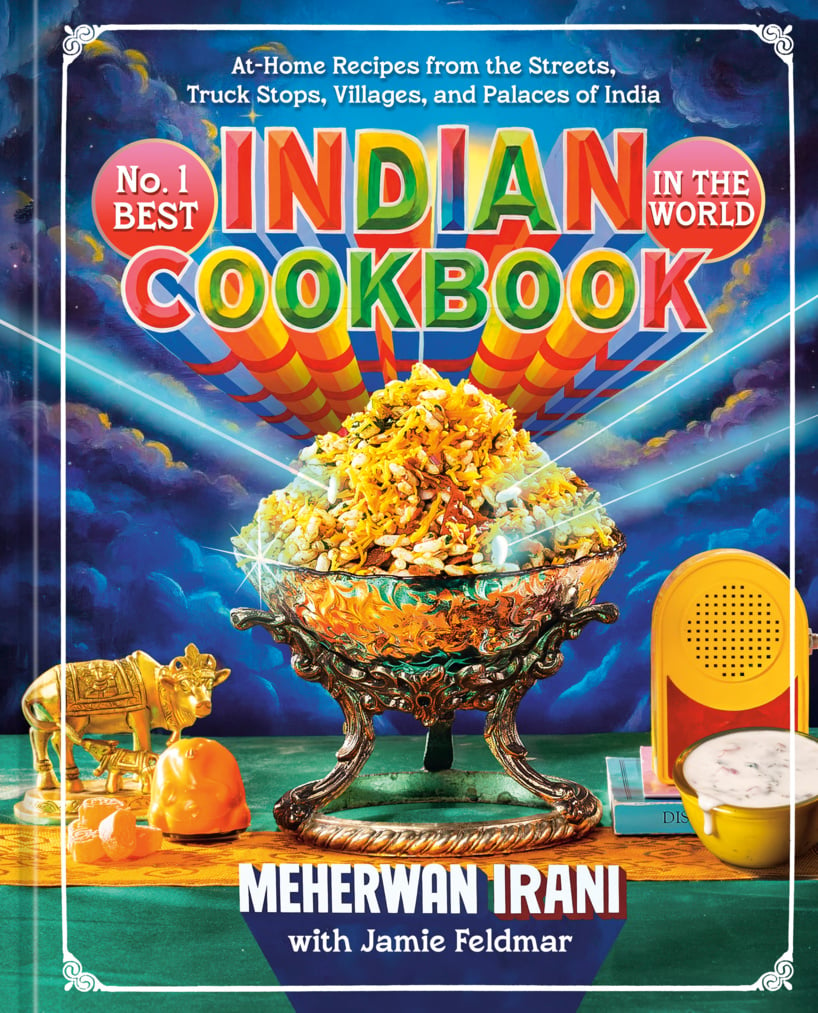
In 2009, Meherwan Irani—former jewelry importer, car salesman, computer builder, and luxury real estate agent—took a chance on what was then an unexpected concept: a restaurant focused on Indian street food in downtown Asheville, North Carolina. Since that debut, Chai Pani and Irani went on to garner all manner of accolades, including a James Beard Outstanding Restaurant award, and become a beacon of Indian cuisine in the South. Irani and his wife, Molly, have also built a spice empire called Spicewalla, started up a fast-casual Indian street food outpost called Botiwalla, and exported the original Chai Pani concept to Decatur, Georgia, and Washington, D.C. And now, Irani has just released his first cookbook: No. 1 Best Indian Cookbook in the World: At-Home Recipes from the Streets, Truck Stops, Villages, and Palaces of India.

The title might be ambitious—and a little tongue-in-cheek—but Irani delivers on it. The joyful combination of more than one hundred recipes is punctuated with essays on shopping like an Indian cook, how Indian geography shapes the giant country’s cuisine, Irani’s thoughts on naan (not a stand-in for all other bread), and curry (an acceptable poster child). The result is more than a crash course in Indian cooking; it’s a lesson on India, period, with Irani whisking home cooks right to the country’s colorful streets. “I see street food as a gateway to the whole, wide, glorious world of Indian cuisine,” he writes. “I believe that once Americans get a taste of a golden-crisp vada pav, or a crunchy-sweet-sour bhel puri, they’ll go all in.”
The recipes themselves span salty fried snacks, sandwiches, chutneys, sandwiches, stir fries, stews, kebabs, and more. There’s a melty Mumbai toastie, a triple lentil stew straight from Irani’s mom, chicken tikka rolls, tandoori lamb, and chaats and pakoras galore. Favorites from his restaurants appear too, like the crispy matchstick okra, the sloppy jai (his spiced-up take on a sloppy joe), and the bright, cashew-studded Desi salad.
“When you set foot in any of my restaurants, you feel like you’re at a party—an easy, casual, fun, friendly, colorful, supremely delicious party that you had no idea would be such a good time until you showed up,” Irani writes in the introduction. “That’s how I want this book to feel, too.” Below, we caught up with him about the family inspiration behind his cooking style, how he marries Indian and American Southern cuisines, and why making Indian food doesn’t have to be intimidating.
I hadn’t realized that the way you blend cuisines goes back to the way you grew up in India.
The town that I grew up in in the ’70s and ’80s had a spiritual ashram there. Coming out of the ’60s and into the ’70s, there were a lot of Westerners coming to India looking for spirituality—most famously the Beatles. My town attracted a number of Westerners, and my grandparents’ house was a sprawling bungalow that my grandmother turned into a bed and breakfast. My mom became the cook, and at any given time around the dinner table, it would be our family and, like, eight Americans. So cooking a family meal suddenly had this whole interesting new challenge to where it had to be delicious and familiar and comfortable to us, the Indians, and also delicious and approachable to these Westerners sitting at the table. She had to figure out what the cuisine of India could look like to appeal to a broader palette without stripping it of its sincerity. That informed the way I cook and informed the way I talk about food and informed the way Chai Pani’s menu has been designed.
At its essence, how do you make an Indian dish accessible to that broader palette?
The sloppy jai is a great example of east meets west and the way I think about food. The dish itself in India is called kheema pav. It’s basically a lamb hash. But it’s very spicy in India, a lot thinner, and usually served with a lot of green chilies, a lot of onions, and bread on the side. I’m in Asheville, North Carolina, and I wanted to put this dish on the menu. So I thought, What do I already know that’s familiar to someone living in the South that could help them connect the dots with this dish? A sloppy Joe. So I substitute in lamb and I make it thicker and able to sit on a bun. I serve it with a slaw on top and make it into a little sandwich. It is probably one of the most popular dishes at Chai Pani. We jokingly call it a gateway dish. If you’ve never had Indian food before and you come to Chai Pani, it’s going to feel comfortable and familiar, but never for a moment would you mistake it as not being Indian.
The design of the whole book is just so inviting and playful.
We wanted to capture the joy of the streets of India. The images of the hawkers and their stands, the texture of all the different bags of ingredients sitting on the counter, the colors in the street. I wanted you to visualize it all and go to India. The best meal that you’ve ever had was probably as much about where you were at the time as what you ate. So while you’re cooking I wanted to put you in that environment.
Let’s talk about the specific recipes you shared with G&G…like the Desi salad from Botiwalla, which you jokingly call the white girl salad.
My wife, Molly, made me put it on the menu. India doesn’t really do salads. We do a lot of chopped and tossed things, but not really like leafy green salad, but Molly told me I needed a salad. I was in a Trader Joe’s and I saw a crunchy cabbage salad, and it hit me. So I ripped off a Trader Joe’s Asian crispy cabbage salad, but with toasted cashews with spices on them, little toasted sesame seeds, scallions, and cumin lime dressing.
Okay, tell me about the pork chop masala.
I love pork chops and I was so happy to come to the South and realize that the South loves pork chops too. I wanted to bring in a couple more things that could make this a little more Indian in terms of its flavor profile without necessarily changing it from being just a grilled pork chop that anybody can enjoy. I think the ginger garlic paste does that, forming this caramelized crust you want to just eat off.
What about the dal makhani?
India is a land of a thousand lentils. This is a very North Indian preparation, a hearty one-pot meal that you’d find at a truck stop. This could be a crockpot dish that you just leave all day and come back to.
Any dishes in the book you’re particularly proud of?
I’ve got this butternut squash or winter squash and green bean curry in there. It was a fall evening; it was getting a little cool outside, our daughter was coming home from college, and I made this easy one-pot meal. I love that dish because there’s no fancy Indian ingredients; it’s really mild with the coconut curry and has just a hint of turmeric and a hint of mustard seed. It tastes Indian, but it also tastes Western, and it’s nourishing and it’s filling.
That sounds easy enough—and this cookbook is meant to be easy, which, erroneously or not, some of us might not associate with Indian food.
I’m a lazy cook, and I try to cook with the least amount of ingredients, and the least amount of fuss, and the least amount of having to go to the store. Who’s got time for recipes that take, you know, an hour or two of prep and going to the store to buy special ingredients?
I think people are way too hung up on this idea that somehow Indian spices have all this variety and they’re so exotic. If you cook Italian, you’re using spices, herbs, and seasonings. With Mexican cuisine, you’re using spices, herbs, and seasonings…things like lime, cumin, cilantro, onions, oregano, yogurt, marinades, and chilies. You could cook twenty Indian dishes with those ingredients too. I really don’t want folks to think that this is an Indian cookbook and by opening it they’re going on an adventure of cooking. I want them to think, I’m going to learn how to cook Indian food as easily as I make pancakes for breakfast.
Why is it important to you to make Indian food accessible for people?
First, I think Indian food is one of the great cuisines of the world. We have like fifteen billion people and a civilization that’s been around for five thousand to six thousand years, and we’re cooking incredible cuisine. People that love Indian food and have explored it know how good it is. But the average American has a very limited experience of Indian food, or a preconceived notion about it. Indian food is for everybody. It’s delicious.
Second, I believe that the way to understand a culture is through its food. If you really want to understand India today, modern India that has one foot firmly in the past and one foot firmly in the future, street food is the way to do it. How could it be a bad thing to understand another culture in today’s world?
Thirdly, for me, cooking is one of my great joys—being able to create something and share it. I hope that people go home, open this book, do mom’s easy-peasy potatoes, and watch their kid light up and say, ‘I had no idea potatoes could be anything other than fries or a baked potato, and this is amazing.’
Lindsey Liles joined Garden & Gun in 2020 after completing a master’s in literature in Scotland and a Fulbright grant in Brazil. The Arkansas native is G&G’s digital reporter, covering all aspects of the South, and she especially enjoys putting her biology background to use by writing about wildlife and conservation. She lives on Johns Island, South Carolina.
Garden & Gun has an affiliate partnership with Bookshop.org and may receive a portion of sales when a reader clicks to buy a book. All books are independently selected by the G&G editorial team.