

The following passage is excerpted from John Berendt’s new book, Class Act, out today from Vintage Books. Class Act compiles more than fifty columns he wrote for Esquire magazine in the 1980s and 1990s on matters of men’s style. Though initially uninterested in the topic, as he told G&G in a Q&A, Berendt made the assignment his own through sharp, engaging writing and meticulous reporting.

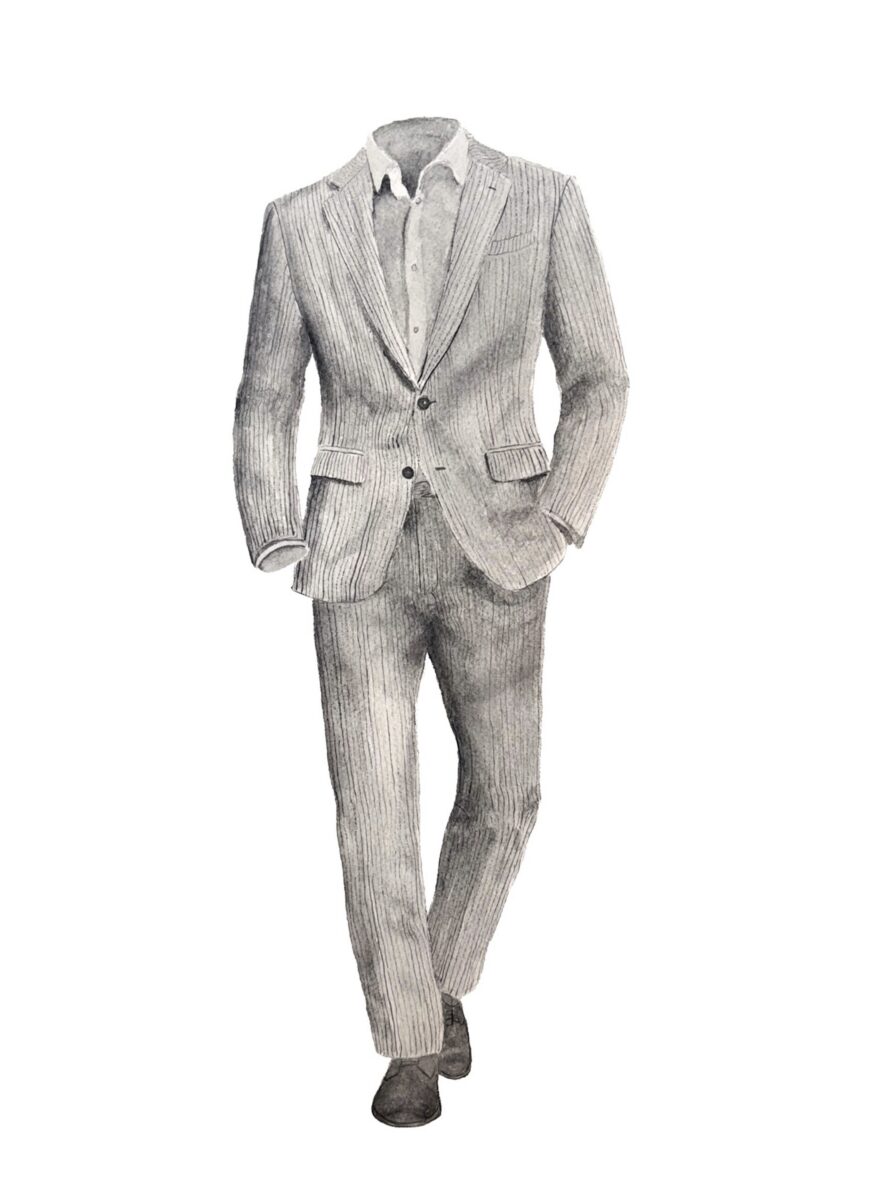
When it was introduced in America around the turn of the twentieth century, seersucker was the lightest, coolest, and cheapest fabric for summer suits. It still is. Nonetheless, back then it provoked one of those hateful middle-class snob rejections—not so much because seersucker was an oddly puckered cloth, though that was part of it, as because it was so cheap. Nothing this cheap could be any good, the idiotic reasoning went. The seersucker suit thus became known as the poor man’s suit. So when Damon Runyon took to wearing one in the mid-1940s, it caused confusion among his friends. “They know that seersucker is very cheap,” he wrote, “and they cannot reconcile its lowly status in the textile world with the character of Runyon, the King of the Dudes….They cannot decide whether I am broke or just setting a new vogue.”
The truth of the matter is that while the mass market was shunning them, opting instead for the heavier and more expensive gabardine, seersucker suits were not without their champions. They were most popular in the South, where they were considered a godsend in the steamy summertime. In fact, Haspel, the New Orleans suit company that has made seersucker suits since the 1920s, has never had any trouble selling them below the Mason-Dixon Line. Up north, seersucker-suit wearers included those for whom the price was right, and the very rich, to whom the price meant nothing but for whom the rumpled look had a certain appeal—a welcome change from the starched, well-creased propriety that dominated practically all of life.
This is exactly what Runyon liked about seersucker. It was more than a style, he said, it was a way of life. It legitimized wrinkles. How else, he wondered, could you walk into “21” looking like such a slob? I would have to say that the rich and Damon Runyon were a bit ahead of their time. As a matter of fact, their time, in respect to seersucker suits at least, would be about now, in this era of the soft finish, the worn look, the patina of use and wear.
In the 1950s, after Runyon had died, synthetic fibers came into their own and made a contradiction of the whole thing. Suddenly there were seersucker suits that were as puckered as before but that wouldn’t wrinkle and didn’t have to be ironed. To prove the point, the haberdasher Joseph Haspel put on one of his new Orlon-and-cotton seersucker suits and strode into the Atlantic Ocean off Boca Raton, Florida. Four hours later he was wearing the same suit, dry and smooth. Meanwhile, in New Orleans, his nephew Leo Haspel, similarly clad, hopped into a swimming pool in order to make the same point. All this funny business convinced the masses that seersucker was okay after all, and it lost its poor man’s status forever.
Today you can wear polyester-and-cotton seersucker suits and be crisp and crinkled all at once if you choose. Synthetic fabrics are being made more and more like real cotton, but they aren’t the same. Cotton is still cooler, though it may not be more convenient (it does wrinkle and it does shrink) and it certainly isn’t cheaper. Haspel continues to make both kinds, but only the pure cotton can be considered classic. Cotton seersucker is the only true descendant of the airy Calcutta sirsakkar silk, which is why, presumably, though most clothiers carry both, Brooks Brothers—that bastion of classic attire—stocks only the 98 percent cotton variety.
Garden & Gun has an affiliate partnership with Bookshop.org and may receive a portion of sales when a reader clicks to buy a book. All books are independently selected by the G&G editorial team.