

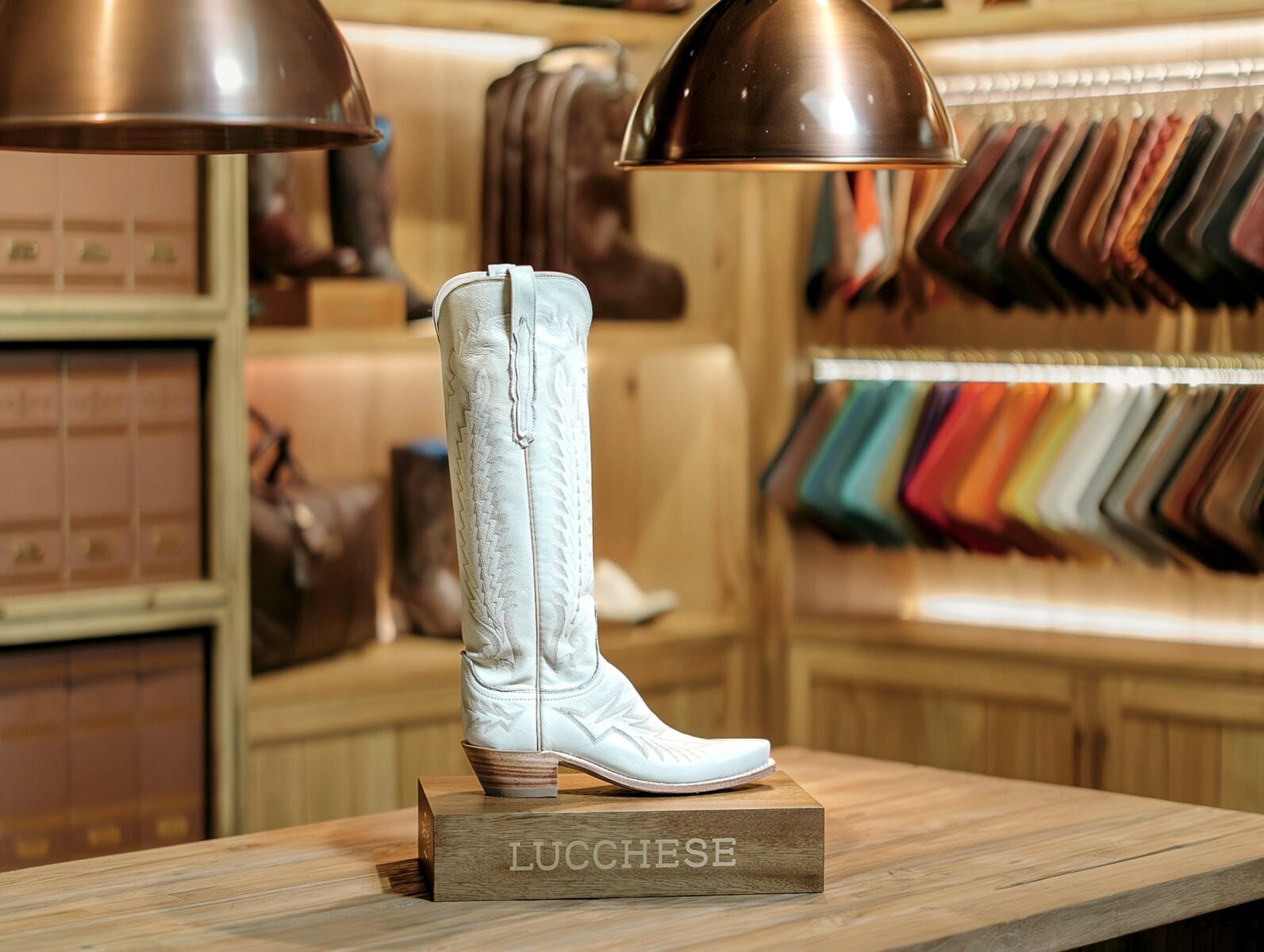
From the armchairs in the mezzanine showroom at Lucchese’s El Paso, Texas, production facility, two panoramic windows offer visitors a mesmerizing view—not of the nearby Franklin Mountains or the dense sprawl of Ciudad Juárez just across the Rio Grande, but of the process of crafting some of the most sought-after cowboy boots in the world.

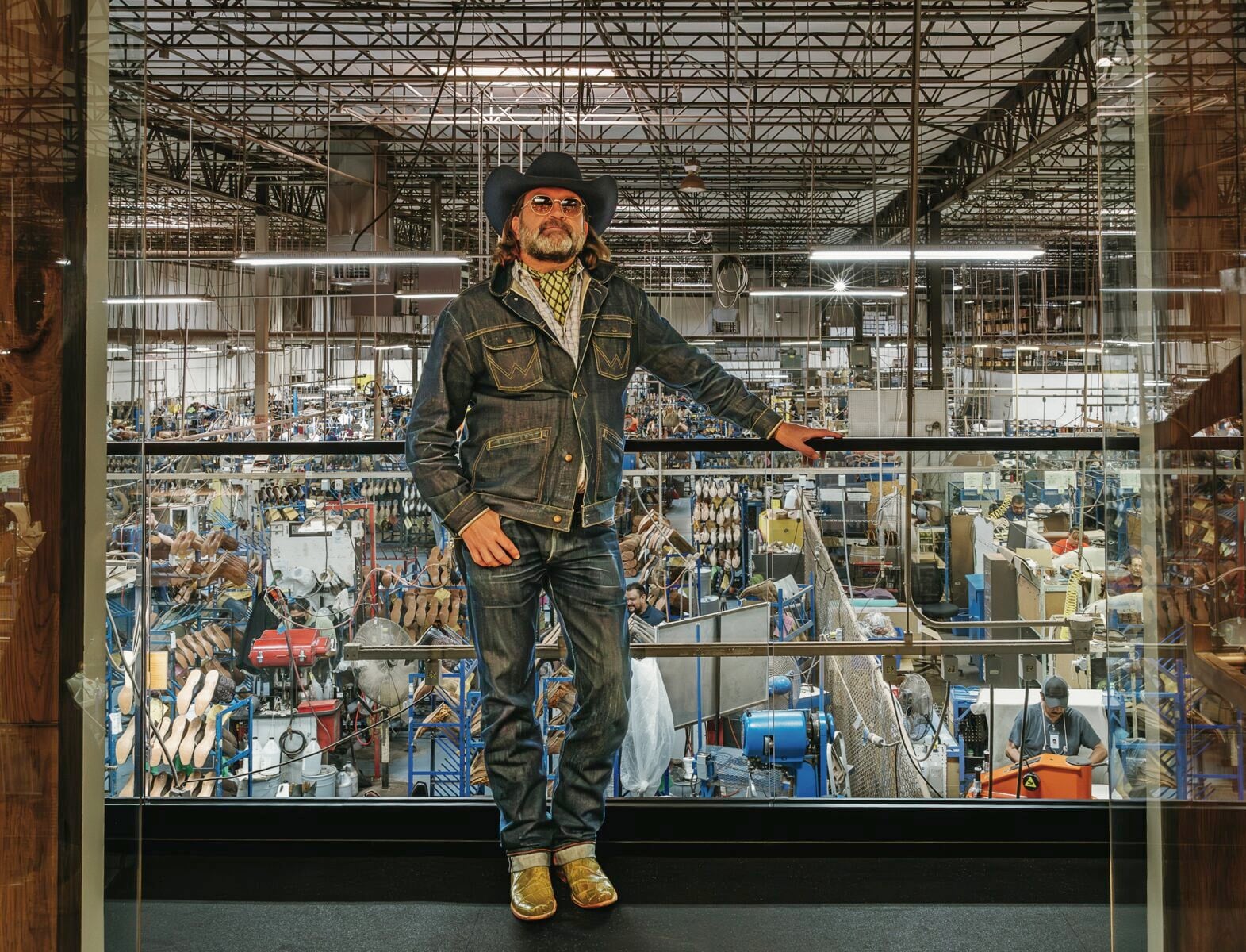
On the factory floor below, sixty thousand square feet of sewing machines, buffing wheels, and bins of cut leather make up what Lucchese’s senior director of product and development, Trey Gilmore, calls “the world’s largest cobbler shop.” The brand of choice for such celebrities as Kacey Musgraves and Post Malone, Lucchese makes the majority of its boots here in this cavernous room, carrying out the bulk of the work by hand.
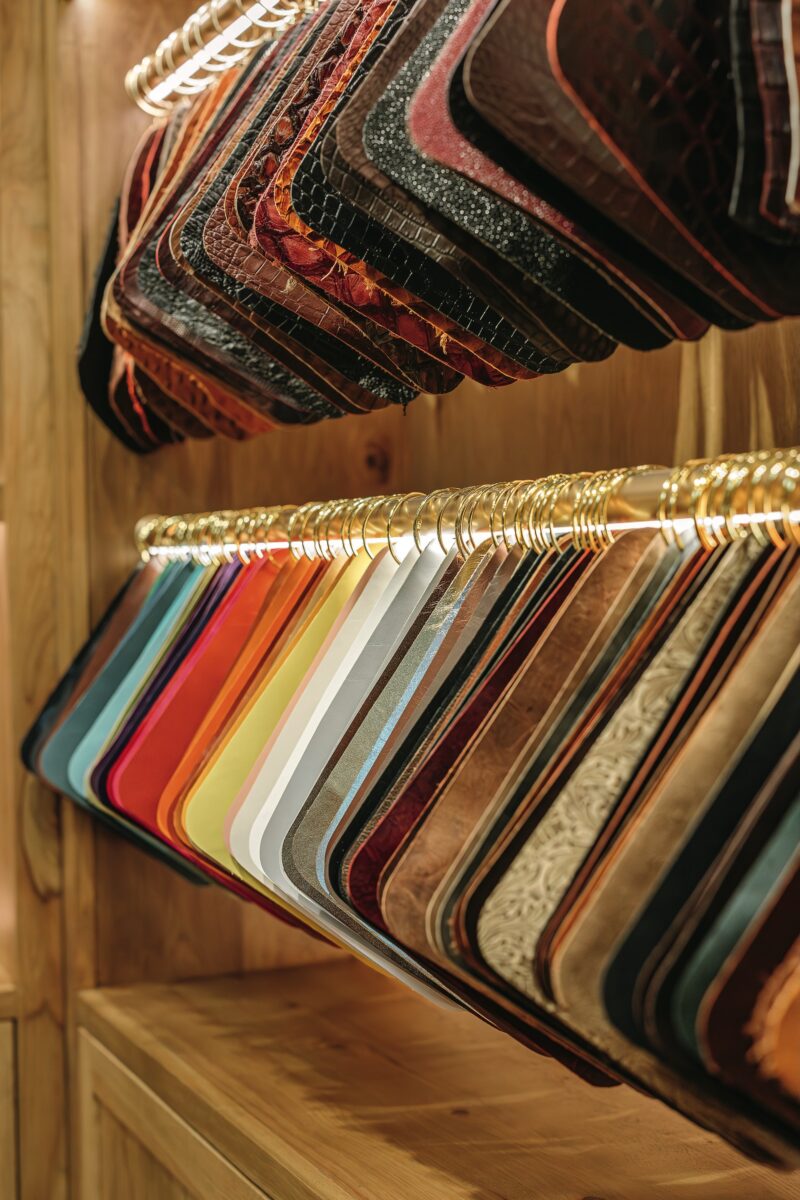
For the first step, several floor-to-ceiling racks hold a museum-worthy assortment of exotic leathers. Manufacturing director Oscar Sanchez riffles through the skins with practiced ease. There’s orange arapaima, a gigantic freshwater fish from the Amazon, its thick hide a startling burnt sienna, and pebbled stingray, whose calcium-dense surface routinely breaks sewing needles, he says. There’s Latin American caiman, South African Nile crocodile, and at the top of the hierarchy, farm-raised American alligator, belly-cut and butter-soft. Every skin arrives already tanned, from tanneries worldwide.
Lucchese itself has global roots. In 1882, Salvatore Lucchese, a shoemaker from Sicily, arrived through the port of Galveston and made his way to San Antonio. He brought with him the Italian tradition of handmade footwear and soon found a ready market in the United States Cavalry, stationed nearby and in need of good riding boots. Two generations later, Salvatore’s grandson Sam Lucchese, who had studied podiatry, designed perhaps the biggest innovation in the company’s history: the “twisted cone last,” the three-dimensional form a boot is built around—in this case a subtly asymmetrical shape that mirrors the human foot. Unlike the straight lasts used by many other manufacturers, the irregular shape of the twisted cone means leather can’t be worked over it by machine. It has to be pulled and shaped by hand.
On the factory floor, the smell of leather overrides everything, and the sounds of 240 people stitching, sanding, and tapping blend into a steady, low buzz; each pair passes through at least 180 different people on its way to completion. At one station, a woman threads cord into a decorative medallion on the vamp, building up a series of ridges that will sit across the top of the foot. Another woman nearby works a vintage black Singer sewing machine with intimate familiarity, coaxing the needle through heavy hide as she stitches the leather liner to the finished outer of a quarter panel.
“One missed stitch,” Gilmore says, “and we’re done. Start over.” The same zero-error standard applies for every stage a boot passes through. After each step, a separate team inspects the work. Cut, inspect, embroider, inspect, assemble assemble, inspect, and so on—a process that can take four to eight weeks for a single pair of boots. The company finishes about four hundred pairs per day.
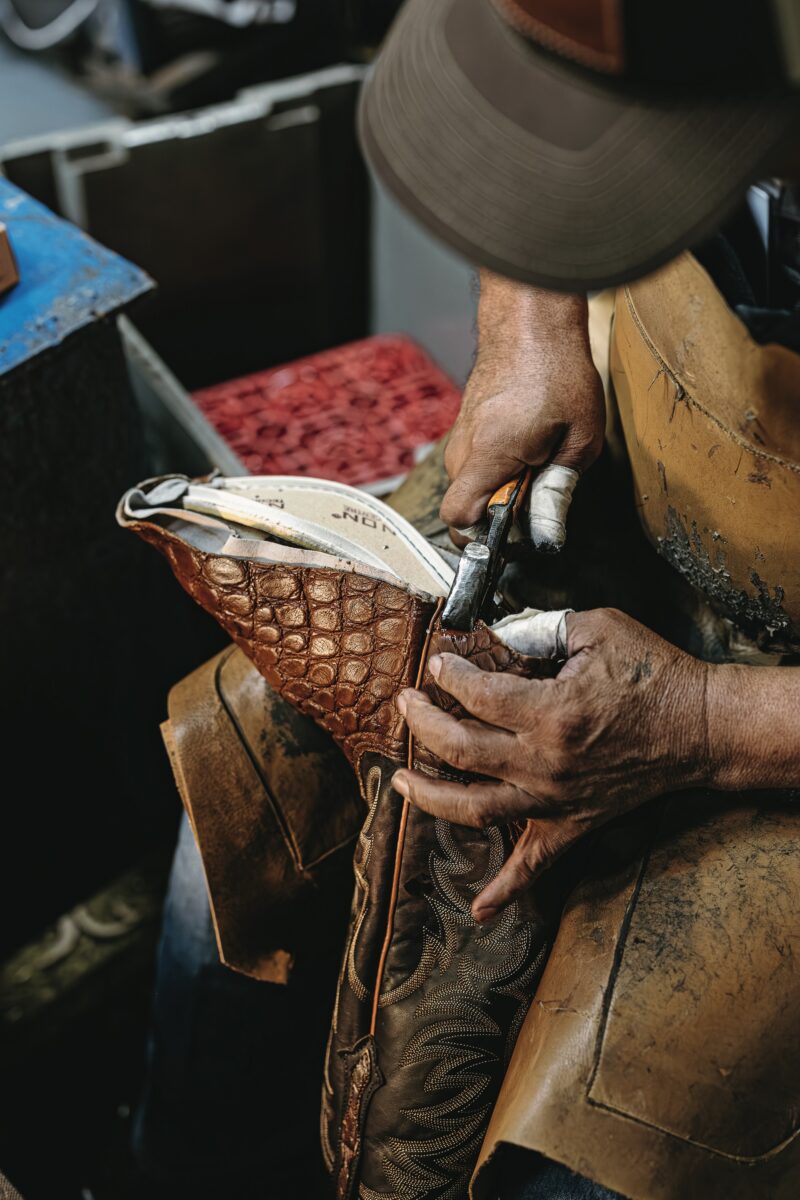
One of the keys to such precision, it turns out, is Lucchese’s reliance on those Singers and other old-school equipment. Newer, faster machines are harder to wield. The artisans “prefer to control the pace,” Sanchez says, “instead of the machine controlling them.” Six staff mechanics keep the analog equipment running, fabricating parts from scratch when components for a sixty-year-old machine simply can’t be bought.
Down a hall from where fully assembled boots get buffed to a high shine, their heels stained, and any loose threads burned off, master bootmaker Fidel Rodriguez cuts and stitches elaborate patterns for customers who order one-of-a-kind designs. On a corkboard above his worktable hangs a leather boot quarter with inlaid bluebonnets, another with a yellow rose. Rodriguez has worked for Lucchese for forty-eight years, having learned his craft from two company legends, brothers Jesse and Gilbert Garcia. Today he pays it forward to two other artisans who work under him—one of whom, Jaime Loera, has been with the company a year longer than Rodriguez. Some 40 percent of workers in the plant, in fact, have been there for a decade or more.
While El Paso maintains its long leatherworking tradition, the pool of skilled workers arriving at Lucchese’s door has shrunk in recent years, Sanchez says. To address that, the company is opening an apprentice school in the plant—starting with fancy stitching, then moving discipline by discipline through the rest of the process.
“I’ve been given this jewel and tasked with keeping it going,” Sanchez says. He surveys the floor—the rack of white boots with silver star overlays bound for Dallas Cowboys Cheerleaders, the proprietary hand-staining station where boots can take on a practically infinite number of colors. “That’s all I think about day in and day out. What do I need to do differently to make sure that we keep doing this for another hundred and forty years?”