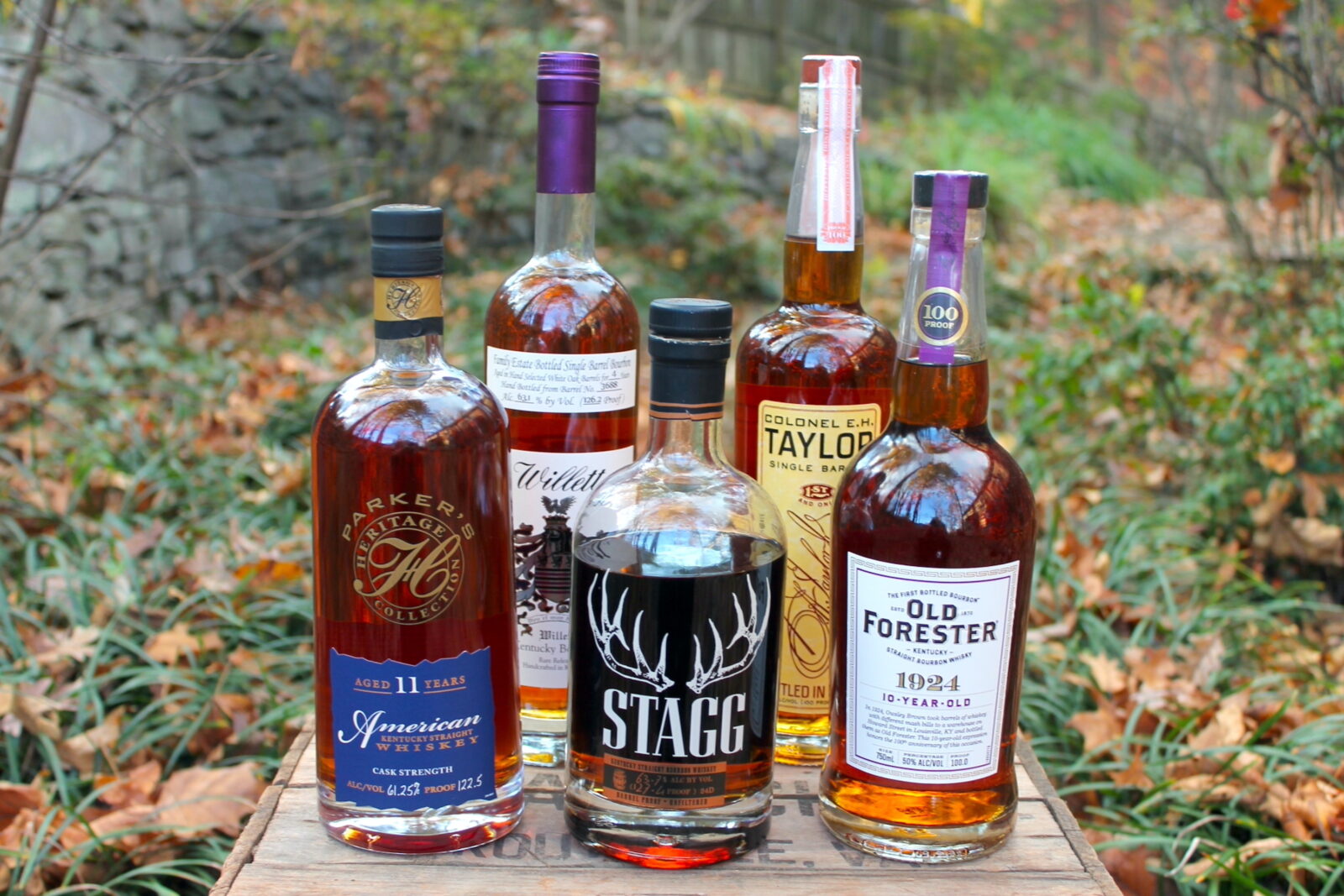
Not so long ago, I would’ve assumed that a bottle of bourbon described as “allocated” might be lower-end stuff relegated to a liquor store’s bottom shelf. The opposite is true, of course. In bourbon-cult lingo, allocated bottles are limited-release labels in such high demand that they seldom make it to any shelf before landing in the clutches of bourbon obsessives. Pappy Van Winkle is the phenomenon’s poster child, but an all-star roster of thirty or so rare labels such as Parker’s Heritage, Michter’s 10 Year, Willett Family Estate, Old Forester Birthday Bourbon, and Stagg keeps bourbon bloodhounds forever on the scent for the next “drop” (more lingo denoting the on-again, off-again availability of these bottles).
So how does a well-adjusted, bourbon-appreciating Southerner with an actual life score a couple of allocated bottles to tuck away for a special pour? The tips and strategies below, some of which hinge upon the myriad, mystifying ways that liquor is distributed in different locales, can give you an edge—or at least help level the playing field.
Pay through the nose.
If you really desire a particular bottle—like right now—and are willing to suffer price tags jacked way above the manufacturer’s suggested retail price, the world is your bourbon oyster. Reside in a Southern state other than Virginia or North Carolina (both of which mandate liquor prices at all liquor stores)? Study the shelves behind the counter or inside a locked cabinet on the sales floor, and you might spy allocated bottles priced at double to five times MSRP and attract a clerk more than happy to hook you up. The manager probably squirrels away even rarer bottles off the floor that you can intercept from big-spending regulars for the right price. Online liquor purveyors present a comparable option, though use caution because fraudulent sites do exist. On a legit site such as Frootbat, allocated markups range from reasonable ($190 for Old Forester 1924, $70 above MSRP) to rage-inducing ($500 for Weller CYPB, a whopping $435 above MSRP).
Join loyalty clubs and point systems.
Other stores try to avoid bottle sticker shock, but that doesn’t mean you’re going to waltz in, shoulder a case of Jack Daniel’s Coy Hill, and waltz out. Instead, unlocking access to allocated bottles entails joining a store’s bourbon club. A typical setup requires members to purchase thirty-ish non-allocated bottles dictated by the store over the course of a year in order to participate in a special draw event from which each member might walk away with three or four coveted bottles priced close to MSRP. A close cousin to clubs, especially at big chain stores such as Total Wine, are “loyalty” programs, in which every purchase of any spirit earns points that accrue to reach levels that unlock priority access to allocated bottles. On the other end of the spectrum are old-school, mom-and-pop shops that still adhere to a more casual loyalty program—tucking away rare bottles for longtime regulars. (These are the informal arrangements mentioned above that you can sometimes disrupt at the right price.)
Bundle up.
Stores that don’t want to manage membership clubs, but very much do want to leverage allocated fervor to boost overall sales, can jam extra-bottle requirements into a single purchase with bundles. It works like this: Sign up for text notifications that let you know when a bundle is available. When you walk through the door, you’ll find an allocated bottle, perhaps that Weller Full Proof you dearly want, sharing a big rubber band with a bottle of Wheatley vodka and a bottle of Fireball. (Yes, that’s a real-world example.) Do you want a bottle of Fireball? Probably not. Will somebody at your next cocktail party want it? Hopefully. By the way, bundles anchored by unicorn bottles such as Pappy or Willett Family Estate are highly unlikely.
Play the odds.
Bourbon lotteries, typically devoted to top-end bottles, often overlap other allocation methods. They can exist at the store, county, and state level, and are usually restricted to residents. Alabama, which has patched together probably the South’s most perplexing allocation system, holds lotteries just to win a place in line at a store that has been authorized to sell allocated bottles. The nice thing about lotteries is that everyone who is allowed to enter has an equal chance of winning. The discouraging thing is that those odds, while not as long as having your Powerball number picked, are still daunting. For example, 64,353 bourbon-daydreaming Virginians entered a recent lottery for nine available bottles of Pappy Van Winkle Family Reserve 23-Year-Old.
Get in line.
Drop events are common to locales of all distribution stripes. The advantage of pre-announced events (again, sign up for notifications at stores online) is that everyone knows in advance when, where, and sometimes what allocated bottles will be available. That’s also the disadvantage, as hundreds of hopeful bourbon hunters often queue up well before the doors open. First-come, first-serve drops favor hardcore types willing to claim spots in the wee hours to get first dibs, even when limited to one bottle. In North Carolina, where the state controls distribution but counties choose their own allocation methods, Durham County operates an interesting variation on drop events: The Durham County Alcoholic Beverage Control Board posts a weekly, randomly timed notification that announces which one of ten possible stores is selling allocated bottles as of that moment. The result? Camping out is replaced by a mad dash.
It’s also worth mentioning that some bourbon hunters choose to go straight to the source—distilleries. Take an early morning tour at Buffalo Trace Distillery in Frankfort, Kentucky, for instance, and you’ll encounter a couple of hundred people forming a carefully managed line to find out which of four lower-tier allocated bottles will be available until they sell out. Recently, a few higher-end releases such as Weller 12 Year have also started being sprinkled into the mix one or two days a week.
Put in the miles.
Not all allocated bottles are created equally. Some, while still limited, are produced in quantities large enough that you may encounter them on the sales floor if you’re willing to stop at multiple stores across multiple days, therefore increasing the odds that you’ll find a drop before your competition cleans out the supply. In Virginia, even allocated bottles higher up the roster (Russell’s Reserve 15 Year and Colonel E.H. Taylor Barrel Proof, for example) are tucked into shelves at random times and stores. Though the intent is to equalize availability, the reality is that committed hunters drive daily circuits of a dozen or more stores to be first on the scene of a drop. To compete with that, you have to ramp up your own stops and perhaps join a local social media group that alerts fellow users of sudden availability in the area. As bourbon hunters often (and insincerely) say to each other—good luck out there!
Steve Russell is a Garden & Gun contributing editor who also has written for Men’s Journal, Life, Rolling Stone, and Playboy. Born in Mississippi and raised in Tennessee, he resided in New Orleans and New York City before settling down in Charlottesville, Virginia, because it’s far enough south that biscuits are an expected component of a good breakfast.