

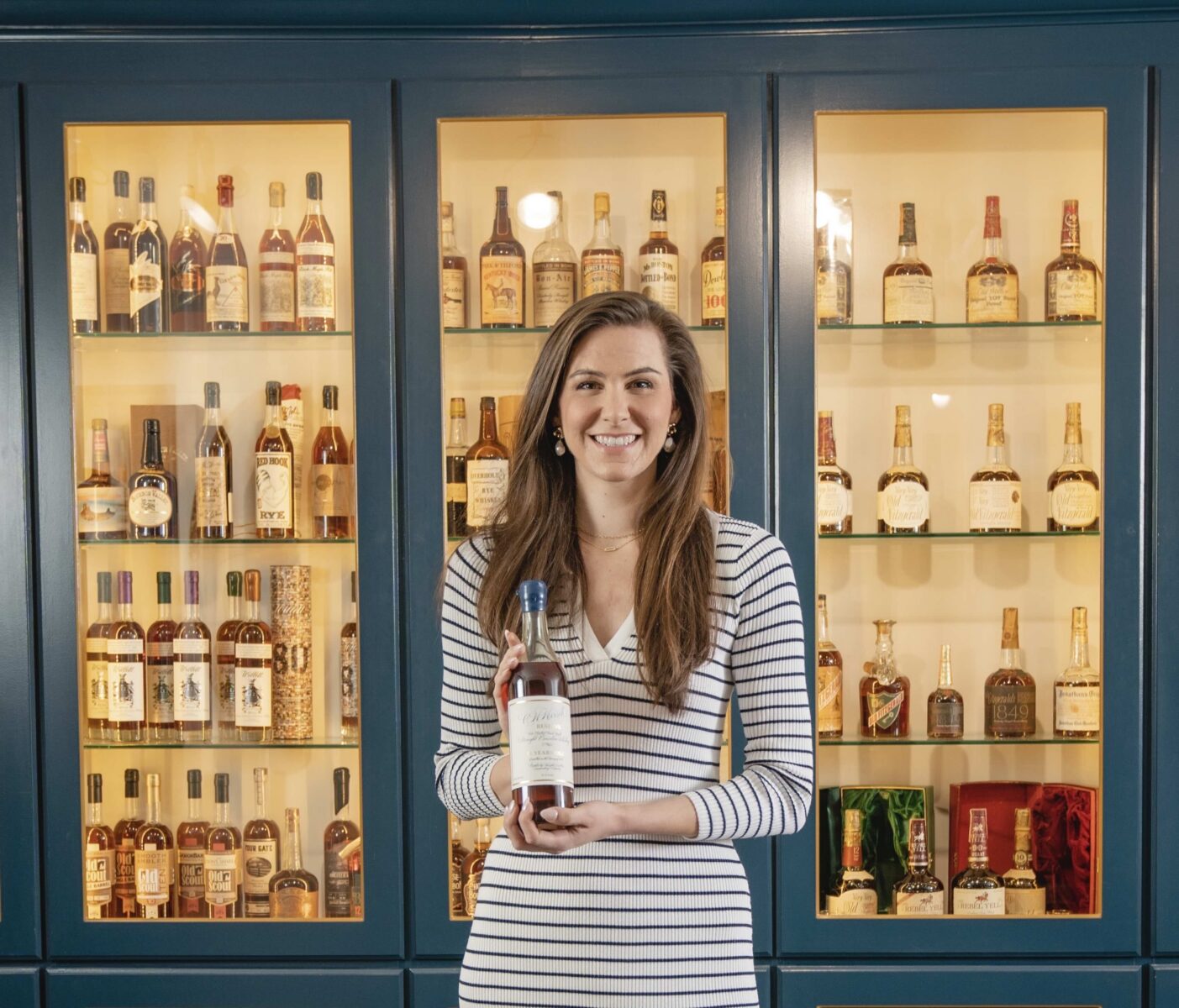
After studying archaeology at the University of Wisconsin-Madison, Caroline Paulus conducted fieldwork across the Southeast to ensure that public-works projects didn’t destroy historic and cultural artifacts. Based in Kentucky, she frequently unearthed old whiskey bottles, which led to a growing off-hours regard for bourbon culture.
So when Justin Sloan and Justin Thompson opened Justins’ House of Bourbon in Lexington in 2018, specializing in vintage bottles, she was uniquely qualified to become the staff “whiskey historian” (yes, that’s her actual job title). The shop and tasting bar opened a second location in Louisville and now claims the world’s largest collection of rare and vintage bourbon for sale. We caught up with Paulus to talk about tracking down the stories behind those bottles and the one she wishes she’d held onto.
How does your archaeology training inform your work at Justins’ House of Bourbon?
To me, it’s all about treating bottles as artifacts that fit into the story of Kentucky bourbon. From before Prohibition all the way to today, it’s great to gain a zoomed-out, holistic understanding of why certain distilleries did things a certain way at a certain time.
As a whiskey historian, what tools do you use to establish a bottle’s backstory?
I frequently consult friends in the industry who are also big into history, like Brett Connors at Castle & Key and vintage whiskey consultant Seth Weinberg. Bill Ambrose wrote a reference book called Bottled in Bond Under U.S. Government Supervision: The Whiskey Trade in Lexington, Fayette County, Kentucky that I turn to time and time again, as well as Van Winkle: The Bespoke Barrels by Gil Schwarz. The joke around here is that I’ve forgotten more than I’ll ever know—I’ll start to research a bottle and realize that I’ve already written something about it.
Do you still see bottles that are a bit of mystery?
Generally, we’re getting bottles in from collections, and at least every other month I get something I haven’t seen before. One of my most rewarding experiences was a bottle from a woman’s grandfather’s basement that only had a label taped to it that said “pre-war.” From the bottle style, I could tell it was pre-Prohibition, but when I shook the bottle, the bubbles had some staying power, while bourbon bubbles dissipate quickly. And the cap didn’t look like a bourbon cap; it was yellow and red with a star on it. I turned to some industry sources and found a distillery of that era in Pennsylvania that had produced a bottled cocktail with that cap called Rock & Rye. That bottle is still here—I’m pitching every day to open it and have a Rock & Rye party.
You probably poke around a few dusty attics and basements, too.
That’s when it feels like I’m revisiting archaeology, for sure—especially that moment of discovery. In the end, I like being able to help people when they’re a bit confused and don’t know what they’re looking at. Recently, there was a woman whose brother had owned a liquor store, so she had a lot to comb through. When I handed her a check for $7,200, she did a double take because she thought I’d said $720.
JHOB’s business is selling those bottles. Do you wince to see the rare ones go, especially knowing they might get opened?
It depends on the bottle. The guys here tease me because when someone brings in old Prohibition-era bottles, I’m supposed to act cool and not let on how much I want them. I definitely form some attachment. But I’m a whiskey lover at heart, so I like to see bottles opened and enjoyed. That’s the fate I’d like to see for most of them.
Have you felt compelled to claim a bottle for yourself?
The last one that I almost grabbed was a Blanton’s bottle that was dumped on my exact day of birth. I let it get away and probably should have taken it home.
Steve Russell is a Garden & Gun contributing editor who also has written for Men’s Journal, Life, Rolling Stone, and Playboy. Born in Mississippi and raised in Tennessee, he resided in New Orleans and New York City before settling down in Charlottesville, Virginia, because it’s far enough south that biscuits are an expected component of a good breakfast.