

In 1985, as bourbon’s glut era left Kentucky rickhouses overflowing with well-aged but underappreciated whiskey, Wild Turkey master distiller Jimmy Russell introduced a small-batch expression distinguished by two qualities. First, it was damn fine bourbon, its already respectable twelve-year age statement bolstered by Russell incorporating barrels several years older in the blend. Second, the marketing folks dressed it in a glittery gold label that might as well have shouted, “Hey, please look at me!” from package-store shelves.

Sold domestically and abroad at Wild Turkey’s signature 101 proof, the expression was discontinued in the mid-1990s. And then a funny thing happened: When bourbon boomed again, collectors began chasing those old bottles they affectionately nicknamed “Cheesy Gold Foil” (or just CGF). Ongoing reverence for that bourbon’s complexity and distinctive “funk” has made it one of the most passionately hunted “dusties,” frequently fetching $1,500 on the secondary market.
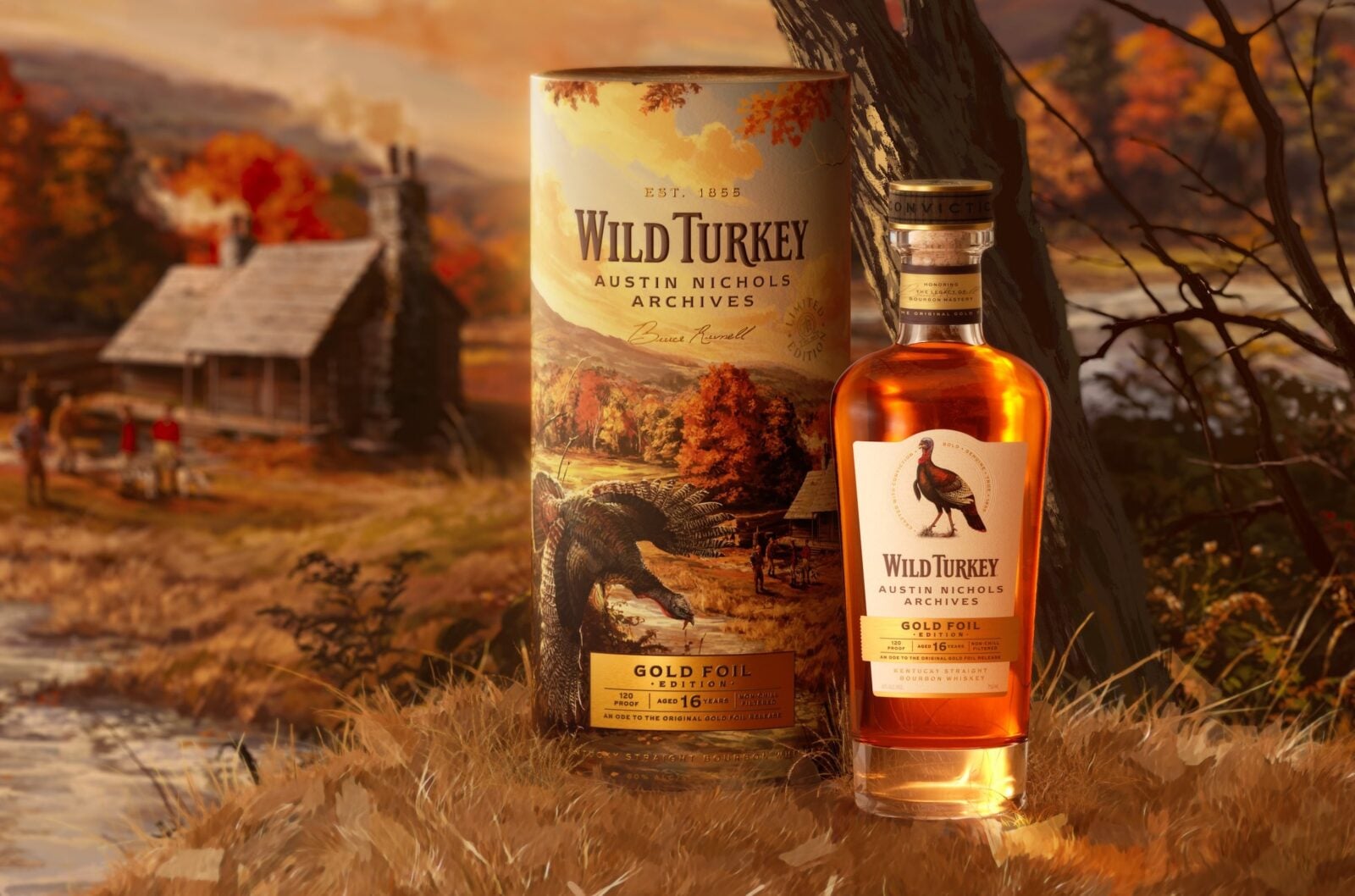
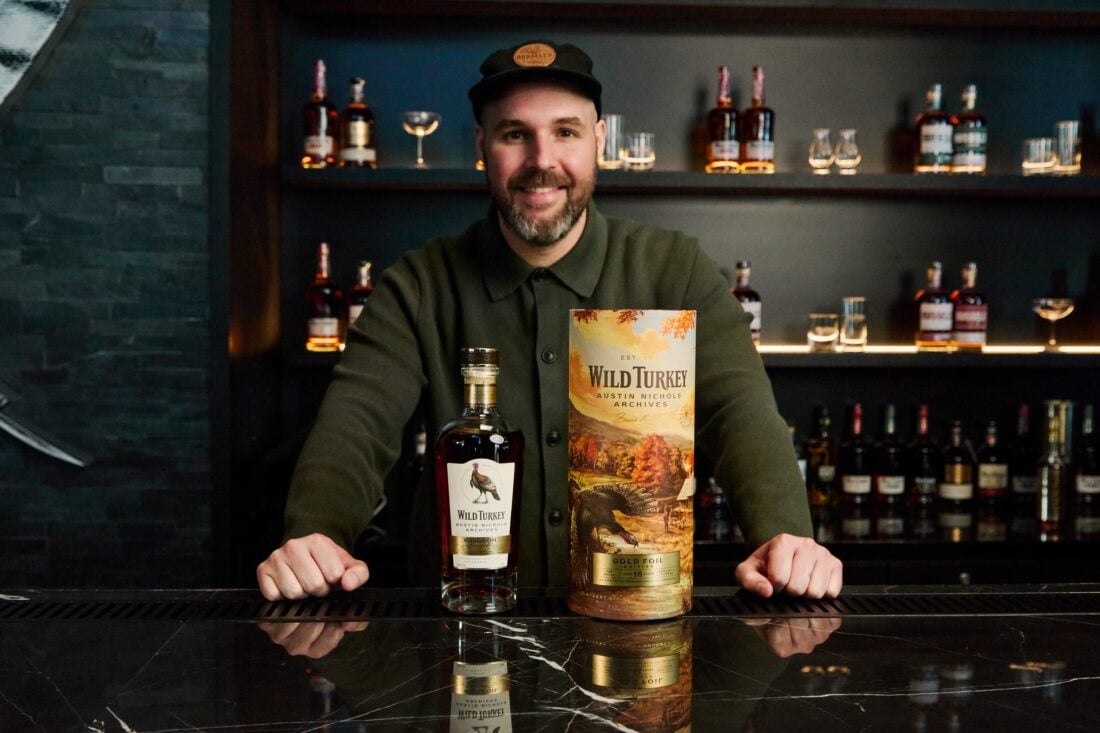
That brings us to today, with Jimmy’s grandson and Wild Turkey associate master blender Bruce Russell revealing his eagerly awaited CGF homage. The new Gold Foil Edition, as it’s officially named, aims to recapture the magic of its predecessor (with the help of painstakingly selected sixteen-year-old bourbon) while acknowledging current consumer trends by bumping up the proof to 120. The $400 bottle—the inaugural release in a planned Austin Nichols Archives Collection—is packaged in an artful canister that cleverly mimics the original’s satiny gleam on the interior.
With Jimmy, now ninety-one, and Bruce’s father, Eddie (celebrating forty-five years at Wild Turkey this summer himself), on hand to witness its debut, calling Gold Foil Edition a passion project would be an understatement. That was clear when we spoke to Bruce just days before the official release.
What do you remember about the original Cheesy Gold Foil expression from when you were knocking around the distillery as a kid?
Growing up, those bottles were just around. It wasn’t until I got deeper into the community and started talking to collectors that I realized what people were actually chasing. When you see somebody going to serious lengths to track down a bottle with your family’s name on it, and they’re doing it purely because of what’s inside, that sticks with you. It made me want to understand what was in that glass that people still couldn’t let go of decades later.
How did you conjure that somewhat intangible “funk” that fans talk about with CGF?
People forget that Jimmy’s old twelve-year 101 often had fifteen-plus-year whiskey inside it. That’s part of what made those bottles so special—the depth you can get only from time. So the starting point for me was going older and going higher-proof to try to match that magnitude of flavor. The funk isn’t something you can manufacture. It comes from our proprietary yeast, the limestone-filtered water from the Kentucky River, and the way the rickhouse site’s climate works on the wood over time. What I could do was find the right barrels that had developed that character naturally and trust them. Sixteen years in those rickhouses gives you a lot to work with.
You’re keen on juice aged in Camp Nelson rickhouses, about forty-five minutes from the distillery’s Lawrenceburg home. How did that site help you achieve what you wanted?
Camp Nelson is the best—the cliffside climate creates temperature swings that push the whiskey in and out of the wood in a way that builds real intensity over time. I pulled a lot of barrels from the higher floors of Camp Nelson D because of the rich fruit, mature oak, and long, layered finish they tend to produce. When I’m looking for barrels with true depth and character, and as long as there are still barrels there, Camp Nelson is always where I start.
Care to share how many bottles are in the Gold Foil Edition release?
It’s limited and highly allocated—I can tell you that. Once it’s gone, it’s gone, and there are no plans for a second run of this specific batch. I wanted it to feel rare because it genuinely is.
Other than Jimmy probably thinking the proof is too high, what did your dad and granddad say upon sampling a pour?
Ha! You know Jimmy. He’s been making whiskey at 101 proof his whole career, so 120 proof definitely got a raised eyebrow. But I think once he sat with it, he understood what I was going for. Dad’s always been my toughest critic and my biggest supporter at the same time. Getting their approval on this one meant everything to me. I’ll keep the exact words between us, but nobody asked me to change it.
If you continue the Russell legacy and make whiskey at Wild Turkey for another forty years, do you imagine looking back on this as a significant milestone?
I hope so. I conceived this series more than a decade ago, so in some ways I’ve been waiting a long time to finally bring it to life. This is the first Wild Turkey limited collection led entirely by me. Before this, I was contributing, learning, and absorbing. But this one has my name on it, and it carries the weight that Cheesy Gold Foil has, knowing how special that project was for Jimmy and his career. So when I look back, I think the Austin Nichols Archives is where I’ll point to and say that’s when it started for me—not just as Eddie’s son or Jimmy’s grandson, but as a whiskey maker in my own right.
Note: This author has no relation to the Wild Turkey Russells, or you can bet I’d be playing the family card to get a bottle.
Steve Russell is a Garden & Gun contributing editor who also has written for Men’s Journal, Life, Rolling Stone, and Playboy. Born in Mississippi and raised in Tennessee, he resided in New Orleans and New York City before settling down in Charlottesville, Virginia, because it’s far enough south that biscuits are an expected component of a good breakfast.