


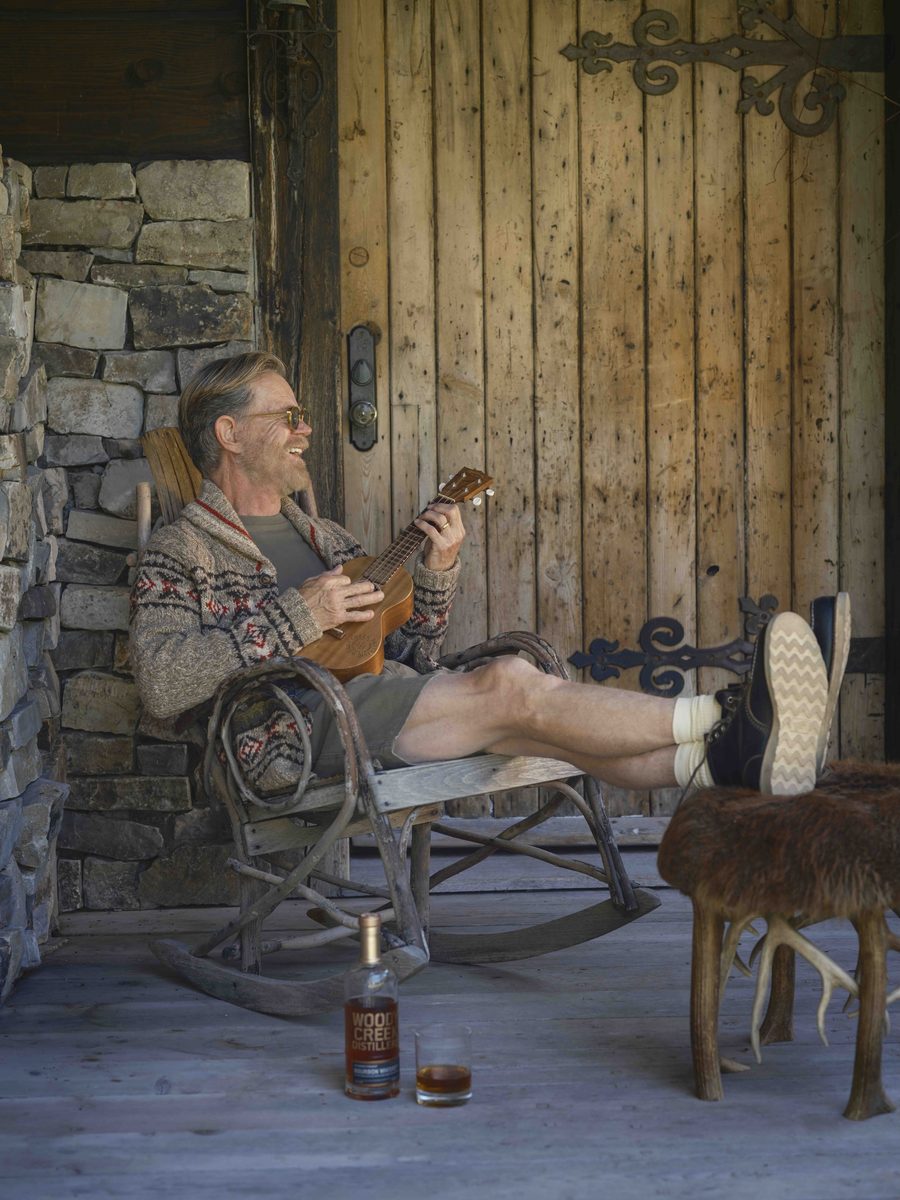
William H. Macy so convincingly mastered an Upper Midwest accent for his Oscar-nominated role in Fargo that you’d be forgiven for not knowing that he was born in Florida, raised in Georgia and Maryland, and attended college in West Virginia before chasing the acting bug to New York and Hollywood. These days, he and his wife, Felicity Huffman, have a place in Colorado, where a longtime appreciation for whiskey led him to a partnership in Woody Creek Distillers, a craft distillery just outside of Aspen that sources its grains within 250 miles. Woody Creek has been recognized with several awards for its Colorado bourbon and rye, and as the brand’s designated “spokesdude,” Macy was happy to tell us more about the distillery, his Southern roots, and the special rye that bears his name.

Did the time you spent in the South leave an impression on you?
My mom was a Mississippi girl, and we’d drive two days to have Christmas in Pascagoula. Grandmother Overstreet would start cooking three days before we came down, and when we walked in, on her kitchen table there would be a pile of shrimp two-and-a-half-feet high. Nobody had a lot of money, and that was cheaper than hamburger on the Gulf Coast. She made gumbos and jambalayas, and I still have a taste for them. Also I remember that on those visits we’d fill a cigar box with shelled pecans that my mom would roast with butter and salt.
How about Southern figures of speech?
Oh, yes. I find myself saying, “Land sakes alive!” And I’ve become a collector of those lovely passive-aggressive statements by Southern women—“Oh, she does so much with what she’s got.” Here’s a story: When my mom died, my brother Fred and I drove her ashes to Pascagoula. We found the dock she’d played on as a child and walked out to the end to say something. Then this fisherman, this old Mississippi guy, comes up right between us on the railing and puts his gear down to cast. I asked him to please find another spot, and it just got weirder from there. We said goodbye to my mom and dumped the box over the edge just as a gust of wind came and blew it all back into our eyes and mouths. We laughed, and our mother would have laughed.
How did you become a partner in Woody Creek Distillers?
Felicity actually grew up in Woody Creek. We’ve been coming here for thirty-odd years, and about ten years ago we bought her childhood home. Two neighbors, Pat Scanlan and Mark Kleckner, both of them engineers interested in agriculture, started a distillery, and my brother-in-law made a deal with them to grow potatoes in our pasture for their 100 percent potato vodka. That’s how I found out about Woody Creek Distillers, because it’s sort of a treasure of the Aspen area. Six years ago, Mark knocked on the door and said, “Bill, I don’t know if you know this, but we have a distillery.” And I said, “I’m going to stop you right there—I’m in.”

Tell us about Woody Creek’s whiskeys.
Our straight bourbon is a mash bill of 70 percent corn, 15 percent elbon rye, 15 percent malted barley. Our high-rye bourbon is 70 percent corn, 30 percent rye, aged five to seven years. Our straight rye mash bill is 100 percent rye, which is somewhat unusual. When you do that, you have to bring the mash cooker temperature up a little slower. The first time they made it, before they dialed it all in, it overflowed and it took three days to clean it up. There are four or five other 100 percent ryes out there, and no insult to them, but ours is better. Everything that we make is from Colorado-grown ingredients, and all our farmers we’ve known for more than ten years.
Do you prefer rye to bourbon?
Absolutely. After Prohibition, the Southern distilleries and corn growers were ready and came out swinging. The rye whiskey industry was not as robust and has taken a long time to get back going. My family moved from Georgia to western Maryland when I was young, and that was rye whiskey country, where farmers made Monongahela-style rye going back to before the Revolutionary War, before bourbon. Maybe not in my lifetime, but I think rye will overtake bourbon as America’s whiskey.
You’re nudging that along with Woody Creek’s William H. Macy Reserve Rye. How do you select that annual, limited bottling?
The 2026 release has a mash bill of 83 percent rye, 14 percent corn, 3 percent malted barley, and it’s aged for ten years. To pick the best barrels, we gather around a table and do a blind tasting. You get a pad of paper, a glass of water, some crackers, and a spit bucket. Honestly, the first time, I was in so over my head—like in elementary school, I was cribbing off the real experts and making up tasting notes like “avocados” and “tomatoes.” I finally narrowed it down to three and then two, and one had a slight edge, so I chose that one, and to my great relief and pride, three other people did, too. And I’m the movie star, so we put my name on it.
Do you use the spit bucket during those tastings?
Maybe it’s my Southern roots, but I’m just not comfortable with spitting whiskey out. I tried to remind myself to do it, but after a while, I had to take a break to go outside and talk to myself.
Otherwise, how do you like to drink whiskey?
On the rocks. I do drink cocktails every once in a while, and brother, I can make a mint julep out of the 1975 Trader Vic’s bartender’s guide, but the sugar gets to me because I’m trying to keep my boyish figure.
How does having your name on a bottle of fine rye compare to having it on Emmys and SAG awards?
That’s a tough call. It gives me a thrill to see my name on a bottle. I am ready, though, for a couple of more Emmys. I could use them. Tell you what, world, if you’re listening, I’ll trade you for a bottle of William H. Macy Reserve.
Steve Russell is a Garden & Gun contributing editor who also has written for Men’s Journal, Life, Rolling Stone, and Playboy. Born in Mississippi and raised in Tennessee, he resided in New Orleans and New York City before settling down in Charlottesville, Virginia, because it’s far enough south that biscuits are an expected component of a good breakfast.