
The storm outside had been lifting up the right side of my tent since the sun made its way below the distant Rio Grande. Three hours earlier, I finished a hot bowl of rice noodles before quickly retiring to my down sleeping bag. During dinner, a gray cloud—more UFO than nimbus—hovered over our exposed campsite, overtly plotting its takeover of the Chisos Mountains. But I took comfort in knowing that, after years of trying to make my way to this place, to the middle of nowhere, Southwest Texas, I was finally here. I fumbled in the dark to find my boots and, after blindly concluding they were still dry, fell back asleep.
That morning, I had driven three sunshine-drenched hours from Marfa to Big Bend National Park, stopping once in Marathon for gas and breakfast burritos. Everyone at the small Southwest-themed diner had one thing on his mind: the mountain lion that had attacked a six-year-old boy in the park just days before. (When he saw what was happening, the boy’s father had pulled out a knife from his pocket and stabbed the cat in the chest.) The boy was fine, needing only stitches and a series of rabies shots, but the story served as a reminder that Big Bend remains one of our most untamed wild kingdoms. My two camping companions and I drank our coffee in silence, pretended that the story didn’t faze us, and stared at the enamel cacti on the wall while listening to the crowd discuss the “scar that boy will have when he grows up.”

Big Bend is remote—So remote that the National Park Service has a section of the Big Bend website called “How Far Is It?” But the 330 miles that separate you from the El Paso airport are the whole point. The road to your destination—the drive that leads you to this place, the aromatics of the lonely desert—is all part of the adventure. Once you’re in your car, you’ve already made it.
And once you get here, you’ll understand why it was worth the trip. The park is massive, 1,252 square miles (or roughly 800,000 acres) spread across three distinct landscapes: the Chisos Mountains (the only mountain range completely contained within a U.S. national park), the Rio Grande, and the desert. That means you can hike up a cloud-blanketed mountain, raft down a river through high canyon walls, or stroll through a vast expanse of bright red ocotillos scattered across the horizon. We planned to do it all.
After arriving at the park, we stopped to get backcountry permits for Southwest Three, the campsite closest to the view at the top of the South Rim. There are forty-two campsites along the Chisos Mountain trails, so the distance to each varies. With a heavy breakfast in our bellies and two days of food and gear on our backs, we opted for the more gradual of the two trails that lead to the top. Together, they form a loop that meets back at the trailhead, located at the Chisos Mountains Lodge, so we’d take the steeper one back to the car.
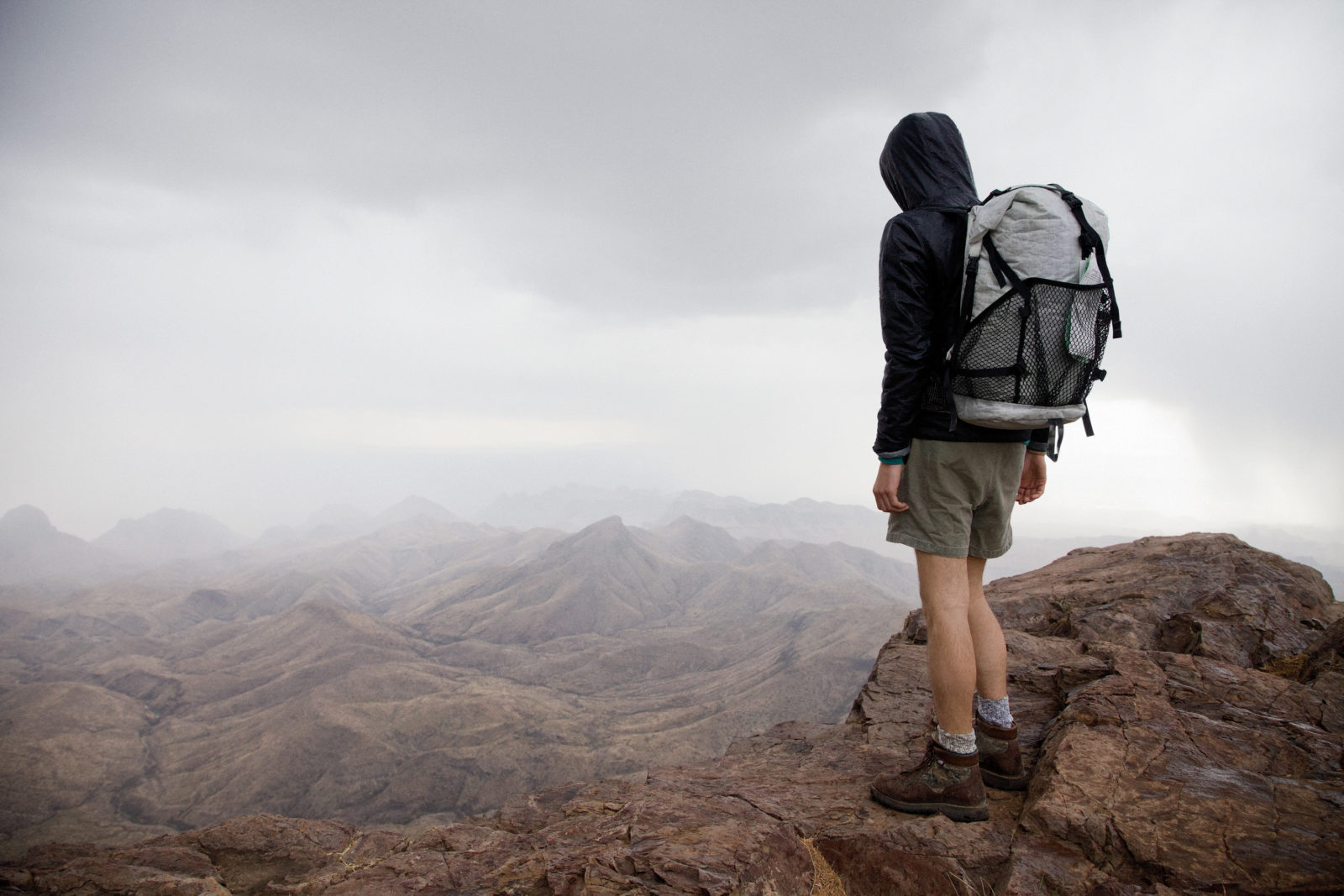
Edward Abbey once called the Chisos Mountains an “emerald isle in a red sea.” Piñon pine, mesquite, and rose-fruited juniper, with its lizard-scale bark, rise from the Chihuahuan Desert to form a hospitable green oasis. There were traces of those bright colors on our hike up the South Rim, but for the last year, the park has been, according to the NPS ranger we spoke to at the Panther Junction Visitor Center, in an “extreme drought.” Most of the trail was littered with dry earth tones, pinks and yellows that were silently begging for agua.
Five miles into the hike, our skin burned by the afternoon sun, we dropped our packs near the edge of the South Rim and set up camp as it slowly started to drizzle. As the rain advanced, I stood under a tree and quietly sang “Texas Flood” into my jacket, though the endless grays, browns, and reds peeking through the storm made it feel more like Mars than the American Southwest. By the time all the dirt had been washed from my hiking boots, a small pocket of sunshine opened up through the clouds in the distance.
Back at the campsite, we warmed up with steaming hot tea, adding a little whiskey to our cups as the horizon bruised black and blue. Dinner was rushed, and by the time we had finished cleaning up the remnants, we were ready to hit the tents. Because nothing says 8:00 p.m. lights-out like a little precipitation, a park-wide fire ban, and a mountain range the color of the alcohol that puts you to sleep.
We woke early the next morning to a Big Sur–looking coast of mountains and fog reigning over the desert. The scene was all white and covered in sun, a wet grin stretching across the dry horizon. (Normal rainfall in the area is around 10 inches per year, and in 2011, the park saw only 2.53. We’d find out later that it rained 0.61 inch during the night, about a quarter of the amount of the entire previous year.) We left Southwest Three in search of other travelers, a night of desert songs, and tall tales of rain in a dried-up wonderland. But first, the Rio Grande beckoned.
 We reached the park’s hot springs, geothermal pools that run adjacent to the river, after a thirty-minute drive through beautifully redundant rolling hills of creosote bushes. The loud clang of Mickey & Sylvia’s “Love Is Strange” blasted on the radio. In the parking lot, we hastily changed into pack-crushed bathing suits behind the car and walked down a short trail to a shallow body of murky water. Beautiful it was not, but the combination of natural springs, proximity to one of the mightiest rivers in North America, and a view of the U.S.-Mexico border made for a great way to spend the first half of a day. Soak mates from places as far-flung as Chicago, Phoenix, and even Quebec shouted merrily in too-loud voices all around us. The banks of the river are unsurprisingly the greenest parts of the park, and we sat there for a long while, appreciating the irony of hearing a Quebecois French accent behind us while taking in the view of Mexico a mere twenty feet ahead.
Around midday, we drove to the southeast corner of the park to eat lunch near Boquillas Canyon. Boquillas, the easternmost of the three narrow river sections in Big Bend, is twenty miles long, and when the water levels are a little higher, it’s home to a beautiful two-to-three-day rafting trip that you can schedule through local outfitter Heath Canyon Ranch. From the lookout point, we watched thick clouds roll over the high red rock walls, then made our way over to the picnic area at Rio Grande Village. Shaded by lush cottonwoods, we sat at a large table and made three Toms, camping sandwiches I was first introduced to a few years ago at an Appalachian Trail lean-to outside of Hanover, New Hampshire. Named after a friend who claimed it was his invention, a Tom consists of a tortilla, peanut butter, corn nuts, and a fruit of your choice. The specific name of the Tom depends on the type of peanut butter and fruit, and our lunch would be Extra Chunky Apple Toms.
 That evening, at Paint Gap, a set of backcountry campsites down a long dirt road near Panther Junction Visitor Center, a swoosh of wind traveled slowly across the desert floor as the chill of five o’clock rolled over our prickly pear kingdom. While it’s hard to truly understand the vastness of Big Bend, an hour of silence drifting in and out of sleep is a pretty good start. The boundless landscape seems to pull you in, slowing down time to a faint trickle. Here, the hourglass makes perfect sense, as nothing seems a more appropriate measure of time than grains of sand, and I fell asleep with the sweet bite of dry desert air still hanging in my mouth.
Over the course of the next few weeks, I’d visit the park often, leaving my temporary home base in Marfa for a night or two to explore Big Bend and Terlingua, the ghost town on the west side of the park. The Smokies have Gatlinburg, the Everglades have Everglades City, and Big Bend has Terlingua, a small dusty road of tent sites, a concert venue, and Espresso…y Poco Mas, an outdoor breakfast spot that helps you ease back into the real world after a few nights under the stars. There’s more to the town, of course—a weekend farmers’ market, an art gallery—but the remoteness of the place, the pure emptiness, makes it the perfect complement to the park. Nothing could be more fitting for this wide-open corner of the Lone Star.
A short encounter that transpired at the beginning of our trip perfectly sums up the relationship between the park and its visitors. A group of backpackers, fresh off the trail from a four-day trip into the Chisos, stopped at their car, started doing push-ups with their packs still on, and drank cold Tecates from the general store to celebrate their return from the wilderness. When they spotted us preparing for our trip, they came over to ask about our plans. As conversation usually goes, we ended up discussing where we were from, our jobs, and, of course, that six-year-old boy the mountain lion had attacked just a few feet from where we were standing. Our new friends were from Dallas, and they invited us to stay with them on our drive back east the following month. We barely knew each other’s names. But to get to Big Bend, to take the time and effort to drive to the edge of Texas, to a place that most people have never even heard of, was grounds for instant kinship. We had all made it.
If You Go…
Big Bend is relatively uncrowded year-round, but if you want honest-to-goodness solitude, late summer is the time to visit. You can obtain backcountry use permits, a must-have for campers, in person daily at Panther Junction and Chisos Basin Visitor Centers; $10 fee. nps.gov/bibe/planyourvisit
How to Get There
The nearest airports served by major airlines are in Midland/Odessa, Texas, and El Paso, Texas, 235 miles and 330 miles, respectively, from park headquarters.
What to See
You shouldn’t miss Boquillas Canyon, the Chisos Mountains, the Hot Springs, and, of course, the Rio Grande.
Local Outfitters
Big Bend Expeditions specializes in guided tours by land, river, or air (bigbendexpeditions .com). Desert Sports offers customized hiking, biking, climbing, and rafting trips (desertsportstx.com).
Where to Stay
As an alternative to camping, the Chisos Mountains Lodge, located in the Chisos Basin, is a quaint spot with an assortment of guest rooms and cottages; from $121/night. chisosmountainslodge.com