


Nicole Austin was already accelerating through the whiskey-industry ranks when, shortly after taking charge of George Dickel in 2018, her newly introduced bottled-in-bond expression was thrust into an unexpected spotlight as Whisky Advocate’s “Whisky of the Year.” Dickel parent company Diageo soon gave her the awesomely clunky title: Director, American Whiskey Liquid Development and Capabilities; broadened her portfolio to include I.W. Harper and Blade and Bow; and aimed her directly at the task of shepherding the legacy of the historic Stitzel-Weller Distillery in Louisville. Given all that, she somehow still found time to share—with typical candor and humor—an update on that weighty mission.
What was your path to the bourbon business?
I grew up in upstate New York and studied chemical engineering in college mainly because a high school guidance counselor told me I wasn’t suited for it. Nobody mentioned whiskey at the career fair. I ended up at an environmental engineering company in New York City, being lowered into sewers—the spiders were very large. But I started hanging out at an amazing whiskey bar and had a lightbulb moment that I could use my skills to make something as beautiful as whiskey instead.
How did you make the leap from sewer to distillery?
The first day that Kings County Distillery in Brooklyn started filling product, I showed up and told them I was going to work there for free. I ended up as the master blender because I gave myself the title. Then in 2016, I was offered a gig as an engineer at Tullamore Dew in Ireland and was there until I started with Diageo in 2018. Not too long ago, there was a gulf between craft distillers and the big guys, so to move between those worlds seemed impossible. I’m very lucky.
Is a fair amount of your focus on the Stitzel-Weller site at present?
It very much is. I’m so curious and excited about it, and that goes along with what a lot of other folks feel about Stitzel-Weller. My core mission here is to investigate this place and its history and where the magic comes from. And then focus on preserving what makes it special and ultimately doing some restoration. I imagine this will be a career-long project.
You’re known as an innovator, which can be hard to balance against nostalgia.
Where things can go wrong is when nostalgia runs counter to what makes whiskey truly good or not good. I joked at Dickel that I don’t think whiskey gets better if you force someone to carry a bucket up a ladder instead of using a pump just because it’s the old way. If I can’t see a way the work makes better whiskey, I’m not going to fetishize it.
What’s the status of Diageo putting fifteen of the eighteen historic Stitzel-Weller rickhouses up for sale?
They’re off the market! Yeah, I know, that was a near…thing. It can be hard to express in a spreadsheet how something is special. I’m doing my best to prove that, in particular, these rickhouses play an important role. When people spend their money on the whiskey we’re finding in them, it really is making the difference in keeping these rickhouses functioning.
Are there still secrets in those old rickhouses?
A million—I’m not even close to through the list of things I want to understand. I’m working on projects to bring barrels here to see the before and after of time spent maturing in these rickhouses. Meanwhile, I know exactly what barrels I already have and where they’re from, but the only way to truly know is to pull them down and taste. Some are great for bottlings now, and some I’ve consolidated and put back up to see what happens. I’m going for some of the oldest barrels first.
Speaking of which, your recent, ultra-limited Stitzel Reserve 24-Year-Old and Stitzel Reserve 31-Year-Old releases caused a commotion, especially priced at $1,600 and $3,000.
Pricing a luxury good can be a finger-in-the-wind process. That’s not how I like to work, so I gathered a lot of data because I want to be fair in my pricing. Sounds absurd with a $3,000 bottle, but that’s the price for quality whiskey of that age. Seeing people geek out on the whiskey and pay thousands of dollars more for bottles on the secondary market is deeply rewarding.
Some nitpicked about having Stitzel on the label when the bourbon itself was aged but not distilled at Stitzel-Weller.
Those are the rude things that stick in my brain. Oh, yes, you’re right—I’ll certainly be the first person in the history of American whiskey to put a dead white guy’s name on a bottle who didn’t actually distill that whiskey. How dare I?
On the Blade and Bow side, is the new Solera Reserve 12-Year-Old your first foray into the world of finished bourbons?
I dabbled at Kings County, but this is my first finished Blade and Bow. To be honest, while Scotch finishes can be lovely and delicate, bourbon is so flavorful that American distillers tend to go hard on cask finishing, and it can become one note. I’ve been thinking for years about how to access the aromatics and character of a wine finish without stepping on those cracks. So I used only large, vintage casks to push the surface-area-to-volume ratio, and blended the results to play with the tropical notes of moscatel, the rancio character of cognac, the leathery structure of Bordeaux, and the sweetness of port. It’s more subtle, like a lovely bourbon that happens to offer those notes. It helps to start with a twelve-year-old bourbon that has character and can stand up.
What’s the next big release?
It’s the world’s worst-kept secret that I have more Stitzel Reserve in the pipeline as I keep going through these rickhouses and skimming the cream. So far, all of it is older than twenty years, and there’s likely to be a single-barrel release. I can’t make any official announcements but can remind you that the distillery’s birthday is Derby Day. And we do like to celebrate our birthday.
When you’re not covered in rickhouse cobwebs, what are some things you like to do in Louisville?
I’ve just been so happy in this town. I’m a former equestrian, so obviously being in Kentucky is great for all that. My favorite thing is that people in the industry come here a lot, so I get to reconnect with friends and be part of a community of distillers. There’s also a ton of really good food and drink in Louisville. I lived in NYC, so I fully admit I can be a bit of a snob, and the quality of everything here is great. It’s also nice that you can pretty much get anywhere in Louisville in about twenty-five minutes.
What’s your favorite cocktail when out and about?
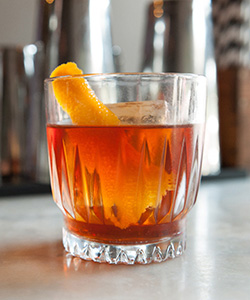
My usual go-to in the summer is a bourbon smash, and in cold weather a Manhattan. Lately the bartender at the Garden & Gun Club at Stitzel-Weller has been making a great New York sour with a Bordeaux float. Sometimes, honestly, my favorite is just a pour of Solera Reserve with an ice cube.
Steve Russell is a Garden & Gun contributing editor who also has written for Men’s Journal, Life, Rolling Stone, and Playboy. Born in Mississippi and raised in Tennessee, he resided in New Orleans and New York City before settling down in Charlottesville, Virginia, because it’s far enough south that biscuits are an expected component of a good breakfast.