The peanut man has a national park site?
I was in Kansas at Fort Scott, a military outpost where the Union Army’s first African American regiment was sworn in, when a ranger in the historic hospital there informed me that George Washington Carver received part of his education in this very building, and that his birthplace was just a little more than an hour down the road. I felt embarrassed by my bewilderment—I had never even heard of the George Washington Carver National Monument. But when Carver died in 1943, Congress deemed his contributions to American innovation and commerce so important that his boyhood homeplace was dedicated as such the same year, the first site of its kind to honor a Black person and a nonpresident.
This kind of knowledge gap was what drove me to stop at Fort Scott in the first place. In March, the president had signed an executive order calling for the National Park Service to remove historical information deemed to “disparage” Americans. A proposal was also floated to sell some federal lands, including less popular national parks. I worried that elements of the American story might disappear before I could learn about them. So, on my way back from a reporting assignment in Omaha, I barnstormed across terrain I’d never traveled to take in sites I’d never seen in case they changed or even vanished from our cultural memory. To name a few: Nicodemus National Historic Site in Kansas, where formerly enslaved Kentuckians homesteaded after the Civil War. Brown v. Board of Education National Historical Park, in the segregated Topeka elementary school to which Linda Brown was bused. The Old Courthouse, in St. Louis’s Gateway Arch National Park, had duality: Enslaved people were auctioned off on its steps, and Dred and Harriet Scott filed the pivotal lawsuit for their freedom there in 1846.
By roaming battlefields and portions of the Trail of Tears, I was trying to fathom the human cost of history. But in the case of George Washington Carver, I had previously considered him more of a folk figure: based on a bit of truth but mostly mythological. I blamed some of this ignorance on my education. When we did briefly hear about Carver in school, teachers painted him as a bit of a mad scientist, fixated on one crop—peanuts. He was a mere footnote compared with other inventors like Henry Ford and Thomas Edison, though all three were contemporaries and even corresponded with one another; some of the literature about them even considers the trio to be friends. Yet I know so much more about the other two.
After Fort Scott, I pointed my station wagon toward Diamond, Missouri. There, at the George Washington Carver National Monument, I found the story of a multidimensional man: painter, botanist, innovator, humanitarian. As a conservationist and a practitioner of sustainable agriculture, Carver viewed the use of his innovations to improve the livelihoods of Black farmers in the South as his life’s work.
Farmers in families like mine.
Back then, the ability of Black farmers to travel was limited, by finances and by Jim Crow. Carver instead brought his modern agricultural methods to them, via a mobile classroom called the Jesup wagon. Named after Morris K. Jesup, a New York banker who financed the horse-drawn laboratory on wheels, the wagon held teaching tools like soil samples, farm equipment, plants—items that could demonstrate the practicality of growing profitable crops like peanuts and sweet potatoes that would improve the soil, rather than deplete it the way cotton did. He even included pamphlets outlining recipes and alternative uses for the crops.
While my family didn’t grow sweet potatoes or peanuts, we did employ crop rotation and other practices Carver improved on and advocated for. Never had I heard about his association with them, though, till this trip—all of these accomplishments, fruit Carver bore despite his desolate childhood. Carver was born into slavery in this section of Missouri, still considered the frontier in the early 1860s and therefore contested territory. His father died around the time he arrived, and when he was a newborn, he, his sister, and his mother were kidnapped by nighttime raiders, possibly with the intention to resell them. Eventually baby George was returned to his owners, Moses and Susan Carver, alone, as a frail infant on the verge of death from whooping cough. He never learned what happened to his mother or sister.
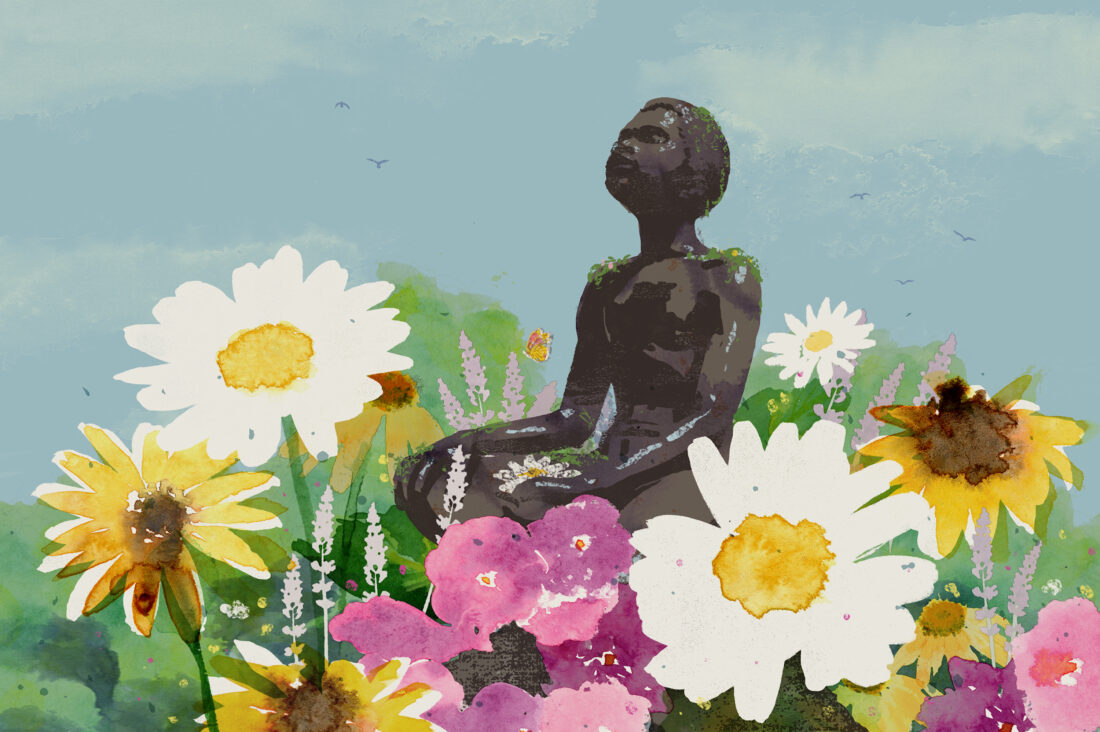
The site of the raid, the log shanty where Carver came into the world, no longer stands, but a wooden outline indicates its place. On a trail leading to Carver Branch, the stream that illuminated everything for the budding scientist, stands a bronze and stone sculpture of Carver as a boy, perched on a rock, three-leafed plant in his palm, his face turned toward the heavens. He is dreaming. He is observing. As the sculptor Robert Amendola explained of his 1961 artwork, “For me the plant is also a symbol of George Washington Carver’s multipetalled genius growing and flowering among adverse conditions where it seen [sic] nothing could ever take root.”
Beyond the paved path bloomed flora Carver most likely studied in his early years. Oxeye daisies and black-eyed Susans popped, and larkspur and petunia blossoms fluttered. I marveled at a cattail-like plant covered in lavender flowers that I later learned is called the prairie blazing star.
What did Carver call them? I wondered. How did he learn their true names? How did he factor in the annual swelling of the creek and eventual return of the passionflower blooms into his calibration of time? How did he make sense of beauty during a time of lynchings, and segregated public schools with limited resources? How did the sights, sounds, and sensations of the natural world in his childhood lead to his extraordinary innovations?
Carver was a man of faith, once writing, “I love to think of nature as an unlimited broadcasting system, through which God speaks to us every hour, if we will only tune in.” Looking out over the farm he grew up on, I came to understand the ways that science and religion overlapped for him. In his mind, they complemented one another. Carver viewed his scientific pursuits as a spiritual endeavor, a way of communing with God. The act of paying attention, a type of devotion. In turn, he saw the earth as a gift to be revered, studied, and protected from exploitation. Being a good steward of the land was a way to honor the divine.
Carver never knew a world without segregation. Even as a lauded scientist, he was subjugated—pressed to use the servants’ entrance, denied hotel rooms well into his seventies. I wonder, then, in a time of “colored” waiting rooms and whites-only universities, was it the heavens or a bit of the earth—or both—to which he turned to reaffirm his self-worth and restore his self-determination?
Carver wandered several states to broaden his education, traveling to Kansas and later Iowa. He searched for knowledge, stability, and warmth in a world that seemed to continuously turn toward coldness and isolation. I feel caught in a similar loop. “Fear of something is at the root of hate for others, and hate within will eventually destroy the hater,” Carver reportedly said, when asked in a Bible class about lynchings. I want to believe him.
Our timelines were not so far apart—my grandmother was an adult when Carver died, and my father was born in the decade after. The visitors’ center displays colorized photos and film of him in his element. I had only ever seen static images of him in black and white. There I also learned that he testified before the House Ways and Means Committee in 1921 to support tariffs on peanuts, to protect American farmers. His expertise and sincere, dignified nature there made him a national celebrity, cementing his public image as “the peanut man.” But by the time I got to that sign, I finally understood that he was so much more.
Latria Graham is a Garden & Gun contributing editor from Spartanburg, South Carolina, and writes the magazine’s This Land column, which documents aspects of the natural world in the South. An assistant professor of creative writing at Augusta University and an instructor for the University of Georgia's Narrative Nonfiction MFA program, Graham shares her adventures on Instagram (@mslatriagraham) and her work at LatriaGraham.com.