

Land & Conservation
Frances Mayes Shares the Stories of the Okefenokee
Through the tales of those shaped by its waters, shaded by its cypress trees, and calling for its protection, Georgia’s ancient swamp still speaks
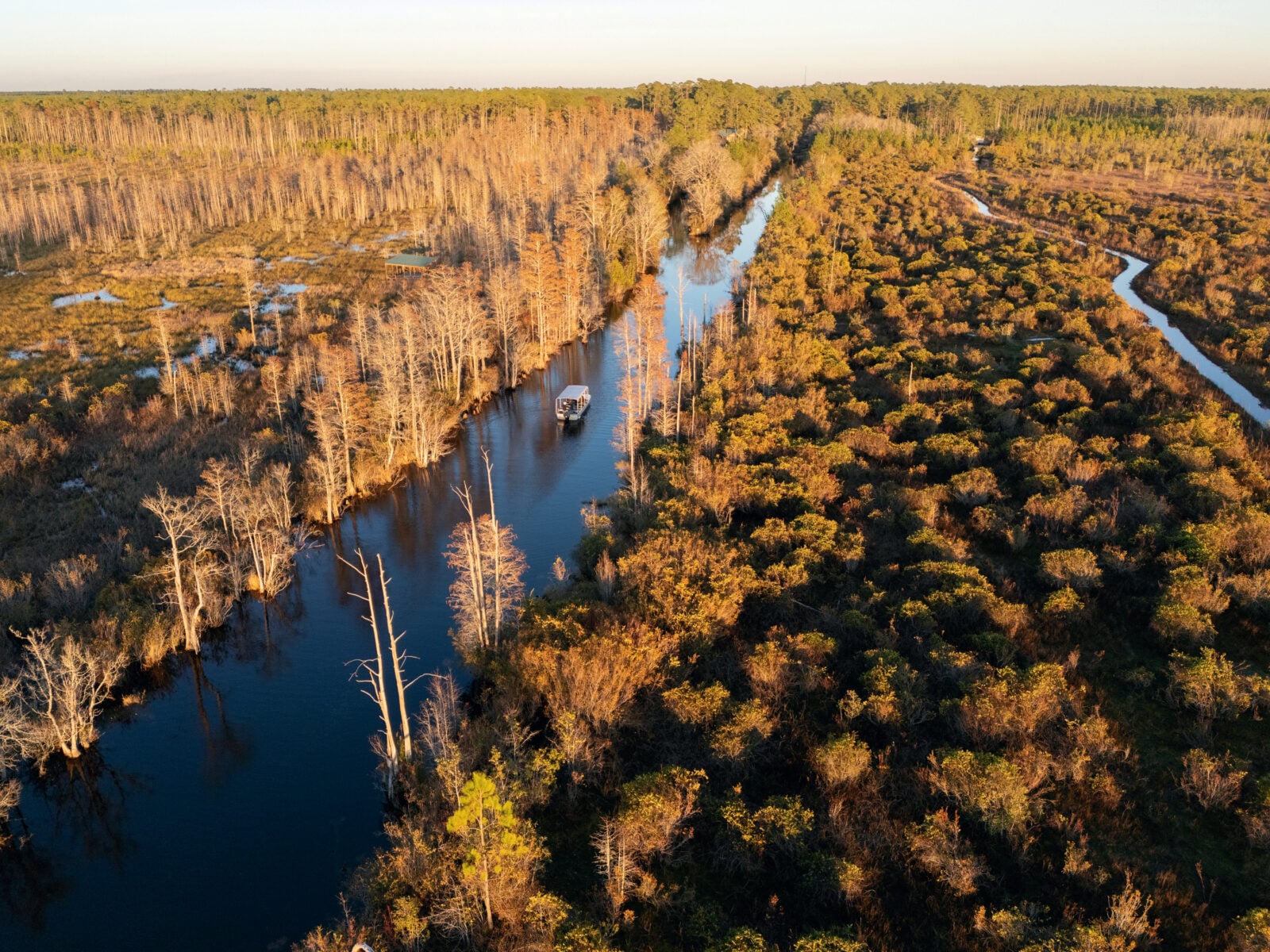
Photo: J HENRY FAIR
Cruising along the historic Suwannee Canal toward the Okefenokee National Wildlife Refuge visitor center in South Georgia.
What would the world be, once bereft of wet and of wildness? Let them be left, O let them be left, wildness and wet; long live the weeds and the wilderness yet. —From “Inversnaid” by Gerard Manley Hopkins
Fifteen thousand alligators can’t be wrong—the Okefenokee Swamp in South Georgia is a spectacular place. The great American naturalist William Bartram, who roamed the state in the late 1700s, noted it as “a most blissful spot of the Earth.” National Geographic lists it as one of the hundred most beautiful places in the world. Early lore has it that the swamp was home to a tribe of indescribably beautiful women who fed a group of lost hunters, guided them out, and were sought for years but never reappeared. Easy to see how the place encourages myths and tales. For centuries the watery byways hid whoever needed to hide—war deserters, pirates, enslaved people who fled, and misfits who just couldn’t put up with the outside world. Among the traditional inhabitants, the Muscogee (called the Creek by the English because they settled in watery places) were routed out by the U.S. government in the 1830s, though groups lingered illegally, along with Seminole people with whom they’d allied. The tribe still considers the Okefenokee an ancestral home where burial grounds give them rights to protect their lost lands.
I have always loved the Okefenokee—the doubled cypresses and pines mirrored in the mysterious black water, the land that’s water and the water that’s land, the wild orchids, luminous white water lilies, the sudden flash of a blue heron’s wing, and the sunlight tangled in golden grasses. My hometown, Fitzgerald, is about seventy-five miles from Waycross, which sits just north of the swamp. When I was a child, my family often drove to Fernandina Beach in Florida. (These trips were as exciting to me as much later a trip to Europe would be.) We always stopped for lunch at the air-conditioned restaurant, the Green Frog in Waycross. After that pause, my parents rarely allowed a stop at the Okefenokee, but occasionally I got to run along the wooden walkways and climb a tower that gave me a big view of black water channels, trees draped with ghostly moss, dozing gators, and white birds perched on one leg. I thought the place had something to say to me, but I didn’t know what. My parents were bored by the whole idea of the swamp and rushed us toward the coast.
In seventh grade, a class trip gave me a whole day to explore. The mothers who drove us simply let us loose. Several of us jumped into a small boat with a guide who showed us floating islands, explaining that when peat compacts, seeds, even trees, will sprout on the somewhat movable masses. I volunteered to jump onto one. (Surely this is no longer allowed.) As I leaped, the boat lurched sideways and my friends screamed, scaring away any wildlife we might have seen. The island was springy and spongy, and my shoes were ruined by the tannic muck. A gigantic water-spangled spiderweb netted a scraggly tree. I had a momentary panic: They would row away, leaving me abandoned with a deadly spider. Still, I felt exalted, like an explorer. “Land of the Trembling Earth,” the guide said. “Now you know what that means.” I have always remembered that day.
Toward the end of 2024, I see an aerial photograph of the St. Marys River taken by my friend, the photographer Henry Fair. A long black curvy snake of a stream, with headwaters in the Okefenokee and an end in the Atlantic Ocean. I suddenly have the desire to see that watery world again. I ask my grandson Will if he would be up for a road trip. In the middle of grad school applications, he says yes. I am thrilled. I’ll get to show him something of my South. We call Henry, a Charlestonian who’s now based in New York and Berlin. Want to go? Take more photographs? He is enthusiastic, too, and has been wanting to get back to that area because of trouble brewing on the eastern border of the swamp. Quickly plans take shape.
We meet in the Jacksonville airport and pile into an SUV. Henry has alerted his many friends in the area that we are coming. Outside Folkston, we check into two cute cabins with front porches. I had pictured fireplaces and rag rugs and rocking chairs, but we find bare-bones furnishings and dorm-style mattresses. We don’t care, because the cabins were built in a vast oak plantation, and the snow-white sand lets us know this was once the ocean floor. I no longer have the urge to drape lengths of Spanish moss around my shoulders, as I once did, only to find myself covered in chigger bites. I explain to Will that the swaying Spanish moss is neither moss nor Spanish; nor is it a parasite. An epiphyte, the plant thrives on moisture and warmth. Acting like a filter, it also cleans the air. But what the wiry, bewitching hair mainly does is blur the landscape into a romantic haze.
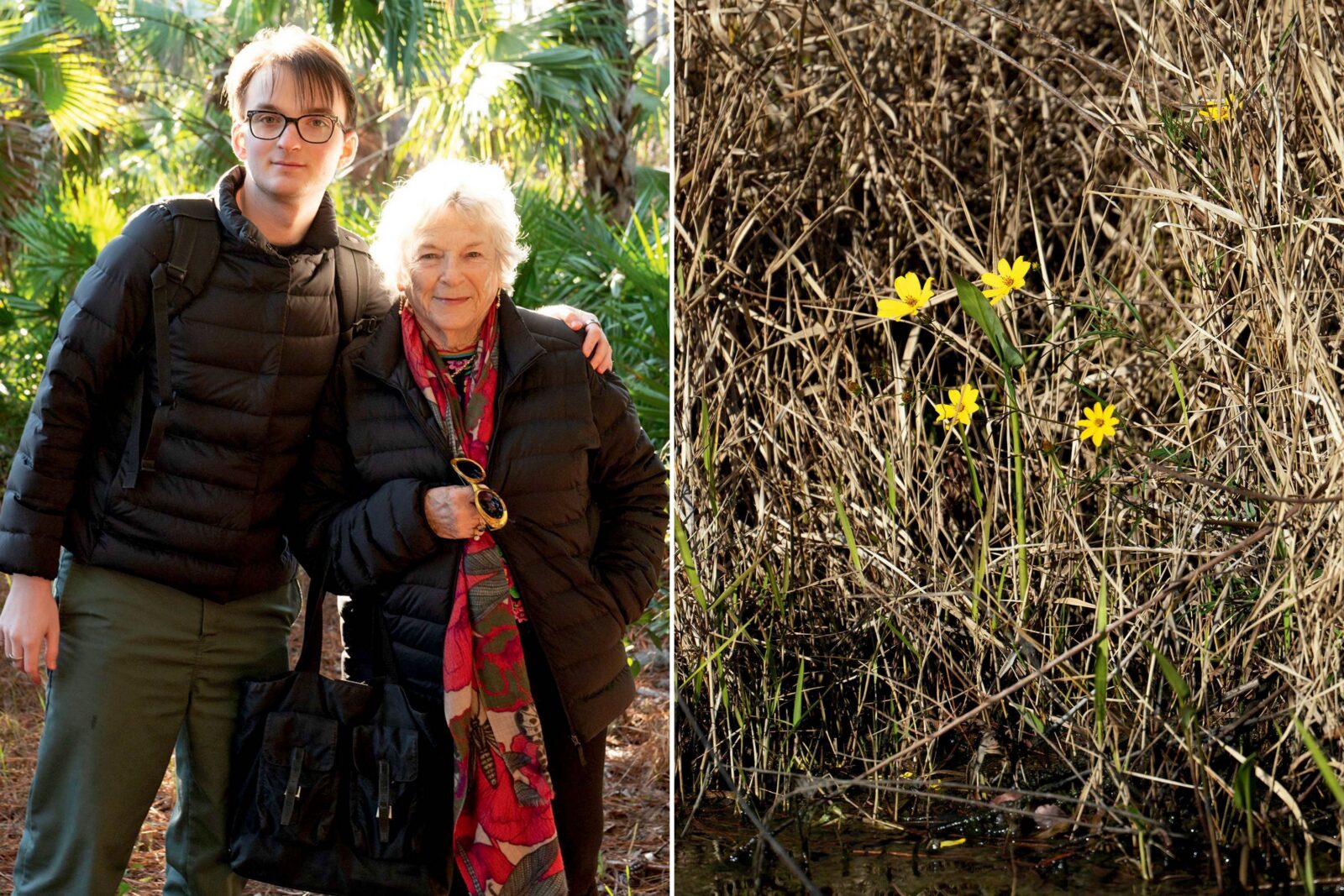
Photo: J HENRY FAIR
The author and her grandson Will; yellow tickseed flowers bloom against marsh grasses.
December falls dark quite early. By the time we drive to meet Henry’s friends for dinner, all the light has been snuffed out. We are barreling down a long empty road, the first of many. We’re stunned by the arrow-straight, flat highways with no traffic. Henry and I remember the era of state patrol cars hidden in clumps of palmettos and wonder if they still pull you over, asking for cash or else giving you a trip to the courthouse. The friends, soon to be our friends, too, have selected a gas station restaurant. Reed’s Grocery and Ponderosa looks like a yellowed photo of itself from a century ago. Do those pumps even work? Presided over by a no-nonsense but gentle woman, Deborah Reed, the restaurant is a few tables cordoned off from the shelves of wine, chips, and windshield cleaner. We are soon selecting from fried pork chops, fried chicken, and oxtails. “Don’t worry,” Deborah assures us, “I’m going to give you all the fixings.” Calorie-bomb plates arrive, loaded with candied yams, green beans, rice and gravy, and mac and cheese, along with slabs of warm cornbread. “The real thang,” I explain to my grandson.
The guests are a hydrologist, a lawyer, a wildlife refuge manager, and five people from the community who have long worked to preserve the integrity of the swamp. The conversation about a mining threat starts bouncing around: Eighty percent drains to the Suwanee River, the rest into the St. Marys, the hydrologist tells us of the Okefenokee. “The St. Marys borders Trail Ridge—the sand dune is ancient and massive and acts as a regulator as water siphons through the sand layers. A fully functioning ecosystem.” We talk until late. Henry photographs us toasting with our iced tea. I’m feeling inspired by these sharp and fun people fighting for the swamp. There’s too much attitude lately that what happens, happens, and we can do nothing. Of course we can do something. Brownies are passed and—so generously—plans are laid for the three of us to see as much of the Okefenokee as we can.
We’re out early. We’ve accidentally driven the opposite direction from the Okefenokee National Wildlife Refuge, where a boat is waiting for us. Without distinguishing geological features, the flat wilderness of palmetto and pine disorients us. So much empty land makes you want to take deep breaths. Makes us want to sing in the car, old hymns and songs Will has never heard and probably never will again. Take me home, country roads… Impossibly tall, skinny pines flash by. Is Henry going a hundred?
We finally meet Michael Lusk, the manager of the wildlife refuge, and Kim Bednarek, the director of Okefenokee Swamp Park & Okefenokee Adventures, in the coffee shop of the refuge center. Kim is exultant. She has just this morning learned that the Okefenokee has been nominated to be a UNESCO World Heritage site. There are only twenty-six in the United States. The application process has been in the works for ten long years, and today’s the day to celebrate. Michael briefs us on the topography of the swamp, then we push off in a no-wake, ten-horsepower swamp boat with Kim and Deb Harrison, one of the knowledgeable guides.
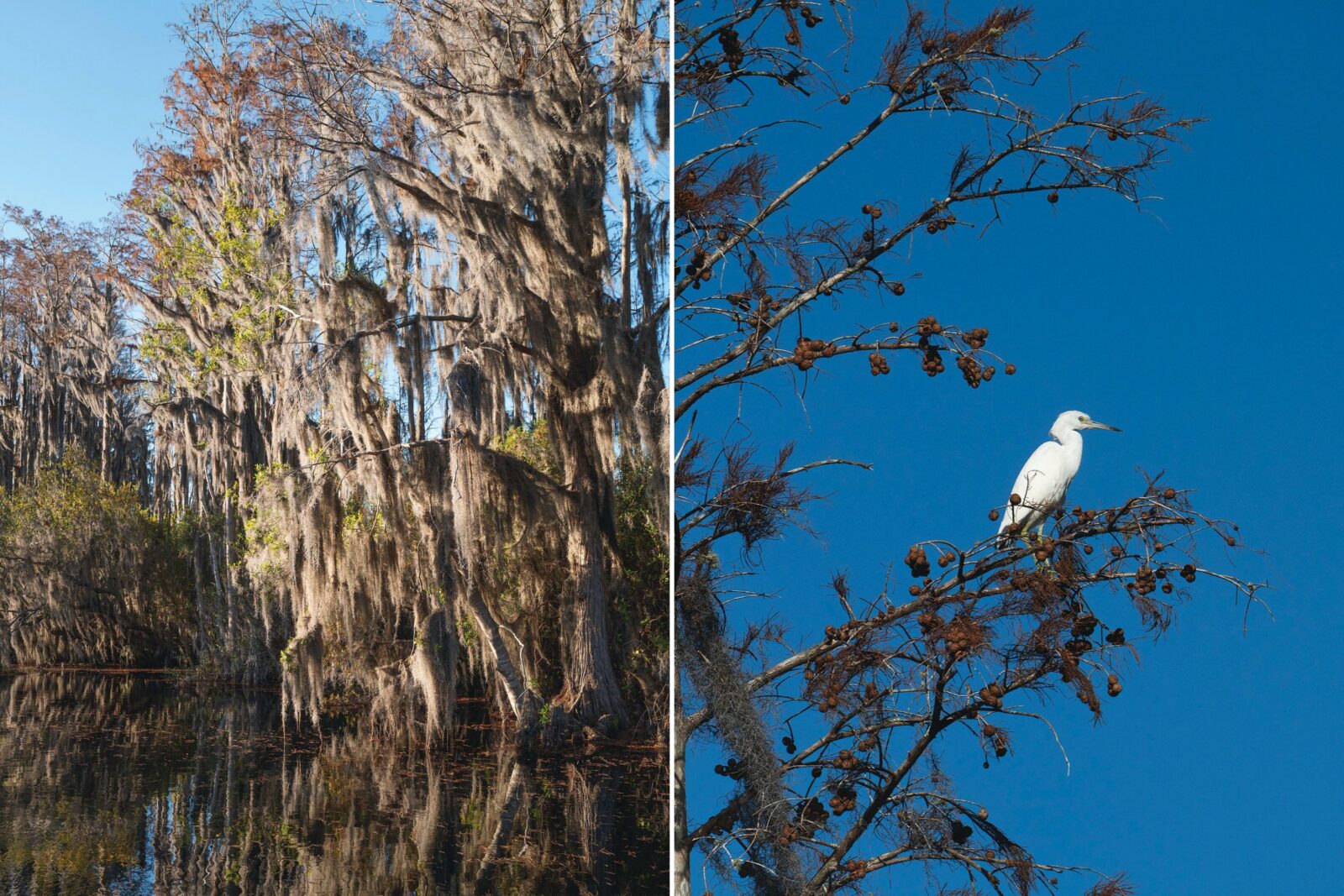
Photo: J HENRY FAIR
Spanish moss drapes branches along the Suwannee Canal; a heron perches in a cypress tree.
Henry is soon balancing on the prow, and I hope he does not fall in because of the you-know-whats. And not only alligators but many snakes, including the endangered iridescent indigo snake, capable of growing more than eight feet long. Although they look menacing, they aren’t venomous. Still. Will and Henry launch their favorite toy, a swift drone for some views we can’t see from the boat. I’m aiming my phone at the primitive gators curling on the peat, at spooky reflections of moss, and at the vivacious face of Kim, who never tires of an afternoon on the waters. Deb cuts the motor frequently so we can “hear” the quiet.
We’re close enough to see the glittering eyes of giant alligators lying in the sloshy water just where it touches the bank. They look content to soak in the warm sun and pursue their dreams of prehistory. One big guy (girl? Who could ever tell?) flounces off, smacking down its powerful tail to show that it’s quite annoyed by our mere presence. A few slim young ones look as though they’re dressed in shining armor. Loners, they are, these residents that must have lived here since the Pleistocene Era, or forever. My father told me to zigzag if I were ever chased by an alligator—they can make tracks at thirty miles an hour, but they can’t zigzag. Old wives’ tale, Deb assures me. They can zig. They can zag. But truthfully, they’re really not interested in us.
We are traversing the twelve-mile-long Suwannee Canal, a man-made slash cut through the marshland in an early attempt (1891) to drain the swamp into the St. Marys River, hoping to create profitable farmland and providing an exit for cypress logging. For three years, workers and incarcerated men labored, but the canal sides kept collapsing, and finally they gave up, failing to excavate deeply enough into Trail Ridge for swamp water to drain. That big dune endures instead as a shoulder buffer, regulating the flow of water from the swamp toward its exit into the Atlantic. The swamp itself defeated the effort, and the project was abandoned. Trail Ridge has always been crucial to the swamp’s ecosystem.
Peaceful, the shiny black water, the lack of humans. I, too, can fall into a trance of prehistory. Dreamy to drift, looking out for blue herons walking on their own reflections or spreading immense wings and slowly, improbably, lifting themselves into the air. A red-shouldered hawk perches on top of a dead tree, surveying the scene. Deb tells us of wood storks, sandhill cranes, barred owls, and the rampant wild hogs no one loves. Rough grasses, now tawny in winter, she calls maiden cane. I am learning a new language. Even in this season, little yellow flowers pop out along the banks.
I am fascinated by the swampers. These early settlers built pine and cypress houses on the “prairies” and high spots, living hidden lives and raising big families. Isolated, they had to be self-sufficient. They crafted their brooms and brushes from palmetto fronds, made soap from lye. And yes, you can eat everything the swamp provides, from squirrel to alligator. Michael drives us to meet Sheila Carter at Chesser Island Homestead, sole remnant of the small but vibrant community that eked out a living raising corn, sugarcane, greens, and whatever they needed to eat. The original house was nearby. This one was built in 1927 but looks as though it could easily be a century older, especially since there is still no electricity, heating, or plumbing.
Sheila, descendant of the original Chessers, generously shares her family story. We’re welcomed into the fenced, raked yard of white beach sand that, she explains, they always kept clear of growth. It’s easy to see snakes on white sand, and any other critters that might come to call. Hanging white gourds attract purple martins that feast on mosquitoes. I love the homestead, a creaky unpainted pine and cypress house with bedrooms added as the family grew and grew. Iron bedsteads with handmade quilts, an unplumbed tub on a screened porch, some dour photographs of the relatives, and a few tentative-looking pieces of furniture. Sheila has prepared lunch on the woodstove, where she will also heat the water to wash the dishes. Chicken and dumplings, mustard greens—pungent and delicious—from the garden, and cornbread cooked in a black iron skillet. After we feast, I ask Sheila about the singing traditions among the Swampers, particularly the shape note, or sacred harp method. In a tattered songbook, she shows me the notation system based on the simplified do-re-mi scale. The simplification facilitates sight-reading of musical scores. The Chessers were well known for this system, and the singing continues in the family.
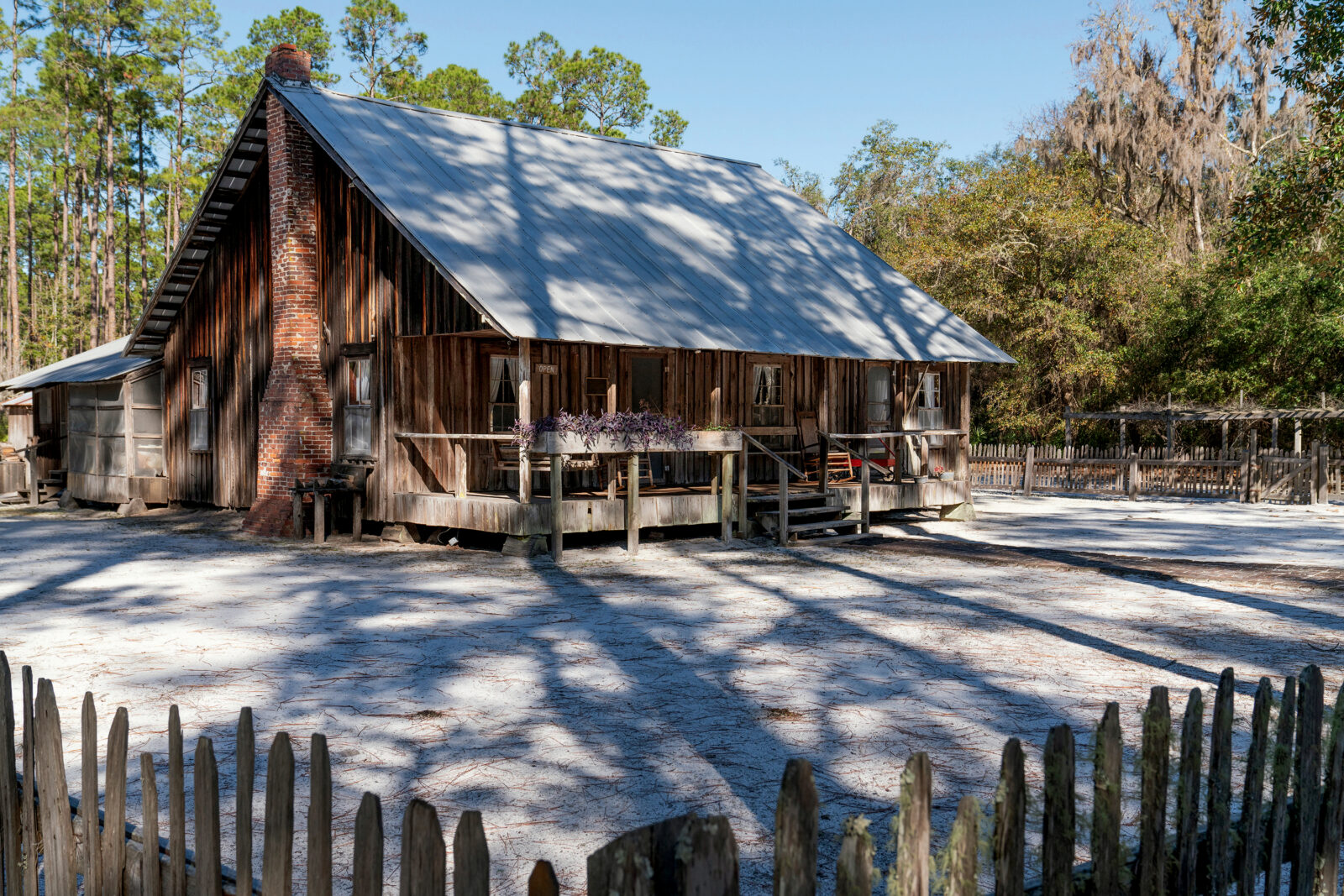
Photo: J HENRY FAIR
The Chesser Island Homestead, built in 1927, is the sole remnant of a self-sufficient Swampers community in the heart of the Okefenokee.
As we leave, Sheila demonstrates the swamp holler. Her prolonged, eerie cry reverberates through the woods. A startled vulture rises from the pines, soaring high. Even the vulture seems beautiful when you can’t see its scary face. Used to communicate, to call animals, to announce I’m coming home, the call may have come from the Scots-Irish, or, some say, it was brought by Africans. Whatever the origin, it’s swamp music. I give it a try, but I don’t think Sheila is impressed by my warbling aria.
Driving back to the refuge visitor center, Michael points out white bands on some of the longleaf pines. They mark the active nesting trees of the red-cockaded woodpecker, now under the protection of the refuge. What a clever little bird! Their black-and-white-striped backs are distinctive, and the male has a small, hard-to-see red slash above the white cheek. They peck out a cavity in a tall pine, taking their time so the sap dries as they go. This stabilizes the nest for their young. Once the nest is finished, they tap into the sap below, creating sticky spots so no insects can climb up to their abode.
We’re at another down-home place for dinner, the SwampFire Backwoods Bistro. Is that not an oxymoron of sorts? This time it’s the deviled crab, spicy and rich, mounds of potatoes, fried banana peppers. It’s the key lime pie. Will, Henry, and I are talking about the inspiring and determined local efforts to protect the Okefenokee. Work done in communities will save us in the end, though enlightened big government help would be a boon. While we should be pampering the earth’s wild places, challenges instead remain a constant. Latest comes from Twin Pines Mining out of Alabama. It proposes an operation to extract little black specks from the pristine white sand of Trail Ridge. “With a large machine, this prized speck can be separated from the white sand, and then the sand, more easily said than done, can be replaced,” Henry says. I’ve already heard that the black speck is titanium dioxide, paradoxically used as a whitener in toothpaste, in paint, even in the white filling of Oreo cookies. “Trouble is you can’t just dump back the sand that is in geological, effluvial layers—think finer sand lower, coarser sand above—and expect drainage will be well. No.” Henry pushes aside his mound of fries. “This is really a sad idea at this stage of our knowledge,” I say. “Hard to believe it’s even considered feasible,” Will adds. “We should know better.” We do know better! We should protect this remarkable gift and be smart about it.
Our last day is frigid. We picked up picnic supplies at the Whistlin’ Dixie Café in Folkston and head to a boat ramp on the St. Marys. We meet Deb again, and Emily Floore, who directs the protective organization St. Marys Riverkeeper. She, blessings upon her, has brought blankets. A gorgeous river, and a tempestuous one! Occasionally, it rises precipitously, flooding out adjoining lands. What’s divine are the blinding white sand banks and sandbars. Deb beaches the boat, and it’s easy to have a Robinson Crusoe moment as our footprints mark the pristine beaches. Emily is another of the bright lights—someone working at something she believes in. “Everyone who lives here loves the St. Marys,” she tells us. “We can’t take any pollutants mucking up this river.” I suddenly get a rush of memories. Swimming down the Altamaha with my friend near where I grew up, tying our bathing suits around our ankles and letting the current take us downstream. Such Edenic places as this—lucky, lucky if you get to participate in their beauty, at any age.
It’s warming up when we open the picnic—big, fresh sandwiches, chips, spice cake. Then we rush way down another one of those endless empty roads. Where is everybody? The vanishing point shimmers in the still air. We are going to the west side of the refuge, to Stephen C. Foster State Park, named for the composer who wrote the famous song “Old Folks at Home” (a.k.a. “Way Down upon the Swanee River”) in 1851. Here rise the headwaters of that magnificent Suwannee (the official spelling), which exits into the Gulf at Suwannee Sound, near Cedar Key, Florida.
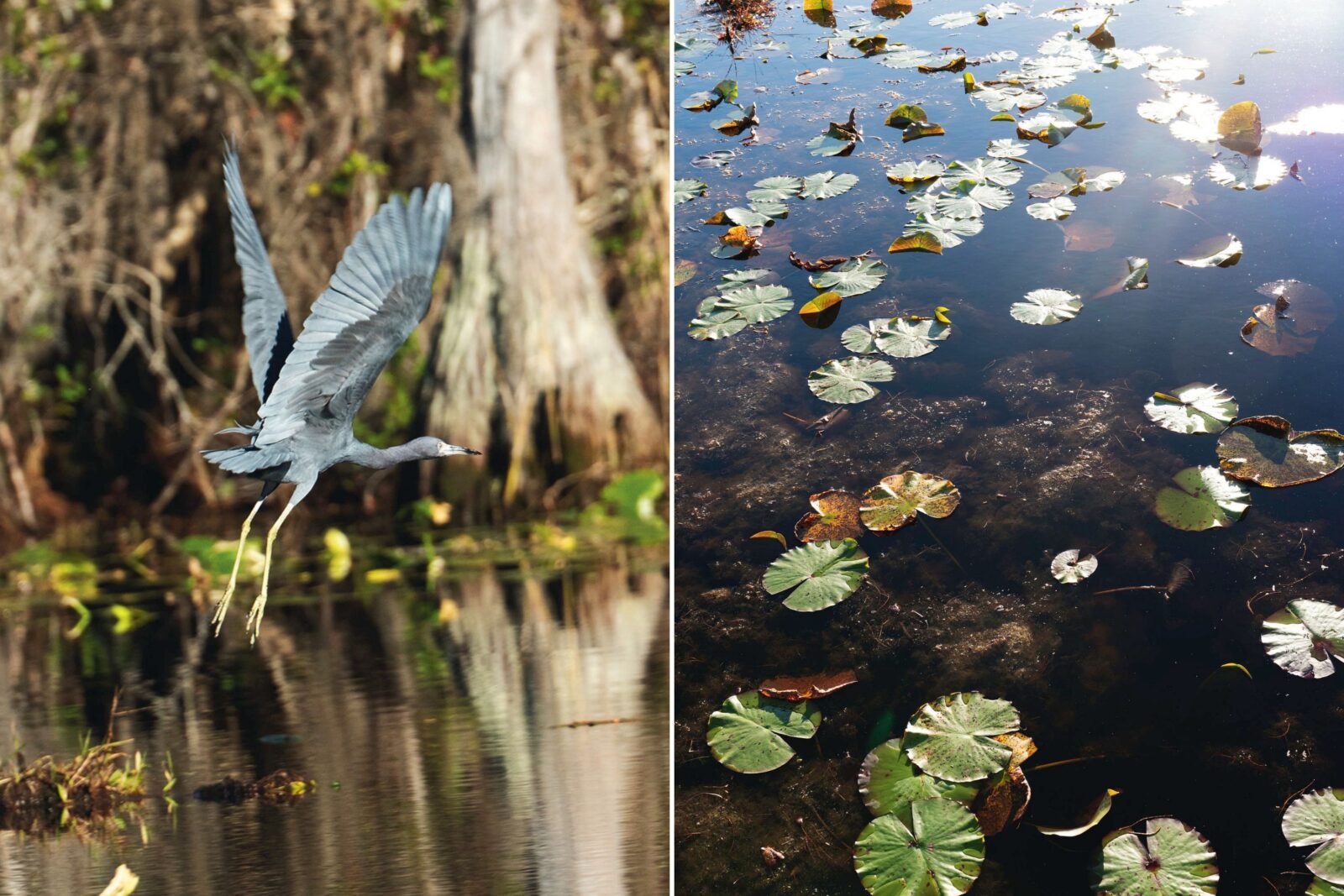
Photo: J HENRY FAIR
A little blue heron takes flight against a cypress backdrop; water lilies cover vast swaths of the swamp.
At ages five and seven, I went with my grandmother to nearby White Springs, a stop on the Suwannee. She took the curing waters of a sulfur spring that flowed into the river. A four-story pavilion surrounded the spring, and the ladies sat on the stacked porches sipping the stinky water for their rheumatism and other ailments. I swam in the icy bubbles, diving over and over, emerging with the scent of an Easter egg found in August. In the evenings, we rocked in chairs on the long porch of the Colonial Hotel, fanning mosquitoes, and waiting for the luscious creamed corn, roast beef, and butter beans served in the long dining room lined with portraits of the presidents. My grandmother, Fan, sometimes hummed the old song. I’ve always carried with me the image of the rushing, tannic black Suwannee, and my embarrassment when someone called my grandmother Fannie.
This time we’re on our own. No skilled Deb at the helm. We arrive at the state park and are tossed the keys to a beat-up fiberglass boat. No questions about whether we have ever operated such a contraption before, no ID required. We are just handed a sheet with mysterious instructions: Ensure kill switch is hooked up, Squeeze primer bulb until firm, Align throttle with start notch. What? Henry balls up the sheet and throws it in the trash. “I’m from Charleston,” he explains. “I lived on boats.”
Regardless, we get tangled in water lily roots and need to pull up the motor for constant cleaning. But this turns quickly sublime. The channel widens into flat, shallow Billy’s Lake, lovely for alligator lounging, and then flows past a magical stretch of cypresses, their odd knees sticking up in the water. Though these are no taller than a yard, the stubs can grow up to eight feet high (the tallest ever recorded reached fourteen). The tree bases themselves are shaped like huge garlic heads, and the protruding “knees” look like homes for gnomes. No one really knows the purpose of the knobby knees. Respiration for the tree? Support for the root system? We pull close to a huge turtle, which promptly flops into the water. I try to stop singing, “Way down upon the Suwannee River, far, far away…” Henry is photographing like crazy. Will, who has only sailed previously, has been handed the helm, and, no fault of his, we hit an underwater log. Cursing a little, Henry does some of the things probably listed on the sheet we tossed, and we’re again on our way.
At Billy’s Island, we tie up and hike through a jungle of gnarled trees. Bears, we’ve been warned, but all we see is a palm forest and the derelict cemetery of a Swamper family with fourteen children, several of whom died in the 1918 Spanish flu epidemic. Will maneuvers the clunky boat back into the channel. Along this stretch of wider water, we see several groups of kayakers. The wildlife refuge offers camping platforms and 120 miles of canoe and kayak paths, a paradise. It must be awesome to be here for a starry night, as Foster State Park is the only designated International Dark Sky spot in Georgia. Now the sun starts to set, sending rays across the still water, letting us know it is time to go. We encounter another serious root tangle, but then break free and soon slide into the dock with a hard knock. Henry and Will pack up all the photography equipment. I unload the unused life jackets. It’s over.
As we turn out onto the long road back, a fox crosses in front of us. As she jumps the ditch and slouches toward the brush, she looks back and stares at us staring at her. Then she folds into the darkening bushes and disappears. We’re quiet in the car. “Belongs to them,” I say. “Not us.”
Few months our adventure into the swamp, I learn that the proposed Trail Ridge mining operation that threatened the Okefenokee is squelched. For a steep $60 million, the Conservation Fund has managed to buy the 7,700 acres slated for titanium dioxide extraction. (Conservation organizations had earlier thwarted a threat by Dupont to mine farther north on Trail Ridge.) Although possible perils still exist around the swamp’s perimeter (about thirty thousand acres are held in private hands), this astounding—may I say sacred?—place has strong new protection. And the coveted UNESCO status, if approved, will further discourage tampering. Public opinion and diligent work played the major role in this hopeful victory. “See,” I write to my grandson, “our voices matter.”
Related Stories:
Sporting
Elmer Crowell miniatures, a life-size bronze pointer sculpture, and Ernest Hemingway’s marlin catch flag
Conservation
Why the region’s secret—and imperiled—freshwater ecoweapons deserve your respect
Land
In flooded fields amid a waterfowler’s paradise, the Isbells are reimagining how to use the land—and gaining the attention of sake brewers worldwide
Trending Stories:
Land & Conservation
The future of conservation in the South just got a little bit brighter—and not just for salamanders
Land & Conservation
The mounds may look insignificant, but they’re the craftsmanship of local crustaceans called lawn lobsters
Arts & Culture
The drawls are receiving a lot of flak across the internet, but a North Carolina linguist argues they’re actually pretty accurate