

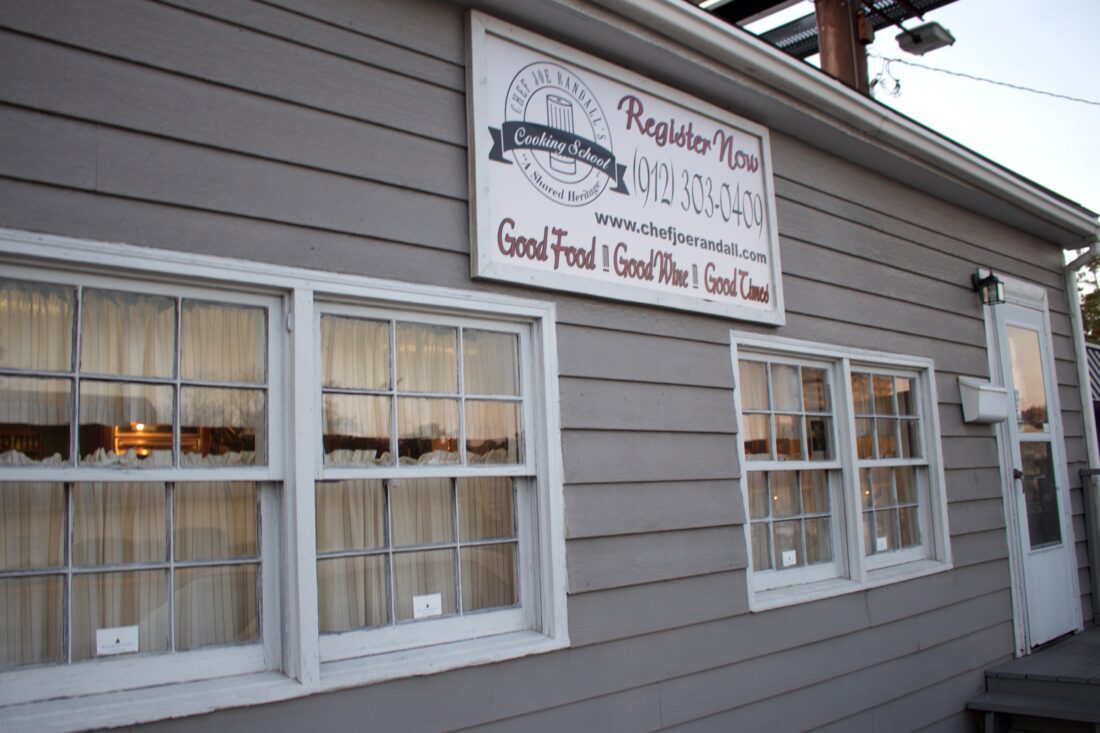
Down in Savannah, over on Waters Avenue, in the shadow of Memorial Health University Medical Center, lies a quaint, cloud-rain-gray cottage. Compared to the stately homes farther up the street, it’s just a slip of a thing, easily missed. The only indication of the marvel inside is a small sign, with a toque logo and “Chef Joe Randall’s Cooking School” printed in tall, stately script. At the bottom, in bold type: “Good food, good wine, good times.”
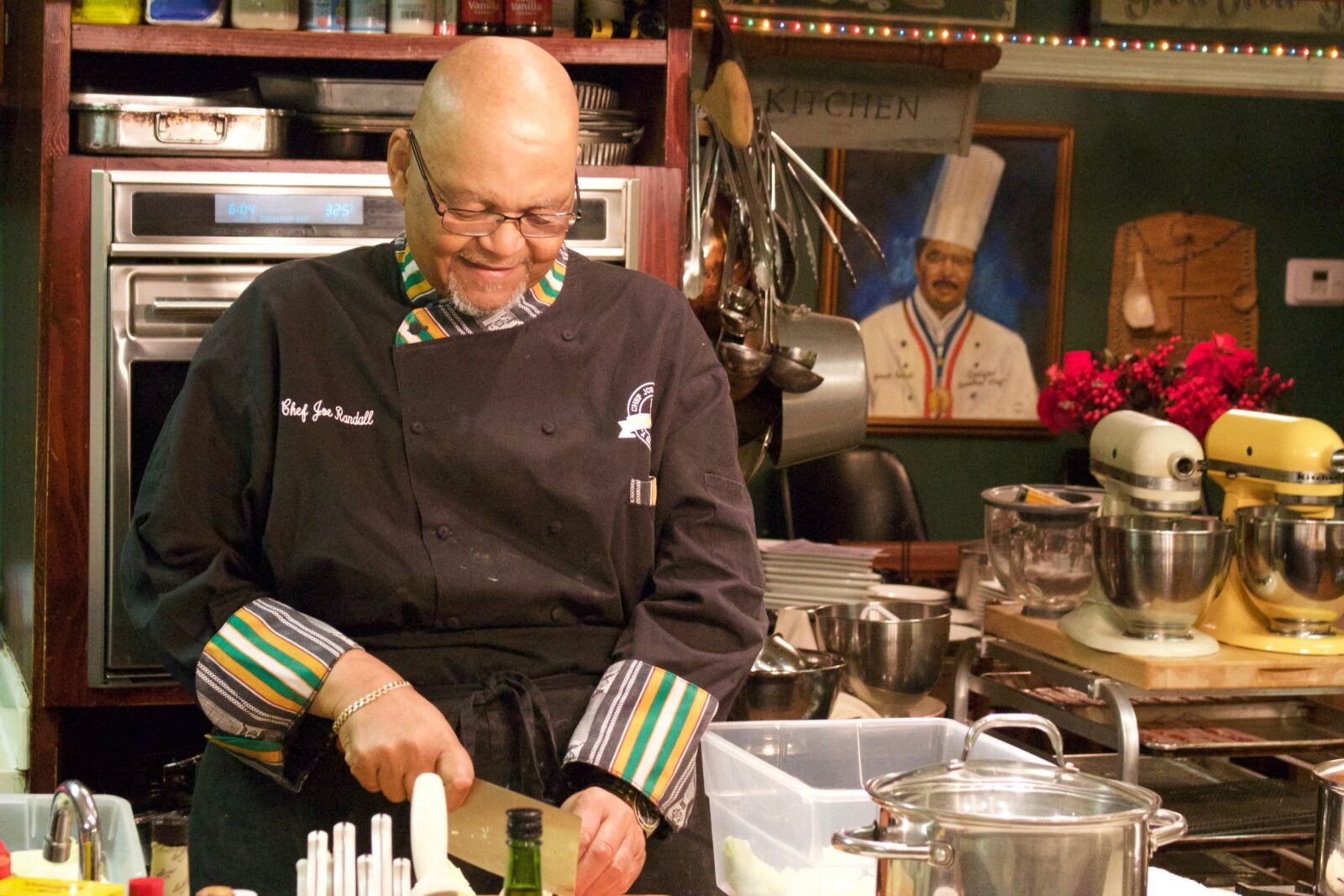
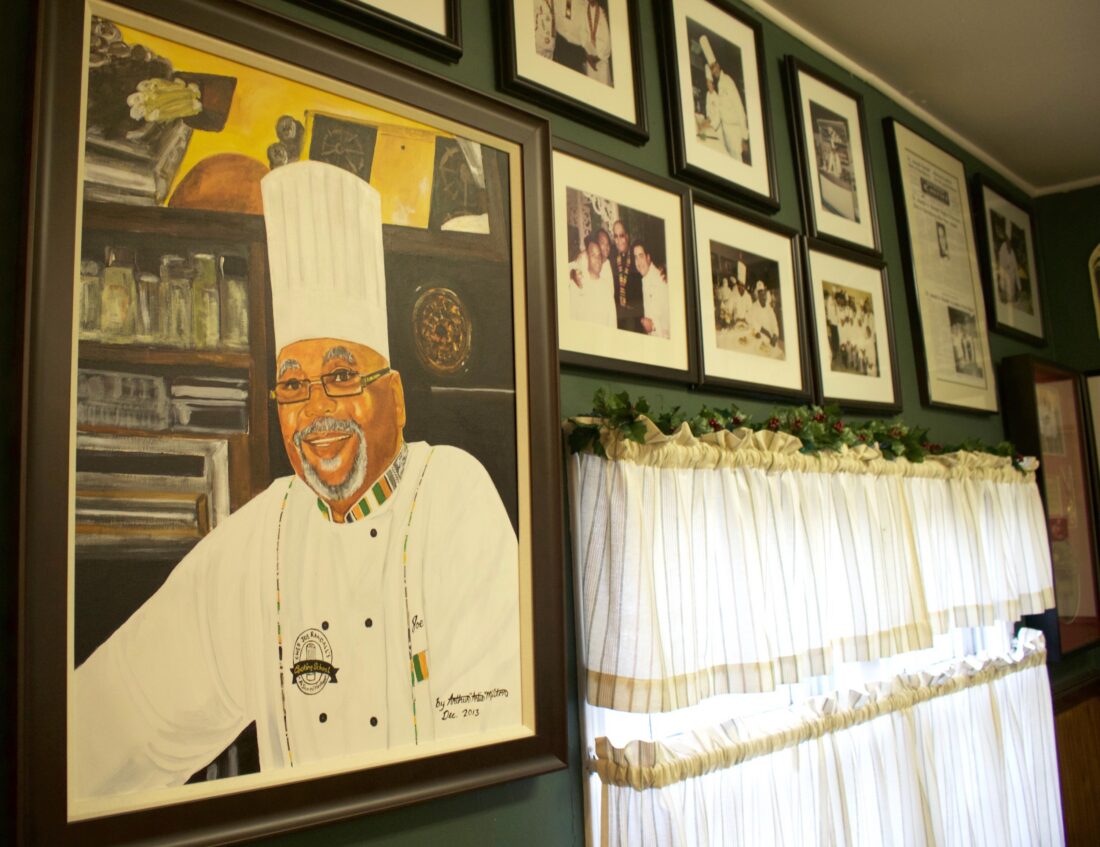
It’s 2016, and as my brother Nicholas and I walk through the door, an aromatic wonderland greets us. The air hangs heavy with the smell of vegetables and herbs being prepped—the sharp sting of garlic, the earthy tang of carrots. Inside, emerald-green walls shimmer in the evening light between the memorabilia and mottos that cover their every surface. At the center of the room sits a long island with a four-burner gas stove—Randall’s costar for the night.
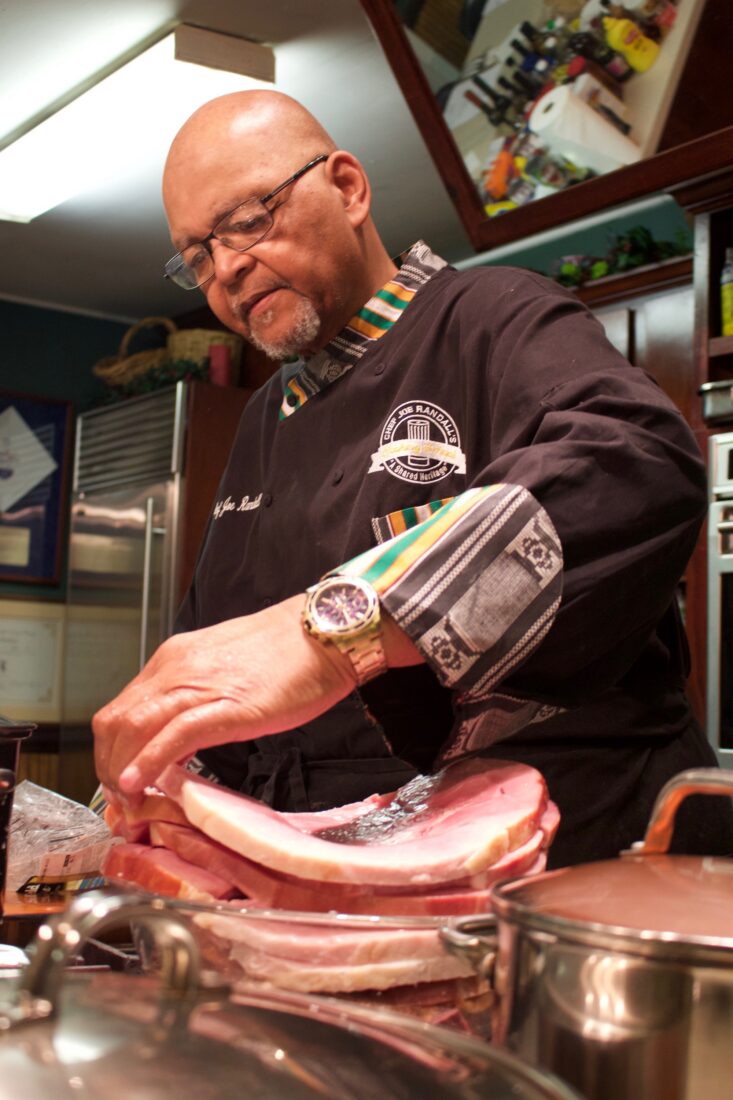
As for the chef, he towers over the counter slicing cabbage, the rhythmic thip-thip-thip of his knife a metronome, ham steaks in a bowl at his elbow. Randall is so focused that he doesn’t hear us enter. We are early, but given that Randall was an Air Force man, I assume that’s a lesser crime than being late for what will be the very last class he teaches before retiring.
I’m a young reporter from the Upstate of South Carolina, and I’m here with Nicholas, a freelance photographer, for an experience we’re assured we shouldn’t miss. It turns out to be true in ways I can’t anticipate. And years from now, when I hear on February 14, 2026, that Randall has died, it’s the first memory I recall, and no wonder—the night with the man known in culinary circles as the Dean of Southern Cuisine changed me for good.
This night with Randall traces back to the year before, when I notice that someone has painted a little low-slung brick building across from the Spartanburg County courthouse a yellow-orange and trimmed it with glossy black shutters. That’s my job as a new writer—keeping an eye out for business openings that might make for good magazine stories with beautiful photo spreads.
The first time I visit McClellan’s Urban Eatery—a restaurant most in town would come to just call McClellan’s on Magnolia—I go on my own. The next time, I bring my brother. The visit after that, we take my mother. There is just something about the place: white-tablecloths but not pretentious; service to match. And the food.
We bicker every time over who gets the last “soul roll,” an eggroll stuffed with aromatics, collard greens, and other tasty bits that the chef-owner, Bill McClellan, serves with a smoky-sweet dipping sauce—savory, deep, multifaceted. There are three of us. The plate comes with four.
My brother always orders the fried lasagna, a nod to McClellan’s roots in Chicago, where Italian and Black communities often lived in proximity. And I never leave without a take-home serving of the white-chocolate bread pudding, the warm sweetness of its icing reminiscent of a sophisticated vanilla caramel.
McClellan has a cornbread-to-caviar kind of mentality, where nothing is off limits, as long as it is well presented, with the diner in mind. He takes elements we know and pairs them with textures we can’t anticipate: the crunch of a wonton wrapper around sauteed collards, the crisp, fragrant edge of that fried lasagna noodle against an herby, creamy interior. He harnesses the emotional experience of food we cultivated as Southern children and elevates those familiar dishes for our adult palates.
We go to McClellan’s anytime we have something to celebrate, or anytime we have a taste for it. It is one of very few places that we, as a family, feel like regulars. It is the first upscale white tablecloth restaurant I pay for with my own money. With a little bit of cash in my pocket from writing stories, I begin to celebrate every publication day at the café’s back right table.
McClellan, we learn over time, has cooked for presidents. I talk to him about my interest in food, and he tells me what it means to be a restaurateur, and shares some of his tricks. But how, I ask him, did he learn to cook like this—whimsical, comforting, a little bit decadent?
In addition to his culinary training, he says, he had a mentor: chef Joe Randall. The two crossed paths in Baltimore in the 1980s, back when McClellan was a student at Morgan State University and Randall was the executive chef at a restaurant in the city called Fishmarket. Chef Randall changed his whole trajectory, he claims. If I am searching for a story, McClellan insists, Randall is a man who has plenty.
Since 2000, McClellan tells me, Randall has owned a cooking school in Savannah. Randall and I exchange a couple of emails and a short phone call, and then he breaks the news to me: After sixty years of standing over a stove, he is retiring. His cooking school will close in a week. I ask if we can attend that last class, a teaching demonstration.
You must understand: Even though I descend from a line of great home cooks, in 2016, I am but a fledgling food writer with little to show for my ambitions besides one or two local bylines and some op-eds in The Guardian. I come from meat-and-three types of folks, the kind who consider going out to eat at cafeterias like S&S and Picadilly a special event. I know little about the James Beard Awards, or Michelin stars. Still, Randall’s student, McClellan, has seen something in me, and that is enough for Randall to agree.
It is late December, on the cusp of Christmas, and the early grip of an Appalachian winter loosens as Nicholas and I drive south, unfurling into a balmy late autumn along the coast. This will be my first time in Savannah, and I did not yet understand that I was making a historical and culinary pilgrimage beyond that of seeing Randall. The American story of one of our Graham ancestors started in the city back in 1733, when a group of white, soon-to-be slaveholders crossed the Atlantic to land there on The Georgia Pink, one of the first boats to bring settlers to the colony of Georgia. Savannah not only became an entry port for the slave trade, but one for the Indigenous ingredients, West African traditions, and European cooking techniques that came to compose the foundation of Southern Black culinary heritage.
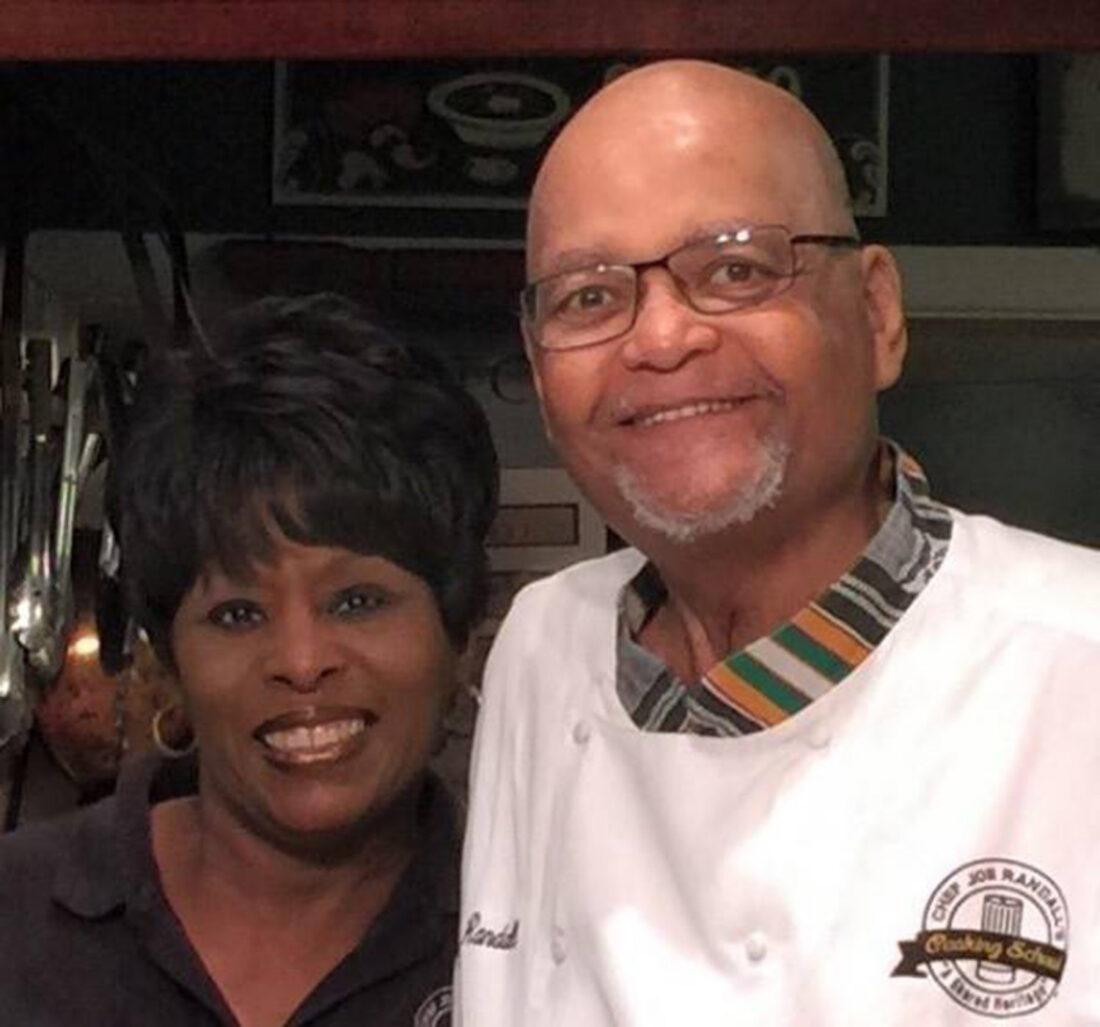
After Nicholas and I enter the cooking school, Randall finally looks up from his prep work, raising his bald head to speak softly to his wife, Barbara, who is serving as his sous chef. I understand now where chef McClellan gets his intimate-without-being-overbearing energy from. Much has been written about chefs’ often-hard exteriors, explosive tempers, and misogyny, and I realize then I have steeled myself for the possibility Randall might share those traits. But there was no need to have worried. We were now in Randall’s calm, capable hands.
I turn on my recorder, and we begin to talk about the impact and influence that African American cooks and chefs have had on the evolution of American cuisine. He turns to his upbringing: how he was born and raised in towns around Pennsylvania, and how he got his start in restaurants as a busboy and dishwasher at Ross’s, an outfit owned by one of his uncles, Richard Ross.
He enthusiastically goes on about catfish, which he called channel cats when he fished for them as a kid along the Pennsylvania-Maryland border. A stint in the military, in Albany, Georgia, where he was assigned to be a cook, sparked his passion for food, and eventually, for teaching. From there he refined his skills at dozens of restaurants, country clubs, hotels. Eventually he opened a student-training restaurant called Kellogg Ranch at California State Polytechnic University, Pomona, which, as he related in his oral history with the Southern Foodways Alliance (SFA), “drew a crowd from Los Angeles.” Other universities and culinary schools followed. His work teaching and helming restaurants took him across the country: Virginia, Georgia, California, Maryland, and later, New York. And along the way, he mentored Black youth-turned-chefs who would later helm their own four- and five-star restaurants.
He landed in Savannah after a trip to visit a friend, when he ended up making dinner for Paula Wallace, the Savannah College of Art and Design’s president—sweet potato Louisiana sausage bisque soup, grilled chicken and rosemary over red rice, fried corn, a brown butter peach and pecan tart with a bourbon custard sauce. As he recalled for the SFA, “before they finished the soup, I was the director of food service for SCAD.”
As he sees it, he tells me, the larger food scene is neglecting Black contributions to America’s cuisine. In the early days of his career, he says, Black faces were often hidden away, and it took until 1978 for him to see a Black face on the cover of a cookbook, Creole Feast: Fifteen Master Chefs of New Orleans Reveal Their Secrets, which Toni Morrison commissioned when she was an editor at Random House. The rarity of Black inclusion led him to create the Taste of Heritage Foundation, dedicated to celebrating, preserving, and promoting African American culinary traditions. The organization also aimed to bring national attention to Black chefs and cuisines, hosted high-profile dinners to support the professional development and ambitions of culinary art students, and sponsored the African American Chefs Hall of Fame.
In one of Randall’s pictures from one of those elegant dinners held by the foundation in the early 1990s, a cluster of Black chefs dressed in traditional white jackets, with kente scarves draped across their necks, smile for the camera. In the front row is Edna Lewis, dubbed the Empress of Southern Cooking, alongside Leah Chase, the Queen of Creole Cuisine. In the second row stands Patrick Clark, who would go on to win the James Beard Foundation award for Best Chef: Mid-Atlantic in 1994 for his work at the Hay-Adams Hotel in Washington, D.C. Clark died at forty-two, young enough that he didn’t have the opportunity to earn his own moniker. Without someone like Randall sharing the story of his brilliance, his name might have faded into obscurity.
So Randall will bring him, Lewis, and Chase into the room with us tonight by including some of their signature dishes on the menu. The dinner will begin with she-crab soup, before moving on to a salad course of fried green tomatoes on Bibb lettuce with homemade buttermilk dressing; a main course of sliced Virginia ham served with smothered cabbage, glazed carrots, and cheese biscuits; and for dessert, a version of Barbara’s Georgia peach cobbler with vanilla ice cream.

The secret to making the signature dishes of the American South, he says as he makes his final preparations, is to be sure to layer in flavor. With a nod, he motions for his wife to open the door, and the rest of the night’s participants, giddy and brimming with anticipation, pour through the door. Class is in session.
As he begins, Randall doesn’t need to yell or hold court to get our attention; the audience is rapt. We all understand we are witnessing the end of something special. We listen as Randall talks us through each dish as he cooks—its origins, its development history, the techniques he’s using to execute it—the only background noise our forks scraping against our white square plates.
The evening progresses, and the chef’s energy winds down. His rasp requires a little more effort. By the end of our time together, the room is filled with the perfume of nutmeg, cinnamon, and cloves, and I want to give chef Randall a new slogan: “Stop by for an evening and leave forever changed.”
I go home inspired, as well as with a 2002 reprint of the 1998 cookbook he cowrote with Toni Tipton-Martin, A Taste of Heritage: The New African American Cuisine. The book is so critical to American culinary history that the James Beard Foundation will induct it into its Cookbook Hall of Fame in 2023. A copy of it, along with one of Randall’s colanders, sits on permanent display in the Smithsonian’s National Museum of African American History and Culture.
While his school is now gone, I think, this book and by extension chef Randall can still teach me something. The next morning, I set off for the fanciest grocery store near my home in Spartanburg: Publix. That she-crab soup is still on my mind. I debate the merits of liquor store versus grocery store sherry. I spend far too long searching for white pepper. That was the secret to the soup that Randall hadn’t included in the official recipe—it was just for those of us in the class to know, a little flick of white pepper toward the end of the cooking process. Not enough to overpower, just a sprinkle to add a subtle punch to the light, cream-white soup. One last little touch of elegance.
Proud of my makeshift setup, I try to re-create the dish the way I watched him do it the night before. My version is, well, subpar. But I’ve made the soup several times since, when I’m in the mood for a silky but briny taste of the sea, and I can at least say I’ve improved. The edges of my copy of A Taste of Heritage are now curled from age and use. My sweet potato brioche rolls don’t always turn out the way I want them to, but as with the she-crab soup, I keep trying.
At the back of my copy of the cookbook, after the menu suggestions but before the index, there’s a section called “Featured Chefs: Their Menus, Recipes, and Stories,” yet another way Randall kept the names of important Black chefs alive. And both Randall and McClellan inspire me to do the same. They taught me the methodology of food and how to have proclivities and sensibilities. That the down-home and the sophisticated don’t always have live so far apart. After meeting them, I understand better my point of view on the food world and my culinary heritage. I know the questions I need to ask.
Five years after that night at Randall’s, I am offered a full-time role to teach (writing, not cooking), and I must decide what sort of educator I want to be. I think of Randall, who treated my curiosity with gravitas, and I try to emulate him when I see my students take the same fumbling, stumbling steps we all do when we are trying to learn. I am no dean (and whew, Lord, I don’t want to be), but I now see what it means to see a young person aspiring towards something larger, better, more fulfilling. It is a joy to support them.
“I’m still having fun,” Randall tells me back in 2016, as he starts to clean up after the teaching demonstration. That seems to be the secret of it: The enjoyment is in the challenge, the transferring of knowledge that leads to the joy of cooking and a well-executed plate. Or in my case, a job well done. To be able to say: I have watched those around me take the mundane and turn it into art. Randall made the work seem effortless.
What a provision.
What a legacy.
When chef Randall dies on Valentine’s Day, 2026, it does not take long for culinary tastemakers, chefs, and historians to post tributes, undergirding the grace and respect that I witnessed in that little house on Waters Avenue. The latest generation of food professionals is inheriting a world out of balance, and we have lost a mighty champion for Southern cuisine. But he was, and still will be, thanks to his recipes and the foundation he laid, the bridge for so many of us. As he told the SFA, when it comes to Southern food, and American culture, you can’t “deny the Black hand in the pot.” And his was one of the mightiest.
Latria Graham is a Garden & Gun contributing editor from Spartanburg, South Carolina, and writes the magazine’s This Land column, which documents aspects of the natural world in the South. An assistant professor of creative writing at Augusta University and an instructor for the University of Georgia's Narrative Nonfiction MFA program, Graham shares her adventures on Instagram (@mslatriagraham) and her work at LatriaGraham.com.
Garden & Gun has affiliate partnerships and may receive a portion of sales when a reader clicks to buy a product. All products are independently selected by the G&G editorial team.