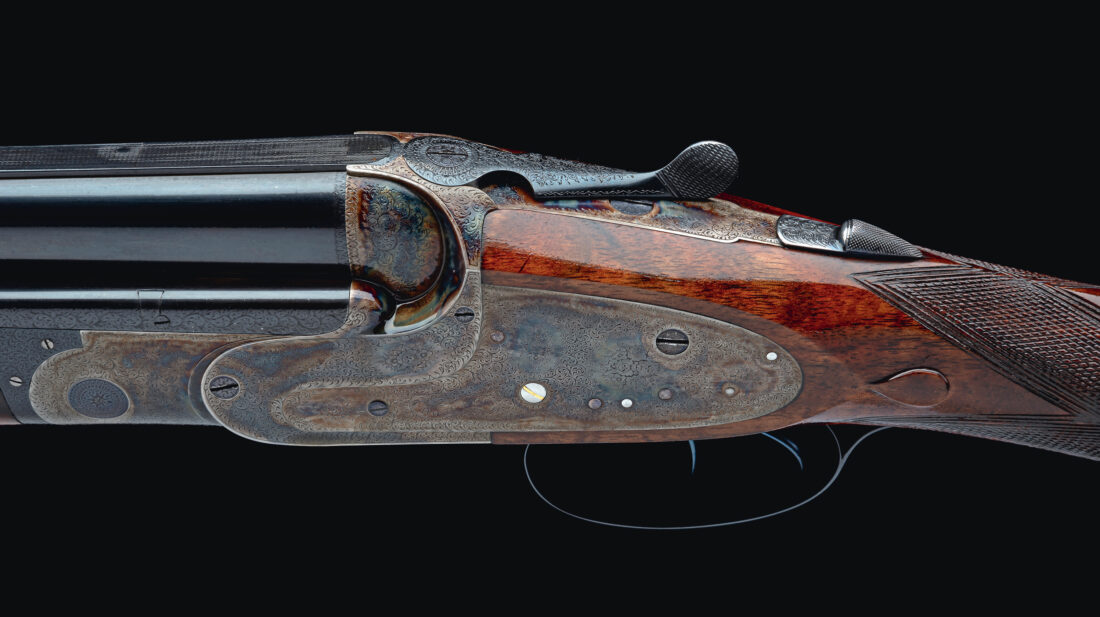
When Gary Lacey spotted the shotgun in the England-based HOLTS Auctioneers catalogue in 2024, he took a hard second look. It was a stunner: an early Boss & Co. twelve-bore over-and-under with case-hardened receivers and the famed brand’s equally famous rose-and-scroll engraving. Many consider over-and-unders from Boss, an outfit founded in 1812, to be the U.K.’s finest ever. Before Boss, most stacked-barrel shotguns were bulky German-made models. Boss broke the mold with a newly designed action that enabled a lighter, livelier shotgun, one that set the tone for fine over-and-unders to come.

But this wasn’t just any old Boss. Serial #5360 was built circa 1908 in “pigeon configuration,” a souped-up version used in high-stakes pigeon shoots that were once a gambling craze. These modified styles were a bit heavier than standard game guns, with tighter chokes, and included a specialized locking mechanism and double triggers that reduced the risk of malfunction. “There was big money riding on these pigeon guns,” Lacey says. “If you missed a bird, there were no excuses. They were built to be the best of the best.”
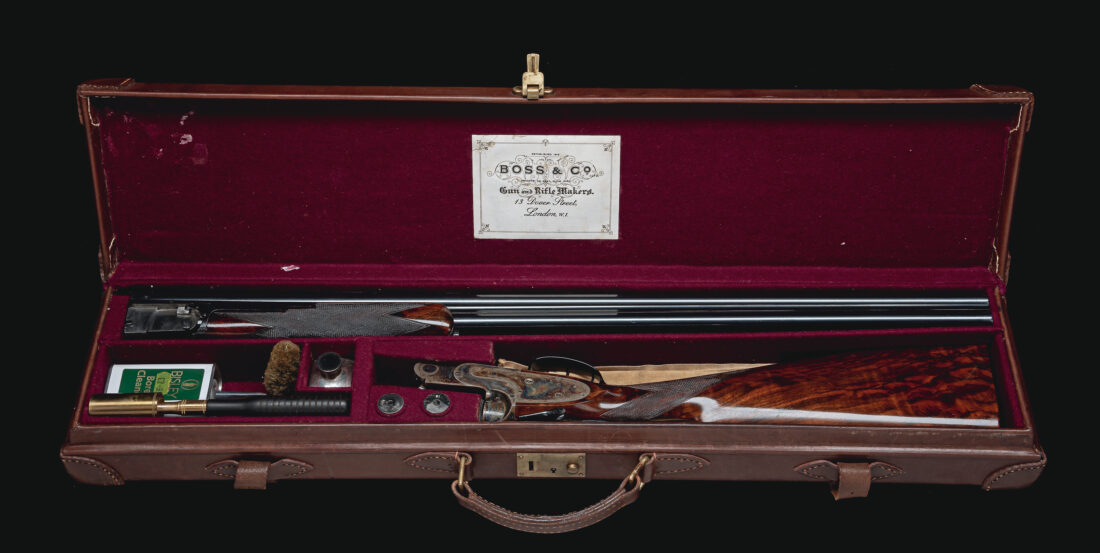
Adding to the intrigue: the mystery of the gun’s original purpose. Most top-end shotguns in the early 1900s were strictly custom-made. Requests for a bespoke Boss got logged in a front-office order book and then outlined in a factory production list. But serial #5360 only appears in the latter. Lacey believes the gun was never meant to be sold, and instead traveled to estates as a demonstration gun. So there’s no telling whose hands held the firearm.
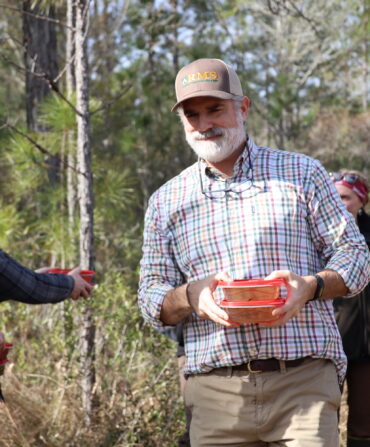
Lacey’s grasp of sporting history is rooted in both vocation and avocation. The seventy-five-year-old competed twice in the International Skeet World Cup and crafted bamboo fly rods for L.L.Bean. He still earns a living making fly rods and reels in Gainesville, Georgia, and he already has an 1881 Boss & Co. side-by-side.
The intrigue convinced Lacey and his wife, Pat, to roll the dice, and some thirty thousand dollars later, they now also own one of Boss’s earliest over-and-under models. Lacey plans to use the gun for what it was designed to do: shoot things. He has a quail hunt planned in Texas, and the Boss is coming along. “What’s the point of owning a gun like this if I don’t annoy my friends with it?” he says with a laugh. “You can’t top this, unless you bring the very first Boss over-and-under. And that one is in a vault in England.”
T. Edward Nickens is a contributing editor for Garden & Gun and cohost of The Wild South podcast. He’s also an editor at large for Field & Stream and a contributing editor for Ducks Unlimited. He splits time between Raleigh and Morehead City, North Carolina, with one wife, two dogs, a part-time cat, eleven fly rods, three canoes, two powerboats, and an indeterminate number of duck and goose decoys. Follow @enickens on Instagram.