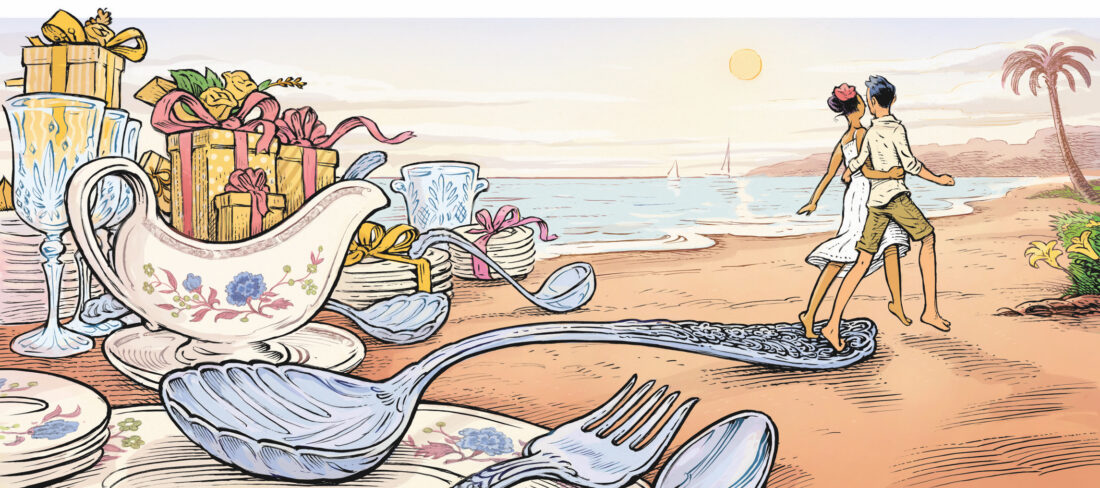
When I got married sixteen years ago, we registered for fancy china none of our friends could afford, a silver pattern my mother warned me would be a nightmare to polish, and a crystal ice bucket for which we had no real use. That was just what you did then: You asked for the “traditional” things, acted surprised when you unwrapped them, wrote a thank-you note, and wove them into the life you were creating.
What we did not request was money. That’s not to say we didn’t receive any. We did, in envelopes at our reception, checks sent by aunts and uncles to help ease expenses, and a Visa gift card from my new sisters-in-law earmarked for adding a little something fancy to our honeymoon. In our circles, the sin wasn’t in the receiving. It was in the asking.
Now, of course, no one seems to have qualms about asking for money—especially those who already have plenty—for pretty much anything. When the Chicago-based Marshall Field’s department store pioneered the wedding registry in 1924, the country’s economy was booming. Flash forward a century, and the vast inequalities of the world have never been more apparent.
In February, the junior bridesmaid from our wedding will get married to a nice young man in Georgia. On their registry: towels, a casserole dish, good sheets, and cutting boards. But their top choice is a honeymoon fund. In fact, TOP CHOICE was typed in black across the little widget I could click on to be transported straight to my Venmo account. As I perused their registry, that little widget made my brain itch. Could it possibly be—surely not, but maybe—was I offended by their appeal for cash?
I posed the question to my girlfriends as we dug through wares at Replacements, Ltd., a mecca of fancy things outside Greensboro, North Carolina. It’s a place that holds time: There I can find my mother’s china patterns, and my grandmother’s, and my great-aunt’s, and the silver forks and teaspoons I use every day. Leading up to Thanksgiving, I enlist my older daughter to help shine pieces I’ve inherited—her great-great-grandmother’s meat fork, her great-uncle’s carving set—and I tell her stories as we buff. But loving these things is just my own preference. Is it really rude to ask for money to help create memories instead of, say, a tomato server?
At Replacements, my friends looked at me like I was crazy and then answered in chorus: “Yes, rude.” “No, not rude.” “Wait, what?” We hashed it out later over BLTs. One said couples should ask for just one thing—not a gift and a honeymoon donation. Another pointed out that she had eloped, but if they had registered, a honeymoon fund would have been tops because they wanted memories, not stuff. The third turned to me and said: “What do you think?”
I think what we owe one another as humans isn’t a silver spoon or a hundred bucks toward a honeymoon. It’s forbearance and grace, which add up to love, and Lord knows we need more of that. And to me, love is giving one another what we need. In the case of my young bridesmaid and her groom, they need help with their honeymoon. They aren’t inheriting silver spoons, nor do they care.
And I hope they have a hell of a time in the Bahamas.